

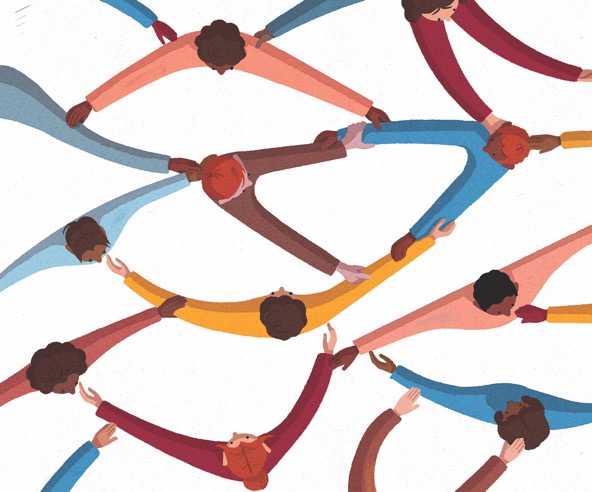
 (Illustration by Pete Ryan)
In 2018, a team of researchers published a paper in Scientific Reports that identified a new organ in the human body.
Anatomists had been mapping the human body with increasing precision for centuries. And yet, in 2018, physicians discovered that a vast, fluid-filled, interconnected network runs underneath our skin, surrounding every organ, lining every artery, cushioning every muscle.
They called it the interstitium. It has a honeycomb, fractal pattern.
Why hadn’t they seen it before? The reason they had not seen it was that the way they prepared tissue for the microscope—fixing it, slicing it, draining it—collapsed the fluid-filled spaces and made them look like solid tissue. The instrument they were using to see determined what they were able to see. And what they were able to see determined what they believed was there. They were also generally learning from cadavers, and the interstitium vanishes when we die.
When imaging techniques changed—when researchers looked at living tissue instead of prepared slides—the interstitium appeared. And once it was seen, it transformed our understanding of the body and health: how fluid moves in the body, how inflammation spreads, how cancer metastasizes, why certain treatments work and others do not. A whole layer of physiology that had been doing the work the entire time was finally visible.
The discovery of the interstitium is yet another lesson in the importance of looking at systems, connections, and relationships—not just in nature or our own bodies, but in our work. A system is made up of component parts that have a relationship to each other, but no system can be reduced to its component parts. It is the spaces between them, and what emerges from those spaces, that make up the whole.
Our field—the social sector, civil society, the giving ecosystem, broadly—is confronting this kind of paradigm shift.
For as long as any of us have been doing this work, we have measured generosity with a particular set of instruments: dollars donated, donors acquired, 501(c)(3) filings, foundation disbursements.
Those instruments are not wrong. They measure something real. But they prepare the specimen in a particular way. They fix it, they slice it, they drain it. And what shows up under the microscope is the hard institutional structure of giving—nonprofits, foundations, major donors, tax-advantaged vehicles, and (only sometimes) givers themselves (otherwise known as people). Everything that happens between those structures—everything relational, fluid, local, and uncaptured—disappears.
For years, the dominant headlines of generosity in America have told a story of decline: Donor numbers are falling. Small-dollar givers are disappearing. Trust in institutions is collapsing. Civic engagement is thinning. These stories, repeated over and over, make us believe that Americans don’t give, don’t care about one another, and cannot see eye to eye on anything—not even the basic acts of kindness that are the foundation of thriving communities. The sector tightens its belt. The fundraising professionals chase major donors because that is where the instruments can still see something. And the story of American generosity becomes a story about institutions, revenue, and fundraising tactics.
If we really want to capture and explore the depth and breadth of the generosity that bolsters the communities we all call home, we need new tools that approach generosity as a living, breathing practice that occurs beyond the boundaries we’ve traditionally confined it to. We need new instruments, ones that don’t limit what we are able to see. And we need to want to see it.
The Connective Tissue
Go to any neighborhood in the United States and you will find generosity thriving in forms our instruments were never built to measure: the mutual-aid network that feeds families during a pandemic, the crowdfunding campaign for a stranger’s medical bills that raises more in a weekend than most small nonprofits raise in a year, the cousin who sends money home every month. These are the connective tissues of American civic life. This is the fluid-filled layer that has been there the entire time, doing the work, holding communities together, absorbing shocks, transmitting trust—while we have been staring at prepared slides and declaring the patient unwell. The generosity was always there. We were measuring with instruments that could not see it.
If the only generosity we can see is the monetary generosity flowing through institutions, we will keep misdiagnosing the patient. We will keep prescribing treatments for the wrong condition. We will keep trying to revive what the instruments measure instead of nourishing what is actually alive, like relying on stale fundraising tactics and top-down institutional interventions instead of supporting grassroots leaders or recognizing community work being done outside the formal nonprofit space.
What the interstitium teaches us about physiology is that the connective tissue is the medium through which the organs function. Without it, there is no body—just a pile of disconnected parts.
This is no less true of civic life. Relational generosity is the interstitium of society itself, not just civil society. It is the medium through which institutional giving becomes meaningful. The connective tissue is what makes the whole thing a body.
Taking Relational Generosity Seriously
What does it mean to take this idea seriously?
It means, first, changing our instruments. At GivingTuesday, we’ve spent years building a Data Commons and tools like GivingPulse that try to image the living tissue—informal giving, service, cross-difference helping—not just the prepared slides from the cadaver. GivingPulse surveys people weekly about what they did in the past seven days, rather than asking them to recall their past year of giving. We treat generosity as a living practice, not one that remains static.
We’ve also built a Civic Intent framework that measures something the old instruments never touched. We look not just at whether someone gave, but whether they feel responsible for the common good, and whether that responsibility extends to people they disagree with. We’re not there yet in cataloguing every single act of generosity globally. No one is. But the commitment to seeing the full picture has to precede the ability to measure it. You do not build a microscope to examine something you do not believe is there.
It means, second, changing our investments. If relational generosity is the connective tissue, then the most important work in front of us is not optimizing the fundraising funnel. It is rebuilding the civic infrastructure in which ordinary generosity can flourish and the soft but equally important infrastructure of trust and belonging—the everyday places and practices where people encounter, trust, and help each other: the libraries, the faith communities, the neighborhood networks. Many of these sit alongside the formal sector, which is the third-largest employer in the country, and yet we have built almost none of the supportive infrastructure around it that we have built around small business. Where small businesses have been bolstered through loan programs, priority contract bids, and more, nonprofits haven’t seen the same investments—and the infrastructure to support the informal everyday generosity happening outside of any organization has seen even less. That’s a choice. A different one is available.
It means, third, changing our language. We have to stop talking about relational, heart-driven, community-based generosity as if it is a softer cousin of the real thing. Generosity isn’t innately transactional, cold, or hyper-rational, any more than love is. It is how we express our belonging to each other. When we talk about it that way—giving it the dignity of being named as civic practice—we open space for a different kind of strategy, a different kind of funding, a different kind of field.
A different strategy means measuring success by the strength and resilience of relationships, not just the length of major-donor lists. Different funding means philanthropy underwriting the complicated infrastructure of communities and networks with the same seriousness it brings to funding discreet interventions from experts in a room far from the people who will be affected. And a different field means training the next generation of civil society leaders not only in donor cultivation but in broader community-building, so that development work becomes the deliberate, patient effort of developing capacity in people, not just treating them like ATMs.
The interstitium was not discovered by people who were attempting to shake things up with their understanding of the body. It came from clinicians who were using a new imaging tool on living patients and kept seeing something that did not fit with their long-held understanding. They could have dismissed it. Instead, they trusted what they were seeing, even though it contradicted centuries of settled anatomy.
We are the people doing this work with a new imaging tool. We are the ones in direct contact with the living tissue of our communities. We can see what the old instruments miss. We can see the overlooked practice of care and belonging that is, right now, holding this country together in ways our national narrative refuses to credit.
Our job—I would argue it is the work of this generation in our field—is to trust what we are seeing, build the instruments to measure it, and invest in the infrastructure to sustain it. To tell the story of generosity as it actually is, not as our outdated tools have led us to describe it.
Read more stories by Asha Curran.