


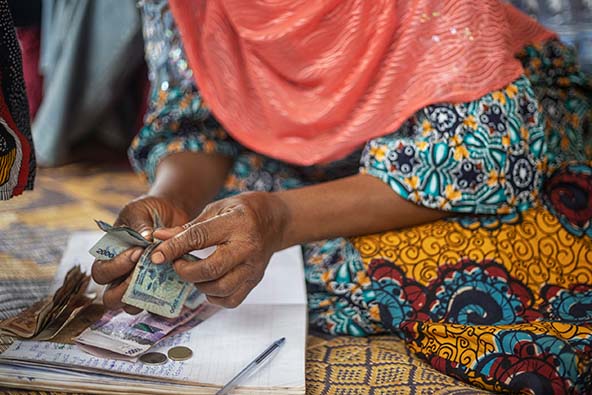
 The treasurer of the Safi Islamic Women’s Association, a Muslim women-only savings group in Jinja, Uganda, counts the group’s savings during a meeting. (Photo courtesy of FINCA)
The 20-year-old debate around microfinance is in the spotlight yet again, sparked by a Wall Street Journal article that recycles familiar criticisms of the sector without considering the damaging implications of its oversimplification. For years, critics have raised concerns about customer over-indebtedness and have called into question microfinance’s real impact. But while it’s important to critically examine any intervention, sweeping claims of failure not only unfairly undermine the entire sector, but also miss a fundamental point: Access to capital remains an essential building block of economic mobility.
I recently returned from Malawi, where I spent time with women running small businesses, most of them renting stalls at their local market to sell produce, phone accessories, and clothing. When they described how they survived week to week, they didn’t talk about “capital.” They talked about having enough cash to restock perishable inventory after a slow week, pay a medical bill without shutting their stalls, or keep their children in school when income fell short.
These women, and many of the 3.4 billion people living on the margins, are entrepreneurs out of necessity. Running their own business is the only way for them to earn any income. Without access to responsible finance, a single setback forces impossible tradeoffs, including selling assets and turning to predatory moneylenders. With access, people can absorb shocks and plan ahead. For millions of people, inclusive financial services aren’t only about growing a business; they’re what make stability, and any path to mobility, possible. For them, the value of microfinance isn’t an academic debate, and the field simply cannot afford to reduce the conversation to headlines.
Challenges of the Microfinance Model
Part of the answer to why so many people consider microfinance a failure lies in how the sector evolved. As many are aware, Muhammed Yunus pioneered microfinance 50 years ago on the notion that all people have agency to shape their financial futures, and several founders, including FINCA’s, figured out how to sustainably provide capital to people who were excluded from traditional financial systems. The model rapidly gained traction, and there was immediate high demand for microloans.
However, to increase outreach, many providers in the sector prioritized scaling and generating returns over deep customer understanding. While this can be an effective strategy for providers operating in high-density markets or serving customers with existing business, it doesn’t work well for institutions aiming to provide solutions to people living on the margins.
For those focused on serving low-income customers, the issue is structural: Even the best models will struggle to deliver impact if the cost of capital is too high. At its best, microfinance blends philanthropic capital and impact investment to build institutions that responsibly serve marginalized customers. Providers borrow from development finance institutions, social impact lenders, and commercial funders to then on-lend to their customers. But it’s a knife’s edge exercise. A provider that doesn’t make enough money can’t attract and retain commercial funders. A provider that focuses too much on profit can’t generate the impact it set out to deliver in the first place. Subsidy and donor support are essential to meeting the needs of inherently harder to reach—and therefore more expensive to serve—customers.
Over the last 40 years, for example, FINCA has used more than $500 million in donated capital to distribute more than $16 billion in loans. Yet the cost of borrowing still exceeds 20 percent in many markets, as capital flows toward lower-risk opportunities. While concessional funding helps, the field needs broader solutions to deliver affordable capital at meaningful scale.
At the same time, resources are clearly shrinking. Global development assistance has fallen for two consecutive years, including a record 23 percent decline in 2025. The result is fewer safety nets and fewer opportunities for people living in or on the fringes of poverty. This shift is making it even harder for poverty-focused organizations to serve the hundreds of millions of people who already rely on microfinance for their daily survival, let alone to extend their reach.
As with any business, to operate, institutions must at least break even. To grow and improve, they must generate returns. Yet the work is inherently complex; providers must serve clients with volatile incomes, operate in fragile economies, and deliver both financial and social impact, while also safeguarding against over-indebtedness and abuse. The underlying issue isn’t just capital scarcity but the nature of capital and the incentives behind it.
Credit Is Essential to Economic Mobility
Most people living in poverty are self-employed, relying on subsistence farming or small, informal businesses. In Africa alone, nearly 83 percent of employment is estimated to come from informal work. And with growing youth unemployment on the continent, self-employment will only become more important to survival.
Small, well-structured loans—whether to build a business, plant crops, or even for consumption in an emergency—can help people break the cycle of poverty. Data from ATLAS, a financial inclusion data platform referenced in the Wall Street Journal article, confirms that, between 2023 and 2025, 66 percent of the global microfinance portfolio across multiple institutions and geographies went toward income-generating activities, including trade, services, and agriculture. During this same period, the median share of both women and rural borrowers was just over half (54 percent).
In addition, contrary to the critique that microloans are ballooning, inflation-adjusted data shows the opposite. According to ATLAS, while nominal loan sizes increased 64 percent over 5 years, inflation rose 116 percent, meaning real loan sizes have in fact declined. Many FINCA borrowers say their loans are too small, leaving them undercapitalized.
Randomized evaluations show that credit truly works when it’s designed well. More flexible, customer-centered approaches can perform substantially better than traditional one-size-fits-all solutions. Studies have found that giving borrowers greater flexibility in when and how they repay reduces financial stress and, in some cases, increases business investment and household income. Other evidence shows that pairing access to finance with skills training, savings, productive assets, and sustained support can generate more durable gains in livelihoods. These approaches guide FINCA’s work and, each year, FINCA surveys its customers to understand the challenges they face and measure the impact—positive and negative—of microlending services. Earlier this year, FINCA polled nearly 8,000 customers, of whom 73 percent reported that FINCA’s services improved their financial wellbeing, while only 3 percent said they were worse off.
The Real Debate: How to Align Capital and Purpose
Microfinance isn’t a silver bullet, but dismissing it won’t help solve global poverty. Instead, the field needs to adopt better ways of working to align capital and purpose. This means inclusive finance providers need longer-term investments, more flexible financing structures, and greater access to funding at the country level.
Social investors like Acumen and Oikocredit have shown that mission-driven organizations benefit more from funding with longer timelines and higher risk tolerance than they do from funding from lenders who demand quick repayment. Opportunity International has successfully combined donor funding with private investment, demonstrating how philanthropic funding can make it less risky and more attractive for commercial funders to enter markets or sectors they wouldn’t normally serve. And Aceli Africa provides incentives to local lenders to serve agribusinesses, helping banks look beyond the traditional risk perceptions and lack of collateral that often leave agricultural enterprises wanting.
Reaching the most vulnerable populations will always require some level of subsidy, because it costs more to meet the needs of non-traditional borrowers. Philanthropic capital is what allows organizations like FINCA to serve high-risk populations. It enables providers to test new approaches that can permanently change perceptions and to focus on impact.
At the same time, financial institutions need to evolve their business models, design better products, and deliver lower costs to customers. Data analysis and technologies like artificial intelligence—which may help organizations listen to customers at scale, analyze what people need, and adapt solutions in near real time—can help. For example, FINCA recently launched a product innovation lab that uses human-centered design to rapidly design, test, and scale new solutions that address the underlying causes of poverty. Additionally, FINCA is partnering with institutions like Amazon Web Services, Thought Machine, and Ikigai to develop a new technology platform that brings affordable, banking-grade technology to microfinance institutions so that providers can finally tailor loan terms to meet individuals’ unique cash flows, speed up the disbursement process, and increase efficiency to lower costs.
These and other approaches are already supporting economic mobility among people living in poverty, and they have the potential to create even greater impact. Rather than choosing between blind optimism and wholesale dismissal, microfinance providers and funders must recognize the value of responsible financial services, while continuing to refine and improve the model so that it genuinely serves the people who need it.
Read more stories by Andrée Simon.