


 (Illustration by Mike Hoyt)
I am not famous. I do not work in philanthropy. I am a woman who grew up in public housing in South Minneapolis. My net worth is negative. And yet in May of 2026, Time named me one of its 100 most influential leaders in philanthropy, a sentence that feels very strange to type. It felt even stranger from inside the room, at a dinner in New York, where I found myself seated somewhere between Chance the Rapper and Idris Elba, trying to decide what, exactly, a person is supposed to do with her hands in that situation.
In January, I built Stand With Minnesota, a website that helped direct more than $40 million to mutual-aid networks, community organizations, foundations, and crowdfunding campaigns across Minnesota, in less than four months. And when the McKnight Foundation asked me to reflect on what philanthropy could learn from me, from the website I built, and from the people of Minnesota, what first came to mind was not especially diplomatic: Put the bag on the table and walk away.
I know that sounds flippant, especially to people who are accountable for how institutional resources are stewarded. It is not meant to dismiss that responsibility, nor diminish the important roles that we each must play before, during, and after crises. But I want to question where decision-making power sits in moments like these. I want to provoke philanthropic institutions to think deeply about what they need to do to more effectively respond as communities come under greater challenge.
This is not always what endears one to the philanthropic sector. But trying to find a more graceful way to say it led me to the heart of what I believe: Giving can be simple. Giving is human. Community knows what it needs. And, more often than not, community is much better at meeting the moment than the institutions built to serve it.
Community Is Simple
The urge to help one another is one of the oldest things about us. We are social creatures, after all. Just a few generations ago, my ancestors on both sides were living subsistence lives, in which survival required everyone, every person had a role to play, and our fates were connected. Our interdependence was not sentimental; it was how people stayed alive.
Agriculture, industrialization, and the long march of American individualism pushed many of us away from that kind of interdependence. We became more focused on the nuclear family, the private home, the locked front door, than on the community at large. Decades of policy pushed us even farther apart. We were sold the lie of scarcity: As wealth pooled at the top, people at the bottom were left to fight one another for crumbs.
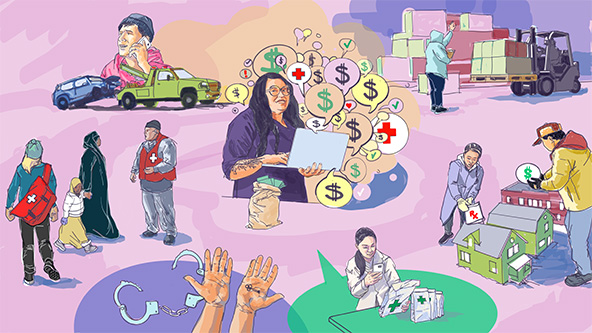
These are some of the reasons why mutual aid has surged. When needs are high, people want to help. Every week online, I amplify calls from people trying to meet the most basic needs: housing, food, prescriptions, transportation, and legal fees. In the face of authoritarian violence, people are crowdfunding for some small measure of safety. There are immigration fees to pay, relatives in detention to visit, children to keep housed, families to keep fed. Trans people are raising money to flee states where their very existence has been turned into a political target.
The question, then, is not whether people want to give. They do. The question is whether philanthropy, as a sector, is capable of meeting this moment. Are institutions living in the same reality as most Americans? Can foundations, structured as they are, move at the speed history now demands?
From what I have seen, the answer is no, or at least not quickly enough, and not in the moments when it matters most.
This isn’t because people inside these institutions don’t care. It is because they are working within structures that make it difficult. I know this because, in the moments when Minnesota most desperately needed resources on the ground, our funders often could not move at the speed of very real and urgent needs. But ordinary people could. And the difference wasn’t will; it was design. It was who was allowed to act, how quickly decisions could be made, and how much trust existed in the people closest to the situation.
The Speed of Need
The people who came to my website not only moved millions of dollars into mutual-aid networks, but GoFundMe campaigns were being fulfilled so quickly that I had to change the links hourly. Within days of the site’s launch, shortly after Renee Good was killed, thousands of people had stepped forward to fund the infrastructure our community needed to keep people safe. But even when foundations in our state had their hearts in the right place, it took weeks before the first emergency funding reached some of the organizations doing work on the ground. It took months to help emerging groups find fiscal agents, bank accounts, and pathways into traditional funding systems.
One of the first problems we had to solve during Operation Metro Surge was how to keep immigrant families housed when they could no longer safely work. Some families had lost breadwinners overnight, as people were taken off the streets or sent to detention despite having legal status. Parents were hiding. Children were afraid. Rent was still due. Too many people in philanthropy told us that the problem was too large to solve.
Community members refused to accept that. Neighbors established rent funds. Volunteers built systems to raise money quickly and move it directly. Across the Twin Cities, PTAs created funds so families in their schools could stay housed. While government agencies and nonprofits continued to search for solutions, community moved.
At first, some foundations told us they would never fund rent. We kept pressing. Eventually, we convinced philanthropic partners that the investment was not only necessary but urgent. We paired larger contributions with matching funds. We created rent-adoption programs, where neighbors could pay their neighbors’ rent. We continued to crowdfund. We made it possible for people to help one another at the scale of the crisis. So far, we’ve paid nearly $40 million in rent.
Foundations must follow laws and regulations, and some constraints on what they can do are very real. But there needs to be a deeper recognition that unprecedented times require unprecedented action. The real question is how much room institutions are willing and able to find within the constraints they operate within, and how much they are willing to change when they are prevented from meeting the moment. It also means identifying what is needed before a crisis hits and being prepared to move and act differently when things don’t follow a neat playbook.
The Community’s Playbook
Our democracy and our collective future are under threat. If philanthropy wants to play a role in building a just future, then it needs to be willing to find new channels, new structures, and new forms of trust.
And who already has those solutions? Not the big consultants. Not the biggest donors. People do. The people in your community. The people whose boots are on the ground. The people closest to the harm. The people closest to the need.
We need funding that moves faster, more nimbly, and through more creative channels. Stand With Minnesota, the website that helped point this enormous amount of money in the right directions, cost less than a thousand dollars to build. Securing funding to expand it took months and was far more difficult than it should have been. But imagine what would have passed us by if I had not already had a platform from which to raise that money myself! How long would it have taken an organization to raise the funds, hire the staff, and build something similar? Would the moment have passed? Would the money have gone, as it so often does, to a few large organizations with the capacity to receive it? What would have happened to the 20,000 people whose rent we paid for five months? The hundreds of families we reunited with donated SkyMiles?
We need money that can fund work like this. Money that can move in hours and days, not weeks and months. We need to recognize that mutual aid is extraordinary, but it cannot carry the burden alone. People want to give. People want to help. People want to live in a village again.
We all have a role to play, and it’s important we reflect on what we each do best and what we can each do better. Philanthropy can help till the soil. It can plant seeds. It can show people what might grow when resources are placed in the hands of those who already know what to do with them. At its best, it makes community action more possible and less fragile.
Or, to put it less delicately: You can put the money on the table, trust your community partners, and watch what happens when you step back. Not to withdraw, but to make space for the people who are already carrying the work.
Read more stories by Ashley Fairbanks.