


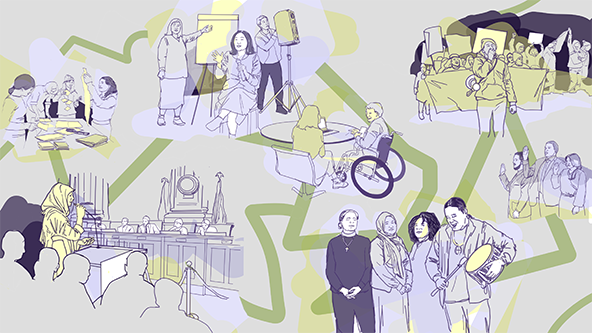
 (Illustration by Mike Hoyt)
When communities are praised for their resilience in times of crisis, we often hear stories about people showing up for one another, neighbors helping neighbors, and organizations stepping forward. What those stories often miss is the years of relationship-building beforehand, developing the leadership, infrastructure, and trust that make resilience possible.
During Operation Metro Surge, in the winter of 2025-26, many looked at the response in Minnesota and asked how immigrant communities mobilized so quickly. How did thousands of people know where to go? How did families find support? How did organizations coordinate legal services, communications, rapid response, mutual aid, and community defense at such a scale?
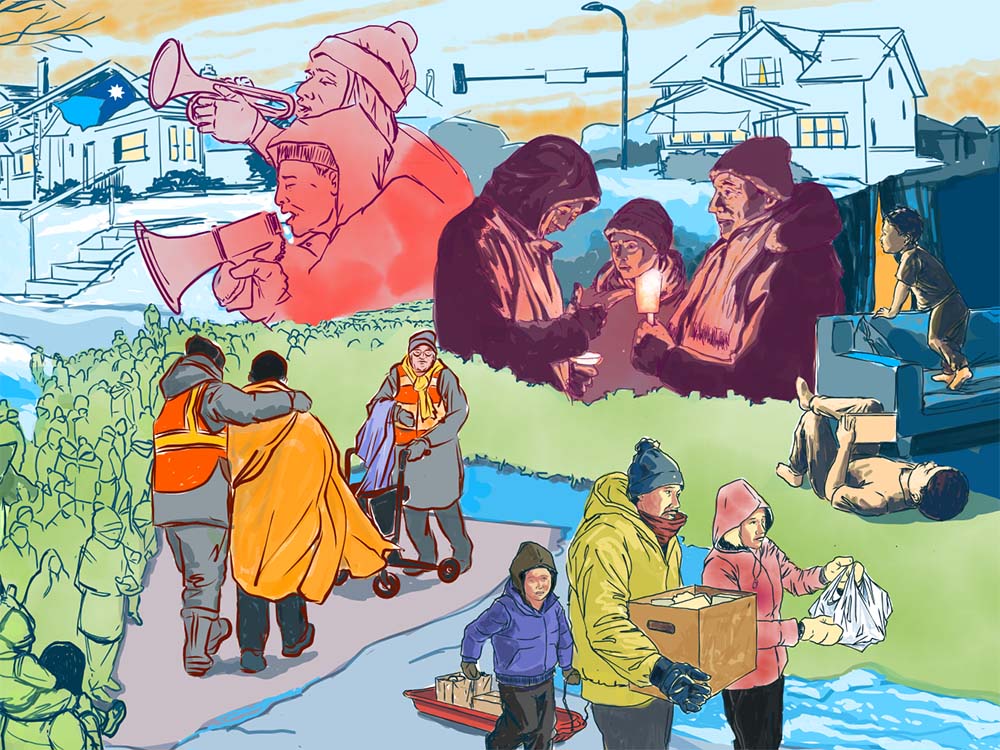
The answer is simple. The response began months earlier, when the decision was made to prepare for what was coming, together. After the 2024 federal elections, organizations across Minnesota could see that immigrant communities were likely to face unprecedented challenges in the years ahead. Rather than waiting for those challenges to materialize, we asked what it would take to build the infrastructure necessary to protect communities before a crisis arrived.
Those conversations led to the creation of the statewide Immigrant Defense Network, which today brings together more than 100 organizations, institutions, faith communities, service providers, and community leaders, all committed to protecting immigrant communities and strengthening democracy across Minnesota and the Upper Midwest. But what began simply as a convening quickly evolved into a shared commitment to collective action, community defense, and long-term power building.
The lessons we learned from building and sustaining this network are not unique to immigration. They are lessons about how communities prepare for uncertainty, how organizations build trust, and how movements create the capacity necessary to respond when people need them most.
1. Networks must be built around purpose (before they are built around structure).
Many networks begin by debating governance models, decision-making processes, and organizational charts. Those questions matter, but they are not where trust begins. Trust begins with shared purpose. From the beginning, the organizations that formed the Immigrant Defense Network understood that we would not agree on everything. We represented different constituencies, organizational cultures, geographies, faith traditions, and strategies. What united us was a shared belief that immigrant communities deserved dignity, protection, opportunity, and the ability to live free from fear.
That common purpose became the foundation for everything that followed. It allowed organizations to collaborate without losing their individual identities. It created space for disagreement while maintaining alignment. Most importantly, it ensured that the network remained focused on the people we existed to serve rather than the institutions participating in it.
Too often, networks become centered on organizations. The strongest networks remain centered on communities.
2. Effective networks distribute leadership rather than concentrate it.
As the network expanded, it became clear that no single organization could coordinate a statewide response. The scale of the challenge required shared ownership. Instead of creating a centralized structure, therefore, the network adopted a distributed leadership model, in which different organizations assumed leadership roles based on their expertise, relationships, and capacity. Some led organizing efforts, others coordinated legal services, while others focused on communications, policy advocacy, family support, or regional organizing.
Together, these interconnected efforts created a stronger and more resilient ecosystem than any individual organization could have built on its own. Distributed leadership is more than just a management strategy. It is a recognition that communities possess diverse forms of expertise and that lasting movements are built through shared ownership. When leadership is distributed, networks become more resilient, less dependent on individual personalities, less vulnerable to burnout, and more capable of adapting to changing circumstances.
3. Representation is not symbolic; it is essential.
Many organizations understand the importance of diversity. Fewer understand the importance of designing networks in ways that allow diverse perspectives to shape decisions.
The Immigrant Defense Network sought participation from organizations serving different immigrant communities, different regions of the state, and different sectors of society. Faith leaders, labor advocates, educators, legal service providers, healthcare advocates, rural organizers, communications professionals, and directly impacted community members all brought unique perspectives to the table.
This diversity strengthened the network. Challenges facing immigrant communities intersect with education, healthcare, labor markets, public safety, housing, economic development, and civic participation. Building a network capable of responding to all of those challenges required bringing together people who understood those intersections. Representation was not pursued because it looked good. It was pursued because it made the work better.
4. Preparedness is infrastructure.
When people think about community response, they often imagine volunteers showing up during moments of crisis. But before a rapid response action can occur, someone must build the communications systems. Someone must train volunteers. Someone must develop legal referral pathways. Someone must establish family support protocols. Someone must create multilingual materials. Someone must coordinate data systems, leadership structures, intake processes, and response plans.
None of this work is glamorous (and much of it is invisible), but all of it is essential. When enforcement actions intensified across Minnesota, our communities benefited from investments that had been made long before those moments arrived, relationships that had already been built, training that had already occurred, and systems that had already been developed. Information could move quickly because trust already existed.
Just as communities invest in emergency management systems before natural disasters occur, they must invest in community infrastructure before social and political crises emerge.
5. Community defense cannot be limited to directly impacted communities. We must build partnerships, and train leaders.
One of the most powerful aspects of the network's growth was the willingness of allies to step forward and ask how they could contribute. Faith leaders, students, retirees, and small business owners all wanted to help.
The future of immigrant justice will not be built solely by immigrant-serving organizations. It will require partnerships with educators, labor unions, small business owners, faith communities, farmers, local governments, and elected leaders. It will require people who may not identify as part of an immigrant-rights movement but who understand that the health of their communities is tied to the well-being of immigrant families. The strategic vision adopted by the Immigrant Defense Network recognizes this reality. Building lasting change requires expanding beyond traditional advocacy spaces and cultivating relationships across sectors that have not always worked together.
Good intentions, however, are not enough. People need real pathways into action. For this reason, the network invested heavily in training and leadership development. Community members participated in Constitutional Observers training. Over 35,000 volunteers learned how to serve as constitutional observers. Organizations received support in rapid response coordination, storytelling, de-escalation, and community organizing. Rather than treating leadership as something reserved for professionals, the network approached leadership as a skill that could be cultivated throughout communities. The result was not simply more volunteers. The result was more community capacity.
When people understand their role, they are more likely to participate. When they participate, they build confidence. When confidence grows, leadership follows. Finally, we learned that some of the most important partnerships come from places movements do not traditionally look.
The strength of communities is revealed during crises.
The greatest lesson from our experience, simply, is crisis does not build strong communities, it reveals them. The response began long before the operation itself, when organizations chose collaboration over competition, when leaders invested in trust before they needed it, and when communities developed infrastructure before it was needed.
The implications are clear: If we want communities capable of responding to future challenges, we must invest in the conditions that make collective action possible, now. We must invest in relationships. We must invest in leadership development. We must invest in training, infrastructure, communications, and network building.
Most importantly, we must trust impacted communities to lead and to support them in moments of crisis. Immigrant communities have always demonstrated resilience. The question before us is whether institutions are willing to invest in the structures that allow that resilience to become power. Because when communities have the relationships, leadership, and infrastructure necessary to act together, they can do more than respond to crises. They can protect families, strengthen democracy, and build the future they deserve.
Read more stories by Francisco Segovia & Carolina Ortiz.