


 (Illustration by Mike Hoyt)
When Operation Metro Surge moved through Minnesota, it tested whether years of organizing had built enough civic infrastructure to hold our fear, grief, urgency, and moral clarity—and turn those feelings into power.
Communities under threat feel the stakes immediately. People are afraid. They are angry. They want to do something. Yet a surge of emotion does not automatically translate into political power. Fear isolates. Urgency scatters. A one-time mobilization can rise quickly and disappear just as fast as it came together.
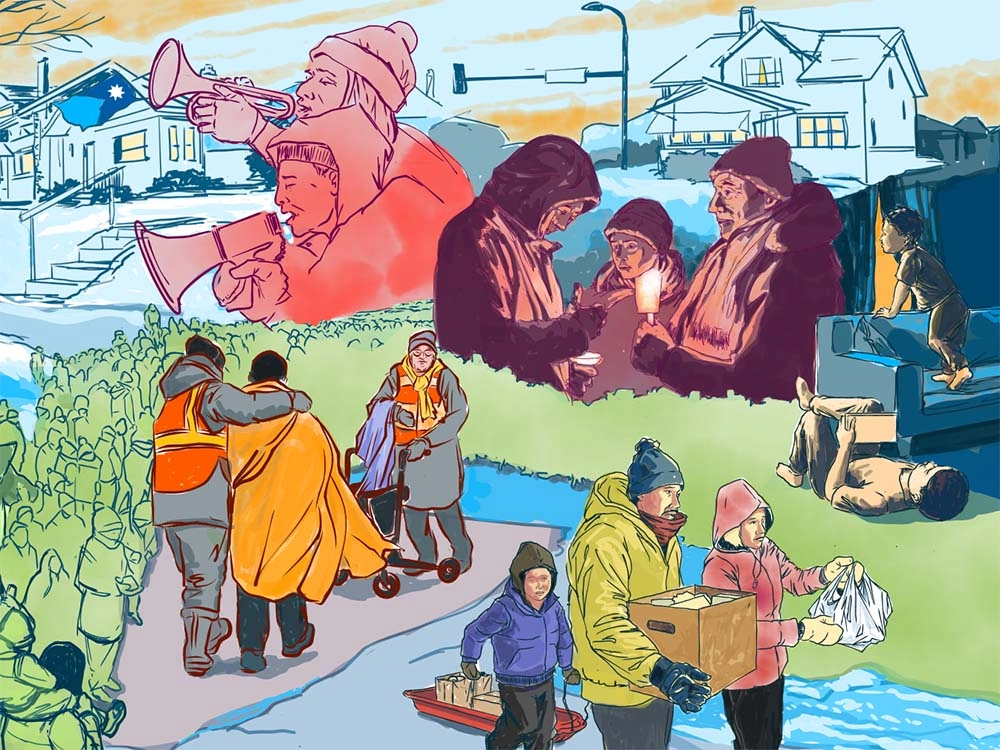
In Minnesota, what looked like rapid response was, in truth, the result of organizing. Through the democracy organizations ISAIAH, Faith in Minnesota, and We Choose Us, we work with congregations, mosques, childcare providers, small businesses, workers, and community leaders across the state to build the relationships and public leadership that democracy requires. For years, organizers and leaders had been inviting people into public life through relationships: sharing stories, listening across differences, analyzing power, moving institutions, and taking action together. Those practices can seem ordinary when the stakes are lower. In crisis, they become protection.
Where We Practice Acting Together
Civic infrastructure is the living architecture of democracy: the relationships, institutions, trainings, communication systems, safety practices, legal support, and coalition tables that allow people to move together when the moment becomes urgent. It includes trusted leaders, but it also includes the pathways that connect them: the clergy formation that prepares faith leaders for public moral action; the base-building that turns concern into leadership; the rapid communication that separates fact from rumor; and the coordination spaces that keep organizations from duplicating or contradicting one another. Civic infrastructure is where people practice acting together before a crisis requires it.
That preparation was not abstract in Minnesota. Just 25 days before Renee Good was killed, nearly 5,000 Minnesotans gathered for “A Light in the Storm,” ISAIAH and Faith in Minnesota’s full-day anti-authoritarianism training and public meeting that had taken more than a year to organize. The gathering advanced a “yes” to a Minnesota rooted in care, dignity, affordability, and belonging, while also naming a “no” to fear, abandonment, and the erosion of democratic life. The gathering trained people to understand the threats facing our state, neighbors, and families, and to see themselves as responsible for shaping what would come next. When the crisis deepened less than a month later, that infrastructure moved from theory into practice.
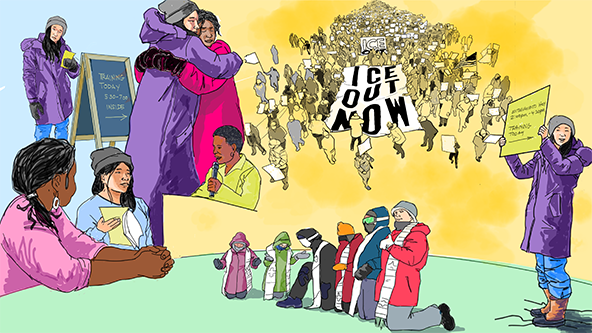
In the weeks after Renee Good’s killing, community leaders helped organize major public actions, including the Day of Unity, Peace, and Service on January 9 and the Day of Truth and Freedom on January 23. The Day of Truth and Freedom issued a statewide call to collective action: no work, no school, no shopping, alongside public witness grounded in dignity and solidarity. That same day, more than 100 clergy protested at Minneapolis-Saint Paul International Airport, calling on institutions to stop cooperating with deportation operations and to stand with Minnesotans. All the protestors were arrested. The public witness drew on relationships, training, and a shared moral frame built over time. Small-town clergy, metro clergy, bishops, and congregational leaders stood together because they had already practiced protecting their neighbors in public. Their witness gave people across the state a visible example of moral leadership under pressure and helped more faith leaders see that they had a role to play.
Public actions like these mattered, but they were only the visible edge of the work. Beneath them were invitations, leader calls, trainings, safety planning, legal support, communications discipline, and follow-up in the days, weeks, months, and years before. ISAIAH and Faith in Minnesota work to build this backbone through leadership development, clergy formation, political education, base-building, and institutional organizing across congregations, mosques, childcare centers, small businesses, and community networks. We Choose Us helps connect that power across a broader pro-democracy ecosystem so leaders, organizations, and communities can move together when conditions shift quickly. The work is slow until it suddenly has to move fast.
The invitation to engage stayed simple and human. Protect your neighbor. Refuse isolation. Do not allow institutions with power to pretend they have no responsibility. Not everyone who showed up shared the same politics, analysis, or organizational home. They did not need to. People enter public life because something happening in front of them violates what they know to be right. Organizing helps that first step become something deeper: belonging, leadership, courage, and the ability to bring others along.
The crisis also pushed organizations to take stock of the ecosystem and the role each of us could play inside it. ISAIAH and Faith in Minnesota brought a disciplined organizing practice: Leaders who knew how to move from fear into action, clergy formed for public moral leadership, and institutions prepared to take responsibility beyond their own walls. We Choose Us brought alignment across the broader pro-democracy field, helping groups with different structures, cultures, and theories of change move with a shared sense of purpose. Mass mobilization groups like MN5051 and Indivisible, small arts and culture groups, immigrant community organizations, trades workers, mutual aid networks, and more decentralized or protest-oriented formations all carried different kinds of power. The response grew stronger when we stopped trying to make everyone play the same role and started asking what each formation could carry. In crisis, organizations need to know who is in the field, what they can move, and how they can act together.
That ecosystem approach also shaped corporate actions. After federal immigration agents reportedly detained workers inside a Target store in Richfield, Minnesota, ISAIAH and Faith in Minnesota helped organize clergy and community leaders to press Target to take responsibility for the safety of its workers, customers, and communities. More than 100 clergy held a press conference, walked to Target Corporate Headquarters, and began a sit-in, asking to meet with CEO Brian Cornell. The action made a clear moral claim: Corporations have power, and communities can organize to demand that they use it. This action grew from the same infrastructure as the airport witness: clergy formation, disciplined communications, relationships with labor and community partners, and leaders prepared to move together. Across the state, local leaders also organized more than 30 Target store actions. The lesson for nonprofits and funders is practical: Civic power grows when communities know how to move the corporations and institutions that shape daily life.
Staying Engaged
The response to Operation Metro Surge also revealed unfinished work. In every urgent moment, people come forward. Some join a team, attend a training, take responsibility, and stay. Others sign up somewhere, attend an action, or ask how to help, then disappear back into daily life. That does not mean they did not care. It means our movements need better ways to absorb people when urgency suddenly expands.
In Minnesota, organizations connected more people to trainings, teams, and action. Groups recognized that a mass response had to become more than a one-time mobilization. And still, some people came in and left, and we may never know who they were. One of the most important capacities in democracy work is the ability to turn a surge of participation into durable organizing.
This requires more than a sign-up sheet. Organizations need absorption strategies that are relational, redundant, and trustworthy. Our common tools for engagement cannot always hold at scale. We learned this in real time at large public gatherings and actions, where digital tools that seemed efficient in planning did not always work in practice. QR codes for registration, commitment forms, and next steps broke down when thousands of people strained cell service and broadband. Some people also hesitated to share personal information because they worried about surveillance, data security, or how their information might be used. Low-tech options, paper systems, trained volunteers, multilingual follow-up, trusted data practices, and clear explanations of why information is being collected all matter.
Organizations also need leadership ladders, volunteer coordination, and next steps that do not depend on a single platform or moment. The pathway of engagement has to move people from attending to belonging, from belonging to leadership, and from leadership to moving others. This is backbone work, but it is not separate from democracy work. It allows democracy work to last.
Other gaps in engagement came from uneven infrastructure. Response systems can fragment. They can depend too heavily on last-minute coordination. Funding can arrive only after the crisis becomes visible. After a major public moment or meaningful win, alignment can loosen as organizations return to their own campaigns, institutions, calendars, and funding realities. The urgency that brings people together does not automatically create the structure that keeps them together.
Finally, movements lose power when they focus only on what they oppose. A shared “no” can bring people together quickly: no to fear, no to isolation, no to abandonment, no to silence. Lasting civic power requires a larger “yes.” During Operation Metro Surge, we heard a larger “yes” taking shape in conversations with leaders, clergy, organizers, and community members. People were searching for a way to name the responsibility they felt to one another. One of the clearest words that emerged to describe this sense of concern was neighborism: the belief that we belong to one another, that protecting one another is a public responsibility, and that democracy should organize around care. Neighborism was not a policy platform. It was a moral and civic claim about what people owe one another. The next step is to translate that moral claim into public systems, institutional behavior, and organizing strategies that make safety, care, voice, and dignity real in daily life.
Investing in Organized Community
For funders, the lesson is clear: If funding only follows crisis, it will always arrive too late. Organizations can only move quickly when they have already built capacity. Funders should invest in the slow work that makes fast action possible: organizing staff, leadership development, communications capacity, multilingual access, data systems, safety planning, and coalition coordination. They should also fund what happens after the peak: absorption, follow-up, reflection, training, and shared agenda-building that turns temporary alignment into durable civic power.
Funders should also measure power, not just activity. Large turnout, strong statements, and visible actions matter. Better questions about building power go deeper: Did people become less isolated? Did new leaders emerge? Did institutions become more willing to act? Did communities most affected gain a stronger hand in shaping what happens next? Did the work leave behind more capacity than it used?
Our practical advice for nonprofits follows from the same lesson: Build before the moment. Know who is in the ecosystem before crisis requires people to move together. Design public actions with absorption in mind, including low-tech and high-trust ways for people to take next steps. Value the backbone work: coordination, logistics, data protection, safety planning, communications, and staff capacity. Stay together after the peak long enough to learn and move toward the next shared horizon. Be ready with a bigger “yes,” not only a necessary “no.”
Operation Metro Surge showed that fear can isolate people, but organized community can interrupt that isolation. Power does not come from message alone, turnout alone, or crisis funding alone. People build power through relationships, institutions willing to act, leaders prepared to move, and organizations disciplined enough to turn urgency into lasting civic infrastructure.
Read more stories by JaNaé Bates Imari & Lilly Sasse.