


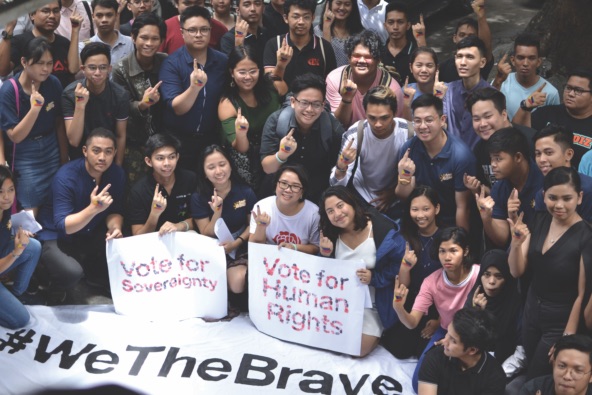
 Youth leaders from DAKILA and its partner organization, We the Future PH, discuss the Youth Agenda at one of the collective’s meetings. (Photo courtesy of DAKILA)
About 70 million Filipinos will be eligible to vote in the May 2025 midterm election in the Philippines. The election could signal a new direction for the Southeast Asian nation, with more than 18,000 federal, regional, and municipal seats up for grabs. The election arrives four years after the authoritarian leadership of Rodrigo Duterte and midway through that of his successor, Ferdinand Marcos Jr. Both politicians have reputations for crushing dissent. Duterte’s administration made international headlines for its regressive policies and extrajudicial killings.
Duterte’s six-year term saw “the demonization of human rights, the closing of civic spaces, and [the spread of] dominant harmful narratives that were anti-progressive [and] anti-democracy [that] led to the curtailment of rights and freedoms,” says organizer Leni Velasco. In 2005, she cofounded DAKILA, a membership-based artist-activist collective whose mission is to use art, culture, and community-building events to create social change. The collective is membership-based and free to join. Currently standing at 1,500 members nationwide, the collective leads communications campaigns, hosts arts- and media-focused events, and organizes artists and young people to shape public discourse and foster political action through subgroups based on geographic region or shared identity or interest.
Heading into the May 2025 election, DAKILA is committed to disrupting entrenched anti-democracy narratives and building the political power of Filipino youth. These young people constitute an outsized portion of the nation’s voting population: 56 percent of voters are aged 18 to 41. The campaign’s message focuses on community issues that the collective is eager to change, such as the cost of living, access to continuing education, and discrimination at work.
Filipino youth face challenging economic and social conditions. They are four times more likely to be unemployed than those 25 and older, and more than one in five young people are jobless or underemployed, according to the International Labor Organization. Many are frustrated that legislation to prevent discrimination in hiring, the workplace, and educational institutions on the basis of sexual orientation or gender identity and expression (SOGIE) has been stalled in the nation’s Congress due to pushback from conservative and religious groups.
Beginning in 2021, as Duterte’s term ended, DAKILA and its partners consulted with young people nationwide to draft a 30-page political agenda for economic and social transformation in the Philippines. Called the Youth Agenda, this document outlines popular demands, including moving forward with the SOGIE Equality Bill, as well as curbing corruption, developing a commission to document human-rights violations, adopting cleaner technologies in public industries, and allocating funding to preserve endangered cultural heritage.
DAKILA’s voter-mobilization campaign is engaging young people one neighborhood at a time. Volunteer canvassers from DAKILA and its partners ask voters to sign a commitment to support candidates who adopt the Youth Agenda. The collection of signatures is then shared with candidates and the media to demonstrate the importance of those issues among voters and to pressure politicians to adopt them into their platforms.
The DAKILA campaign is focused on organizing around local elections that are more competitive than federal contests to reengage disillusioned young voters who are desperate for wins. The strategy will also allow the movement to make some difference in the short term and develop momentum that will grow into the 2028 presidential election. Velasco notes that some senatorial candidates will be responsive to the Youth Agenda if the campaign demonstrates sufficient support among voters.
Canvassers began their work in January 2025 and will continue until the May election before assessing their successes and shortcomings to regroup for the next election cycle. “Both the citizens and the social movement need to experience concrete gains to reignite the hope that a better future is possible,” Velasco says. To do that, she adds, “we need to build power from the grassroots.”
Read more stories by Marianne Dhenin.