


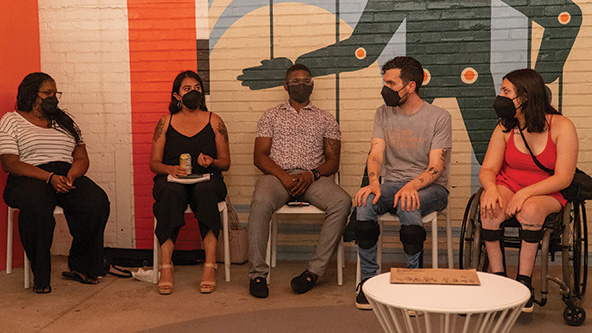
 A group of disabled community members in Atlanta, Georgia, talk at an NDS organizing event in 2023. (NDS cofounder, president, and CEO Dom Kelly is second from the right.) (Photo courtesy of Tyler Boozer)
Disabled Americans face significant barriers to participating in our democratic process. The overwhelming majority of polling locations nationwide are inaccessible, and many states have restrictive voting laws that limit mail-in voting or ban ballot drop boxes. More than 11 percent of disabled voters reported encountering difficulties when voting in the last general election.
New Disabled South (NDS), a disability-rights and disability-justice nonprofit organization founded in 2022, is working across 14 states in the US South to eliminate these barriers. With the 2024 elections rapidly approaching and voter suppression rampant throughout the region, NDS is working on multiple fronts to ensure disabled people’s voting access so their voices can be heard on critical issues.
While 2024 marks the nonprofit’s first involvement in a general election, its leaders have deep experience in electoral politics and voting-rights advocacy. NDS cofounder, president, and CEO Dom Kelly has worked for voting-rights organizations in Georgia and served as the senior advisor for disability on Stacey Abrams’ 2022 gubernatorial campaign. What he witnessed in those roles—disabled voters were disenfranchised and often overlooked, even by progressive groups—made him realize the need for a disability-led organization. He observes that it is not enough for some organizations to work on disability-rights issues if disabled people aren’t given a seat at the table. “If you don’t have that lived experience,” he says, “you’re only looking at the issues from the outside.”
One of NDS’ main objectives is combating efforts to disenfranchise disabled voters. The organization’s other priorities include improving outcomes in the legal system, ameliorating poverty, and securing access to health-care services. These priorities address issues that disproportionately affect disabled people nationwide: Disabled people face arrests, incarceration, and police violence at higher rates than nondisabled people. Disabled people also experience poverty at a rate of more than twice that of nondisabled people. The issues are even more pressing in the South, where more than 20 percent of the population is disabled—the highest rate in the nation.
NDS hired 10 employees in its first year; its entire staff and board are disabled and have roots in the South. The organization also launched a 501(c)(4) arm called New Disabled South Rising (NDSR) in February 2023. “We recognized that if our goal was to build a political home for disabled people, we needed to be able to have the flexibility of a 501(c)(4) to do that,” Kelly says.
Philanthropic funders, including the Ford Foundation, Borealis Philanthropy, and the Robert Wood Johnson Foundation, have been vital to NDS’ rapid growth. An individual donor provided seed funding for NDSR. In November 2023, Open Society Foundations awarded the organization a two-year grant as part of its mission to reduce barriers to voting nationwide.
The organization’s early efforts include partnering with Data for Progress to conduct a six-state survey on voter perceptions of disabled people and disabled people’s experiences in the South. The survey results will serve as a framework for a multistate qualitative research effort that NDS will launch this summer. NDSR was also the fiscal sponsor on an Atlanta, Georgia, ballot referendum campaign to allow voters to decide whether a $90 million police training facility should be built in the city.
Looking ahead to the upcoming general election, NDS is partnering with nonpartisan voter registration, education, and turnout efforts across the region. The nonprofit will offer guidance for “these organizations [to] bring a disability lens to their work,” NDS’ organizing director, Lila Zucker, says.
Read more stories by Marianne Dhenin.