


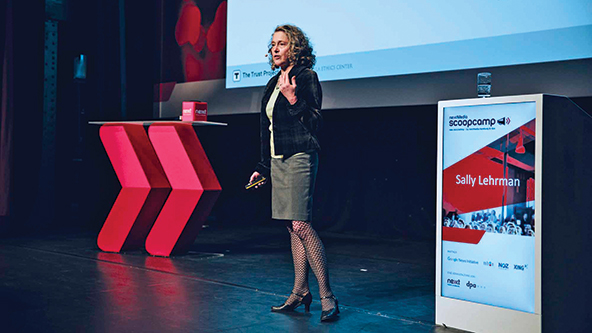
 The Trust Project founder Sally Lehrman presents on the project at ScoopCamp 2018. (Photo courtesy of The Trust Project)
The decline of public trust in civil society has alarmed defenders of democratic values and human rights in recent years. In a June 2022 speech to the 50th session of the Human Rights Council, UN High Commissioner for Human Rights Michelle Bachelet said that a host of “global diseases” such as rising inequality have created a breeding ground for the proliferation of misinformation and disinformation, which have contributed to the erosion of public trust in the media.
In a 2021 poll, Pew Research Center and Elon University’s Imagining the Internet Center asked tech-industry experts whether digital spaces would better serve the public by 2035. The overwhelming response was that these spaces would only improve with deliberate intervention—precisely the objective of The Trust Project.
Since 2014, The Trust Project has promoted transparency in journalism by identifying trustworthy outlets for audiences and working with news organizations to improve the quality of their reporting. Founded and headed by award-winning journalist Sally Lehrman, the nonprofit is an international consortium of more than 100 news organizations, including high-profile outlets such as The Economist, The Washington Post, South China Morning Post, and El País, as well as regional and local outlets.
Upon its launch, The Trust Project facilitated working groups with top editors from around the world to create a set of standards for rigorous, ethical, and transparent journalism to indicate to readers the extent to which a story, outlet, or journalist is trustworthy. Based on a combination of codified journalistic ethics and in-depth interviews they conducted with the public, the editors devised eight “Trust Indicators”: best practices, journalist expertise, type of work, citations and references, methods, locally sourced, diverse voices, and actionable feedback. News partners can use The Trust Project logo on their published work and website only if they commit to applying the eight indicators.
The Trust Indicators are accessible via The Trust Project website, and each participating news partner has a page devoted to them, explaining how it applied the indicators to its work. The indicators also have associated machine-readable signals—a corresponding schema.org vocabulary of markups and digital tags—embedded in the page code so that they are readable by third parties. Major internet search engines and social media like Google, Bing, and Facebook can process the machine-readable signals of participating new partners’ pages to assess if news is trustworthy and reliable. In turn, these internet giants defer to The Trust Project as an “expert advisor” in their own initiatives to privilege reliable, trustworthy news.
Research shows that the presence of the Trust Indicators improves trust among a publication’s readership. Assessing the impact of these indicators, the Center for Media Engagement at the University of Texas at Austin found that “evaluations of the news organization were higher when indicators were present.” The same held true for evaluations of the reporters who wrote articles employing these indicators. Reach PLC, which publishes the Mirror, concluded from their own surveys that readership trust increased by 8 percent after the Mirror incorporated the Trust Indicators.
From the Digital Ashes
In 2012, Lehrman brought the Society of Professional Journalists’ (SPJ’s) New Media Executive Roundtable and Online Credibility Watch to Santa Clara University’s Markkula Center for Applied Ethics, where she was serving as the Knight Ridder Chair in Journalism in the Public Interest and the senior director of the journalism program at the university. She subsequently created the Roundtable on Digital Journalism Ethics, after she and her colleagues had growing concern over a number of years about the changes happening in the digital space. Lehrman observed that in the intervening years, the media’s traffic-driven digital turn resulted in unsavory and sometimes unethical practices. Lehrman felt these changes were communicating the wrong message to the public “that this is entertainment, this isn’t news and that we [journalists] don’t care about the impact or checking our facts and doing the reporting that will help the public understand what’s really going on here,” she says. “And what I realized was we needed to do more.”
Unlike the age of print journalism—when a reader could easily differentiate news reporting from op-eds and advertisements—the digital space, with its uniformity, can make it very hard to distinguish between legitimate, thoroughly reported stories and advertorials. Consequently, readers have difficulty in discerning the trustworthiness of a source and are exploited by bad-faith actors who present themselves as truth tellers.
Increasing concern about the ethical compromises that outlets were making to adjust to the new digital landscape motivated Lehrman, in 2014, to turn to tech-media experts such as Google News vice president Richard Gingras to inquire whether algorithms could be used to address the problem. When they told her it was possible, Lehrman saw an opportunity for ethical journalists and partners to repair a broken system.
Lehrman was able to galvanize editors and media executives precisely because of the prevailing consensus among committed journalists about the industry’s decline. Importantly, she had also been a John S. Knight Journalism Fellow at Stanford University, which gave her access to the Knight Foundation and Craigslist founder Craig Newmark—both were early funders of The Trust Project. Their investments helped legitimize the project as well as build fundraising momentum.
Democracy Fund has also been an important funder and supporter. Paul Waters, the director of the fund’s Digital Democracy Initiative, was excited about Lehrman’s enterprise as soon as he learned of it and believes it to be instrumental in preserving the public good. “The way people come to know and understand things is changing and at a very basic level,” he remarks of information gathering in the digital age. “The Trust Project is a step forward in helping people understand what’s going on, especially in the online environment.”
Global Project Management
The Trust Project has had to navigate a media landscape driven by maximizing profits and fraught by political polarization. ProPublica Director of Audience Strategy Dan Petty, who was formerly a strategic partner of the project while working at MediaNews Group, emphasizes the project’s work “both as a moral imperative and imperative for democracy.” But for media companies, he adds, “it’s also a business imperative.”
“Speaking from a business perspective, if people don’t trust your product, they’re not going to engage with it, they’re not going to buy it, they’re not going to buy a subscription, they’re not going to donate,” Petty explains.
The Trust Project also believes that diversity, equity, and inclusion (DEI) in journalism is essential to building and sustaining public trust. Research from the Knight Foundation shows that lack of diversity in newsrooms unsurprisingly affects outlets’ story selection and often leads to unconscious bias in how stories are told, which leaves many Americans feeling as though the media does not represent them or grasp their experience. “Platforms do not have a strong record on addressing racial inequality, so to see a project coming out of that social milieu is important and helps to push lots of other conversations forward,” Waters observes. DEI is often prioritized only when newsrooms are not older and male, Pew Research Center found, which means the newsrooms in most need of reform are slowest to adopt it.
As The Trust Project considers expanding its work and the consortium, the exhaustive nature of its implementation can be an additional strain on overstretched newsrooms. “The challenge is, operationally, carving out the time. Editors are busy, writers are busy, management is busy,” Petty says. “But taking the time to do this and do this right is super-important. If you know you’ve got a crisis of trust, you really want to make sure you do this right. We [at MediaNews Group] really relied on The Trust Project to give us the frameworks and the questions and the thinking; that was what was so helpful. Yes, it was painful, but it would have been way more painful if we didn’t have them as a partner.”
Lehrman says that one of the big challenges with scaling is the continual uphill battle with funding and building systems that are robust and comprehensive enough to support news partners who want to implement the Trust Indicators. The technological dimension of this can be especially tricky, and the project is figuring out how to facilitate tech adoption and implementation. “When I noticed it was really hard for some sites to do the technical work and I also learned how many were on WordPress, we developed a WordPress plug-in,” Lehrman says. In addition, as the project expands globally, so too does the need to translate their indicators into language that works within those specific local contexts.
The indicators, furthermore, are not static or fixed frameworks. Rather, they require constant reevaluation. While Lehrman describes this as the fun part of the work, it is also very time-consuming and requires continual iteration. “It’s important we’re continuing our research, continuing to have working groups, so we can maintain and develop the Trust Indicators so they are always representative and at the right level for the moment,” she says.
Read more stories by Noor Noman.