


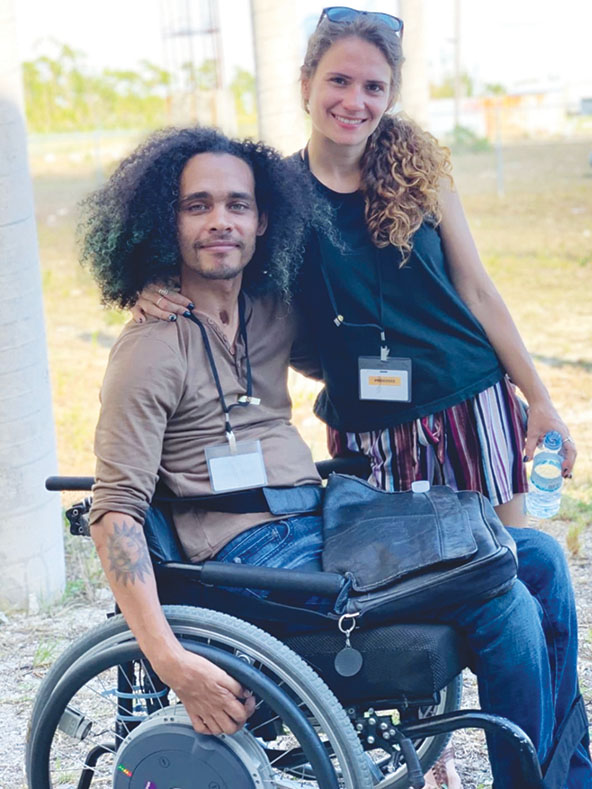
 Partnership for Inclusive Disaster Strategies coexecutive directors Germán Parodi (left) and Shaylin Sluzalis on their deployment to the Bahamas to help with Hurricane Dorian disaster relief, September 2019. (Photo by Partnership for Inclusive Disaster Strategies)
After Hurricane Maria struck Puerto Rico in September 2017, emergency response teams rushed to support survivors of the deadliest and costliest storm ever to hit the island. Among them was a team of disabled first responders from across the United States who traveled to Puerto Rico to provide relief and humanitarian aid for disabled people. The group was organized by the nonprofit Portlight Inclusive Disaster Strategies and one of Portlight’s nascent projects, The Partnership for Inclusive Disaster Strategies (PIDS).
“The partnership was established because we knew that we needed an organization that has a specific focus on the rights, needs, and inclusion of people with disabilities before, during, and after disasters and emergencies,” says Shaylin Sluzalis, co-executive director of PIDS. Today, PIDS is an independent 501(c)(3) and the only disability-led organization working on inclusive emergency management on a nationwide scale.
The organization serves America’s 42.5 million disabled people; aging Americans; and people with access and functional needs who are more vulnerable during environmental and climate disasters, public-health crises like the ongoing COVID-19 pandemic, and other emergencies like mass shootings. In the United States, disabled people are two to four times more likely to die or sustain critical injuries during a disaster than nondisabled people, Sluzalis explains, “largely due to the lack of access to resources, information, and assistance throughout the disaster process.”
The Americans with Disabilities Act (ADA) of 1990 and the Rehabilitation Act of 1973 require that local and state governments ensure disabled people equal opportunities to benefit from public programs and prohibit discrimination in public accommodations and programs receiving federal financial assistance. In other words, governments are obligated to make their disaster responses accessible. However, this is seldom achieved because the needs of disabled people are often treated as an afterthought, according to experts and disaster survivors.
The Federal Emergency Management Agency (FEMA) appointed a disability coordinator within its Office of Equal Rights only in 2007 as a requirement of the Post-Katrina Emergency Management Reform Act of 2006. Creating the position was a response to the grossly disproportionate number of hurricane-related casualties among disabled people and older adults. AARP estimated that 73 percent of Hurricane Katrina-related deaths in the New Orleans area were among people ages 60 and older, although they made up only 15 percent of the city’s population when the storm hit in 2005. Younger disabled people were also overrepresented in the death toll. In 2010, FEMA launched the Office of Disability Integration and Coordination (ODIC) to support the coordinator’s work.
Germán Parodi, co-executive director of PIDS, says the root cause of current shortcomings in the nation’s emergency preparedness, response, and recovery systems is that disabled people are excluded from relevant decision-making processes. “Oftentimes, emergency managers only see us as patients instead of collaborators,” Parodi says. “This systemic exclusion in the preparedness phase leads to collapses in the response.”
Running counter to the many forces that ignore or bar disabled people, PIDS was created to empower members of the disability community and ensure their inclusion in the emergency management process. The organization recognizes that disabled people are not just capable of contributing to emergency management work, but are, because of their lived experiences, especially suited to making disaster preparedness, response, and recovery efforts more inclusive.
Disability-Led Emergency Management
Portlight Inclusive Disaster Strategies, PIDS’ founding organization, was created in 1997 to facilitate various projects involving disabled people. Portlight has responded to dozens of emergencies, including spearheading partnerships with local organizations to provide for disability-related needs in the aftermath of the US invasion of Iraq in 2003 and the 2010 Haiti earthquake.
In August 2023, PIDS supported on-the-ground disabled responders to the wildfires that devastated Maui.
Portlight launched PIDS in 2016, but the project did not come to life until the following year, according to Marcie Roth, its first executive director. One of its first projects was organizing the Disability and Disaster Hotline to assist with the response in Texas and Louisiana to Hurricane Harvey in August 2017—just weeks before Hurricane Maria made landfall in Puerto Rico. From 2017 to 2019, PIDS was led by Roth, now the executive director and chief executive officer for the World Institute on Disability (WID). Before PIDS, Roth was appointed by President Barack Obama to FEMA, where she served from 2009 to 2017 in various positions, including as ODIC’s inaugural director.
“When I was at FEMA, I recognized that there was a real gap in any sort of disability-led community organizing, specifically focusing on what happens for people with disabilities before, during, and after disasters,” Roth says. She saw leading PIDS as a chance to address this gap and bring her experience from government into the nonprofit world in a way that would strengthen relationships between the two realms. In 2017, Roth started her work at PIDS by building bridges between representatives of groups like disability rights-oriented organizations, government officials, and other stakeholders.
PIDS continued to operate as a project of Portlight, absorbing its disaster-response-related work until 2019, when it was reconstituted as an independent 501(c)(3) so that it could pursue more funding opportunities and form its own board of directors. Sluzalis and Parodi became PIDS co-executive directors at this time. Currently, the organization has six staff members. Its work is also made possible by dozens of volunteers.
The Disability and Disaster Hotline has expanded to provide information, technical assistance, and resources to people with disabilities, their families, and organizations supporting disabled people in the wake of disasters. In addition, the organization hosts regular stakeholder calls, where government, nonprofit, and private-sector representatives interested in the disaster-related rights and needs of people with disabilities come together to discuss systemic barriers, share resources and best practices, and build community resilience.
PIDS also continues to organize ground response teams that coordinate with local organizations to provide disaster relief in what it calls “DisabLED Response.” In August 2023, PIDS supported on-the-ground disabled responders to the wildfires that devastated Maui and Hurricane Idalia in Florida. Its first-ever international mission was a deployment to the Bahamas following Hurricane Dorian in 2019. Responders connect with local organizations and disabled survivors to identify and meet the community’s needs. They provide emergency supplies, including durable medical equipment and medications, and help survivors navigate response systems and access other support, such as FEMA’s assistance programs. PIDS also liaises with government agencies and other nonprofits to advocate for equitable and inclusive engagement of disability-led organizations.
Portlight funded PIDS until it became an independent organization in 2019. Now it generates funds in part by providing contracted services to other nonprofits and small businesses, including developing continuity of operations plans and gap analyses and providing technical assistance and training in emergency preparedness and response. Major philanthropic foundations, including the Ford Foundation and Borealis Philanthropy, have also awarded grants to PIDS.
Shaping a National Conversation
The organization’s mission could gain a significant boost from new federal legislation, which the organization has helped shape. The Real Emergency Access for Aging and Disability Inclusion (REAADI) for Disasters Act would establish a National Commission on Disability Rights and Disasters to study the needs of disabled people, aging Americans, and people with access and functional needs and make recommendations to ensure their inclusion in disaster-preparedness conversations.
The legislation would also create a national network of centers focused on training and technical assistance to help states and localities to better engage and support disabled people at every stage of the emergency management process. “It would provide local support and assistance that is vital during disasters,” Sluzalis notes, bolstering the sorts of networks and relationships that PIDS fosters through its preparedness work and engages during its disaster-response missions.
While the REAADI for Disasters Act moves through Congress, PIDS continues its work. In May 2023, the organization received a $250,000 grant from The John D. and Catherine T. MacArthur Foundation for one of its most enterprising missions yet: supporting the disability community in Ukraine during the Russian invasion. In February 2022, within days of Russia’s first attacks, PIDS began working in Ukraine in partnership with WID’s Global Alliance for Disaster Resource Acceleration and Fight for Right, a disability- and women-led NGO based in Ukraine’s capital, Kyiv.
Read more stories by Marianne Dhenin.