


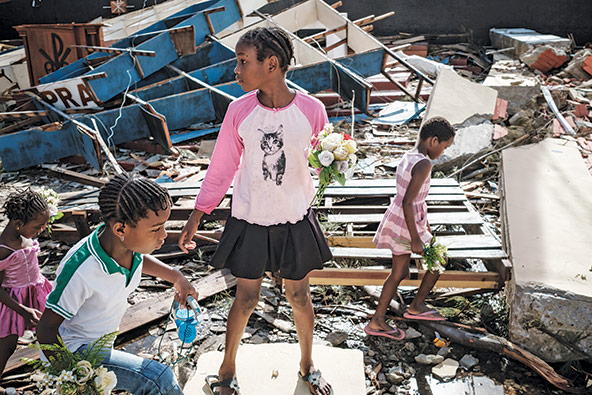
 Girls collect artificial flowers from the rubble of a building destroyed by Cyclone Idai at Sacred Heart Catholic Church in Beira, Mozambique, on March 24, 2019. (Photo by Yasuyoshi Chiba /Getty Images)
Across the globe, armed conflicts and climate change are triggering humanitarian crises that have uprooted a staggering 70 million people from their homes.1 International aid providers have been stretched to their limits. The global humanitarian community faces a choice: fall short in its mission to save lives and prevent the suffering of millions of people, or find a better way forward.
During the 2016 World Humanitarian Summit, the United Nations (UN), international humanitarian organizations, and the governments of affluent nations committed to transform the global humanitarian system into one that favors local humanitarian leadership (LHL). That is, they would devote more of their resources and yield more authority to local and national humanitarian actors (LNHAs), including government agencies, civil society, and community-based organizations operating at the national or subnational level in a country.
But governments and international agencies—including Oxfam—have faltered in adopting the public commitments they made. Donors and aid agencies, for instance, agreed to share at least 25 percent of global humanitarian funding as directly as possible with responsible governments and civil-society organizations in vulnerable countries. Yet 96 percent of all humanitarian funding still flows to international actors.2 According to one study, Syrian NGOs were handling 75 percent of program implementation but receiving less than 1 percent of direct funding.3
Governments and civil society in crisis-affected contexts should be leading humanitarian action wherever possible, while international actors assume a supporting role. This means that aid agencies, donors, and the UN should be directly funding local and national actors; striving for equitable partnerships; strengthening technical, institutional, and leadership capacity; and providing support to bolster a local response. National governments bear the primary responsibility for protecting their citizens and deserve international support for disaster management.
The Vision and Progress of LHL
In the run-up to the World Humanitarian Summit in 2016, 29 international nongovernmental organizations (INGOs) and a number of local and national NGOs signed the Charter for Change (C4C), which articulated eight commitments to “practically implement changes to the way the humanitarian system operates to enable more locally led response.” They ranged from cocreating stronger partnerships with local organizations to ensuring that the indirect costs (i.e., not directly attributable to the project) of local organizations are covered to giving appropriate credit to partners publicly.
At the conclusion of the summit, 18 donor governments and 16 international humanitarian actors also signed the Grand Bargain, a package of reforms for humanitarian financing, including providing more direct funding to local and national humanitarian actors. Direct funding is valuable to organizations implementing humanitarian interventions because it allows more money to go directly to programming, rather than to entities that process the money and then take a percentage of indirect costs. Additionally, the first recipient of funding typically has the most influence on the shape of the program.
The signatory INGOs pledged to achieve the C4C commitments by May 2018 but failed to do so.4 In December 2018, at the Charter for Change annual meeting, the signatories agreed that the initiative had been successful in driving change at the policy and organizational level. Parties agreed to several changes, including extending the target date to 2020 and committing to increasing the funding passed to national and local civil-society actors to 25 percent.
Despite the slow progress on the C4C, the movement to support LHL has gained momentum. The global humanitarian community is no longer questioning its merits and plausibility. Major donors, such as the Department for International Development (DFID) in the United Kingdom, Global Affairs Canada, and the Bill & Melinda Gates Foundation, have all endorsed LHL. The discourse among international humanitarian organizations and funders has shifted from the “what” of LHL to the “how” and “when” it can be implemented.5
Recognizing the importance of flexible funding to the strength and sustainability of local and national organizations, the UN High Commissioner for Refugees (UNHCR) adopted a policy in 2019 to cover indirect costs (at a rate of 4 percent of the total direct partner costs) to local and national organizations.6 And countries such as Belgium and Italy have amended legislation to enable direct funding to national and local humanitarian actors in crisis-affected countries.
A modicum of progress has also occurred in the amount of global humanitarian assistance that goes directly to LNHAs. From 2007 to 2013, LNHAs received 1.87 percent of direct humanitarian assistance.7 As of 2018, that figure increased to 3.1 percent—an improvement, but far short of the 20 and 25 percent targets that signatories to the Charter for Change and Grand Bargain pledged to reach by 2018 and 2020, respectively.8 Donors have been contributing more funding to humanitarian pooled funds—a single pot of unearmarked funds for more efficient disbursal to implementing agencies—including country-based pooled funds that LNHAs can collect. Despite this progress, INGOs continue to receive the lion’s share of these funds.9
Transferring Authority
Most of the visible LHL advances have related to funding. Although money is essential to the strength and sustainability of organizations, local and national actors care as much or more about the terms of partnerships and funding, including whether they are able to make decisions, set agendas, and access donors.
Yet few signs of progress exist in these areas. Such structural change will require international actors—both donors and international NGOs—to bear the additional risk of funding more, smaller NGOs. That has not yet occurred, even while local and national humanitarian actors continue to bear great personal safety and security risk themselves. “We local actors have done a lot to demonstrate our strength, singularly and collectively, and it doesn’t have much impact,” says Ahmed Abdi, head of Arid Lands Development Focus (ALDEF), a national humanitarian and development NGO in Kenya. “The wheels of change within the system are too painfully slow to enable shifting of power and space at decision-making tables.”
In addition to donors’ and international actors’ shouldering a greater share of risk, other obstacles to funding LNHAs directly include internal rules, due-diligence concerns, and traditionally short-term and project-based humanitarian funding. International actors also lack sufficient knowledge and trust of LNHAs. These obstacles, in turn, have delayed the strengthening of LNHAs and made them less able to respond rapidly in large-scale emergencies. Finally, host governments have also failed to issue clear mandates on the leadership role of LNHAs in humanitarian response.10
Despite these real challenges, international organizations and the governments of affluent nations must start turning policy into practice. By 2030, the vast majority of the world’s poor will live in fragile or conflict-affected states that will struggle to provide humanitarian assistance without the right kind of help.
Oxfam and fellow proponents of LHL believe that humanitarian action led by responsible governments in crisis-affected countries, assisted and held accountable by civil society, can more quickly save lives and act more appropriately to meet the needs of local populations.11 Local and national actors are always the first responders in times of crisis, know the context and people the best, and are answerable to their communities. They can also segue seamlessly among resilience, disaster-risk reduction, conflict resolution, and recovery efforts.
“In many cases, [local organizations] have … had a presence in the area since long before the disaster, so we have many important relationships in place,” says Duke Ivn Amin, the director of resource mobilization and communication at Jago Nari, a national development nonprofit in Bangladesh. “We have the trust of the communities, and we can mobilize all the local resources quickly. We are on the front lines of the emergency. We are monitoring all the information in real time and sharing it with other responders. Without us, a response could be delayed and could be more costly.”
If international aid providers want to strengthen local leadership, they need to treat partner staff with respect and engage in joint planning.
By contrast, international actors often show up only after a crisis has hit, lack knowledge of local communities, and import their own ways of doing business, incurring higher costs. Because they have too small an investment in disaster-risk reduction and prevention by both crisis-affected and donor governments, assistance is often insufficient, inappropriate, and late. The global humanitarian system is constantly overstretched and underfunded, unable to meet the growing needs of both emergency response and strategic disaster-risk reduction and preparedness.12 As a result, the current international humanitarian system, led by international actors, is not saving as many lives as it could.13
Emphasizing investment in LHL does not mean international actors are no longer necessary. On the contrary, international actors must play essential roles in humanitarian action—particularly in emergencies in which national governments are unwilling or unable to respond appropriately. But it does mean relinquishing more authority and money. “INGOs like Oxfam should recognize that our roles are shifting,” says Maria Rosario “Lot” Felizco, Oxfam in the Philippines country director, who is based in the country and leads Oxfam’s operations there. “That means our behavior needs to shift, too. We have to let go. Our partners will take this work forward. Our role as direct emergency responders will be reduced.”
International actors will also continue to play a vital part in sharing best practices and innovation across different contexts, providing various types of assistance, and, under the current system, attracting donors and providing fundraising guidance. Further, local leadership is also not always possible—for example, in mega-crises or when governments or civil society have little experience in response, although in those cases, international actors should follow the lead of the government and civil society in the affected country as much as possible and only until the local and national actors are able to lead again.
Test Case: Cyclones Idai and Kenneth in Mozambique
LHL is not a new concept, and INGOs have been testing new models since long before the 2016 summit. We have reviewed two of the most serious recent disasters triggered by natural events in Mozambique and the Philippines to get a sense of what LHL looks like in context and what lessons the responses provide for future emergencies.
In Mozambique, Oxfam and two other INGOs—Save the Children and CARE—have been collaborating since 2007 through a consortium called COSACA, which works with local civil-society partners and the government to coordinate an effective response within 72 hours of a declared emergency.14 In the consortium’s vision, INGOs will need to respond only when a crisis overwhelms national capacity, while the national government will manage preparedness in cooperation with local and national civil-society organizations.
This INGO partnership model proved effective in disaster response, especially for major flooding in 2015, the 2015-17 drought, and Cyclone Dineo in 2017. But it confronted perhaps its greatest test when catastrophic cyclones Idai and Kenneth hit Mozambique six weeks apart in March and April 2019. Idai caused massive flooding, landslides, and destruction in Mozambique, as well as in Zimbabwe and Malawi. At the time, it was the worst tropical cyclone on record to hit Africa. More than 1,000 people died, and 1.9 million people were affected, losing homes, livestock, crops, and livelihoods. The presidents of Zimbabwe, Malawi, and Mozambique all declared national disasters.
Mozambique is one of the poorest countries in the world, and the cyclone aggravated a situation of already dire need. The fourth-largest city, Beira, was among the hardest-hit areas. Bridges, roads, buildings, and sanitation systems were all demolished. “Beira resembles a city at war,” reported Oxfam staffer Stewart Muchapera during his visit there a week after Idai hit. “Homes have been razed to the ground as if bombed from the air; some are submerged in water; roofs have been blown away, trees uprooted, and fields and crops flooded.” Rising water trapped people in trees, and helicopters had to rescue many of them because the roads were impassable. More than 4,000 cases of cholera were reported in the storm’s aftermath.
The government struggled to lead the response, relying heavily on the UN and international humanitarian organizations, which descended on Mozambique in force. The scale of the devastation stretched the COSACA partnership model. The outbreaks of cholera moved the international humanitarian community to save lives quickly, even if it meant bypassing local and national partners. International funding fell short of the UN’s request for the response—only 45 percent funded by summer 2019—which led international actors to devote fewer resources to local and national partners than they might have otherwise. Notwithstanding good intentions on the ground, the scale and urgency of the disaster overwhelmed the response and hampered prioritizing local humanitarian leadership.
Despite these problems, local and national entities did play an important role in the response. In many cases, local actors were the first to respond because they were already in or near the affected communities. COSACA partnered with the government to conduct one of the first needs assessments and then, through local NGO partners, was rapidly dispatched emergency stocks, including tents and hygiene kits.
One such partner was Ajoago, a local social-justice nonprofit organization in Inhambane province whose mission focuses on the socioeconomic development of vulnerable rural communities, including response to emergencies that natural hazards cause. José Mucote, executive director of Ajoago, started the organization after Cyclone Eline in 2000 killed 700 people and left approximately 329,000 people displaced in Mozambique. Other COSACA partners included national development and humanitarian NGO KULIMA, which has for more than 30 years worked with farmers to distribute food and agricultural kits in hard-hit rural areas, as well as Kukumbi, a rural-development nonprofit that responded with interventions addressing water, sanitation, and food security.
Oxfam in Mozambique Country Director Rotafina Donco shared her thoughts on this reality when one of the authors visited the capital, Maputo, in July 2019. “Our partners are the first responders,” Donco said. “They were the first to show up in communities and save lives while INGOs were busy writing funding proposals. They used their discretionary funds right away to respond.”
The 2019 response in Mozambique highlights many of the tensions that still exist in efforts to move toward an LHL system. Although climate conditions such as drought, floods, and cyclones affect Mozambique consistently, global humanitarian funding for the country is so limited that even Oxfam struggles to conduct humanitarian work: Oxfam Mozambique had no humanitarian budget or humanitarian staff prior to cyclones Idai and Kenneth, and only a limited budget for emergency relief and recovery, because of ongoing budget cuts. When the cyclones hit, these limitations forced the Oxfam country office to rely on international actors to lead efforts in devastated areas like Beira, even with the support of the COSACA consortium. The work of the INGOs was lifesaving—they brought high-quality expertise and leadership and were strong assets to local leadership. But international organizations whose methods and priorities did not always align with those of local leaders and organizations were still the ones leading the response.
“If international aid providers want to strengthen local leadership, they need to treat partner staff with respect and engage in joint planning,” says Antonio Carlos Dias, executive director of the Agency for Local Economic Development of Cabo Delgado in Mozambique. “They need to be ready to disburse money to partners quickly so local NGOs can act fast, without depleting our few resources. They need to help us address the physical and security risks we face—with insurance, for example. We struggled with all of these issues in the response to Cyclone Kenneth. In the end, we felt more like a service provider than a true partner.”
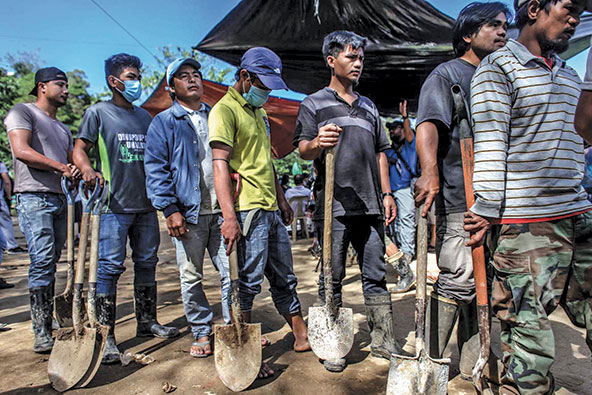 Volunteers line up on Sept. 19, 2018, to dig up victims of a landslide in Itogon, Benguet province, Philippines, triggered by Typhoon Mangkhut. (Photo by Basilio H. Sepe/Getty Images)
The Mozambique case clearly illustrates the need to strengthen the capacity of local and national partners so that they can rapidly scale up their response efforts in a major emergency. International organizations must collaborate and coordinate with local and national partners and use their influence to ensure that local voices are heard in all phases of disaster management. Every emergency they participate in should leave local and national organizations stronger, more independent, and more confident that they can handle—or avert—the next crisis.
Test Case: Typhoon Mangkhut in the Philippines
The Philippines, by contrast, is an example of a country where LHL can function even in large-scale emergencies. The government and domestic civil-society organizations are capable of large-scale humanitarian action, although it may be applied unevenly. For the most part, however, the government is willing and able to lead; domestic civil society can backstop; and the government can call upon international actors for help as needed. So, in the Philippines and similar countries, international actors should shift to a supporting role, following the lead of local and national humanitarian actors. The response to Typhoon Mangkhut leaves no doubt that the local humanitarian leadership model can work effectively to save lives.
The Philippines is the third most disaster-prone country in the world.15 Located on the Pacific Ring of Fire, which hosts numerous fault lines and trenches, the country experiences approximately 20 earthquakes daily.16 Roughly 21 million Filipinos live below the national poverty line, and income inequality is rising. In 2009, following Typhoon Ketsana and extensive advocacy from civil-society organizations, the government began to invest more significantly in disaster-risk reduction, preparedness, and humanitarian response, as well as its own ability to lead in humanitarian crises. The government accelerated these efforts following Typhoon Haiyan in 2013.17 A handful of INGOs, such as Oxfam, CARE, and Christian Aid, also began adopting a more partner-based and partner-led humanitarian action model.
In September 2018, Typhoon Mangkhut struck the northern coastal area of Cagayan in northern Luzon, affecting 2.14 million people. The Category 5 storm triggered floods and landslides and destroyed crops, farmland, and houses. The impact on agricultural livelihoods in particular was extensive, as the storm caused massive damage to crops, and fishermen were not able to go out to sea. The government, however, was able to lead the response; the National Disaster Risk Reduction and Management Council mobilized different agencies to perform specific tasks in early-warning, response, and recovery efforts and led government-response clusters.18 INGOs participated in the clusters, and they and the UN provided technical support as needed.
When Typhoon Mangkhut began to bear down on the Philippines, local and national NGOs in the affected areas were ready to respond with help from INGOs, including Oxfam. These local and national organizations included the Citizens’ Disaster Response Center, a national network with a local NGO member based in Cagayan; the People’s Disaster Risk Reduction Network; and the Humanitarian Response Consortium (HRC). The partners had a long-established presence in the affected area, solid knowledge of the local context, and strong relationships with the government and other key stakeholders in the province.19 The organizations conducted a pre-emergency assessment, and, because the HRC maintains contingency stocks and warehouses, they could quickly activate and position emergency shelter materials, water kits, and hygiene kits in different municipalities. Within a week after the typhoon made landfall, the coalition distributed lifesaving materials.
This speedy response took place a full week before the UN’s Office for the Coordination of Humanitarian Affairs (OCHA) could mobilize. When OCHA assembled an international assessment team of INGOs and UN agencies, the initial assessment report benefited from on-the-ground reporting and analysis that local and national organizations carried out. And as international actors started mobilizing financial resources from donors like the UN Development Programme and the European Union’s humanitarian assistance department (ECHO), Oxfam and other INGOs transferred as much as 80 percent of the funding to these local partners who were already leading the response.
Oxfam and many other participants in and observers of the Mangkhut response consider it successful compared with recent responses; it was more effective and largely locally led. But this success story did not happen overnight. For years, the Philippine government, Philippine civil society, and select INGOs had been working together to build and strengthen LHL models throughout the country. For example, in 2015, Oxfam joined forces with Tearfund and Christian Aid in a three-year pilot project aimed at enabling local organizations and communities in the Philippines to better handle disasters without significant help from international agencies. The project included a rechargeable quick-response fund and grants for emergency stocks and warehousing—all of which played a role in the Mangkhut response.
“Sustainability can come only from local actors with long-term capacity to lead humanitarian action,” says Oxfam in the Philippines Country Director Felizco, who emphasized the importance of this multiyear engagement to strengthen local organizations during a visit by one of the authors (Fatema Sumar) to Cagayan province in July 2019: “Agencies like Oxfam come and go, but local partners will always be there.”
However, not all international actors in the Philippines are aligned with this LHL approach. Some INGOs still consider local leadership to mean hiring local staff, even if their organization does not work with local and national partners. But the Philippine government has asserted its leadership more forcefully since Typhoon Haiyan, including by establishing new guidelines for humanitarian response and limiting international access.20 Other countries, such as Indonesia and Haiti, have done the same. These moves demand that international actors’ roles change more rapidly. INGOs must shift from service delivery to providing the support that local and national humanitarian actors request, including specific technical support, funding, communications, and program quality.
“There is still a need for more multiyear investments that deal with preparedness, response, and strengthening the institutional capacity of local humanitarian actors,” says Esteban Masagca, director of the Philippine NGO People’s Disaster Risk Reduction Network, which responded to the Mangkhut emergency. “Local actors are the implementers that are directly engaged in social preparation, coordination, delivery of services, and postdisaster activities, yet we are not fully recognized as coleaders.”
An Action Plan
While forms of LHL have always been in place (neighbors have always helped neighbors), international actors’ intentionally and systematically relinquishing power and resources to local and national actors in emergencies is relatively new. And no matter how sincere the intentions of those holding power, the global humanitarian system has always involved an element of colonial paternalism and racism. As Degan Ali, executive director of the African charity Adeso, sees it, “[T]here are so many elements where the [humanitarian] system is [steeped] in colonial and racist structures. We have to be honest about who the humanitarian system is. It is dominated by the UN and INGOs that are predominantly Westerners and mostly white people. The majority of the decision-making in these institutions lies in the hands of white people.” 21
People in vulnerable countries and communities deserve not only to receive aid but also to lead effective humanitarian programs themselves.
To date, the actors who have held all of that power have sat in places like New York, London, and Geneva, and the people most affected by the decisions have been in the Global South. Recent research from the Overseas Development Institute found that international actors define the elements of capacity according to their own vision of what local and national actors should look like, which donor requirements and self-interest drive in turn.22 Glaringly absent from the discussions are those local and national actors.23 As Ali rightly and powerfully states, the international community is still setting the parameters by which it assesses capacity, effectiveness, and progress.
A full transformation of the current humanitarian system requires humility, trust, risk, and a willingness to share knowledge and resources, as well as the spotlight. It calls for humanitarian donors and practitioners—including Oxfam—to engage with local and national governments and civil society in new ways, reexamining every facet of their engagement, with an eye toward shifting power to responsible local and national actors and supporting them to the extent that they need and want the humanitarians to do so. Everything from funding flows to accountability mechanisms to relationships and communication to who does what on the ground in an emergency can and should be subject to scrutiny. This is a time of transformation in which, to succeed, the sector needs to innovate at every level.
Where to start? We suggest the following six steps:
First, affirm locally led responses when possible. International actors should look before they leap into a humanitarian response and should design their intervention based on the capacity of local and national actors. Doing so will require complying with the Charter for Change and Grand Bargain commitments, shifting their roles to support local and national actors, and constructing their new role in humanitarian crises. Whenever possible, national governments should assert their role in leading a response, assess the ability of both government and domestic civil society to lead and respond to the crisis, and work with global humanitarian partners to determine the best roles for international, local, and national actors.24
Second, fund local and national actors. While building local leadership and capacity presents a multitude of considerations, funding remains a top constraint. International actors can continue to play a significant role in raising awareness and resources to engage in humanitarian emergencies. However, a new funding model—one that transfers a significant portion of funds to local and national actors before, during, and after a crisis—must develop quickly. This will require greater transparency and accountability regarding how funds are raised, transferred, and spent. It will also mean helping national governments and local and national NGOs to set up financial systems that can readily absorb and use funds for humanitarian response. Donor governments, the UN, INGOs, and the Red Cross/Red Crescent societies need to uphold the commitments they made in the Grand Bargain and Charter for Change to direct at least 25 percent of humanitarian funding to local and national actors. The funding we give local and national actors should be multiyear and flexible and should include coverage of indirect costs.
Third, bring equity, if not equality, to local partnerships. Most of the modest progress toward LHL to date is related to funding and funding mechanisms. While funding is necessary, LNHAs also care about the terms of partnership and funding, including the opportunity to engage in decision-making and agenda-setting and have better communications with and access to donors. When we talk about investing in LHL, we mean putting the voice and needs of local and national partners on par with international actors’ agendas. This shift will require rebalancing the power relationships between international and local and national actors so that local and national partners are not merely contractors implementing their international counterparts’ priorities.
Fourth, invest in capacity strengthening before and during crises. This concept applies in countries vulnerable to both natural hazards and conflicts. Capacity strengthening should follow best practices, including having the partner contribute to the capacity assessment, prioritize the gaps, map out its own plans to fill the gaps, and identify its “teachers.” It should also prioritize active learning, such as shadowing, secondments, and simulations, over PowerPoint training and other classroom-style methods. And the knowledge sharing does not need to be only one-way investments from international to local and national actors, or from the Global North to the South. Capacity-strengthening initiatives among countries in the Global South, particularly those that share a language, culture, or experience, can be equally, if not more, effective.
Fifth, build evidence and new measures of success based on local humanitarian leadership. Transforming humanitarian action this way requires new ways of doing things. As international actors start investing in local leadership, they need to consider how they measure success and effectiveness. They need to document and learn from collective successes and failures, so they understand what works and how best to scale up efforts. They also need to gather evidence about many aspects of LHL, including its most enabling conditions. The knowledge they gain through research and learning must then inform both programming and advocacy.
Sixth, invest in, and recognize, women’s leadership. Women and girls experience heightened vulnerability in emergencies, but aid providers who lack a gender lens often overlook their specific needs, as well as their knowledge, skills, and agency. Supporting women and women’s organizations to play leadership roles in humanitarian settings must be an overarching goal of the localization agenda.25 Likewise, as they engage in strong partnerships with LNHAs and look to support the leadership of those organizations, international actors should make sure they are carefully considering women’s organizations and organizations working on gender, even if they are not the traditional humanitarian partners.
At Oxfam, we believe that every person has a right to influence the decisions that affect his or her life. The LHL movement is not just about flexible funding or efficient response times. It’s not even just about saving lives. People living in vulnerable countries and communities deserve not only to receive aid in emergencies but also to lead effective humanitarian programs themselves. LHL is breaking the mold of paternalism that has been the reality for far too long in the humanitarian system. We must begin to prioritize equity, power, and support for the people closest to the problem.
Read more stories by Fatema Z. Sumar & Tara R. Gingerich.