


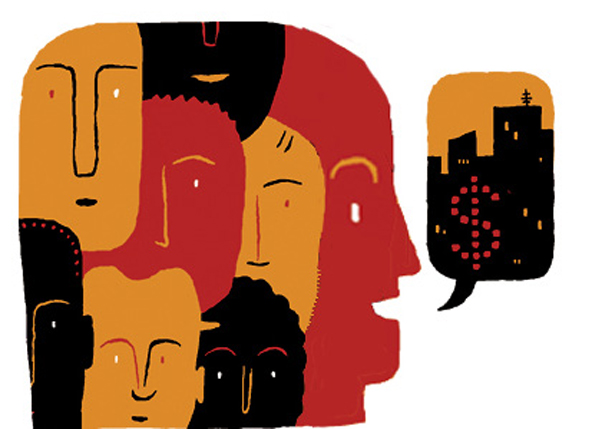
 (Illustration by Adam McCauley)
Who represents residents in urban neighborhoods when key decisions are made on their behalf, such as how money is spent on redevelopment? One would think the representatives would be the neighborhood’s elected leaders: the mayor, city council members, and state legislators whom the residents have elected to speak for them.
New research by Jeremy Levine, assistant professor of organization studies at the University of Michigan, suggests we should look beyond elected politicians. He finds that the most important players can be community-based organizations (CBOs), nonprofits that purport to represent the neighborhood’s interests—but are not democratically elected.
Beginning in 2010, Levine undertook a multiyear ethnographic study of six neighboring areas in Boston, all with a high proportion of residents who were low-income and minority. Known as the Fairmount Corridor, the area was designated for new public-transit stations along the Fairmount Line, and local CBOs were pushing for more investment in housing and other real estate in conjunction with the new train access. These nonprofits had banded together in loose coalitions to advance their neighborhoods’ chances of winning more development funds from both governmental and private sources.
Levine spent four years attending 214 separate meetings with leaders and workers from nine CBOs based in the neighborhoods of Upham’s Corner, Grove Hall, Four Corners, Codman Square, Mattapan, and Logan Square. He also spent many months working at Boston’s City Hall and at a foundation that funded Fairmount Corridor development projects to observe how the CBOs interacted with both local government and private funders, and he went to community meetings with residents and CBO representatives.
He found that the CBOs were the crucial intermediaries between the money needed to start, run, and complete development programs and the neighborhoods they represented. Funders both private and public used the CBOs as the point of contact to accept funds designated for local projects. Elected officials did not perform this role, he says, and were largely side players or had no role at all.
“Bureaucrats expect and assume that CBOs are the representatives of neighborhoods,” Levine says. When the area won a multimillion-dollar grant from President Obama’s Choice Neighborhoods program, for instance, the local CBOs participated in the grant writing and the discussions about how to spend the money. They then received the money and handled the expenditures, he says.
When one nonprofit in the study, the Mattapan Community Development Corporation, went bankrupt, the neighborhood’s legislators struggled to find a new group to replace it, and Mattapan lost out on development money. The representatives themselves were not able to quarterback the economic projects without a CBO, he says.
“The difference isn’t so much how grants happen, but more so about the political roles that the organizations are fulfilling compared to before,” Levine says. As nonelected representatives, CBOs cannot be held accountable by residents who feel they do not support their interests. Americans should decide whether they feel that nonprofits are the right actor to play this role in local governance.
“No neighborhood is monolithic in terms of its interests,” says Nicole Marwell, an associate professor at the University of Chicago’s School of Social Service Administration. But the paper shows “the ways in which it’s just much easier for city development bureaucrats, unelected officials within city government, to work with organizations that also have development goals in line, than with elected officials, who may have other goals.”
Jeremy R. Levine, “The Privatization of Political Representation: Community-Based Organizations as Nonelected Neighborhood Representatives,” American Sociological Review, 81(6), 2016.
Read more stories by Chana R. Schoenberger.