


 Ukrainian refugees arrive by train in Przemyśl, Poland, on March 3, 2022. (Photo by Beata Zawrzel via Getty Images)
On October 26, 2019, billionaire financier and philanthropist George Soros spoke on NPR’s All Things Considered to promote his new book In Defense of Open Society. The then-89-year-old reflected on the idea he had expended so much money and energy to promote, only to see it falter.
“When I got involved in what I call political philanthropy some 40 years ago, the open society idea was on the ascendant—closed societies were opening up,” Soros said. “And now, open societies are on the defensive and dictatorships are on the rise. … I have to admit that the tide has turned against me.”
Open Society Foundations (OSF), the pioneering philanthropy that Soros launched in the 1980s preceding the momentous opening of Central and Eastern Europe (CEE), is undergoing a wide-ranging reevaluation and overdue strategy shift. One of the world’s largest philanthropies, with an endowment of $22 billion and annual budget of about $1.4 billion, simply wasn’t getting the results it wanted. Since the mid-2000s, autocratic leaders across the globe have put the liberal-minded development community on its back foot, including philanthropies such as OSF, which, over four decades, had won bountiful praise for tenacious democracy promotion and human-rights work. Open society—Austrian philosopher Karl Popper’s concept of a polity in which the state protects individual freedom, the inspiration for Soros’ philanthropy—is under fire just about everywhere in the world. Agencies that fund open society are being attacked—and none more fiercely than New York-based OSF, both in the United States and abroad. This unwanted attention may speak for OSF’s efficacy, but it has undermined the grantmaker’s methods and greatly complicated its mission.
There’s perhaps no better example of this struggle than Soros’ native Hungary—he emigrated in 1947 to the United Kingdom, studying there under Popper—where OSF has pumped hundreds of millions of dollars dating back to the 1980s. The party of authoritarian populist Viktor Orbán—elected for one term in 1998 and four times again since 2010—has turned the former jewel in OSF’s crown into a pariah within the European Union, clamping down on civic space, minorities, and independent media. Orbán elbowed OSF out of the country in 2018, sending its large regional office to Berlin, and forced Soros’ prize project, the Central European University, to relocate its main campus to Vienna.
To its credit, OSF is aware of the dilemma, if not of a sure-fire way to remedy it. “We cannot remain the same while the world and the context for our work change around us,” proclaimed OSF’s new president, Mark Malloch-Brown, in 2021, shortly after assuming the post and announcing the rethink. With a résumé starkly different than that of human-rights activist Aryeh Neier, OSF’s president from 1993 to 2012, Malloch-Brown is a career British diplomat and Labour Party member who served as deputy secretary-general of the United Nations under Kofi Annan, among other high-level international postings.
“The intertwined challenges of today, such as the global pandemic and climate change, can no longer be effectively addressed through 40 separate national, regional, and thematic programs and foundations,” Malloch-Brown acknowledged. OSF’s governance structures had become equally unwieldy with a global board, eight regional boards, and 17 issue-oriented boards.
OSF’s soul-searching and the weighing of lessons learned is healthy—and imperative. But the revamping in progress pushes the foundation into new territory for a philanthropy. In light of a worldwide democratic recession and authoritarian resurgence, OSF is jockeying to take on the global political backlash against progressive causes, or “global open society threats,” as the organization calls them. OSF’s reassessment of how it can effect social and political change will be successful only if it indeed manages to help curb these trends in the long term.
The OSF Empire
Since its founding, OSF has stood alone on a pinnacle for the breadth and depth of its mission. The recognition that a remodeling is necessary is in itself remarkable since philanthropies aren’t touted for their powers of critical self-reflection: Like its peers, OSF doesn’t usually engage external evaluators, nor does it have electorates or independent oversight bodies that make it accountable.
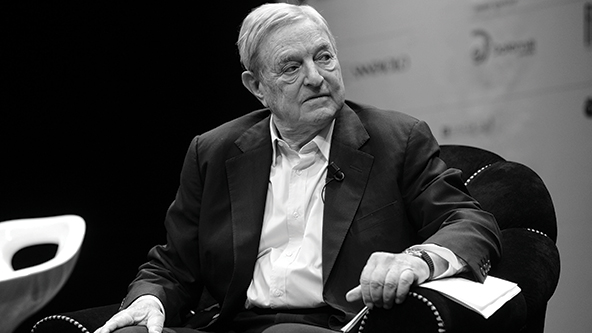 George Soros, the patriarch of the Open Society Foundations, speaks at the Festival of Economics in Trento, Italy, in 2012. (Photo by Niccolò Caranti)
The “radical” and “fundamental” reorganization that Malloch-Brown announced reveals an institution with an unusual striving to digest the lessons of its labors. Across the decades of battles and institutional expansion, OSF had become bloated and unfocused, with 44 offices and projects in 120 countries strewn across the globe. More than 50 percent of grants were less than one year in duration; operational costs tallied a quarter of the total budget. “If OSF’s crazy quilt of programs looks like something tacked together every time George Soros had a new idea or met a new person, well, that’s because it is,” said one former OSF administrator, who asked to remain anonymous—a request made by many of my interviewees who have been, are, or hope to be recipients of OSF monies. External experts and insiders alike, once so complimentary, complain that OSF had become sluggish, too concentrated on the United States, and ever more top-heavy, with its time frames too short: all characteristics anathema to the lean, decentralized, hyperlocal philanthropic model that Soros himself had nurtured in the 1990s and aughts.
A foundation that once prided itself on circumventing red tape had become mired in it. “This funder is a mixed bag,” carped Inside Philanthropy in 2021. “If they pick you to send a proposal, the process can often take a year to two years to hear back—or not at all. While its program officers are highly knowledgeable, they’re not always the most responsive.”
OSF’s program budget—about $877 million for programs and grantmaking in 2022—stands to benefit from the streamlining. Nine thematic programs—among them international migration, public health, drug policy, and women’s rights—are being folded into the new program structure, while two other programs are being assigned to external entities. OSF staff slimmed by about a fifth after the closure of 22 national- and regional-level foundations. (In 2020-21, almost the entire staff of nearly 1,700 members was offered severance packages.) These steps simplify the structure to six regional programs: the United States, Latin America and the Caribbean, Europe and Eurasia, Asia Pacific, Africa, and the Middle East, as well as a global programs team, which runs the “centerpiece” climate-justice and sovereign-debt-reform programs.
The task of a global team for transnational advocacy and lobbying is to get the most important voices from the Global South heard where the issues of the Global South are decided. Moreover, intersectional justice (the ways in which multiple forms of discrimination intersect in systems defined by inequality) is a key determinant of almost every project. OSF aims to counter the disadvantages, for example of the Global South, through multiple entry points such as debt relief, taxation, social protection, climate justice, drug policy, and migration. And reflecting demographic shifts, OSF is backing social movements driven by young people, along the lines of Greta Thunberg’s Fridays for Future, as a means to effect change. Lastly, it is partnering more regularly with other philanthropies and governments in large outlays on grand challenges, such as the climate crisis, with long timelines that intersect with other priorities.
 Hungarian Prime Minister Viktor Orbán leaves a 2021 bilateral meeting with British Prime Minister Boris Johnson at 10 Downing Street in London. (Photo by Tim Hammond/No. 10 Downing Street)
The audacity and risk-taking reflect OSF’s founder, whose fortune owes much to his massive, timely 1992 bet to short the British pound that earned him the moniker “the man who broke the Bank of England.” Soros’ track record since he began funding scholars and dissidents in communist Eastern Europe and South Africa is astounding. OSF’s long list of grantees reads like a who’s who of international NGOs, civic-education projects, and independent media outlets. During its life span, OSF’s incarnations have dispersed more than $19 billion in the form of more than 50,000 grants. The foundation’s trailblazing and best practices over four decades fill whole books. A striking anomaly in philanthropy when it took off, OSF didn’t act like a typical charity funding one-off projects that addressed a specific problem. Rather, as a transnational network of regional foundations, it set its sights on social and political transformation—even regime change, albeit by peaceful, grassroots means.
Soros reaps credit for helping to upend Soviet communism and aiding the besieged people of Sarajevo in the 1990s Bosnian war, for nurturing the color revolutions in post-Soviet Eurasia in the aughts, for boosting the first female and anti-corruption candidate ever into the Slovakian presidency in 2019. In the United States, Soros had a hand in bringing to life a new generation of US politicians, including President Barack Obama and former Georgia state representative and gubernatorial candidate Stacey Abrams, as well as scores of progressive prosecutors around the country. OSF also backed the Black Lives Matter movement in the United States from its onset. Between 1998 and 2021, the OSF network invested around $50 million to nurture the field of palliative care worldwide, which, say experts, put palliative care on the global public-health agenda. And he never shrank from other new causes, like prison reform or the plight of the extreme marginalized, such as the Roma, those living with HIV, and refugees.
Such work has also attracted powerful enemies. Leaders as powerful as former President Donald Trump and Russian President Vladimir Putin vilify OSF and Soros for their outsize clout. If one goes by the word of his detractors in right-wing media outlets, Soros pulls the strings in the global economy and instigates radical leftism, too. OSF’s activities in Hungary and Russia had been, presumably, so effective that their leaders forced it out, charging OSF with undermining the state.
What will happen when the target of such vilification passes the torch? Will OSF, with its creative chaos, celebrated nimbleness, and controversy, outlive its nonagenarian founder, who is stepping back, leaving ever more decision-making to others? Soros’ 37-year-old son, Alexander, who holds a PhD in history from the University of California, Berkeley, was recently named chairperson of OSF’s seven-person board of directors. Two other Soroses—George Soros’ wife, Tamiko Bolton Soros, and his daughter, Andrea Soros Colombel—are also board members. Almost all of the 26 advisory boards have been or are being scrapped, concentrating immense discretionary power in the hands of the board of directors. That Alexander Soros, rather than a nonfamily professional, is stepping into his father’s shoes underscores the fact that this philanthropy, like most others, will remain a family affair in which the clan’s whims and quirks affect its direction and focus—for better and for worse.
Opening Europe
The current era of transition isn’t OSF’s first. It has undergone several shifts with the times and picked up lessons along the way. The foundation’s first phase spanned the 1980s and early 1990s, when the Soros Foundation Budapest and then the Open Society Institute, the precursors of the 2010-renamed Open Society Foundations, operated in authoritarian contexts such as the one-party states of Eastern Europe and the Soviet Union, and apartheid South Africa. A striking anomaly as a private philanthropy in the regions, the Soros outfits established themselves, legally, in the Soviet bloc and supported a mixture of dissident scholars, open-minded students, proto-NGOs, and clubs that took root in the cracks and fissures of the creaky autocratic states.
As a private philanthropy, it did so with an unbureaucratic dexterity that no nation-state or development agency could hope to command. This effort included the sponsoring of many individuals but also dissident movements, such as Solidarity in Poland, the independent and anti-authoritarian labor union that relied upon a strategy of civil resistance to advance workers’ rights and social change. Soros couldn’t have written a script better than that which played out in the Eastern bloc from 1989 to 1991, when dictatorships folded one after another, the movers of civil society at the forefront.
This first phase extended into the early 1990s, when the blossoms of open society empowered themselves as independent actors in freshly liberated democratic societies. “OSF’s work was hugely important and original at the time,” says Mary Kaldor, civil society and global governance expert at the London School of Economics and Political Science. “It contributed to democratization in an important way.” George Soros established independent foundations across CEE and the former Soviet Union that received no-strings-attached lump sums of money from Soros, which they distributed, at their discretion, to the hundreds of civic-minded groups and causes that they felt showed promise. Such bold investing reflected acts of trust unseen among development agencies.
“It’s hard to imagine what civil society would look like in CEE had Soros and OSF not been involved,” argues Emily Tamkin in her 2020 biography The Influence of Soros: Politics, Power, and the Struggle for an Open Society. “Most people working in ‘civil society’ spaces in countries in this region, at least that I have met, have somehow been involved with OSF at one point or another.”
Backlash
The second phase, during which OSF’s budget shot up into the hundreds of millions of dollars, began as these democracies stabilized themselves. OSF functioned as a partner in transitional reform—politically informed, operationally flexible, and with an ear always close to the ground. Through its local foundations, it supported efforts, for example, to ensure more parliamentary transparency, free and fair elections, a modern judiciary, and independent media. Soros dedicated himself, as Daniel Bessner, a historian at the University of Washington, puts it, “to building permanent institutions that would sustain the ideas that motivated anticommunist revolutions, while modeling the practices of open society for the liberated peoples of Eastern Europe.” The Soros communities, notes Tamkin, spoke the language of inclusive democracy: liberal, secular, rational.
This vision was everything that the growing numbers of right-wing national populists in CEE weren’t, including Hungary’s politico Viktor Orbán, who, as an OSF scholarship candidate, studied at Oxford University on Soros’ dime. But it was Orbán who understood more quickly than OSF’s champions that the ideas of the educated, English-speaking, liberal-minded “elites” benefiting from Soros’ largesse weren’t resonating with the average Hungarian, whom the free-market restructuring of the economy—part and parcel of the liberal recipe—was subjecting to enormous pain and suffering.
Such criticism reflects Bessner’s appraisal that the Soros institutions’ early work embraced a free-market philosophy—inasmuch as a free society depends on free, if regulated, markets—that, as it was applied across CEE and Russia in the 1990s, impoverished millions of ordinary people and thus played directly into populist hands. Despite Soros’ many public denunciations of laissez-faire capitalism since then, Bessner argues that while “Soros recognized earlier than most the limits of hypercapitalism, his class position made him unable to advocate the root and branch—read: anti- or post-capitalist—reforms necessary to bring about the world he desires.” OSF vice-president Leonard Benardo says it was a “massive, massive failure on the part of the West” to understand human rights chiefly as political and civic constructs and not in social and economic terms. In fact, these shortcomings, among others, have had the effect—contrary to the claims of Putin, Orbán, and US Republicans—of neutralizing much of the positive energy and hard work logged over the years in OSF-grantee countries. “The big mistake was taking neoliberalism for granted,” Mary Kaldor says. “There wasn’t even a discussion about it.”
Other critics charge that OSF’s key mistake was funding a liberal elite who looked properly polished to Western donors but had little in common with ordinary people. “When nonprofits in, say Hungary, are funded by an American philanthropist, then it’s not grassroots anymore,” notes Dániel Mikecz, a political scientist at the Institute of Political Science at the Hungarian Academy of Sciences.
Oxford University historian Timothy Garton Ash argues along similar lines. “The figures to whom Soros gravitated and with whom he entrusted his foundations tended to be intellectuals living in the major cities, which means, too, that they tended to come from a certain level of privilege,” Garton Ash told biographer Tamkin. “How could a society be opened, and how could opportunity to participate in it be made more equitable, if the people who were charged with opening it all came from a similar social stratum?” This image, mixed with anti-Semitism and other phobias, was deftly exploited by the likes of Orbán to consolidate his base and win elections.
OSF’s brand became so toxic that some grantees were eventually willing to distance themselves from it. One of these groups, which asked to go unnamed, says that it is stronger today without OSF affiliation. “Our funders now are diverse; thus we’re not dependent on any one of them. In this country, association with George Soros and OSF had become a liability,” says the representative of one such organization, a sentiment that other grantees in CEE and Central Asia echo.
Expanding the Footprint
By 2000, OSF was already into its third phase: moving beyond Europe and Central Asia to South West Asia, Africa, South America, the Middle East, and the United States. The idea was to take the winning OSF method—and in 2000 the consensus was still that this method did win—and apply it elsewhere. OSF adopted a broad, thoroughly Western agenda of progressive causes that spanned minority rights and LGBTQ concerns to education reform. In Baltimore, Maryland, Soros plunked $60 million into work on drug-addiction treatment, school and prison reform, and juvenile delinquency. In the 2004 US presidential election, Soros dipped into overtly partisan politics for the first, but not the last, time, backing the Democratic candidate John Kerry’s bid against George W. Bush’s reelection.
 Mark Malloch-Brown, former Labour MP and Deputy Secretary General of the United Nations, became the new president of the Open Society Foundations in 2021. (Photo courtesy of World Travel & Tourism Council)
Although the Kerry campaign ended in defeat—despite $28 million in Soros donations—the Baltimore effort ended on a positive note, with lasting drug programs becoming policy and double the number of drug-dependent people receiving treatment. But here too OSF ran into hard questions ultimately applicable to all philanthropies: Should well-heeled individuals step in to provide services that governments should execute themselves? Does this take the onus of responsibility off states to do their jobs? Can philanthropy reform police departments or address the racist bias of criminal-justice systems?
By this time, EU membership was in sight for Central European states (in 2004 Hungary, Slovakia, the Czech Republic, and Poland joined), and OSF warned its grantees there that soon it would hand off to the EU, which boasted many times its financial clout. In terms of democracy, CEE was considered a done deal—not perfect by far, but a wrapped package, successfully delivered. If there were still rough edges, EU membership would polish them, as it had in postwar Germany, Italy, Greece, and Spain—European countries that successfully transitioned away from legacies of strong-arm, fascist states. The end of history, as political scientist Francis Fukuyama labeled the ascent of Western liberal democracy, was nigh.
The OSF foundations in CEE, like Poland’s Stefan Batory Foundation and the Hungarian Helsinki Committee (HHC), received ample warning and then “spin-off” monies to set up individual endowments or otherwise transition to an independent entity, namely as organizations that may receive periodic OSF funding but that rely on other sources too. Many, like Batory and HHC, managed to make this jump, while others didn’t. The Lithuanian and Latvian foundations had to downsize significantly but reestablished themselves at a smaller size, working on grant-funded projects.
A Flawed Theory of Change
OSF entered into a new phase about a decade or so ago, when its sway appeared to diminish at the macro level despite ever-larger budgets (2013: $873 million), staffs, and global reach. In Hungary in 2010—the very year that OSF began transitioning out of the country—Orbán came to power for a second time, after an eight-year spell in opposition, riding a wave of national populism that singled out liberal groups as not just the opposition but the enemy of the Hungarian people. Orbán remains in power today, more firmly entrenched than ever.
“Soros and OSF assumed that there’s a linear progression of democratic development in these places, that democratic systems would produce prosperity and liberties that people would want and that they’d never turn back,” says Ivan Vejvoda, Balkans specialist and acting rector of the Institute for Human Sciences, Vienna. “That was an illusion.”
Since the late aughts, Soros himself recognized that OSF’s theory of change was flawed in a significant way. Elected leaders across the globe, opined Soros in 2016, had “failed to meet voters’ legitimate expectations and aspirations and … this failure led electorates to become disenchanted with the prevailing versions of democracy and capitalism.” The tide had turned against open societies after the global financial crash of 2008, Soros argued. “This in turn led to the rise of nationalism, the great enemy of open society.”
But rather than throw in the towel—Soros had long maintained that the foundation would not outlive its founder—he endowed it with the bulk of his fortune: $18 billion added to the $5 billion already in its account. A fact that Soros had underestimated in the past would guide OSF’s work: “The lack of redistributive policies is the main source of the dissatisfaction that democracy’s opponents have exploited,” Soros concluded.
The resounding OSF takeaway from its decades in the trenches—and intrinsic now to most of its programming—is that economic inequality erodes confidence in democratic institutions and abets the rise of authoritarianism. An unequal division of wealth doesn’t in itself cause extremism to grow, but it offers fertile ground. “When economic policies disproportionately benefit those at the very top, everyone else is more likely to believe that democracy cannot deliver for them,” explains Brazilian economist Laura Carvalho, OSF’s current global director of equity. The upshot, she says, is social unrest, frustration with democratic governments, and environments primed for authoritarians.
In its new strategies for Africa and the entire Global South, for example, OSF is feeling out fresh economic development models: “We recognize the violence of an unregulated and unchecked neoliberal and financialized view of development that de-emphasizes the well-being of people and communities,” states its new One Africa strategy. Much to the disservice of ordinary Africans, OSF has concluded, this ideology has become ensconced in the institutions of governance and in popular consciousness: “We will support spaces and processes for African thinkers, activists, and policy makers to challenge economic orthodoxies in ways that reflect African contexts and priorities and go beyond critique to new imaginations.”
The One Africa strategy review outlines the contours of this new, African-driven economic model but leaves its details to be hashed out in the continent’s own forums. It will prioritize investment in health and education, secure bargaining power for workers, support tax justice to address inequalities, and stem corruption. In addition, Africa shouldn’t hesitate to break free from existing trade agreements and broker new ones that make trade and investment benefit Africans. This may not be socialism, but it’s a kind of capitalism very unlike that pushed by international development agencies for decades.
Besides economic injustice, the arsenals of populist autocrats have been greatly enhanced by the sophisticated information technologies with which they augment their repressive tactics and illiberal narratives, both within their own societies and beyond their borders—as Russia, Iran, and China do. In beating the enemies of open society, argues Malloch-Brown, it is more impactful to respond to disinformation than, for example, to monitor elections or back specific political parties.
In addition to sponsoring independent journalism, as it has for decades, this effort entails OSF’s support of civil-society contributions to the EU’s new Digital Services Act (DSA). This groundbreaking legislation is designed to clean up the world’s largest online forums by making social-media platforms accountable for the risks they pose to societies: for example, through minimizing the spread of disinformation by tweaking algorithms and closing fake accounts. OSF funded a plethora of grantees working with European Digital Rights, an association of dozens of civil-rights organizations from across Europe defending digital rights and freedoms. And OSF seed-funded DSA Observatory, a project run by the University of Amsterdam that acts as a hub of expertise on the DSA.
The New OSF
Consecutive OSF leaderships had tried—and only partially succeeded, at best—to give the eminent organization an update: to achieve the outsize impact that their spending sought and turn OSF into a truly global foundation. The years of helter-skelter expansion had turned OSF, according to Inside Philanthropy editor David Callahan, into an “octopus” of far-flung offices, staff members, and projects spanning almost every continent, involved in a wide array of diverse progressive issues, their links to one another or a bigger picture increasingly tenuous, and collaboration across topics and borders difficult. The constant flurry of initiatives came and went at such a rate that even its own board members couldn’t keep up with them, observed former staffers.
 Alexander Soros, the oldest son of George Soros and second wife Susan Weber, is the chair of the Open Society Foundations and heir apparent of his father. (Photo by Ilya S. Savenok/Getty Images)
“OSF had become more internally focused and process-heavy, which was exhausting for many staff who were still trying to deliver for their programs and grantees,” says Merrill Sovner, a former OSF staffer and assistant director of the European Union Studies Center at CUNY Graduate Center in New York City. Perhaps even more damning, OSF had become top-heavy and bureaucratic, the opposite of what had originally distinguished it from the pack. Also, tensions between OSF’s decentralized national and regional foundations and the centralized expertise and budgetary offices in New York City had become fierce, staffers say. Ever more of OSF’s decision-making happened there rather than by locals, in the field.
Malloch-Brown’s team has responded to this with a sweeping reorganization to create a leaner, more focused OSF in which regional work is overseen closer to its location and grounded in local knowledge. The six regional centers now control more than $527 million in funds—over a quarter more than in 2020—and exert more authority over the entirety of their own programming.
“We have more regional autonomy than was previously the case, but we also have a more flexible and more responsive central funding system,” says Binaifer Nowrojee, OSF’s current regions vice president and the transformation’s original operations chief. Nowrojee argues that OSF will work much more effectively across borders, at greater scale, and with lower operational costs and no duplication. In sub-Saharan Africa, for example, eight offices distributed across the continent were folded into three, which operate now as one program.
Moreover, OSF’s Roma program was transferred to a new independent entity in Brussels, which will make it the largest in the world when it opens later this year. OSF’s higher-education program was transferred to the Open Society University Network, a global network of higher-education institutions. The Europe and Central Asia program—as well as the US program eventually—will receive less funding, while the programs in the Global South are being ramped up. Since 2019, spending in Latin America and the Caribbean has increased by 50 percent. Nevertheless, the largest spending focus is still the United States, with a 2022 budget of $234 million, a figure larger than it would normally be because of donations made to Democratic candidates and causes during the congressional midterm elections. In order to stay close to the populations on the ground and their problems, all program staff must reside in the regions where they work—a measure reminiscent of the organization’s 1990s style. And in terms of longer, bigger bets, as of 2023 a quarter of all grants will be at least three years in duration. A simplified grantmaking process is supposed to make accessing these monies much easier, a perk surely welcomed by the legions of frustrated applicants.
OSF’s transformation is not restricted to its structure. Though still in transition, OSF has already launched into new programming. The climate crisis, for example, is a fresh field for OSF—and not at first glance a natural fit. For one, it’s not a neglected topic; there are already thousands of groups dedicated to the topic. Moreover, among global philanthropies, which disperse a total of $801 billion a year, in 2021 just 2 percent went to efforts to reduce greenhouse-gas emissions. But OSF has zeroed in specifically on climate justice, namely the just division, fair sharing, and equitable distribution of the burdens of climate change and its mitigation. The Global South is experiencing the brunt of climate breakdown, although it has contributed the least to it. In contrast to the overwhelming technical focus that has dominated in the field thus far, OSF claims that its interest is “a more people-centered, holistic, socioeconomic approach” to climate.
In charge of this mission—and reflective of OSF’s more globally diverse staff, another transition goal—is Yamide Dagnet, a former diplomat and a native of the Caribbean island group of Guadeloupe, who in 2021 assumed the newly created role of director for climate justice. Dagnet’s background is in international climate negotiations, and her OSF assignment is to devise a strategy to accelerate “political and economic transformations to achieve climate and social justice in strategic low- and middle-income countries.” She represented OSF at COP27 in Egypt in November 2022, where OSF joined with representatives from the Global South to win approval from the Global North to create a facility to address the “losses and damages” of poorer countries from climate breakdown. The victory was long in coming; the Global South side had been laboring on this topic since COP1 in 1995. The United States and most of the richer nations had long opposed this—for the very reason that requests for compensation could be sky-high as the climate crisis worsens.
At COP27, OSF also joined supporters of another project indicative of OSF’s direction: one that links action on climate and development, involves a broader push, and is led by the Global South. The Bridgetown Initiative is a campaign to reform the world of development finance—particularly how rich countries help poor countries cope with and adapt to climate change. Led by its founder, Mia Mottley, prime minister of Barbados, the alliance of states and nonprofits stands behind the Bridgetown Initiative, the first priority of which is to persuade the International Monetary Fund to rechannel at least $100 billion of unused supplementary foreign exchange reserve assets to countries in need.
And the Bridgetown campaign goes further, calling for automatic debt relief for countries struck by pandemics or natural disasters; an extra $1 trillion of funding from development banks for climate resilience; and a new mechanism for channeling private-sector investment into climate mitigation. Outrageously high debts, argues Mottley, are just one characteristic of an international financial architecture that is outdated and unsuited to the needs of the Global South.
Much less in Malloch-Brown’s new spirit, OSF was a participant again at the World Economic Forum in early 2023 in Davos, Switzerland. The WEF has long served as the affluent symbol of a globalizing world where the wealthy and powerful hold forth insisting that more trade will bring the world more freedom. For the first time in many years, George Soros was not among the attendees. But Malloch-Brown was there, and OSF partnered up with 45 others—including the Bezos Earth Fund, the IKEA Foundation, The Rockefeller Foundation, many big-name corporations, and public-sector groups—to establish an initiative to fund and grow “public, private, and philanthropic partnerships” to unlock the estimated $3 trillion of financing required every year to reach carbon neutrality by 2050.
Although this initiative may be well-intentioned, most climate experts argue that the real muscle lies with heavyweight states and transnational organizations, such as the United States, China, the European Union, and the United Nations. They maintain that the creation of carbon pricing systems, clean-tech investment, and many hundreds of billions in state aid to boost the green-technology sector will be decisive to transforming the global economy—not the charitable donations of the very players who have in their pursuit of wealth exacerbated the climate crisis in the first place.
War on Multiple Fronts
Early in 2022, Russian military forces invaded Ukraine, launching a war that continues to this day. It represents the gravest threat to open society in Europe since the fall of communism—and calls OSF’s very mission into doubt. After all, as late as 2012, George Soros was confident that Russia—and OSF’s 25-year involvement in the country—was on the right track. Two years later, Russia invaded Crimea, and a year later it expelled OSF from its territory. Democracy’s allure, Soros still believes, is the greatest threat to closed societies, which is how he explains Putin’s determination to subjugate Ukraine.
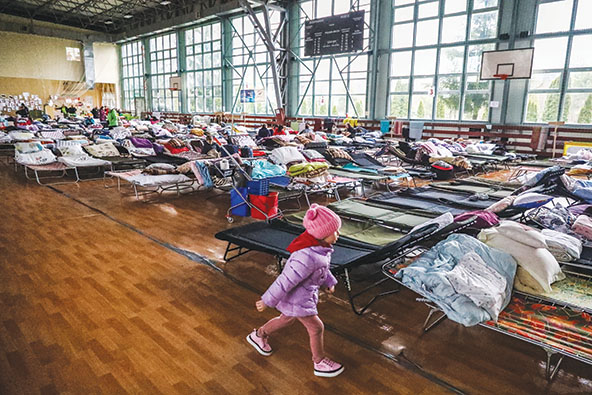 Refugees from Ukraine stay at a temporary shelter in Hrubieszów, Poland, on April 1, 2022. (Photo by Beata Zawrzel via Getty Images)
OSF’s new $100 million discretionary fund to respond rapidly to breaking crises proved useful almost at once. OSF, which has supported civic democracy in Ukraine since 1990, dug yet deeper into its pockets to launch the Ukraine Democracy Fund, starting with $25 million. OSF’s wartime mission is the creation of a “civic frontline” of NGOs to defend Ukraine and lay the groundwork for a postwar democracy by protecting civil society, distributing medical supplies, and sustaining Ukraine’s free media, among other tasks. Very quickly, the Ukraine fund received donations from the Schmidt Family, Oak, and Ford foundations, among others, raising its total to $45 million.
OSF’s new captains are frank about the unique challenge of taking on the forces of the global right in this new age, and the new Soroses in board positions appear eager to build on George’s legacy, not reverse it. Unfortunately, all of their gravitas together doesn’t measure up to that of OSF’s patriarch; yet the foundation is now very much in their hands at a critical and precarious juncture. The person of George Soros has so defined OSF since its earliest incarnations that it’s impossible to imagine it without him. Most probably, it’s going to be less quirky, off the cuff, and sprawling—the UN veteran Malloch-Brown is making sure of that.
As similar as George Soros’ ideas on open society in Ukraine may sound to those he uttered 35 years ago—after all, Russian tanks versus an embittered Eastern European populace fighting for freedom is familiar to him—OSF embodies an institution that has learned about the complexities of open society and, in doing so, has richly fleshed out Popper’s original concept. But the global economic and political consequences of the war in Ukraine—supply disruptions, energy crisis, millions-strong refugee flows, inflation, China siding with Putin, missed climate targets, food shortages—exacerbate the inequality, extremism, and anti-immigrant hatred that feed authoritarian and fascist movements. Thus OSF, in fighting for open society, finds itself confronting all of these big-ticket issues at once. As much as OSF has learned about democracy promotion, the organization’s task at hand seems to expand every time OSF believes it’s close to zeroing in on an antidote.
Read more stories by Paul Hockenos.