


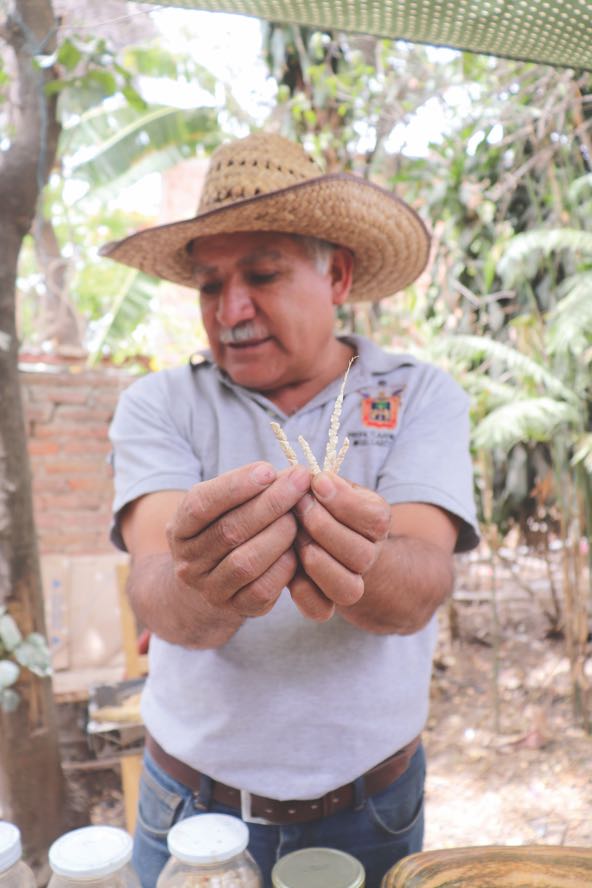
 Ezequiel Cárdenas holds a sample of the smallest corn varieties at his agroecological garden La Casa del Maíz in San Juan Evangelista, Jalisco, Mexico. (Photo courtesy of The Reach Alliance)
In Jalisco, the Mexican state known for its tequila, exporters have depleted the region’s natural resources. The rolling hills outside the capital, Guadalajara, long said “to grow anything,” are now so parched that cracks run meters into the soil.
The moisture once stored in the earth now leaves in crates of blueberries, raspberries, and avocados, bound for global supermarkets and consumers’ health-conscious breakfasts, while Jalisco’s health is in crisis.
Not only the soil suffers. Farming communities once rich in nutritious, culturally significant foods struggle to connect with customers and one another. The social economies that sustained their work are unraveling as traditional knowledge and practices slip away, no longer passed on to future generations.
Those fighting for agroecology understand the urgency of the crisis. In Spanish, campesino—often translated into English as “peasant”—conveys a sense of pride and political identity that the English translation fails to capture. The word represents a long history of political organizing, economic frustration, and care for every person and species in the agricultural ecosystem.
As environmental pressures mount, campesinos are developing creative ways to maintain their food systems and livelihoods. Their model, known as an alternative food network (AFN), includes a range of practices that resist the agricultural industrialization of the global economy. AFNs prioritize locality, sustainability, and partnerships across the supply chain. In Guadalajara, farmers and agroecologically minded consumers have been organizing market-based AFNs since 1996. While challenging extractive capitalist logics, these models struggle to compete with the low prices of hyper-scaled agricultural conglomerates.
Organic pricing offers a glimmer of hope, showing that some customers will pay extra for agroecologically produced food. Yet becoming a certified organic producer—a lengthy, bureaucratic, and costly process for the average campesino—does not work for many small farms.
To help campesinos compete with certified organic producers, participatory guarantee systems (PGSs) use a community-based approach in which farmers, consumers, and local actors assess production practices.
The Strength of Grassroots
PGSs emerged from the environmental and cooperative movements of 1970s Europe, where small farmer and consumer groups began experimenting with localized accountability systems. These groups gained momentum in Latin America in the 1990s with Brazil’s Rede Ecovida de Agroecologia, a network of farmers and consumers in southern Brazil that evaluated farms while advancing agroecology and food sovereignty. Its success inspired similar systems in Mexico and across the region.
Mexico’s version of PGSs, the Red Mexicana de Tianguis y Mercados Orgánicos (Mexican Network of Organic and Flea Markets), was established in the early 2000s. The Red built on decades of campesino organizing and alternative market experiments in Guadalajara. For these groups, certification was never just a technical matter—it was inherently political. Certification reflected campesino autonomy and collective resistance to an export-driven agricultural model that drained local resources. Campesinos built credibility and trust-based relationships with consumers through regular farm visits, workshops, and assemblies.
The impact of grassroots PGSs was recognized in federal policy in 2006 with the passage of Mexico’s Law of Organic Products (LPO), a commitment to promoting “participatory organic certification of family production and/or that of small producers.” Amendments in 2010 granted PGSs official status as Sistemas de Certificación Orgánica Participativa (SCOP), a designation limited to small or family-based producers selling directly to consumers.
Official recognition brought several benefits to PGSs. Campesinos now have legal access to the national organics market and can sell under the “organic” label without prohibitive certification costs. PGSs have also validated grassroots knowledge systems in a policy environment that often favors agribusiness. They have demonstrated that alternative certification models can coexist with third-party systems, paving the way for broader global adoption.
Today, PGSs are active in dozens of networks that vary in size, geography, and structure. Some are anchored in weekly tianguis or farmers markets, cooperatives, and regional associations that connect multiple communities. Verification is a social process: Campesinos invite consumers onto their plots, discuss practices at open meetings, and circulate knowledge in ways that bolster production and community ties. While state recognition through the LPO confers legal legitimacy, the vitality of PGSs relies on grassroots energy.
El Jilote has become Guadalajara’s model of grassroots certification founded on trust between producers and consumers. It emerged in 2011 from the Network of Sustainable Agricultural Alternatives (RASA), a network that integrates farmers working with agroecology with consumer groups, academic researchers, and others, and that shares collective learning processes with all members. At the time, RASA wanted to make visible the dynamism and multidimensionality of the agroecological products produced by its farmers.
El Jilote’s approach is simple: A virtual market connects producers and consumers in a participatory guarantee system that verifies agroecological practices and strengthens community trust. Endorsement depends on local relationships rather than foreign logos that hold little meaning for the average consumer. The “market” is a relationship: Producers open their plots and practices to the community, and endorsement arises from what is observed together.
The certification process begins with small, interdisciplinary teams of agronomists, environmental engineers, biologists, agroecological farmers, and consumers visiting farms. The respective specialists then review production methods, consider the buyers’ perspective, and link observations to agroecological values.
As part of this process, El Jilote introduced a “star” rubric, awarding recognition across ecological, social, cultural, economic, political, and ethical dimensions. The stars highlight strengths and offer suggestions for producers—improving soil and water management, strengthening community ties, or shortening supply chains—while making production values visible to consumers. Decision-making remains consensus-based, ensuring legitimacy and accessibility for farmers and consumers.
The result is a guarantee rooted in local values and needs and recognized by the community when food is sold to consumers at tianguis or farmers markets—not to wholesalers or for export. This “certification” fulfills the logic of Mexico’s participatory certification framework, promoting and protecting local producers instead of relying on distant retail markets.
Participatory guarantee systems are the lifeblood of AFNs, building trust that allows communities to grow and scale together. Trust requires honesty about limits, however. One cooperative leader noted that third-party audits can cost “more than a thousand dollars per hour,” a barrier that pushes alternative certifications back into the realm of the pay-to-play labels they intend to replace. As a result, some groups feel that “certification isn’t worth much … and participatory certification is sometimes not valued either,” according to the leader.
This is partly why El Jilote’s focus on agroecological parameters has proved critical to its success. By recognizing financial realities and gaps in how certification is perceived, the committee provides a fairer, more transparent system that communities can trust. Since none of El Jilote’s certification teams rely on the system as their main source of income, costs remain low for small producers. The growing number of endorsed producers offers evidence of broad engagement and community benefit.
El Jilote currently endorses five production units and archives expired certificates, making continuity and turnover in the network visible. Its endorsements are now recognized as a federal SCOP, signaling formal maturation but without having abandoned its grassroots, community-driven design. These features help explain why El Jilote’s model remains credible to producers and consumers and has endured for more than a decade in Guadalajara.
A Model for Reshaping Food Economies
The future of agroecology through PGSs is about standards but also community trust, empowerment, and reclaiming campesino identity as a source of pride and political strength in the face of industrial agribusiness. The success of PGSs in Mexico is closely tied to the evolving agricultural practices of diverse groups of farmers.
The participatory nature of PGSs gives communities greater control over food systems, fosters relationships between producers and consumers, and strengthens trust. El Jilote’s use of star-based rubrics and its consensus-driven committees and digital market demonstrate how creativity can keep local systems resilient, even amid global competition. While prioritizing community-based farming, the program preserves traditional knowledge, allowing farmers to reclaim agency over food production.
As a movement rooted in campesino empowerment that resists dominant food systems, PGSs emphasize local connections between people, land, and traditions. Its growth depends on expanding these trusted circles, including more voices, and deepening relationships across regions. As the network spreads and evolves, it has the potential to be embraced by other farmers seeking inclusive, fair, and ecological ways to nurture local knowledge and share food.
Looking ahead, the adaptable, inclusive approach of PGSs make them well-suited for adoption in other countries, especially in regions with strong smallholder farming traditions pursuing community-centered certification and market participation. As demand for sustainable, transparent food-production systems grows, PGSs provide a flexible market alternative that supports local agricultural knowledge and practices. By prioritizing ecological balance and food sovereignty, the system offers a blueprint for reshaping food economies around the world.
Read more stories by Shreya Agarwal, Alonso Muñoz Sanchez, Charles Pinto, Maya Povhe, Erica Di Ruggiero & Gregorio Leal Martínez.