


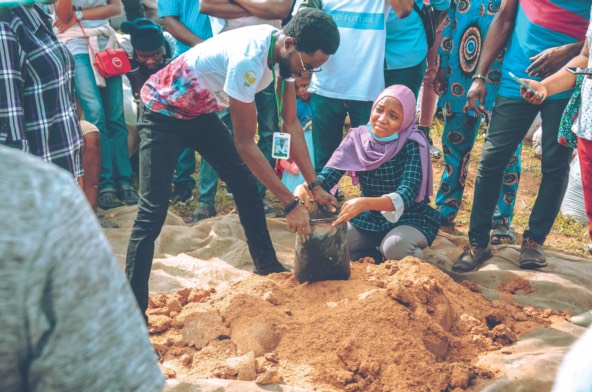
 Samson Ogbole (left), founder of Soilless Farm Lab and Enterprise for Youth in Agriculture, teaches a farming class. (Photo courtesy of Soilles Farm Lab)
"Food should not be seasonal, because hunger is not seasonal," says Samson Ogbole, the founder and team lead of Soilless Farm Lab. A biochemist and farmer, Ogbole launched the lab in 2020 in Ogun State, in southwestern Nigeria, in order to augment traditional farming methods by integrating hydroponics—the practice of growing food in water—with machine learning, artificial intelligence, and greenhouse farming. True to its name, Soilless Farm Lab has innovated modern farming by growing food without soil.
Nigeria does not grow enough food domestically to feed its population, and this shortfall has caused problems. In June 2024, Nigeria’s imported-food inflation spiked to more than 36 percent following a drastic economic downturn. Nigeria's dependence on imported food is a result of domestic production not keeping pace with demand. The decline in food output started in the 1960s, in post-independence Nigeria. By the 2010s, agricultural contribution to Nigeria’s gross domestic product had dropped to 37 percent from 61 percent in the 1960s, while the cost of food imports increased by 25 percent over the same time period.
Most farmers in Nigeria practice subsistence farming in rural areas, growing only enough crops on small-scale farms to feed their families and sell within their communities. In the wet season, which runs from April to October, farmers plant and harvest water-dependent crops like maize and yams. In the dry season, which occurs in the intervening months, such crops are scarce; only farmers who can afford irrigation can grow them, which limits supply and makes food more expensive. Prolonged dry seasons due to extreme heat and drought mean longer periods of low food production, food scarcity, and increased food prices.
Similar climate-related challenges of extended rainfall and flooding during the wet season damage crops and strip the soil of nutrients needed to grow food. In 2022, an estimated 700 billion naira (approximately $440 million) in crops, livestock, and farmland were lost due to flooding. Such extreme weather also abets diseases and pests that destroy agriculture.
“We want to ensure that we no longer have food during rainy season alone,” Ogbole says of the lab’s goals. “You could realize that the cheapest a commodity can be can suddenly become the regular price of that product year-round.”
Hydroponic Produce
Ogbole was raised by his grandparents, who were commercial farmers. He went on to major in biochemistry at Igbinedion University in Okada. In 2013, during his obligatory one-year postgraduation service for the National Youth Service Corps, he worked at the International Institute of Tropical Agriculture (IITA), a nonprofit research-for-development institute where he learned tissue culture and aeroponics. It was at IITA where Ogbole decided he wanted to become a farmer. In 2016, he and economist Olisaeloka Okocha cofounded PS Nutraceuticals, a company dedicated to soilless farming.
By 2019, Ogbole was ready to venture on his own. He sold personal property, took out loans, put up his remaining belongings as collateral, and started Soilless Farm Lab, which was incorporated in October 2019 and began full operation in January 2020.
The Soilless Farm Lab’s headquarters is located on a 90-acre solar-powered greenhouse farm. Currently, the lab cultivates crops—leafy greens, yams, tomatoes, and peppers—that can only grow inside the controlled environment of the greenhouse, which uses an AI-automated irrigation system. Seedings are sprouted in a nursery after seed extraction or from a cutting of the parent plant. A sterilization process removes all traces of disease-causing microorganisms before the crops are transferred to the hydroponic fields.
Soilless farming reduces “the quantity of water and nutrients lost by about 70 percent, compared to soil farming,” says Deborah Akintola, head of sales at Soilless Farm Lab. Higher-nutrient crops, in turn, allow for a longer shelf life of produce. With lower production costs, Soilless Farm Lab can sell products that are cheaper and higher in quality than traditionally grown crops.
The curriculum, which initially included courses on soilless farming and agribusiness, was expanded to include lessons in marketing.
Soilless Farm Lab depends on a team of experts—agronomists headed by Emmanuel Atolagbe, business developers managed by Sandra Attah, a monitoring and evaluation department led by Paul Idoko—to operate along the entire agricultural value chain, from production to distribution, maintaining food quality from farm to customer. When the company started, it had 26 such facilitators—including Samson Ogbole. By May 2020, the lab began paid trainings. Graduates of the program were recruited as volunteers, who could then rise to become interns and eventually full-time staff. Soilless Farm Lab now has 79 paid staff members as well as a number of former trainees working as volunteers in departments they gained experience in.
The lab reaches far beyond its young farmers and has directly benefited the local community. Ogun residents rely on the farm’s supply of electricity, clean water, market, and accessible roads. The market provides a space for trade, and accessible roads have encouraged tricycle transportation business.
While Ogbole fully financed the lab’s launch, it now generates revenue through several services, including paid training, farm setup, and consultations for other institutions and farmers. The company sells its produce at different farmers markets in the country. Because of its need for imported materials, such as seeds, greenhouse technology, twine, sensors, and agrochemicals, Soilless Farm Lab also exports food produce to the United Kingdom to help hedge against naira devaluation.
Next-Gen Farmers
In Nigeria’s agricultural sector, most farmers are older and male, from rural areas. Ogbole knew that to realize his goal of eradicating hunger through tech-driven farming techniques, he needed to share his knowledge of soilless farming with younger generations of Nigerians—approximately 70 percent of the population is under the age of 30. In January 2023, he launched Enterprise for Youth in Agriculture (EYiA), a program that trains young people ages 18 to 29 to become farmers.
“Food is one thing that gets to unite us,” says Adekemi Adeoye, one of EYiA’s 20 training facilitators. She says that food should mostly be the business of youth so that they can care for generations to come. “You could see that the [older] generation have played their role, and they are gradually leaving the space. What becomes of [today’s generation] if we don’t bridge that gap?”
EYiA derives from Work and Learn, a five-day program that Ogbole started in September 2020 to teach people the basics of soilless farming, climate-controlled farming, and the agricultural value chain for aquaculture. Three years later, thanks to a sponsorship by the Mastercard Foundation, he expanded the program into its current, three-month iteration. The curriculum, which initially included courses on soilless farming and agribusiness, was expanded to include lessons in marketing, branding, product design, and sales.
To reach as many young people as possible, the program is completely free for participants. Applicants are admitted after completing an online assessment that is based on a short lecture about soilless farming, in addition to an interview. EYiA provides participants free accommodation in addition to a 73,000 naira ($49) monthly stipend. One thousand students are accepted into the program each quarter, with 4,000 students trained annually. To address the gender gap in Nigeria’s agricultural sector—where men outnumber women three to one—EYiA relies on a quota system in its recruitment process to ensure that more than two-thirds of accepted students are women.
Every cohort of 1,000 students is divided into 20 groups of 50 participants, who are assigned to care for a three-plot hydroponic farm. The group of 50 are then broken into subgroups with different responsibilities aligned with the disciplines in their curriculum: 16 participants are on the technical team, 12 on the agronomy team, 8 on the packaging and branding team, 6 on the logistics team, and 8 on the accounting and management team.
Taiwo Abimbola, who began EYiA in October 2024, says he had developed a passion for soilless farming as a former student of crop science and horticulture during his studies at the Federal University of Oye-Ekiti. While at EYiA, he helped construct a water tank, screen-house, and net-house. Although he has worked at Soilless Farm Lab for more than 10 weeks, he’s unsure about pursuing this career path, due to his financial constraints. “It takes a lot of capital to start [soilless farming], and I’m not in any state to start that on my own,” he says.
After completing the three-month program, the groups become companies that are registered under the Corporate Affairs Commission (CAC). The small-scale enterprises sell their healthiest produce to Soilless Farm Lab, depending on the crop they plant and when they’re ready for harvest. Members of the company are shareholders and receive dividends from the sales. Those who stay after the end of their training become staff of their company and earn a monthly salary in addition. For the next nine months, EYiA offers free consultations to each company to ensure its growth and profitability for over two years. To date, Soilless Farm Lab has trained more than 8,000 farmers and created more than 19,000 jobs and 160 farm companies.
“What makes [EYiA] successful is that there are others who understand [modern farming] and take it to new heights that even I could not fathom,” Ogbole says. “Once we can transfer the knowledge to the next generation, we are successful.”
Read more stories by Chiamaka Muoneke.