


 (Illustration by Nancy Marks)
In the face of social and political backlash, and often alongside previous initiatives that did not meet their intended goals, many organizational leaders are tempted to divest in diversity, equity, and inclusion (DEI)—formal organizational efforts to identify and address unjust inequality. But this moment, while fraught, is also an opportunity to redesign DEI for effectiveness, improving not only the experiences of people from historically marginalized groups, but also overall well-being and organizational resilience.
An important starting point is to look at how leaders interpret disagreement and conflict. Organizations often perceive conflict related to DEI efforts as interpersonal breakdowns, when in fact it frequently reflects deeper tensions, including gaps between mission and incentives, commitments and authority, and values and practice.

The challenge for leaders, then, is less about assessing the merits of DEI than about designing and sustaining equitable and inclusive practices in the context of their specific organization.
Drawing on a composite case from the social sector, this article focuses on the distinction and relationship between alignment (how clearly DEI is tied to organizational strategy and structures) and congruence (how well that strategy is enacted across operations, roles, and norms). For leaders across sectors, DEI success or failure often depends on their ability to navigate tensions between these two dimensions, and how those tensions shape team members’ experiences and relationships. When leaders do not design and implement them well, DEI efforts risk becoming ceremonial, detached from core organizational outcomes, or entirely disposable.
When Societal and Organizational Tensions Conflict
When societal tensions enter an organization without structural scaffolding to hold them, conflict rarely remains interpersonal.
Consider Monica, whose story is an anonymized composite that reflects recurring patterns we have observed across organizations and recounts specific points of interpersonal conflict in one of these spaces. Monica leads a regional nonprofit focused on expanding college access for low-income students through test preparation and socio-emotional support. Its office is located in a historically mostly white but increasingly racially diverse working-class town.
In 2021, Monica deepened her organization’s commitment to racial equity by launching a series of racial allyship trainings. Monica engaged a training provider recommended by a primary funder, but the initiative faltered when the provider adopted a compliance-driven approach focused on legal risk management and behavioral interventions to address microaggressions. The provider encouraged employees to speak up when they perceived harm, but did not offer any recourse for dialogue or repair. It also offered a technical approach that emphasized immediate responses to behaviors without attention to long-term work to strengthen connection, resilience, or opportunity to learn from mistakes.
In the years that followed, employees increasingly disagreed about whether the initiative was valuable, with perspectives generally split between the organization's two functional teams. The first team, a 20-person program staff responsible for program design and delivery, consisted of slightly more women than men and was a racially diverse group in their mid-20s to late 30s. The second team, a 10-person operations staff responsible for working with prospective and current students and families to support program administration, consisted entirely of women, most of whom were over 40, and all but two were white.
Due to a complex set of interpersonal dynamics, Monica meanwhile became more reluctant to translate racial allyship principles into organizational operations. As a white leader navigating an increasingly high-friction DEI climate, she sometimes hesitated to voice her specific concerns about training content and framing. And her education at high-status universities, like most of her program team, made her keenly aware of latent but increasingly visible class dynamics between the two teams.
In late 2023, at the encouragement of a funder, Monica coordinated a general racial equity training with a new provider. Whereas the previous training sessions prompted mostly private disagreement, this session produced noticeable disengagement, with several operations team members rolling their eyes at points and others openly engaging with their phones more than the facilitators. Eventually, when prompted by a facilitator to share reflections, a senior operations team member expressed disdain at being “told what to do” by program staff, despite having a longer tenure and no direct-report relationship to any program staff member.
Immediately following the session, a program staff member said to no one, but loud enough for everyone to hear, “White people just don’t get it.” This comment, alongside the operation team’s lack of engagement during the session, explicitly surfaced tensions that had been building for years.
Alignment, Congruence, and Why Conflict Escalates
Monica’s situation illustrates how conflict intensifies when DEI efforts bring to light inequities that strategy and operations are not designed to absorb. While social sector missions may champion access to education, economic mobility, or inclusive workforce development, internal organizational structures and cultural norms do not always fully reflect the same principles. Cultural competence may be underdeveloped, and internal inequities in pay and well-being may mirror those seen in the private sector.
Alignment and congruence help explain when and how tensions like these shape team members' day-to-day experiences and interactions. Although organizations often treat these two concepts synonymously, understanding how they differ and how to pursue them in DEI work is essential to success.
Strategic alignment refers to the degree to which an organization explicitly connects a strategic initiative to its mission, goals, and decision-making structures. Congruence refers to whether the organization enacts that initiative consistently across roles, incentives, and informal norms. Alignment answers the question: Is this core to who we are and how we succeed? Congruence answers: Do our everyday practices reinforce what we say we value?
In DEI work, alignment fails when leaders cannot explain how DEI advances strategy. Congruence fails when organizations ask staff to meet equity goals without the authority, resources, or required cultural and structural support to do so. Indeed, when both misalignment and incongruence are present, organizations can reasonably expect negative reactions and resistance to DEI.
The table below details four theorized outcomes for sustainable and resilient equity work, depending on the alignment and congruence of DEI efforts. (The terms ceremonial and disposable draw from scholarly literature in organizational behavior.)
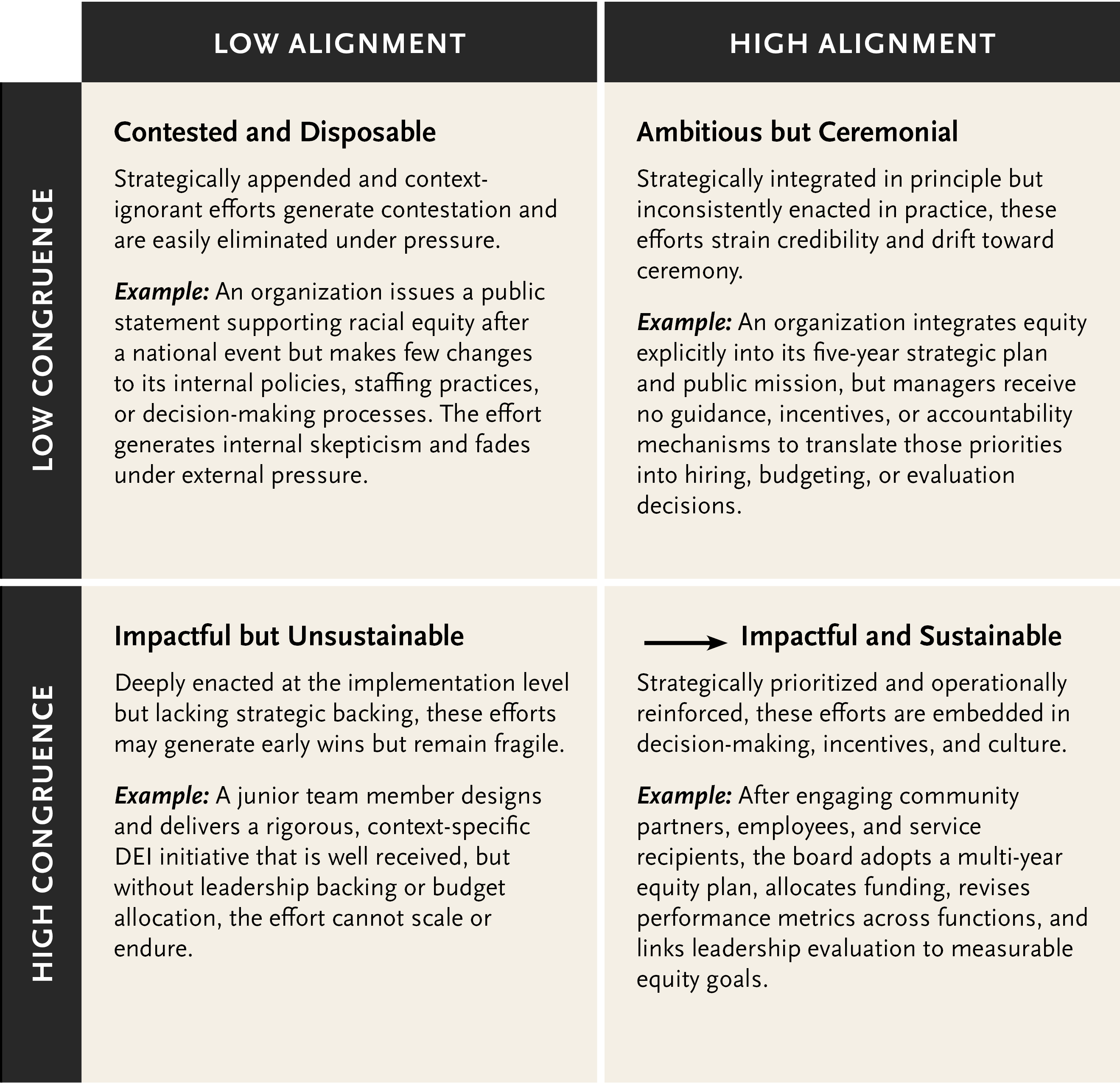 The alignment and congruence of DEI efforts greatly influence their durability and effectiveness. (Chart design by AR Creative)
Prior to 2021, with a more modest DEI strategy, Monica’s organization operated comfortably in the “impactful and sustainable” quadrant. The organization saw limited internal concern and addressed DEI-related challenges with students and families through discrete engagements with a few select culturally competent staff. Although this worked as a temporary arrangement, Monica recognized it placed undue burden on these team members and was therefore unsustainable.
Because of this, she was excited to build the full team’s capacity to engage with students and families across cultural difference through racial allyship work in 2021. However, by 2023, disengagement and open resistance from the operations team made it clear that the organization’s DEI work was at risk of falling into the “contested and disposable” quadrant.
Designing for Durability
If misalignment and incongruence drive conflict in DEI implementation, then durable solutions must engage how team members understand and relate to organizational strategy and design, and how stated and latent cultural norms support or hinder the success of strategy and design. Leaders can make DEI initiatives at their organizations more effective and durable in three main ways:
1. Aligning internal and external equity goals. Effective leaders understand how societal inequalities intersect with their organization’s strategy and operating model. They clarify how external equity goals align with internal culture, incentives, and work structures to prevent unclear priorities and fractured communication. This requires organizational-level self-awareness and a clear understanding of how the organization works toward its goals in the context of its external environment.
This is especially important in the social sector. Take, for example, a charter school in which 90 percent of the students are Black. Given well-documented racial disparities in educational experiences and outcomes, strategic alignment around equity is essential if the organization is to fulfill its stated mission. Monica’s organization could have drawn a clear through line between its commitment to racial allyship and equity and the day-to-day coordination between the program and operations teams. Such alignment and congruence could have strengthened cross-cultural engagement with students and families; deepened recognition of how race, class, and culture intersect to shape barriers; and improved the organization’s ability to address them.
Importantly, detailed racial equity approaches may not be as appropriate for organizations that do not directly interact with community members or organizations that serve a different demographic composition, such as a primarily rural and white community where economic inequality plays a larger role in shaping access to social services. An organization’s awareness of context, environment, and goals is a first step toward effective and durable DEI work. At a minimum, they need supporting structures and processes that ensure fairness, access, and dignified treatment for team members and the people and communities they work with. Scaling beyond this in a way that does not support alignment and congruence can lead to performative and symbolic work.
2. Tailoring DEI to specific intersections of identities and roles. Being curious about how race, gender, class background, and other identities show up across different roles, departments, and hierarchy can unearth potential faultlines, or areas that are more susceptible to conflict. Faultlines can activate and amplify team members’ perceptions that their social identities are negatively evaluated or stereotyped.
Many of Monica’s operations staff, for example, perceived themselves as having less power than program staff in their specific context, in part due to their lower-status educational credentials. To help address the tension around power dynamics and perceived authority, we designed a workshop session that focused on identifying unstated dynamics and norms. A shared insight emerged when several operations team members reported feeling condescended to by program staff who referred to the town as “backwoods,” implying it was culturally unsophisticated. A program team member responded, “It sounds like you experienced a microaggression,” a term central to the prior racial allyship workshop series.
Monica later reported that the team made progress in the weeks following this session. Some participants began reflecting on how their racial identities might shape their interactions with prospective students and their families—an idea that some operations team members were defensive about in earlier racial allyship trainings, because the sessions were framed in a punitive and compliance-driven way. Monica shared that the introduction of a shared vocabulary allowed team members to interpret perceived slights in a less accusatory way.
3. Investing in programs that emphasize self-awareness, emotional regulation, and cultural competence. Strategic alignment and operational congruence set the stage for effective DEI work, but they do not guarantee it. Sustained success requires that people have the interpersonal capacity to engage with each other respectfully and to disagree in productive rather than destructive ways. Without this, conversations intended to work through disagreement can devolve into call-out dynamics—conversations that intend to surface disagreements or experiences of harm but devolve into punitive labeling—that can result in alienation and shame, and erode team cohesion.
Effective DEI learning and development efforts must therefore build team members’ capacity to understand their own cultural lenses and emotional triggers, regulate responses in moments of conflict, and avoid reactive behaviors that damage trust. For leaders, this includes the ability to engage and hold team members accountable and provide corrective and developmental feedback, regardless of social or racial identity. In their zeal for demonstrating commitment to equity, leaders with traditionally dominant social identities, including men and white leaders, may drift into pre-emptive overcorrection. In response to broader societal realities of inequality and discrimination, they may withhold the provision of difficult feedback, undermining equity efforts.
Alongside intergroup contact anxiety, this helps explain research findings showing that women, and women of color in particular, receive less developmental feedback than their male counterparts, potentially leading to career shifts, and deferred or never received promotions and advancements. Conversations in which race, class, and other context-relevant identity categories are explicitly relevant can be difficult, but disciplined leadership requires engaging them with clarity and consistency. Avoidance does not protect belonging. Rather, it erodes legitimacy and efficacy.
From Resistance to Redesign
Resistance to DEI is not always rooted in rejection of its core values. Often, it reflects a mismatch between aspirational commitments and the organizational conditions required to enact them. In an environment of polarization across myriad dimensions, DEI is most effective when it focuses on context specificity, strategic alignment, and operational congruence, embedding equity into the fabric of how organizations and team members operate, solve problems, and grow.
Leaders who learn to treat conflict as diagnostic rather than disruptive can redesign DEI to withstand backlash and internal strain, making it harder to marginalize and easier to sustain.
Read more stories by Ahmmad Brown, Molly Routt & Dustin Liu.