


 (Illustration by iStock/stellalevi)
The performing arts sector is paradoxical: deeply innovative yet structurally resistant to change. While endlessly inventive onstage and behind the curtain, the organizational structures that support the creative work are notoriously slow to adapt, relying on legacy models ill-suited for today’s complex funding challenges.
According to the 2022 Arts and Economic Prosperity report, over 80 percent of Americans believe the arts to be important to their local economy and their community’s livability. But in May 2025, calls by the Trump Administration to close the National Endowment for the Arts (NEA) led the agency to abruptly withdraw or cancel hundreds of grants awarded to arts organizations across the United States. Organizations of all sizes reacted by cutting expenses and seeking more earned and contributed revenue, with some dipping into their endowments and using working capital to fill the gaps. This response illustrates what the field has known but not fully addressed: Years of persistent underfunding have made for deeper, structural frailties in the financial well-being of the performing arts.
As current and former performing artists, leaders, and consultants in the nonprofit performing arts industry—and as people who care deeply about coming together to reimagine the future of the field—we believe there is an underexplored economic lever available to the industry: the intentional building of strategic partnerships. Those who can take advantage of the range of possibilities partnerships offer will set the stage for more agile organizations and greater innovation across the field.
Challenges in the Performing Arts Industry
Performing arts organizations face two significant barriers to long-term sustainability. First, the cost of doing business has rapidly grown beyond what can be reliably covered by contributed and earned revenue. This phenomenon, known as the Baumol effect, was documented by economists William J. Baumol and William G. Bowen in their 1965 article, “The Performing Arts: The Anatomy of their Economic Problems.” They observed that the performing arts, like other labor-intensive sectors such as healthcare and education, will see cost growth that consistently outpaces sectors that can be automated. Translation: A week of symphonic music cannot become “more efficient.” Not only is it more expensive to produce art today than it was a decade ago, but the cost is rising faster than before.
Exacerbating the Baumol effect is “institutional exceptionalism.” Performing arts organizations often take a “go it alone” approach, positioning themselves as incomparably unique while simultaneously competing with their peers at the regional and national level. Rather than galvanizing public interest and demand for their art form, they focus on boosting their own brand. This exceptionalism reinforces competition for limited resources at the expense of the sector as a whole.
In this article, we discuss two antidotes to these historical stressors and then a mix of strategic partnerships to pursue to strengthen organizations. While the Baumol effect cannot be fully eliminated, its economic impact and the field’s entrenched institutional exceptionalism can be mitigated with new and strategic approaches to scaling. Capturing economic and organizational efficiencies requires two critical conditions: clarity of organizational purpose and a well-defined business model.
Antidote #1: Clarify Organizational Purpose
To partner with others, an organization must first understand what makes it special and, second, the role it plays in the larger ecosystem. Most performing arts organizations can articulate clear missions, visions, and values, yet many lack a clear purpose statement, which we define as the unique combination of an organization’s identity and its desired impact.
In her 2021 SSIR article, “The Four Principles of Purpose-Driven Board Leadership,” former BoardSource CEO and President Anne Wallestad urged boards to think about “purpose before organization” when considering how to allocate resources in service of their intended impact.
AXIS Dance Company offers a compelling example. Dedicated to creating a “radically inclusive dance sector and world by removing barriers and showcasing the beauty of difference,” AXIS has long collaborated with renowned choreographers to create works for its company of disabled and non-disabled dancers. Recognizing that it could not achieve its mission through performance alone, AXIS developed a comprehensive accessibility resource for the industry. Its Access Guide for Presenting and Touring the Performing Arts helps venues move beyond basic ADA compliance to design truly welcoming and accessible spaces. By leveraging its identity, AXIS expanded its impact beyond the stage to advance its purpose.
Performing arts organizations that clearly define their purpose are better positioned to make strategic decisions about how to operate within the field. This foundational work allows them to leverage their unique strengths, maximizing their impact both individually and collectively.
Antidote #2: Map the Business Model
If purpose defines identity and impact, the business model shows how that purpose is put into practice. Opera Philadelphia offers a tangible illustration. When Anthony Roth Costanzo assumed the role of general director and president, he did so with a commitment to “bring opera to more people, and bring more people to the opera.” He also inherited a company in deep financial crisis with a looming $4 million debt and an upcoming season with only 30 percent of tickets sold.
Understanding that earned revenue alone would not fully sustain Opera Philadelphia, Costanzo implemented a radical pay-what-you-can pricing strategy designed to create audience accessibility while building community relevance. Starting at $11, the “Pick Your Price” initiative was an immediate success, selling out the entire season in a few weeks.
Yet Costanzo knew financial sustainability would also depend on cultivating partners, generating philanthropic support, and increasing the company’s civic value. To achieve this, Opera Philadelphia launched partnerships across the city’s civic and cultural sectors, including with the Rodin Museum, Temple University, Jean-Georges Philadelphia, and the famed Wanamaker Building.
The results were significant: Costanzo’s first season ended with a $1.5 million surplus, allowing Opera Philadelphia to double the number of performances for its next season. Building on their initial ticketing strategy, the company introduced the Opera Pass program, with an impressive 40 percent of its members subscribing to the entire season. Though often viewed by the field as mere pricing innovation, Costanzo’s business model proved to be the mobilization of a clear purpose built and sustained through the ecosystem of community partnerships.
Building Together What We Can’t Build Alone
Aligning purpose and business model provides the foundation that performing arts organizations need to pursue strategic partnerships successfully. The matrix below illustrates a range of approaches spanning short- and long-term partnerships, from loosely coupled collaborations to tightly integrated alliances.
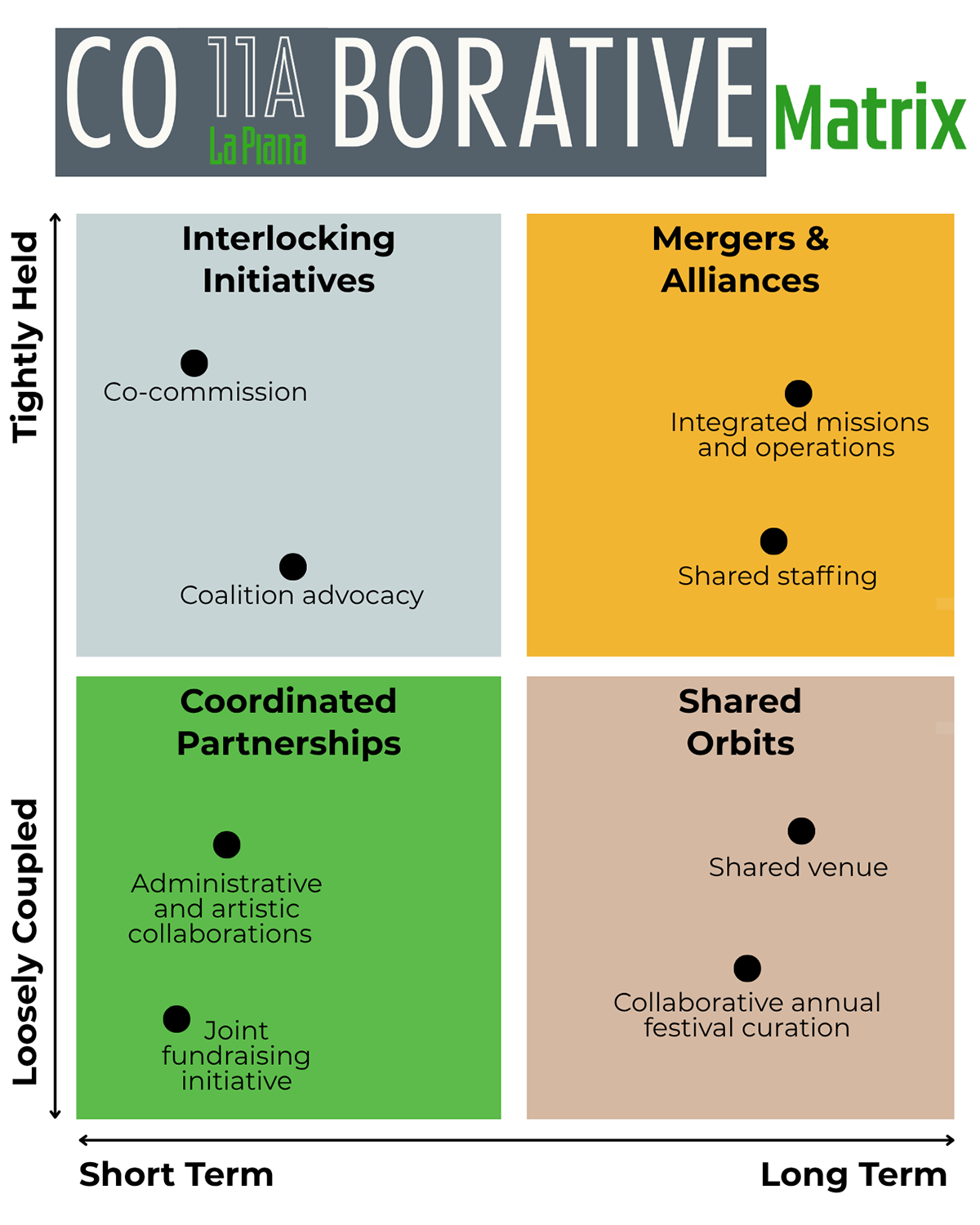 Matrix of Strategic Partnerships
Organizations pursue partnerships for many reasons: to achieve marketing, artistic, or fundraising goals; amplify common causes; expand geographic reach; leverage resources and capabilities; reduce costs; or merge operations. The appropriate partnership structure depends on the purpose it is intended to serve. This matrix provides a framework for organizations to seek and execute realistic, meaningful, and cost-effective partnerships that align with their capacities and strategic priorities.
Coordinated Partnerships: Short-Term and Loosely Coupled
Coordinated partnerships are typically one-offs or time-bound initiatives designed to promote a shared goal or collaborate around a shared initiative. They capitalize on flashes of innovation that benefit all organizations involved. Coordinated partnerships can also mobilize resources to benefit the field as a whole, whether through a new production with a clear purpose, the generation of emergency funds, or the building of political capital. And even with limited integration, they generate more value than going it alone.
One example is the recent production of “Firebird” presented jointly by Dance Theater of Harlem and Gateways Music Festival, which operates in association with Eastman School of Music. Both organizations are dedicated to empowering multicultural and Black artists, not only showcasing their talent, but helping to redefine the cultural and aesthetic narrative in ballet and symphonic arts. Dance Theater of Harlem, a well-established organization in New York City, helped to elevate the brand of the non-local Gateways Music Festival by broadening its exposure around a shared purpose.
COVID brought many performing arts organizations together for short-term, loosely coupled initiatives. Chicago Acts Together gathered over 100 performing arts organizations for a joint fundraising initiative. Elsewhere, arts organizations banned together for advocacy purposes. In San Diego, 28 local theaters started One Theater, One Story, a collaborative campaign to survey audiences and advocate for artists’ relevance and survival needs. Similarly, more than 200 arts leaders in New York City had a daily “Culture @ 3” call to discuss ways to advocate for government support through collective action.
Interlocking Initiatives: Short-Term and Tightly Held
Interlocking initiatives involve dedicated resource sharing to support a specific goal over a defined period. Co-commissions are an increasingly common form of interlocking initiatives, bringing together geographically dispersed organizations to share the costs, risks, and administrative complexity of creating a shared new work for multiple stages. This is increasingly common in the co-commissioning of new operas, where the cost and complexity of new productions is especially high.
Recently, a first-of-its-kind collaboration between two pillar arts organizations in New York City, the Metropolitan Opera and Museum of Modern Art (MoMA), highlighted the life and art of Frida Kahlo and Diego Riviera. The Met’s production, “El Último Sueño de Frida y Diego” (“The Last Dream of Frida and Diego”), was coupled with MoMA’s exhibition “Frida and Diego: The Last Dream,” which presented their art in an installation designed by Jon Bauser, the opera’s set designer. This interlocking initiative showed that interdisciplinary collaboration not only elevates the audience experience but also generates revenue for both organizations.
Shared Orbits: Long-Term and Loosely Coupled
In shared orbits, organizations partner over a longer time horizon but remain loosely coupled to maintain ownership over programming and other strategic priorities. This allows for ongoing partnership possibilities while retaining organizational autonomy. The benefits of shared orbits are the deduplication of resources and their attendant cost savings, as well as the possibilities of expanded audience reach through cross promotion.
To coordinate this type of partnership, groups might create or designate an umbrella organization to provide back-end operational support for multiple arts organizations. For example, The Woodruff Arts Center (WAC) in Atlanta coordinates venue scheduling and provides centralized human resources and finance functions for its constituent organizations: Atlanta Symphony Orchestra, High Museum of Art, and Alliance Theater. This organizational structure generates significant cost savings while preserving the artistic freedom of each constituent institution.
Mergers and Alliances: Long-Term and Tightly Held
Mergers and alliances are the most complex form of partnership. When successful, however, the payoffs can mean the difference between organizational survival, continuing financial instability, or closure. They demonstrate how economies of scale at both the artistic and administrative levels can help organizations respond to Baumol-driven cost pressures while preserving and strengthening the cultural ecosystem they collectively serve.
In 2019, the Toledo Symphony Orchestra and Toledo Ballet (and, in 2024, the Toledo Jazz Orchestra) merged to form the new multi-disciplinary Toledo Alliance for the Performing Arts (TAPA). In integrating into one organization, the groups combined operations, unified their donor base, and aligned around a shared educational mission, thus leveraging economies of scale. The merger enabled TAPA to open a 56,000-square-foot facility that houses all administrative functions and education programs and expands available performance spaces in Toledo.
Alliances in performing arts are prevalent as smaller theater companies continue to rebound from the pandemic. They help mitigate cost pressures while preserving artistic identities. Philadelphia alone has produced two notable alliances built around shared artistic leadership. KC MacMillan is the artistic director for both the Inis Nua Theatre Company and Tiny Dynamite, while Allison Heishman has the same role across the Azuka Theatre and Simpatico Theatre. The impact of these alliances goes far beyond the cost savings of a split salary. By sharing artistic direction, the theater companies also coordinate artistic planning so that their individual productions draw continuous interest from the Philadelphia audience.
Where Do We Go From Here?
Strategic partnerships across the four archetypes of the matrix offer a pathway to a thriving, mutually reinforcing performing arts ecosystem. Beyond reducing duplication, sharing resources, and expanding reach, these models catalyze knowledge exchange, spur innovation, and fortify the cultural relevance and social impact of the field.
With clarity of purpose and well-defined business models, performing arts organizations can proactively identify and pursue an array of strategic partnerships. But to do this requires intentionality, effort, and organization design. One idea is for organizations to create a formal, cross-functional team that brings together artistic, development, marketing, and operations to identify, evaluate, and implement partnership opportunities. This team can assess potential collaborations, guide integration, and plan for ways to demonstrate impact. It’s important for individual organizations to build their own partnership muscles across silos in order to partner well with others.
While the performing arts will always strive for artistic excellence, the future of the sector increasingly hinges on the field’s capacity for collaborative intelligence, both within and across organizations.
Read more stories by Jessica Phillips, Christine Chen & Julian Chender.