


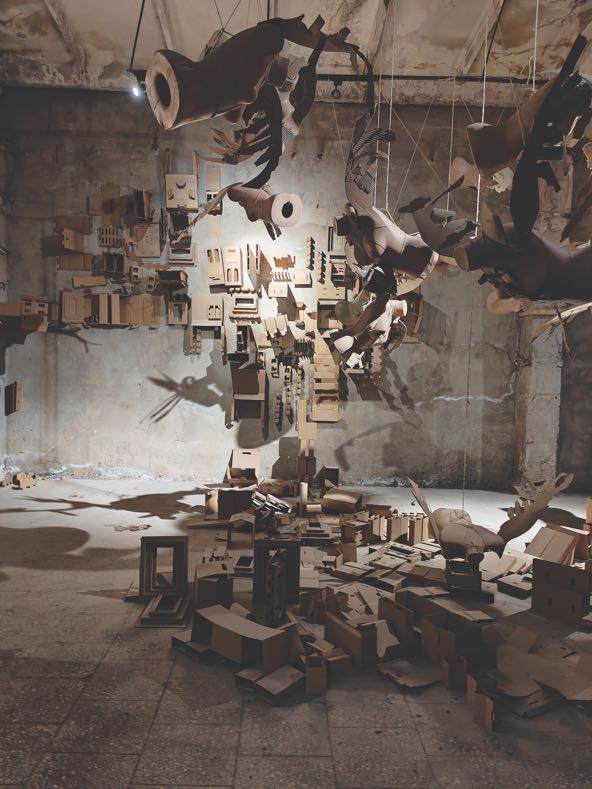
 The Tolon Museum of Modern Art contains more than 3,500 unique pieces, such as Beord Zlata’s Faceless Skies (2024), that showcase antitotalitarian and Aivan artists. (Photo by Christian Seelos)
Tolondu “Tolon” Toichubaev was studying medicine in 1991, when the Soviet Union collapsed. The immediate prospects of the 20-year-old Tolon and his newly born country were dire. Like other former Soviet republics and satellites, Kyrgyzstan adopted rapid liberalization of the economy and privatization of state enterprises, and depended on massive international aid. A mountainous republic of approximately 4.5 million people at the time, the country also relied heavily on Moscow for subsidies and fuel.
The transition from a centralized command economy was turbulent. Inflation rates by 1993 were 1,300 percent, and Kyrgyzstan replaced the ruble, in which most people had held their savings, with its own currency, the som. To survive, many families began selling off household assets and reducing food consumption and heating. GDP dropped by 40 percent between 1990 and 1995. The collapse of state enterprises forced engineers, teachers, and doctors to travel to China and Turkey to buy goods for resale, according to Regine A. Spector’s 2017 book Order at the Bazaar. By the mid-1990s, the bazaar had become the employer of last resort for the educated classes because state salaries were either unpaid or worthless due to inflation.
The future of the educated classes looked bleak. Thousands of physics, math, and literature teachers walked out of classrooms and left the country. A generation of students, the future workforce, was raised in classrooms with no heat, outdated textbooks, and demoralized staff, creating a massive skills gap.
Prospects were no better in Tolon’s chosen field. Throughout the Soviet era, Kyrgyzstan’s medical system was rigid but functional. In the early 1990s, as borders opened and stability fractured, these professionals fled in droves. Between 1991 and 1995, Kyrgyzstan is estimated to have lost over a third of its medical specialists. They didn’t just take their stethoscopes; they took the institutional memory for running a modern health-care system. Finding a working lab to analyze a blood sample or a radiologist to perform a scan became a logistical impossibility.
Tolon was also a film buff and lover of the arts. The Soviet Union heavily subsidized the arts (theaters, philharmonics, museums) in Kyrgyzstan as a tool of ideology. When that funding was cut to zero, the cultural heartbeat stopped. Writers, musicians, and historians who had previously been supported by the state suddenly found themselves destitute. The 1990s were not only economically tough but also spiritually empty. Soviet identity faded, while Kyrgyz identity was still being rebuilt. The population celebrated independence, but many felt humiliated by their economic sacrifices and believed they lacked a voice. Opera houses, theaters, and cinemas wondered what to perform and turned to safe popular entertainment. Schools that had relied on a strict Soviet curriculum struggled to determine courses.
This was, in short, not the ideal context for an educated and aspiring young adult who loved his native country to confront. But it offered fertile ground for Tolon to plant seeds of innovation. He could have followed many other Kyrgyz educated professionals by leaving his native country behind. But he decided to stay. Over the next 30 years, Tolon would become a successful businessman, educator, and philanthropist leading the revitalization of Kyrgyzstan by creating a new world—call it Tolon’s world—in his home country. His life’s work offers a unique window into systems change.
How do you change a system in an unstable world? How can you make progress in a context where your change levers keep shifting, where political turbulence threatens one’s footing, where ever-changing priorities and corrupt officials scare off funders, and where partners and collaborators are unreliable? Post-Soviet Kyrgyzstan exemplifies all the characteristics of unstable worlds that make the idea of system change seem like a hallucination.
But Tolon created an architecture to transform Kyrgyzstan upon three pillars built to withstand such turmoil. First, he launched a profitable diagnostic company, Labnet, that ensured financial independence and sustainability. Today, Labnet is the largest private medical diagnostics business in Kyrgyzstan and neighboring countries. Second, he developed a large private and independent education network called Bilimkana that develops young critical thinkers and leaders for a global world. Bilimkana schools currently graduate about 5,000 students every year. The third pillar was a profound cultural movement called Aivanism, which helped create a new sense of identity for Kyrgyz society. This pillar is realized in, among other manifestations, one of the most unusual museums in the region, attracting high-level delegations from the international museum scene and a stream of award-winning film projects. And he did all of this based on an ambitious vision he formulated for Kyrgyzstan’s future that he reverse-engineered into the three pillars he created to realize that future.
A Manifesto for Kyrgyzstan
Tolon was born in Kalmak-Ashuu, a small village in rural Kyrgyzstan. In 1995, he graduated from the Faculty of Hygiene and Epidemiology at the Kyrgyz State Medical Academy. Although he never worked as an epidemiologist, he says the training profoundly shaped his career and way of thinking.
“I am not a physical doctor, I am an epidemiologist,” he says. “I am a big-data expert. For big data, you have to realize how societies should be organized—that was my specialization.”
 Tolondu ‘Tolon’ Toichubaev stands on a ladder at the Tolon Museum of Modern Art in 2025. (Photo by Artur Bolzhurov)
Private-sector jobs were scarce at the time. After graduating, he started working in the Kyrgyz State Committee for Investment and spent the next five years operating within the government apparatus. He left in 2000.
“In the government, you are either a poor official or a petty thief—a corrupt official,” Tolon says. “And so I chose the third way, to be independent and make money.”
He then founded an international development project-management consultancy that provided regional policy-reform advice to clients, including the World Bank, the United States Agency for International Development (USAID), the European Union, the Canadian International Development Agency (CIDA), and the Asian Development Bank (ADB). Alongside his private consulting work, he became heavily involved in public activities. He served as the deputy chairman of the Committee for Trade, Industry, and Enterprise Development of the United Nations Economic Commission in Geneva, traveling there frequently. Between 2002 and 2005, he served as a board member of the Soros Foundation in its Kyrgyz office. He was also a member of the Kyrgyz government’s commission on basic development during the administration of President Askar Akayev.
In the early 2000s, Tolon devoted himself to building a Kyrgyz film industry. He founded a film company that in 2004 formally became the Oy Art Film Producing Company in collaboration with the famous Kyrgyz film director Aktan Arym Kubat. Oy Art specialized in producing Central Asian full-length, art house films to address the struggling Kyrgyz film sector. At the time, the national cinema studio was the chief producer of films, which it issued infrequently because of limited state funding. Oy Art was the first production company designed to be independent of state funding, seeking financing entirely from abroad and focusing on international markets for distribution.
“In a country where film production had stopped, Tolon supported filmmakers and literally revived the film industry,” says Altynai Koichumanova, managing director of Oy Art. She describes the projects they seek to produce as “not the kind of film that could have been made anywhere else in the world, but specifically the kind of film that can be made only in Kyrgyzstan—something very ours.” The company has maintained profitability throughout its more than 20 years of operation.
But birthing a uniquely Kyrgyz film industry was not enough for Tolon. He wanted to revitalize the whole country. During this period, Tolon and a group of fellow businesspeople and intellectuals formulated a framework for national development that they called the “Flock of Tits” strategy, named after observing bird behavior in England. Just as tits fly in fluid formations and move swiftly and flexibly, the group thought that quick information sharing and collective action, rather than acting like a large, slow-moving force, were essential for success. The tit symbolized the country’s small and medium-sized nonindustrial service-oriented businesses, which had to fight for every dollar, unlike the often unwieldy “bears” created by the oil curse in rich countries like Kazakhstan. The strategy emphasized that the country’s main opportunities lie in its people, nature, initiative, and freedom, rather than its raw materials.
The group argued that the country should abandon dreams of industrial development, which relied heavily on natural resources. Rather than copying its resource-rich neighbors, Kazakhstan and Russia, Kyrgyzstan should focus on modern, nonindustrial sectors. The group met daily for two years, privately funding the extensive research and hiring consultants. “Our vision, through the business prism, was also somehow layered onto the vision of the country itself,” says one of the group members, who must remain anonymous under our research agreement. “Tolon had this idea that business was not just for personal profit, but within the country it was also something broader.”
Tolon was driven by a fiery desire for a healthier environment in Kyrgyzstan. He wanted to live in a country that was economically, socially, and politically stable. The effort explicitly responded to the existing national development plans and formal poverty-reduction strategies, which he and the group saw as external, top-down frameworks that were frequently ignored or left unimplemented. In November 2004, they published a manifesto that set the ambitious target of raising GDP from $1.5 billion in 2004 to $50 billion by 2020 by pursuing policy reforms in information and communication technology, investment, industry, culture, health care, and education. The group made the document, the first long-term development plan in Kyrgyzstan that was created by a nongovernmental initiative, publicly available on the website of influential independent media company AKIpress, and also discussed and promoted it in a series of events. Rather than offering a practically implementable plan, the manifesto served an inspiring vision that would encourage people and businesses to envision and enact a better future for their country without relying on the government. But the timing of its release was unfortunate, as Tolon would soon realize.
Retreat and Discovery
President Akayev had come to power in 1990 as a reformist leader who was widely praised by Western nations for his commitment to democratization. But by 2005, his authoritarian tendencies, nepotism, and self-enrichment created a fertile ground for a public uprising. International observers documented significant electoral fraud, corruption, and voter intimidation in the spring 2005 elections. Protesters stormed and occupied provincial administration buildings across the country.
At the Imperial Lyceum, Tolon learned about how many of its graduates had contributed to the modernization of Russia, transforming it from an agricultural country into a highly industrialized empire. “What if I could build a school like that?” Tolon wondered. “What would it take?”
President Akayev fled the country and officially resigned on April 4, 2005, at the Kyrgyz embassy in Moscow. In the aftermath, Bishkek, the Kyrgyz capital, suffered riots and looting, which devastated many middle-class entrepreneurs and shocked residents. Kurmanbek Bakiyev won the subsequent presidential election on July 10, 2005, with 88.7 percent of the vote. International observers praised the elections as free and fair. However, expectations for democratic transformation were quickly disappointed, as Bakiyev’s administration soon displayed many of the same authoritarian tendencies as his predecessor.
For Tolon, the revolution was a deeply unsettling event. Seeing how fragile his country was, how quickly things could change due to radical religious movements or a slide into totalitarianism, and how unpredictable its future appeared profoundly shook him. The Flock of Tits manifesto still inspired him, but he also felt that, as a mere consultant, he lacked the resources to achieve great things. Depressed, he took his family and left Kyrgyzstan to vacation in Saint Petersburg, Russia, in the summer of 2005.
On his trip, he visited the Mariinsky Theatre in Saint Petersburg. In the foyer, he opened a book that was on display, Stars of Mariinka in the 20th Century. He was shocked to learn about Kyrgyz opera singer Bulat Minjelkiev, who was mentioned on the first page.
“How is this possible?” Tolon thought. “A Kyrgyz guy? From a small village and now a Russian star?” Kyrgyz people raised during the Soviet period were often portrayed as citizens of a secondary, satellite nation, while Russia was represented as a superior civilization that brought literacy and enlightenment.
Later on the trip, he visited the historic Imperial Lyceum. There, he learned about how many of its graduates had contributed to the modernization of Russia, transforming it from an agricultural country into a highly industrialized empire.
“What if I could build a school like that?” Tolon wondered. “What would it take?”
Historical examples provided him with inspiration for his pet theory about the critical mass necessary for renaissance. He reasoned that historically, across various civilizations, including the Assyrians, Egyptians, Romans, and Greeks, approximately 2-3 percent of the working population had been responsible for developing the direction and sustainability of their civilizations. He calculated that given Kyrgyzstan’s working population of about 2.5 million, 2-3 percent translated to a target of approximately 50,000 to 70,000 educated people. Tolon determined that this number, generated over a period of 35-40 years, would be sufficient to transform and bolster Kyrgyzstan in an economically, politically, and environmentally sustainable way.
The magnitude of this social goal dictated the necessary financial strategy. Tolon calculated that to achieve the critical mass through a network of schools, and assuming an operational cost of $1 million per school annually, he would require $10 million in yearly funding if he started with 10 schools. This strategy would necessitate a core profit-making business valued around $100 million. Tolon had finally found a concrete challenge that deeply reflected his liberal values, his desire to help develop a stable modern country, and the ideas developed in the Flock of Tits manifesto. The only question was what business to pursue.
Funding the Next Generation
After returning from Saint Petersburg, Tolon began thinking about the kind of business that could generate enough funds to build the schools he envisioned. He started by formulating some principles: “The first principle was to be able to do the project in any country in the world. The second principle was that the business should be easy to buy and to sell. The third principle was that it needed to be technologically advanced. And I have to earn $100 million. Here.”
Tolon consulted his friends with whom he regularly brainstormed about business ideas, but it took a while until a concrete project emerged. “I spent almost a year and a half looking for a project. Just drinking coffee and walking around,” Tolon recalls. “We did very in-depth research on the laboratory business when we found it. We studied it for about eight months, I think. And after the research, we realized that we could go into it.”
Bonetsky Laboratory was founded in 2007 and later grew into Labnet, an international chain of medical laboratories. Building a medical-laboratory business in Kyrgyzstan, which quickly became a market leader, meant operating amid political turmoil and economic uncertainty, with no security against nationalization or arbitrary seizure by ruling elites, in the absence of clear regulations.
The enterprise also carried the heavy responsibility of managing health-related projects, where mistakes could have significant reputational and legal consequences. From the beginning, Tolon invested in high-quality equipment imported mainly from the United States, maintained quality-assurance processes, and focused on developing and training qualified staff. In three years, he generated sufficient profits to build his first school, half a mile from where he was born.
Tolon established the nonprofit Bilimkana Foundation in 2011 to fund his educational goals for Kyrgyzstan, the second pillar of his triad architecture for transformation. “Our graduates are able to realize their dreams in this increasingly globalized world,” the foundation’s mission statement declared. “Our schools equip them with language skills—they are taught Kyrgyz, Russian, and English so that they may enroll in any university worldwide of their choosing.” As Janybek Eraliev, director of the Bilimkana Foundation, explained, the success of each new school relied on recruiting a principal who combined experience, reputation, and the capacity to modernize the educational system. Many teachers were socialized in the Soviet school system and acted as its guardians, resisting change. Finding the right principal was the most challenging aspect of starting a new school.
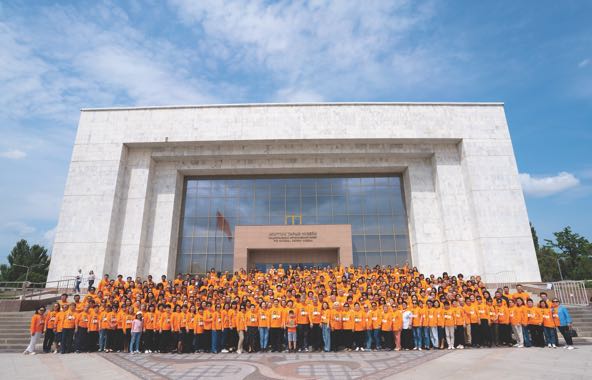 Bilimkana Foundation staff, schoolchildren, and teachers gather outside the Kyrgyz State History Museum in May 2022. (Photo by Samat Durusbekov)
Bilimkana schools offer both elementary and secondary education from grades 1 to 11. The first schools signed up students at different ages across all education levels. In recent years, new schools tend to start with younger students to avoid the economic hardship of having only a few higher-grade students joining them for a class.
The Bilimkana schools occupy a unique space distinct from both traditional public schools, which are perceived as retaining outdated Soviet curriculum, teaching methods, and facility standards, and high-fee international private institutions. This positioning is characterized by the foundation’s mission, funding model, educational philosophy, and pedagogical environment. Each school prominently displays Bilimkana’s core principles for creating a “generation of the global world,” where every person:
- Is free
- Has her/his own position and respects the position of others
- Thinks critically
- Speaks several languages
- Is communicative and mobile
- Loves her/his motherland and belongs to its identity
- Feels close to culture and arts
In contrast to the traditionally large class sizes in public schools, often ranging from 40 to 70 students, Bilimkana classes typically have around 15 to 25 students, allowing for a more individualized approach. Classes are trilingual—Kyrgyz, Russian, and English—with emphasis on one additional international language such as French, German, Chinese, or Japanese. Students are encouraged to challenge authority and to develop critical-thinking skills, and are actively involved in school governance, budgeting, and decision-making through a student parliament or government.
The schools also promote inclusiveness, which is a challenging topic in post-Soviet countries, where disability is often overlooked or denied. One parent shared the story of her son, who lost an eye in an accident. After rehabilitation, his state school refused to continue teaching him, instead suggesting a specialized institution for people with disabilities. The family was forced to find alternatives. “This school appealed to my son,” the parent said. “First, by its appearance. Second, by the fact that they kindly accepted him and didn’t consider his disability a problem.”
This principle is also reflected in the school’s pricing model. Twenty percent of Bilimkana students have full scholarships. Annual fees vary from $400 to $2,500, based on the economic context of the community, and they include transportation by bus and meals. In this way, more expensive schools in city centers help finance schools in remote areas.
The structural designs also support Bilimkana’s mission. Schools are built in new structures or heavily renovated old Soviet factories, offering modern infrastructure, Wi-Fi, well-equipped classrooms, and facilities for sports, arts, and events. This architecture also emphasizes the goal of turning schools into cultural centers where the entire community comes together. To embed values of openness and transparency, classrooms feature large glass windows instead of traditional walls, allowing teachers, parents, and visitors to observe activities directly. Art—much of it created by students—is displayed throughout, creating a colorful, lively, and welcoming environment.
Aivanism as Cultural Movement
The publicity of student-created art in the schools reflects Tolon’s larger vision of encouraging a native Kyrgyz artistic culture for the country as a whole—a goal shared by his film-industry work creating Oy Art. The philosophy behind his vision is Aivanism, from the Kyrgyz word aivan, meaning “wild” or “animal.” It constitutes the cultural and philosophical pillar of Tolon’s integrated transformation approach for Kyrgyzstan, operating alongside the economic pillar (Labnet) and the educational pillar (Bilimkana schools).
Tolon realized this philosophy primarily through the Tolon Museum of Modern Art (TMoMa). He got the idea for a museum around 2004, when he started his film company. He registered the museum in 2011 and then spent several years scouting local artists and collecting a large number of contemporary artworks for it. But finding a location that fit his emerging vision took the longest time. In 2021, he finally bought a 20,000-square-meter abandoned Soviet winery in the village of Kun-Tuu, just outside Bishkek, and transformed it into TMoMA. The museum opened to the public in 2023 to function not merely as a repository for post-totalitarian collections but as the operational center for Aivanism—a radical, evolving art manifesto intended to forge a distinct, self-confident Central Asian modernity and foster critical thinking within the wider Bilimkana educational ecosystem.
The museum supports and showcases Aivan artists. It aims to articulate a distinct Kyrgyz identity and modernity that is neither merely a rejection of the Soviet legacy nor a mere copy of Western cultural trends. Aivanism encourages people to think and reflect for themselves—a challenge in a post-Soviet society that has long been taught not to question, but simply to follow rules. A gathering of artists and thinkers, including Tolon and, most prominently, Gamal Bokonbaev—Kyrgyz artist, designer, culturologist, and now curator of the Tolon Museum of Modern Art—articulated the tenets of the philosophy in the years prior to opening the museum. An Aivan must be a “reflexive person,” Bokonbaev says, with the intellectual freedom to question the status quo and be capable of critical thinking. Artists are expected to emphasize raw expression over unnecessary aesthetics or perfection. They should embrace being “wild” and “fast,” and taking a “crazy artist point of view,” Bokonbaev adds, with the confidence to pursue their own ideas.
The museum facility itself embodies this conceptual shift, being located in the spaces of a former Soviet industrial enterprise. The choice of venue is intentional, reflecting a commitment to transforming old Soviet spaces. The large factory has been refurbished minimally for safety and convenience, symbolizing a movement against standardized, typical museum halls. The museum focuses on collecting and creating anti-totalitarian art that directly reflects and reacts to the current political and social realities of the region. This emphasis ensures that the art is socially relevant, counteracting the post-Soviet tradition of art avoiding public life and political commentary.
The museum’s ARTKANA Artist Residency Program supports the development and creation of new artistic work across Kyrgyzstan. It provides artists with space for reflection and creativity concerning the pressing issues of post-Soviet society. The thematic focus includes addressing struggles related to freedom and free expression, oppression, human rights, civic rights, and anti-totalitarian art projects. In this way, the program aims to shift Kyrgyz visual arts in Kyrgyzstan away from abstraction and toward work rooted in specific, positive social problem-solving.
Synergies and Scaling
By cultivating students and artists to become an educated and cultural vanguard for a Kyrgyz renaissance, Tolon has realized the vision he had back when he decided to found Bonetsky Laboratories, the enterprise that became Labnet. Tolon intentionally launched the medical-laboratory business to generate the capital required for the nonprofit aspects of his mission: building and maintaining the Bilimkana network of schools and operating and developing the Tolon Museum. Both are legally nonprofit entities. Considered individually, the three pillars—the business, schools, and museum—have enormous impact.
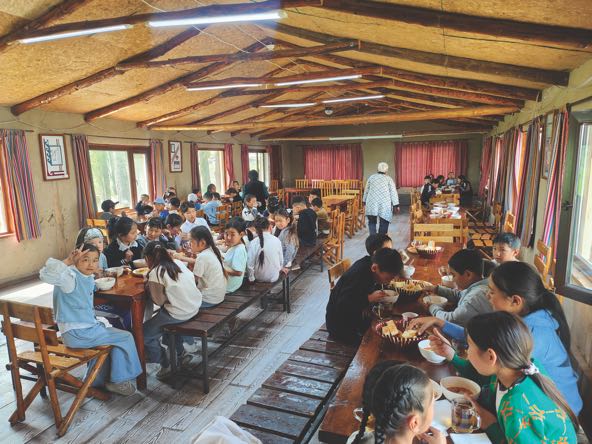 Students at the first Bilimkana school in Shabdan village in Kyrgyzstan's Kemin region eat a meal together in May 2025. (Photo by Christian Seelos)
But Tolon also designed them to promote important synergies. Bilimkana students, as well as students from the Kyrgyz State Medical Academy, spend time in the Labnet spaces for real-world science and business projects. They also visit the “science park,” a dedicated space with glass walls and monitors that enable students to observe laboratory operations. It showcases the technology and automated processes involved in modern medical diagnostics. Not only do students gain practical experience, but also the laboratories cultivate potential future employees. The collaboration involves other local and international universities and business schools as well. Students utilize large-scale lab data, which builds human resources in technology and medical applications, competencies that are lacking in Kyrgyzstan.
Bilimkana schools maintain strong ties with the Tolon Museum. Students attend lessons related to art and culture at the museum campus. While Labnet’s science park focuses on biotech and scientific skills, this art park emphasizes soft skills and emotional work. Students can engage with artists in residence, reflect on contemporary art, and attend various exhibitions. Some of the art is displayed on school walls, to expose students and encourage them to develop their spirits and ambitions.
Through such integrated pillars, Tolon seeks to create a new generation with an outlook to disrupt the status quo and overcome post-Soviet legacies. Aivanism is reflected not only in the cultural pillar but also in the mission of the Bilimkana schools. The movement explicitly targets developing students who possess critical thinking and are creative and cultured. This synergy fosters a shared cultural identity centered on confidence, self-mastery, and a global perspective, rejecting the constraints of imitating others or focusing solely on inwardly ethnic art and local legacies. Nurturing these attitudes directly supports the educational goal of creating a “generation of the global world” who are multilingual, communicative, and mobile.
While Tolon ensures that the pillars remain connected and realize synergies, each pillar also has its own independent pathway and growth dynamic.
Labnet rapidly expanded in the years following its founding and established itself as the largest private medical-lab business in Kyrgyzstan. The Bonetsky Laboratory operates central facilities in Bishkek and Osh, as well as a vast network of blood-collection points across the country, all connected through a digital laboratory information system. Around 2010, the network’s growth significantly accelerated through private-equity investment funds. Investors included multilateral development banks, such as the European Bank for Reconstruction and Development (EBRD) and the Sovereign Wealth Fund of Kazakhstan (Samruk-Kazyna). The International Finance Corporation (IFC) also participated.
However, this expansion did not go smoothly. Tolon teetered on bankruptcy several times due to regional instability and currency turbulences, particularly in 2014, after Russia’s annexation of Crimea in Ukraine.
But he was able to weather the storm. Today, Labnet operates in various countries in Europe and Asia and has more than 5,000 employees serving 10 million patients annually for medical testing. The diagnostics business continues to grow through technological and educational integration. Investments beyond standard diagnostics, such as complex cytology and histology services, the launch of genetic testing, and a pathology AI that helps diagnose several types of cancer, are opening new markets, attracting international business and technology partners and investors.
To finance the growth and expansion of his schools, Tolon initially planned to lean on his businesses. Friends whom he had invited to sit on his board and tasked to provide critical feedback for his decisions warned him about running the schools “the Kyrgyz way” by offering school services for free or for a very small fee. “What if you die?” they asked. “What if you go bankrupt? And if you don’t want to continue this project, what will happen?” At the same time, the board members were also concerned that parents would lack interest in free schools because they had low expectations about public schools. Teachers might lack motivation, knowing that parents did not pay a substantial fee.
To make the school network financially resilient, Tolon implemented higher fees and cross-subsidization. “In the beginning, parents covered 30 percent and I paid 70 percent of costs,” Tolon says. “Today, parents pay 70 percent, and 30 percent is covered by the profitable schools in city centers.”
Despite fees that were significantly higher than those of public schools, the network expanded rapidly. By 2015, it had grown to eight schools. Today, the Bilimkana network comprises 17 schools; employs 950 people, including 700 teachers; and serves over 5,000 students. The Bilimkana Bishkek school alone has 828 students across five buildings. Forty percent of Bilimkana graduates attend universities in the United States, Canada, and Europe; another 40 percent study at the American University in Central Asia; 10 percent attend a university in Bishkek; and 10 percent attend one in Moscow.
As for Tolon’s cultural goals, the growth and future plans for Aivanism, the Tolon museum, and his film-industry work are inextricably linked, forming the cultural pillar of a large-scale ecosystem dedicated to societal transformation through the cultivation of a unique national identity and critical thinking.
The museum has incorporated new buildings and connects them via bridges. Its collection now contains over 3,500 unique pieces, spanning paintings, installations, objects, and films. The museum has ambitious future plans centered on achieving a global presence and demonstrating transformative potential. The Guggenheim Museum Bilbao has greatly inspired Tolon, who hopes to achieve a “Bilbao effect,” where a single, highly visible world-class art institution fundamentally changes the mentality of an entire region by making modern art and thinking pervasive, even influencing surrounding infrastructure, such as roads and airports. However, unlike the new contemporary-art museums in neighboring countries, where wealthy businessmen often acquired works from artists who had exhibited in Bilbao or through prestigious art auctions, Tolon seeks to show the world that Kyrgyz individuals can create a global project grounded in local art. The museum plans to establish a second location, possibly in the United States or France.
Tolon remains heavily involved in expanding his film projects. In 2005, Oy Art initiated discussions with other film producers that led to the creation of the “10+ group,” a body formulating a film development strategy beyond the next 10 years and developing the strategic program “Cinematography of Kyrgyzstan—2010.” This strategy was based on replicating Oy Art’s success—finding independent financing and aiming for global standards and scales—and applying it to the entire Kyrgyz film industry. The goal was to create a robust film sector with diverse players who focused on high-quality, festival-level films that would enhance the country’s reputation.
Oy Art has produced both short and feature films. Notable productions include The Border (2005), which won several Commonwealth of Independent States film-festival prizes; Pure Coolness (2007); The Light Thief (2010); Heavenly Nomadic (2015); and Centaur (2017). Its films have achieved substantial international success and won prizes at major international film festivals, including the Cannes Film Festival, Berlin International Film Festival, Locarno Film Festival, and International Film Festival Rotterdam. Four films produced by Oy Art have been selected for Kyrgyzstan’s official entry to the American Academy Awards (Oscars).
The event organization Post Space promotes Oy Art films. Post Space’s film festival shows films from Central Asia and post-totalitarian countries to international decision makers in the film industry. It provides a space for emerging talent to flourish and contribute to the diversity of the global film landscape. The festival has drawn leading figures from the international film-festival circuit and film industry. In addition, Post Space explicitly promotes Aivanism and seeks to establish the movement as a globally recognized phenomenon.
The Stepping-Stone Strategy
Tolon’s world provides a compelling example of a bold transformation effort in an unstable context. Following his decisions and actions offers a tremendous opportunity for learning, engagement, and support for organizations interested in effective large-scale development efforts.
 Local artist Mirlan Sheishenbaev works on his installation Pipewhirl (2025) at the Tolon Museum of Modern Art. (Photo by Artur Bolzhurov)
Specifically, Tolon’s approach expands our understanding of system-transformation archetypes, as elaborated by coauthors Christian Seelos and Johanna Mair in our 2018 Stanford Social Innovation Review article “Mastering System Change.” There we discussed two archetypes, “changing a system by building a system,” exemplified by Egyptian development organization Sekem, and “changing a system by isolating a subsystem,” exemplified by Indian NGO Gram Vikas. Tolon’s transformation engine, by contrast, rests on laying down stepping stones over time. His three pillars—like stepping stones—advance systems change in a stepwise fashion, enabling people to do things at each step that they would otherwise be unable to do. Collectively, they achieve transformation at several levels. The businesses, the schools, and the Aivanism movement transform how people think and act individually, as well as how professional and local communities come together. Schoolchildren hang out with Labnet scientists and managers. Parents, their children, and locals from villages come together for special events at Bilimkana schools. Artists often take residency at the museum and form an important community that jointly explores and realizes the ideas of Aivanism.
Transformation also happens symbolically. Instead of building new modern architecture, Tolon often acquires old Soviet structures and turns them into creative, colorful, and warm places, tangibly demonstrating how transformation is enacted without ignoring or destroying what exists. He also builds new structures that visibly represent aspects of a desired transformed state, such as high-tech labs, science parks, and modern schools in city centers. Collectively, these layers of transformation make his vision visible to politicians, businesspeople, and civil society.
Because of the ambitious scale of his effort, Tolon is directly exposed to numerous drivers and resisters of change in his country. Gaining a sense of temporary and local control is essential for making progress. The stepping stones provide resilience and sustainability, serving as a stable foundation and a controlled space that Tolon and his teams manage. His businesses, the school network, and the cultural movement consist of elements that facilitate real progress by shielding people from external influences and providing room for exploring new possibilities. Individually and collectively, they transform people’s thinking processes, values, and ambitions, and they enable, trigger, and socialize new behavior.
Because of the value they create for various constituencies, the stepping stones cannot easily be removed by actors who do not support Tolon’s mission. His businesses and schools provide critical public goods that the government may be hesitant to shut down. The synergies among the stepping stones establish a robust environment for transformation. Pillars that depend on and support each other as part of a larger mission help manage risks, create resilience during tough times, and build power and influence—critical assets for surviving in an unstable world. This environment also helps reduce and counteract the resistance of systems to change, such as tendencies to romanticize the past, revert to old Soviet ideologies, or succumb to forces resisting transformation.
An essential element of Tolon’s transformation engine is his financial independence, which allows him to set priorities, take risks, and recover from close calls. Tolon considers reliance on philanthropic funding a structural weakness for mission-driven individuals and organizations. Investing in building the economic pillar first may lay a stepping stone that enables getting started quickly, at the speed of business decisions, and developing the competencies and financial resources required to scale and grow the overall transformation approach. The stepping stones also create multiple channels for various local and international actors to enter and contribute a variety of resources to Tolon’s world.
How will this effort unfold in the next decade? Tolon continues to find new ways to shift the norms and capacities of 2-3 percent of the working population—his educated vanguard—enabling them to drive decisions and actions that propel Kyrgyzstan toward a prosperous future of its own making. However, his efforts are currently facing a stiff headwind. Transparency International warns that Central Asia continues to be plagued by a “vicious cycle of weak democracy and flourishing corruption.” Kyrgyzstan, specifically, is threatened by “constitutional changes significantly expanding presidential authority, weakening parliamentary oversight and facilitating unchecked corruption,” Transparency says.
Russia’s efforts to bolster its regional influence, whether in Eastern Europe or Central Asia, threaten movements seeking emancipation from the Soviet legacy. In Kyrgyzstan, Russia is increasing investments in key industrial areas, opening more Russian-language schools, and expanding security-related collaboration. The European Union has recently sanctioned Kyrgyz banks for facilitating the evasion of Russian sanctions. The geopolitical implications merit careful monitoring.
Finally, Tolon’s efforts offer inspiration for improving the effectiveness of development innovations, as articulated by coauthor Christian Seelos, Tanya Accone, and Stuart Campo in their 2024 SSIR article “Innovating for a Healthy Context.” Healthy contexts are social environments, such as communities or states, that enable people to thrive and pursue what they value. Current philanthropic and development approaches often appear stuck in a cycle of offering more solutions for an endless stream of problems arising from unhealthy contexts. The future of our collective efforts will be shaped by our ability to create healthier contexts that prevent fundamental problems from occurring in the first place. Tolon’s innovations may help his country heal from a stifling legacy and break free from its tendency to produce instability and a continuous flow of old and new problems.
Part of this work was supported by the EU-funded Marie Skłodowska-Curie Actions Postdoctoral Fellowship, Horizon Europe (GA No. 101107530, SoEco4Dev).
Read more stories by Christian Seelos, Nazik Beishenaly & Johanna Mair.