


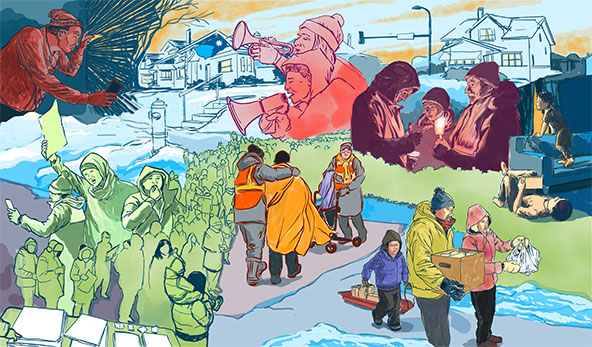
 (Illustration by Mike Hoyt)
In the past year, philanthropists have been forced to ask what we do when the ground shifts beneath us, and the crisis in our home communities touches every aspect of life. Each of our cities lived through something no American community should have to endure: Large-scale federal immigration enforcement operations that took lives, separated families, tested our constitutional freedoms, undermined businesses and jobs, and strained the limits of our civic infrastructure.
In the face of these conditions, our philanthropic responsibility has had to evolve, to balance mitigating immediate harm with advancing long-term mission. How to act decisively amid legal and political uncertainty (and the erosion of the rule of law)? This is our new reality. Every one of us must adapt and respond.
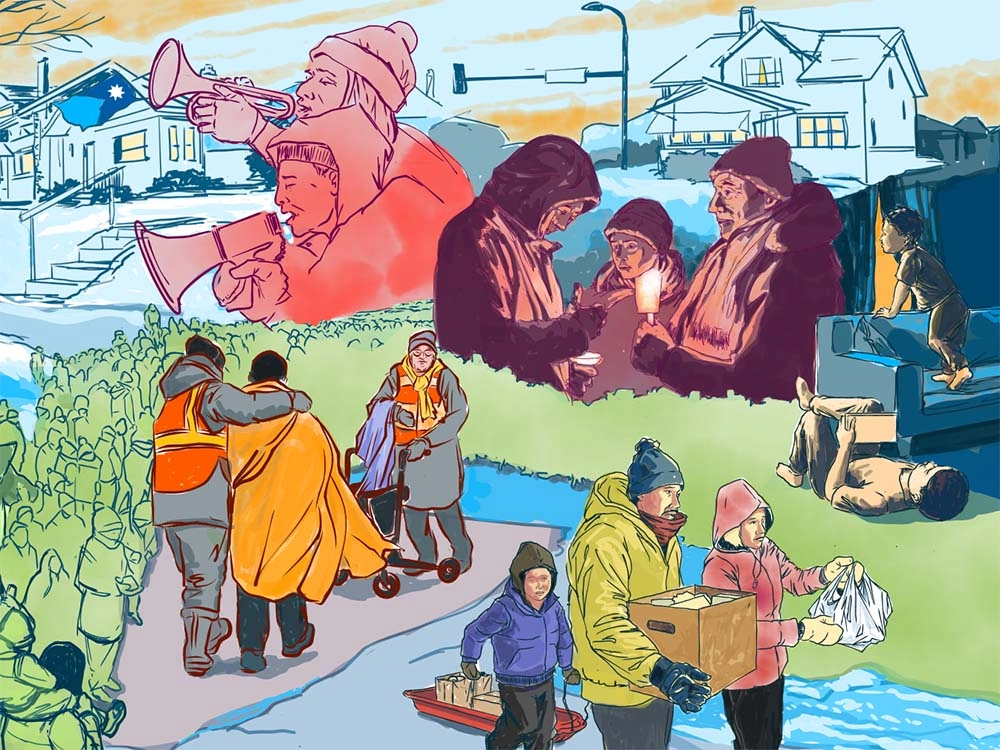
What we’ve witnessed in Los Angeles, Chicago, and Minneapolis (and beyond) is merely the prelude to what is still coming. When a government decides that some residents can be stripped of due process, rounded up without warrants, held in inhumane conditions, and face no legal check and no political consequence, it has already established a template for undermining American democracy and our nation’s highest ideals. However, the response of our communities offers us a playbook. Neighbors showing up for neighbors, diverse sectors uniting, and immigrant- and people of color-led organizations building mutual aid networks with remarkable speed and effectiveness.
Institutions must now be just as brave. We write this as three foundation presidents whose communities’ civic infrastructure is holding, but not without strain. What follows is a set of hard-won lessons from three cities about what it takes to protect and prepare communities, defend democracy, and stay ready for the next fight.
1. Preparation Is a Long-Term Investment
What looked like rapid coordination was actually the result of the sustained, general operating support for our grantees that had prepared them to withstand a moment like this. In 2024, when the California Community Foundation mapped the landscape of immigrant and civil rights defenders across the state, we found exhaustion, high leadership turnover, and significant gaps in regional coverage. The strategy was clear: raise money quickly, make it accessible, and close the gaps. One gap that stood out was underinvestment in the Central Valley and Central Coast regions of the state: Through funder organizing, we were able to target resources where communities needed them most, doubling the amount that went to support these regions with $25 million directed toward the Central Valley and $24 million to the Central Coast.
When the immigration enforcement raids began in Los Angeles, the rest of us knew we could be next. In Minnesota, immigrant-led and immigrant-serving organizations had sounded the alarm months before Operation Metro Surge arrived; McKnight heard them and moved resources accordingly. The Immigrant Defense Network, COPAL MN, Unidos MN, Fe y Justicia, and CAIR-MN built legal clinics and trained people on how to exercise their constitutional rights and de-escalate violence. By the time of the surge, more than 30,000 Minnesotans had already been trained as constitutional observers, volunteers armed with nothing more than phones and whistles.
It is because of their bravery that we have video footage and eyewitness accounts that reveal the truth of what happened on our streets. It is the reason we know the names Renee Good and Alex Pretti, both shot and killed by federal agents.
Preparation also means investing in democratic infrastructure. Since 2023, MacArthur, Knight, McKnight, and many other foundations have supported Press Forward, a national initiative with state and regional chapters keeping local newsrooms open, resourced, and growing. Local journalism is oxygen for democracy, allowing people to make safe decisions and hold institutions accountable, and those investments paid dividends. The Chicago Sun-Times broke important ground in reporting on Gregory Bovino’s background when little information about him was publicly available, which Press Forward supported. Outlets like L.A. TACO, THE RAID, and Sahan Journal (also supported by Press Forward) were the windows through which the rest of the country watched the worst of what a government can do (and the best of what a community can be).
The question every funder must ask now is whether the communities they serve are ready, and what they need to be. Every investment should be in service of that answer.
2. Community Readiness Requires Trusting Communities
Our sector has a habit of letting planning distract from taking action. But community leaders in each of our cities showed us that there was no need to reinvent solutions or issue requests for proposals to find the right partners. We just need to connect to the people already doing the work and be ready to resource them.
Immigrant and refugee-led networks have been on the frontlines of moving money, food, services, and care to those in need. Mutual aid networks and crisis response funds like Stand With Minnesota, Immigrant Rapid Response Fund, and the Los Angeles Neighbors Support Fund moved faster than any formal system ever could, raising and distributing millions in funds and in-support for urgent needs like food, housing, and essential surges, as well as legal support and community safety resources. The Illinois Coalition for Immigrant and Refugee Rights led Know Your Rights training and hosted a Family Support Hotline staffed in more than 20 languages.
We did not build these networks. We backed the people who did.
When circumstances demand it, we must also be willing to give resources directly to families, as we saw during the COVID pandemic. However, this time—when people were trapped in their homes for months, when businesses lost customers—and workers—and shut their doors, and when paychecks stopped, even though rent was still due—there was no government relief, only government provocation.
For McKnight, direct relief had never been part of our model, but we listened to the need and adapted by deploying millions in emergency rent and utility bill relief: $2.6 million to keep Minnesota families housed—moved through trusted partners like the Family Housing Fund, Neighbors Helping Neighbors, and Esusu to deliver rapid grants alongside a revolving fund of zero-interest microloans, and a $300,000 grant to the Citizens Utility Board of Minnesota's Lights On, Homes Warm fund as Cold Weather Rule protections expired and households across the state faced a collective $156 million in past-due utility bills. Each investment was designed to meet an immediate need while seeding longer-term stability for families. For us, the acute crisis is directly connected to our long-term mission and affirms the need for philanthropy to deliver tangible benefits in people’s lives today.
3. Protecting Democracy Demands Coalitions as Deep as the Threat
Attacks on immigrant communities are attacks on democracy itself—on due process, on the rule of law, and on the principle that people cannot be detained by masked agents. Responding requires a coalition that is broad and deep, rooted in the most affected neighborhoods and connected to the small businesses, faith communities, and block-level organizations that sustain civic life.
United for Chicago demonstrated what that looks like in practice. Built with MacArthur's support, the coalition spanned business, philanthropy, civic organizations, nonprofits, and faith leaders, and was designed around the everyday people, organizations, and small businesses that anchor communities. Together, the coalition responded to tactics that break civil norms, such as due process and basic human dignity, by speaking with a unified voice, when needed, and tapping into sector expertise on specific issues without splintering. The Resurrection Project prepared communities for anticipated immigration raids by expanding its removal defense team, launching rapid response legal workshops, and creating an online portal for community members to report enforcement activity. The Illinois Restaurant Association and the Illinois Hispanic Chamber of Commerce created the #ChicagoBitesBack restaurant guide to show solidarity and invest in independent businesses significantly impacted by federal immigration agency tactics. They made clear that Chicago would not be divided against itself.
In Minnesota, no single actor or entity was responsible for how the region navigated the moment. Everyone played a part. Much of that capacity traces back to lessons learned in 2020, from the neighbor-to-neighbor communication networks, neighborhood groups, and parent associations that formed in response to George Floyd's murder, which never fully dissolved. Our community’s agility in raising and deploying resources is tied to this moment as well.
You cannot spend a crisis forging alliances or finding your way into communities. By the time the moment arrives, those relationships must be firmly in place.
4. Images Must Be MADE to Be Worth a Thousand Words
Images and stories make the human cost of injustice undeniable in ways that op-eds and think pieces cannot. One of the most defining images of the anti-immigrant crackdown was of 5-year-old Liam Cornejo, in his unmistakable bunny hat, the hands of a federal agent on his shoulders.
Our platforms can make moments like these impossible to ignore. In Los Angeles, the California Community Foundation turned its own building into a statement, projecting billboard-sized stories of people impacted by enforcement operations onto its downtown headquarters, alongside the faces of ordinary Angelenos and a single question: Am I Next? McKnight launched the Best of Minnesota campaign to tell a different story than the one being broadcast nationally. Drone footage of the marches reached millions—sweeping, undeniable images of ordinary families and neighbors standing together in subzero cold to defend their community and their country.
Being a funder and convener is not enough. We have to be leaders unafraid to use our voices and our visibility to make sure the human impacts are seen, amplified, and connected to the larger story being written.
5. If We Are Not Taking Risks, Who Will?
There was a time when it would have been inconceivable for the federal government to be overrunning neighborhoods in American cities. That time is over, and standard operating procedures no longer cut it. We cannot let theoretical risk overshadow real harm when the unthinkable is already happening.
We saw everyday people respond to extraordinary risk with extraordinary courage, not waiting for permission or a strategic plan. Foundations have to be willing to do the same: to adapt, to move quickly, and to match the boldness of the people we exist to serve. Across our three foundations, that has meant defending individual rights, due process, and civil liberties through investments in legal services and organizations. It has meant supporting work that strengthens democracy and community, even when doing so invites scrutiny from the very forces seeking to undermine them.
The unbreakable spirit we witnessed in our three cities reminded us of why our cities were targeted in the first place. They are places made stronger by people of many cultures, experiences, and talents, working and living side by side. If philanthropy is looking for an opportunity worthy of risk, it is investing in people and communities who refuse every effort to divide them.
An Era of Permanent Disruption
Efforts to divide, destabilize, and overwhelm communities have not been (and will not be) limited to federal enforcement actions. Our cities were also absorbing the shocks reshaping the country at large: volatile markets driving up the price of gas and groceries, rapidly advancing artificial intelligence, diminishing federal services and resources, and a fragmented media environment. Navigating overlapping pressures that compound one another demands that we think and act across the full complexity of community experience.
Foundations that stay in traditional lanes—responding only to what they have historically funded, or that allow risk to outweigh courage—will not be equal to this moment. These five lessons are more than a playbook for when a crisis comes to your town. They are a posture for an era of permanent disruption: investing early and in community leadership, building coalitions before you need them, using your voice and your visibility freely, and being as brave as the people in the streets.
Read more stories by Tonya Allen, John Palfrey & Miguel Santana.