


 (Illustration by Tracy Walker)
If you want to predict how long someone is going to live and how healthy they will be throughout their life, find out their address. All around the world, it is becoming increasingly clear that postal codes predict health and well-being. Communities’ human, social, and financial assets determine their residents’ opportunities to enjoy safe parks and playgrounds, live in affordable housing, drink clean water, and shop in stores that sell healthy and affordable food. These community characteristics do not just influence the well-being of adults but also predict the opportunities children will have to attend good schools and participate in extracurricular activities like sports teams and youth groups.
Because of the strong correlation between these community characteristics and residents’ health, a growing number of grant makers are shifting their resources to focus on equity in order to build healthier communities. These funders aim to reduce barriers and create greater opportunities for well-being, educational achievement, and economic mobility. This equity-attuned grantmaking approach is committed to distributing more resources to the most socially and economically distressed communities.
Evidence suggests that the most distressed communities are not benefiting from the shift in philanthropic resources. University of Michigan professor of social work and public policy Luke Shaefer, along with colleagues at Princeton University, developed an Index of Deep Disadvantage to identify the most disadvantaged communities in the United States. They found that while grant makers can name some of these communities—Flint and Detroit in Michigan; Cleveland, Ohio; and Camden, New Jersey—most remain invisible. The 100 most disadvantaged communities are on tribal lands or clustered in less densely populated geographic regions, like Appalachia and the Mississippi Delta. These communities are in what we call our “blind spots,” and, as Shaefer and his colleagues have contended, “our poverty policies suffer when social science research misses so many of the places with the greatest need.” 1
Grant makers have historically devoted fewer resources to less densely populated suburban and rural communities, even though they may be just as distressed as, if not more so than, their urban counterparts. Indeed, the 2007 Rural Philanthropy report notes that while rural areas are distressed and increasingly diverse, distance and isolation have made philanthropy “heavily skewed toward urban areas.” A 2015 Economic Research Service study of more than 1,200 of the largest foundations in America supports this finding, stating that “the average real value of grants to organizations based in nonmetro counties from 2005 to 2010 was about $88 per capita, less than half the average [$192 per capita] given to organizations in metro counties.”
We believe that philanthropy suffers from a blind spot. Even when grant makers are focused on equity, the examples above suggest that they are likely to systematically overlook the most distressed communities, which are in more rural areas across the United States. Philanthropy is unlikely to achieve its equity aims when the people living in communities with the greatest needs are getting fewer grant dollars than those living in more advantaged communities.
In what follows, we test the blind spot hypothesis for one statewide funder, New Jersey Health Initiatives (NJHI), a statewide grantmaking program of the Robert Wood Johnson Foundation (RWJF), the nation’s largest philanthropy focused exclusively on health. Using our backgrounds as researchers, practitioners, and grant makers, we show how two aspects of distress—lack of human capital and economic disadvantage—predict communities’ likelihood of both applying for and receiving funding.
Our results confirm this blind spot where the most distressed communities are the least likely to apply for funding. After presenting the data for this case study, we explore the reasons for these inequities and provide real-world examples of how funders can successfully modify their operations and programming to better serve these communities.
This analysis is particularly timely because the COVID-19 pandemic has magnified the inequities that exist between communities and the work required to increase opportunities for healthier lives. As RWJF president and CEO Rich Besser wrote in a Washington Post op-ed last year, “even when structural failures could imperil every American, the greatest strains [due to the coronavirus] will fall on certain demographics because of their economic, social, or health status.” The state of New Jersey has at least 17 funding pools established to respond and recover from the COVID-19 crisis. However, some of the most disadvantaged communities in the state did not secure funding because they either did not apply or were too slow to apply and the funds were already allocated.
This COVID-19 response and recovery effort demonstrates how grantmaking may contribute to widening the gap between communities that are distressed but have the capacity to make themselves seen by grant makers and the most distressed communities, which lack that capacity. Grantmaking organizations need the tools to make equity-attuned funding decisions that can alleviate this strain and reverse this widening gap.
Two Traditional Approaches
The two most commonly adopted approaches to grantmaking are person-based and place-based funding. In the person-based approach, grantmaking focuses on providing resources directly to individuals. In some cases, individuals use resources to move to “opportunity zones”—communities where there are better opportunities for goods like education, housing, health care, and employment.2 However, as Harvard sociologist Robert Sampson observes, “The real conundrum is how to address the larger structural realities of inequality and not just try to move people around.” 3
One problem with the person-based approach is that the ability to move to an opportunity zone assumes proximity. For those in distressed areas, the nearest opportunity zone could be dozens of miles away and, consequently, could require movers to sever access to social networks that are vital to their mental and physical health.4
By contrast, the place-based approach aims to reduce distress by investing in communities, instead of individuals. Traditionally, this investment is accomplished by funding a local nonprofit to address the causes of inequity and increase opportunities for health and well-being. A well-known example of a nonprofit funded through the place-based approach is the Harlem Children’s Zone (HCZ), which seeks to improve education, health, and economics for children and families living in Harlem. The Atlanta Regional Collaborative for Health Improvement (ARCHI) is another successful example. It works with community leaders in health and education to create and sustain a more vibrant Atlanta.
Place-based approaches capitalize on the thousands of community-based nonprofits in the United States that are dedicated to making neighborhoods safer, increasing access to primary care, and providing affordable childcare. As we will show, communities that have an abundance of human capital are more likely to have community leaders and organizations rally around a shared agenda, like HCZ and ARCHI, and bring their needs to the attention of philanthropists. But what about the most distressed communities, which lack such assets? They are more likely to fall into a philanthropic blind spot in which they cannot even formulate their most important needs and communicate them to grant makers.
Measuring Distress
Philanthropy is accountable to fewer governing bodies and less transparent to public scrutiny than other sectors, which may partially explain why it has been slower to use research to drive its agenda or evaluate its efforts.5 To address this shortcoming, we devised an analytical method to determine whether grant makers are meeting their goal of funding the most distressed communities. The first step is to define what it means to be a “distressed community,” based on what we identify as the most significant indicators of distress: economic disadvantage and lack of human capacity.
The role of economic disadvantage in a community’s distress is so fundamental as to be intuitive. Communities’ economic assets shape the quality of children’s schools, the affordability and safety of housing and public recreational spaces, and businesses’ financial stability to provide steady employment opportunities.6 To conduct our analyses, we used the Opportunity Index, an annual report by the bipartisan policy campaign Opportunity Nation that provides data about what opportunity looks like in the United States. The index offers a multigenerational measure of economic mobility and reflects ongoing and persistent economic challenges, rather than a brief economic downturn.7
The role of human capacity in a community’s distress may be less intuitive but is just as important. We define human capacity as the skills, training, and experience of individuals within a community, as well as the organizational capability to harness and deploy those skills.
To see why human capacity is important, consider that nearly all grant makers require organizations to apply for grant dollars. So, the ability to receive funding relies on the presence of individuals or institutions with the capacity to apply for them. Few smaller and rural communities have the expertise and nonprofit infrastructure of a community-based nonprofit. Less densely populated communities also have fewer community-based organizations.8 In other words, they have fewer nonprofits with both the expertise to secure funding and the readiness to develop and implement projects that address macro health challenges like the opioid crisis, childhood lead exposure, and high school graduation.9 Furthermore, nonprofits play a valuable role in shaping how communities respond to upstream health challenges, such as crime and violence.10
In addition to infrastructure, fewer individuals outside densely populated metropolitan areas have the expertise to craft successful funding applications. Even after controlling for the presence of colleges and universities, other researchers have shown a positive correlation between the proportion of adults with a college education and grants per person in a county.11 And rural areas tend to have a less educated population than urban areas. Moreover, many smaller communities and organizations applying for grants experience a resource cost problem, wherein the administrative effort required to get a grant outweighs the value of the grant.
These examples demonstrate the importance of including human capacity when characterizing community distress. How to measure human capacity, however, is more complex in terms of potential variables, from including density of nonprofits to percentage of adults with postsecondary degrees. For our approach, we used a continuous measure of rurality developed and validated for the purpose of assessing health equity to determine how isolated a community is.12 To characterize a community’s rurality, this measure incorporates information about nearby communities that could provide capacity.
With these tools, we are able to measure both economic disadvantage and human capacity in a community. These tools also provide a framework to evaluate funding strategies and test our hypothesis that the most distressed communities—those that have high economic disadvantage and low human capacity—are in a philanthropic blind spot.
Who Gets Funded?
To explore potential blind spots in grantmaking, we used funding data from NJHI for all grants made between 2015 and 2018. During this time period, NJHI received initiative-based funding applications for $34 million in funding and granted more than $10 million in funding.
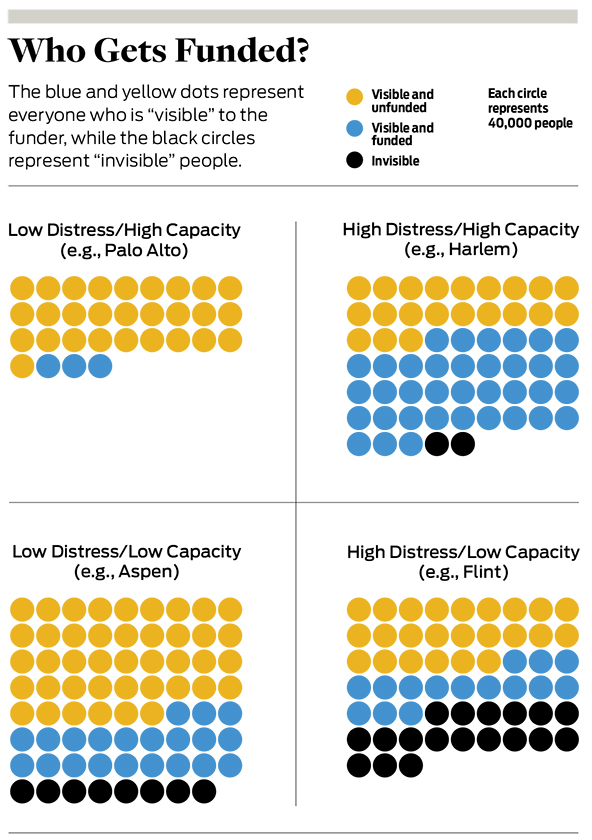
To look for grantmaking blind spots, we assigned each person in New Jersey to one of three groups. People in the “invisible” group live in areas of New Jersey not covered by any grant application to NJHI, such that the area is functionally invisible to funders.13 Those in the “visible, funded” group live in areas covered by successful grant applications, while people in the “visible, unfunded” group live in areas covered by unsuccessful grant applications, since grant makers are potentially aware of these communities even if they do not fund applications. If our hypothesis about blind spots is correct, then disadvantaged communities with low human capacity (such as Flint, Michigan) will be more invisible to funders than disadvantaged communities with high human capacity (such as the Bronx, New York).
To test the hypothesis, we assigned municipalities in New Jersey to one of four national reference groups. The first group is “low economic disadvantage and high human capacity.” These are wealthier, urban communities, like Palo Alto, California. The second group, “high economic disadvantage and high human capacity,” consists of urban areas with high degrees of poverty, such as Harlem, New York, and Newark, New Jersey. The third group, “communities with the most economic disadvantage and the lowest human capacity,” represents the hypothesized blind spot. These are the highly economically disadvantaged, low-capacity communities, like Flint, Michigan. The last group is composed of communities that have low economic disadvantage and low human capacity. These communities are in more rural but wealthier areas, like Aspen, Colorado. We defined the boundaries between quadrants using the median values of economic disadvantage and selecting the boundary for human capacity such that there were approximately equal numbers of New Jerseyans in each of the two quadrants with high distress.
Our analysis reveals that the hypothesized blind spot exists. The blue and yellow dots represent everyone who is “visible” to the funder, while the black circles represent “invisible” people. Many more black circles exist in the bottom right quadrant than in any other quadrant, indicating that people living in the most economically disadvantaged and rural communities are also the most likely to be invisible to funders. In New Jersey, 718,000 people living in the Flints are invisible, compared with 81,000 living in the Harlems. Thus, 30 percent of the people living in the Flints are invisible, whereas only 3 percent of those living in the Harlems are invisible.
A second observation from our findings is that despite its blind spot for the most distressed communities, NJHI is broadly successful in funding economically disadvantaged communities. In this figure, each dot represents 40,000 people. The two “high distress” quadrants on the right have more blue dots than the “low distress” ones, indicating that people living in economically disadvantaged communities are more likely to receive funding than their counterparts living in more economically advantaged communities. Overall, more than two million people (43 percent of 4.66 million) in economically disadvantaged communities are funded, compared with about one million (26 percent of 4.13 million) in economically advantaged communities.
The figure illustrates a third point: To evaluate whether funders are meeting their equity goals, it is important to look at the entire population within a grant maker’s region (black, yellow, and blue circles) and not just compare the characteristics of funded and unfunded applications (yellow and blue circles). To see why, consider the different conclusions we would reach if we excluded the black circles and compared only the yellow and blue circles. If we looked only at ratios of yellow to blue, we would conclude that the Flints are 62 percent as likely to get funding as the Harlems. When we include the black circles, however, we conclude that the Flints are really only 44 percent as likely to get funded as the Harlems.
If funders evaluate their grantmaking by considering only grant applications received, they are likely overestimating their equity in giving. People living in the most distressed areas are also the most likely to be invisible to funders. Even after we account for economic disadvantage, grant applications covering more rural areas are less likely to be successful than those covering urban areas.
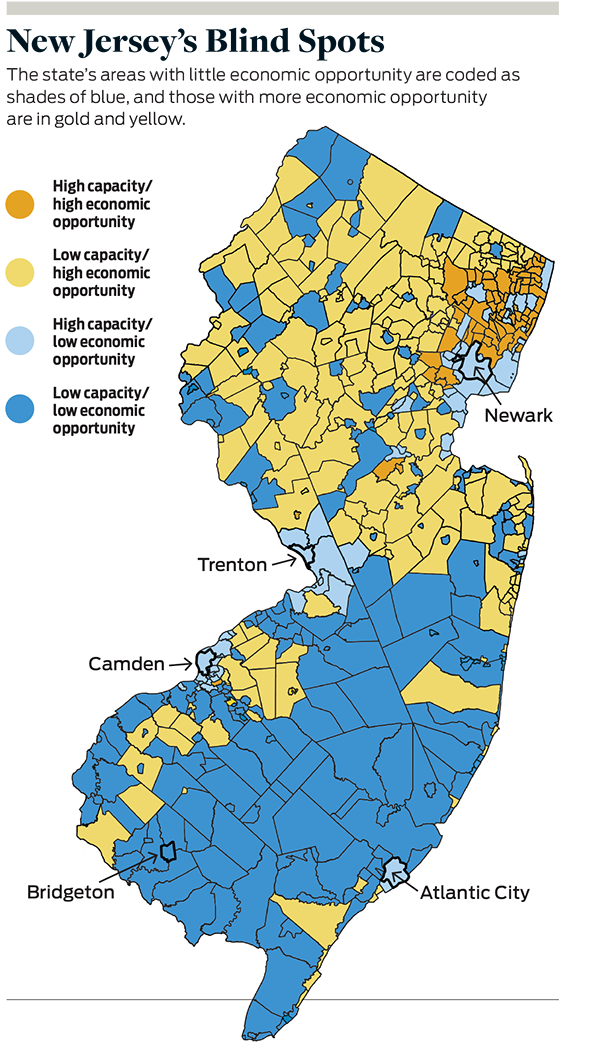
As in the rest of the country, New Jersey’s municipalities span a range of economic distress and have a range of human capital, and its outcomes cluster in different regions. Using the measures described earlier, we mapped New Jersey’s economic disadvantage and human capacity, coding areas with little economic opportunity in shades of blue, and those with more economic opportunity in gold and yellow, using the Opportunity Atlas for data on economic opportunity. The light blue areas are those distressed areas with higher capacity—areas near Newark and Trenton, for example. The gold areas are those with both capacity and higher economic opportunity—the more upscale suburbs of New York City.
Clear regional differences exist. The darkest blue areas are almost exclusively in the southern part of the state. These areas are far away from the economic drivers in Philadelphia and New York City. In contrast, areas like Newark, which are low in economic opportunity but high in human capacity (light blue areas), are located near the urban centers. The areas of high economic opportunity (yellow and gold) are centered mostly in the northern parts of the state.
A Comparative Case Study
We decided to delve more deeply into two specific communities, Bridgeton and Newark. We selected them because they have many things in common (e.g., socioeconomic challenges to health and equity) but diverge in two important ways: the assets they have to address these challenges, and the institutional and nonprofit capacity they have to attract philanthropic resources.
Bridgeton | A small New Jersey community of 24,000 people in the southern part of the state, Bridgeton lies between the Pine Barrens and the fertile farmlands that give the Garden State its nickname. It is about an hour west of Atlantic City and an hour south of Philadelphia.
Bridgeton faces challenges common to many formerly thriving industrial towns. The once walkable downtown is now boarded up; hotels, movie theaters, and department stores lurk under brick facades and painted-over signs. The Latinx population, which comprises 50 percent of residents, adds vibrancy and diversity; small restaurants and retail shops lining the streets reflect the influence of the immigrants from Mexico and Latin America. The surrounding neighborhoods are not within walking distance, and many houses need cosmetic and structural repairs. They tend to be occupied by renters, and, as in many low-income rental communities, landlords neglect to paint, fix pipes, and attend to crumbling sidewalks. Tenants in Bridgeton, however, have little leverage. One-third of them live below the poverty line, and more than a third may be undocumented and unwilling to risk eviction by angering their landlord.
As with many distressed communities, the low-performing school system in Bridgeton is struggling. Only a quarter of Bridgeton’s residents have a high school education, and only 1 in 20 has a college degree. Bridgeton has no anchor institutions, such as universities or health-care systems, and has few people and organizations with the time and skills to assist with the resources required to build a healthier and thriving community.
Newark | Only a few miles from New York City, Newark is the largest city in New Jersey. With 282,000 residents, it is more than 10 times the size of Bridgeton, but it faces many of the same challenges. More than 25 percent of the population lives in poverty, many residents do not feel safe in their neighborhoods, and many older adults are socially isolated and have limited access to nutritious food. In 2019, Newark made national news when water testing indicated that lead had contaminated most residents’ water supply. The city worked rapidly to distribute water faucet filters—the same filters used in Flint, Michigan. Still, further testing showed more contamination.
Despite these challenges, Newark has resources. A 30-minute train ride from New York City, it has a richness and diversity of assets—corporate headquarters, health-care systems, a city health department, two universities, and a county college—that Bridgeton does not have. Whereas 1 in 20 Bridgeton residents has a college degree, 1 in 6 Newark residents does. Anchor institutions like University Hospital, Rutgers University, Prudential Financial, and Panasonic Corporation of America—in addition to museums, restaurants, and other assets—attract talented individuals to Newark and retain some of its best and brightest young people.
The city also has a sophisticated and experienced nonprofit infrastructure. There are 336 nonprofits in Newark, 119 of which have revenue of more than a million dollars per year. The city even has its own philanthropic liaison. Foundations recognize the importance of nonprofit funding—several foundations in New Jersey fund only in Newark and the surrounding metropolitan area. Newark has nonprofits with the readiness to develop and implement projects that address challenges like the opioid crisis, childhood lead exposure, low high school graduation rates, crime, and violence. Bridgeton, on the other hand, has only 20 nonprofits, and only one has the operating and programmatic capacity found in Newark.
Bridgeton and Newark face similar challenges, but Newark has a developed network of organizations and high-capacity people to work on those challenges. Newark knows how to ask for help in its heavy lift. But how can Bridgeton get the resources it needs? What would this city need to bring the right partners to the table, to share resources and collaborate to make housing safer and more affordable, to improve schools, and to make sure children have enough to eat?
Why Blind Spots Exist
Looking at the structures underlying philanthropies and place-based giving offers several reasons why blind spots can arise, despite funders’ intentions. Indeed, the case study happened because co-author Robert Atkins, the director of NJHI, wanted a way to quantitatively test whether funding decisions were consistent with the funding goal of improving health equity.
First, most large foundations are located in metropolitan areas and have built relationships with institutions and organizations in those communities. As noted, Newark has its own philanthropic liaison, and several foundations in New Jersey fund only in Newark and the surrounding metropolitan area. That organizations gravitate toward familiar partners is not unusual.
Second, many grant makers assume that urban centers have higher rates of poverty than rural areas. Moreover, many funders believe that they maximize impact and do more good when their grants go to addressing distress in densely populated areas. The rates of poverty, however, are higher in rural areas than in urban areas. In addition, it would be difficult to demonstrate that a grant going to a metropolitan community to improve high school graduation rates, increase the food security of agricultural workers, or reduce childhood lead poisoning assists a greater number of individuals than if the same grant goes to a nonmetropolitan community. In other words, giving to more densely populated areas does not clearly result in a greater equity return on investment for the grant maker.
Our case study reveals that this aim to be efficient systematically disadvantages populations in less urban, more distressed communities. These communities lack the human capacity to make themselves visible. Bridgeton doesn’t have a stream of college graduates returning with degrees in digital design to start websites, or a popular social media presence to attract home buyers and merchants.
This challenge possesses a circularity for grant makers: Communities with high levels of human capacity get more funding and in turn increase their capacity to get more funding. Thus, funders committed to equity must amend their grantmaking process, even at the cost of presumed financial efficiency. There are several possible solutions to this blind spot, ranging from small tweaks in grantmaking to radical rethinking.
Place-Based Solutions
One aggressive, place-based solution involves directly and specifically supporting low-capacity communities. In order to give them the best chance of winning funding, this approach provides heavy technical assistance at the front end of the application process for nonprofit organizations. Below, we describe how changes in NJHI’s grantmaking operations created opportunities for distressed communities in New Jersey with low levels of human capacity.
Millville | East of Bridgeton, Millville has a population similar in size to Bridgeton (28,000 residents), and similar assets and challenges. Like Bridgeton, Millville is home to only 31 nonprofits and is not on the radar of most grant makers in New Jersey. In 2018, the Holly City Development Corporation (HCDC) of Millville was 1 of 10 community-based organizations awarded a grant through the NJHI Upstream Action Acceleration funding initiative. HCDC’s five employees sought to “inspire and empower neighborhood change” through economic development, housing, and community development. In 2018, its total revenue was around $630,000.
Instead of the traditional 10-page funding proposals, HCDC and other organizations applying for funding through the Upstream Action Acceleration initiative submitted brief, three-page proposals describing their community, the project they proposed to implement to address policy systems change, and the cross-sector coalition that would help them. The goal of this shorter, easier application was to reduce opportunity costs for smaller nonprofits. Organizations like HCDC with promising brief proposals received coaching from NJHI’s technical assistance provider, Healthy Places by Design. These one-hour coaching sessions were essentially human-capacity donations, helping community-based organizations focus on achieving their aims. After coaching, applicants submitted full proposals that were more likely to be funded.
Salem City and Egg Harbor City | Even New Jersey towns smaller than Millville have big-city challenges. Indeed, the median municipality size in the state is about 8,800 people. One, Egg Harbor City, is part of the New Jersey Pine Barrens national reserve, with a population of 4,200 residents. More than a third of residents under the age of 18 live below the poverty line.
Salem has a population of 4,700 people. Almost a third of the population is under 18, and more than 40 percent of children and adolescents live below the poverty line. Salem is one of 31 School Development Authority (SDA) districts that were created in New Jersey after a state Supreme Court case (Abbott v. Burke) found public primary and secondary education in poor communities throughout the state to be unconstitutionally substandard. There are only four nonprofits in Egg Harbor and seven in Salem City.
NJHI targeted communities like these, which are in the blind spot of most grant makers, through its Small Communities Forging Hyperlocal Data Collaboratives initiative, which aims to build equity within small communities in South Jersey. Applicants received human-capacity resources such as readiness assessments, assistance with funding applications, and sustained technical assistance throughout the funding initiative. Instead of an open call for proposals, NJHI used existing data resources (e.g., the Municipal Revitalization Index and the Opportunity Atlas) to identify blind-spot communities and invite them to apply. Invitees provided a description of a dream team of five leaders from their community who would work together on a project. Each dream team member received a $300 gift card for their time in completing readiness assessments about assets, partnership capacity, technology, and community health needs. Importantly, applicants were not excluded based on these assessments. Instead, the assessments informed NJHI about necessary technical assistance and resources.
Rather than writing proposals on their own, applicants cocreated their funding initiatives through a daylong event in partnership with a team of experts. The connections, information, and intensive support provided the conditions for creative collaborations and the development of preliminary, data-driven ideas on how to best make use of existing opportunities. Each community dream team then worked with a facilitator who provided guard rails and helped teams develop ideas for their $50,000 in grants. Crucially, even after they received the funding, the dream teams retained access to the technical assistance providers, so the communities had an ongoing source of human capacity.
The Hybrid Approach
A second solution combines person- and place-based approaches. Rather than funding nonprofits and institutions in the most disadvantaged communities, grant makers select and fund community resident teams. Four funders in particular have successfully incorporated such hybrid approaches into their funding initiatives.
The Colorado Trust | In 2010, the Colorado Trust reimagined its grantmaking to focus on community engagement and health equity. With a mission to improve health and well-being in the state, the trust realized that to best serve Colorado’s sparsely populated communities, it had to bypass nonprofits and shift power and resources to resident teams. “These community partners, with the help of local organizers, are building resident teams to facilitate community meetings and help provide inroads into the most disenfranchised and neglected areas,” two staff members of the trust explained in an overview of incorporating this new approach. “Ultimately, funding will go to these resident teams to implement their plans, and they will determine how the funding is disbursed. The recipient nonprofits will report to the community, not to the foundation.” 14 Residents know the challenges in their community, and this model gives residents the tools and resources to lead efforts that foster civic connection and identify and solve health challenges.
The Dog Patch | Five years ago, this section of Pueblo, Colorado, experienced surges of gang violence. In 2014, the homicide rate was more than twice that of metropolitan boroughs of New York. Partnering with community residents, the police department, and community-based organizations, the Dog Patch has implemented community-oriented policing and an oral-history project. These initiatives have catalyzed conversations between residents and law enforcement that have fostered trust and community safety.
The California Endowment | Philanthropy also overlooks communities like the Elk Valley and Yurok tribes located in northwest California, with high rates of unemployment and substance abuse. But The California Endowment is an exception. Through its Building Healthy Communities initiative, the endowment puts resources directly into the hands of the tribal communities. To encourage the participation and engagement of community residents, foundations ought to “sequence and synchronize their work in a way that gives residents the time and opportunity to train and prepare, so that they can come to the collaborative table ready to engage in meaningful dialogue and not feel intimidated,” says Anthony Iton, senior vice president of the initiative.15 As with the Colorado Trust, community organizing is a central feature of The California Endowment’s hybrid approach. These funders seek to increase opportunities for healthier lives by renewing local democracy and strengthening community institutions.
Community Foundation of South Jersey | Community foundations are public charities dedicated to improving well-being in a specific geographical area, and a growing number of them are giving residents the tools and resources to lead in making that change. One of these tools is community endowments, which are like savings accounts. A board of residents governs the endowment and decides how to allocate or “grant” the earned interest.16
In the summer of 2019, the Community Foundation of South Jersey launched the Transform South Jersey initiative to increase the social, cultural, and economic health of South Jersey communities. Six communities in South Jersey received grants of $100,000 and support that included assistance in implementing the Orton Family Foundation’s Community Heart & Soul approach, a stepwise process in which Heart & Soul coaches guide residents of small cities and towns in working collaboratively to shape a future based on their values. As part of the initiative, an endowment of at least $25,000 will be established in each community to address the priorities each community defines through that collaboration.
Narrowing the Gaps
We have argued that traditional grantmaking approaches benefit distressed metropolitan communities—the Newarks and Harlems—over distressed, more rural communities, like the Bridgetons and Flints. High-capacity organizations have more experience with the processes of grantmaking and have preestablished relationships with funders. Community-based organizations in cities like Baltimore, New York, and Los Angeles also have the resources to employ expert grant writers and project managers. Funding such organizations with existing capacities is a reliable, safe way to meet basic philanthropic aims.
But this approach systematically excludes the Bridgetons and the Flints from the funding table and widens the gap between the already distressed and the most distressed communities. To be equity-attuned and close the gap, foundations have to create relationships and dedicate resources to ensure that the most distressed communities are visible and do not get left behind. This inclusive mindset ensures that all communities have the ability to weather storms and become more resilient.
Grantmaking improves by engaging new voices in the conversation. Funders make space for these new voices when they consider both the economic disadvantage of communities and their human capacity. For example, Bridgeton’s mayor, Albert Kelly, knew that the Summer Feeding Program sponsored by the US Department of Agriculture was undersubscribed in Bridgeton. He believed (correctly) that the youth in his community could be trained and employed to decrease childhood hunger by increasing enrollment and working at summer feeding sites in Bridgeton. This demonstration project became the basis for NJHI’s Next Generation Community Leaders initiative, which supports youth serving organizations to make their New Jersey communities healthier.
Philanthropy must do more than simply hope that the country’s Bridgetons find a way to submit funding proposals that make them more competitive with the Newarks. It must engage in the thoughtful, time-consuming work of building its own capacity to serve places like Millville and the Dog Patch.
We are not against funding individual nonprofits. Rather, we believe that grant makers should expand their funding approaches to reach the communities of greatest need. Traditional place-based approaches are clearly effective at improving communities in distressed urban areas. In distressed communities where nonprofits can effectively address community challenges, philanthropy should work with those organizations. In distressed communities without this capacity, however, philanthropy must change its grantmaking so these communities do not get left behind.
Philanthropies worldwide are currently deciding how best to deploy resources to ease the social, physical, and economic consequences of the COVID-19 pandemic. Growing evidence suggests that the hardest hit tend to be communities that were already distressed.17 We urge funders to consider both economic disadvantage and human capacity in their decisions on resource allocation. This particular point in history is an opportunity to narrow, rather than widen, the gaps between distressed communities.
Read more stories by Robert Atkins, Sarah Allred & Daniel Hart.