


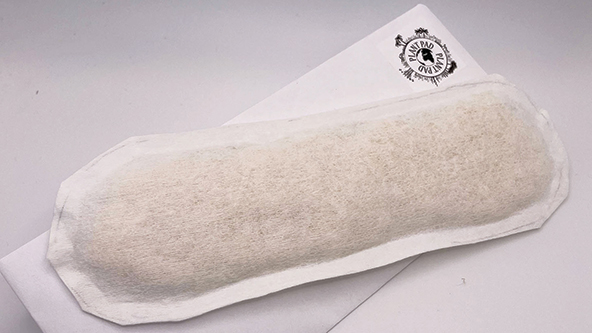
 The PlantPad Consortium researches plant-based solutions to manufacture sustainable menstrual products, such as the sisalfluff menstrual pad. (Photo courtesy of the Prakash Lab)
An estimated 500 million people worldwide live in period poverty, defined as lacking access to safe and hygienic menstrual products, basic hygiene facilities, and menstrual-hygiene education. Not having access to products like tampons or pads prevents many people from participating in activities and contributes to school absenteeism—an estimated 1 in 10 young people worldwide miss school during their menstrual cycle.
In March 2023, a group of entrepreneurs, academics, and NGOs already working on period poverty in Africa and Asia launched the PlantPad Consortium to bring their individually funded research and initiatives together to test local, sustainable, and affordable solutions and share their results with local businesses. The global consortium’s core research team is based at Stanford University, with other partners based in Germany, France, Kenya, Nigeria, and Nepal.
Because cost is a significant contributor to period poverty, the PlantPad Consortium seeks to lower production expenses by manufacturing menstrual-hygiene products from locally sourced and low-cost plant material. “Around the world, it should be possible to make these essential products locally,” says Manu Prakash, an associate professor of bioengineering at Stanford University and principal investigator of the consortium’s core research team.
Using local, plant-based materials will also reduce environmental impact. The absorbent core of most commercial menstrual pads is made from synthetic fibers and plastics mixed with cotton or timber-derived fiber. Cotton is water-intensive to produce and, therefore, challenging for arid climates, and timber is scarce in many countries and requires harmful chemicals to process. With partly synthetic cores, leakproof bases, and extra-absorbent strips, commercial pads can be up to 90 percent plastic. The average menstruating person uses almost 17,000 tampons or pads in their lifetime, and the vast majority of these products end up in landfills, releasing toxic chemicals and microplastics during their centuries-long decomposition process.
To find plant-based alternatives to the plastic-laden menstrual pad, in September 2021 researchers who are now a part of the consortium began testing natural materials like banana fiber, which is abundant in parts of Asia where there is significant need for menstrual-hygiene products.
Researchers share their findings with consortium partners that have manufacturing capacity. One example is Berlin-based NGO NIDISI, which plans to produce menstrual pads using banana fiber through Sparśa, a women-led social business that NIDISI founded in Bharatpur, Nepal. Sparśa already has a banana-fiber processing plant, and its pad factory will open in mid-2024.
Once the pads are on the market in Nepal, the team will launch a menstrual-hygiene advocacy and education program to destigmatize menstruation and educate about menstrual-hygiene products. “Right now, only 15 percent of women use sanitary pads in Nepal,” Sparśa’s manager Sudha Dhakal says. “Part of the problem is lack of education,” she adds, noting that the majority of women use other materials, like wool, cloth, or leaves.
In 2022, the Stanford-based team derived an absorbent fluff-like material from the sisal plant. Sisal is native to Mexico but also cultivated in parts of South America and East Africa, where its fibers are used to manufacture rope and twine. The Stanford researchers shared the processing route they developed to transform sisal into an absorbent material with the consortium partners. Last November, they published their research in the academic journal Communications Engineering. One partner, Olex Techno Enterprises, is preparing to manufacture sisal-based menstrual pads in Kisumu, Kenya, where the plant is widely grown as a cash crop.
The PlantPad Consortium is now pursuing funding as a collective to expand its research capacity and build small manufacturing plants in new places to develop a better understanding of local needs, test its protocols, and improve manufacturing processes. Eventually, Prakash says, the consortium plans to launch an open-source database where researchers can publicly disseminate their findings about different plant fibers and manufacturing processes. The database would allow entrepreneurs to follow the consortium’s efforts and apply the latest findings locally. Additional research sharing would also facilitate new partnerships like those in Kenya and Nepal.
“The consortium can act as a global research repository,” Prakash says. When local entrepreneurs use it, “they bring the local action needed for it to be valuable.”
Read more stories by Marianne Dhenin.