


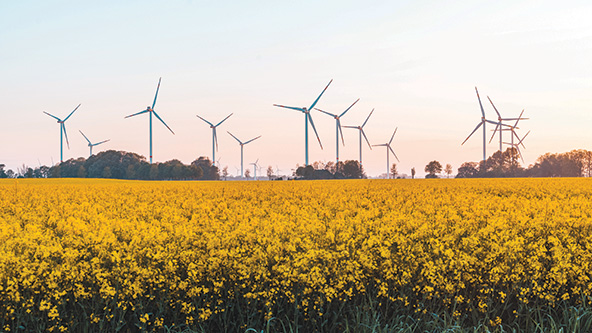
 Research by Agora Energiewende is leading the clean energy transition, including wind farms, in Germany. (Photo by Marcus via Adobe Stock)
Germany’s clean-energy transition, called the Energiewende, was already underway in 2011 when events halfway around the world heightened the program’s urgency. On March 11, a powerful earthquake and tsunami hit the Fukushima Daiichi Nuclear Power Plant in Japan, triggering a full-scale meltdown that released prodigious quantities of radioactive contaminants.
If a technologically advanced nation like Japan could suffer such a devastating mishap, Germany’s conservative chancellor Angela Merkel reasoned, then so could Germany. Her thinking was shared by more than 250,000 protesters who surged onto Germany’s streets that week, demanding an end to nuclear power. This massive outpouring of civic concern buttressed Merkel’s motivation to accelerate the Energiewende, which the previous administration had set in motion.
In contrast to Merkel, leading Green Party politician and former high-level energy official Rainer Baake had long opposed nuclear power. Merkel’s response to Fukushima, he believed, opened a pathway to renewable energy, but one requiring a precise strategy. “We needed good, robust research and a forum where people could discuss [the strategy] openly,” Baake recalls. Germany could become a trailblazer in climate action by transitioning to a low-carbon energy supply that forsakes not only fossil fuels but also nuclear power.
Germany had already vowed to cut CO2 emissions by doubling its share of renewable energy by 2020—which it accomplished—and raising that goal to cover more than 80 percent of electricity consumption by 2050. By 2011, Germany’s wind turbines, hydroelectric plants, solar cells, and biogas digesters had already made up 20 percent of the nation’s electricity, thanks to legislation passed in 2000 that granted independent clean-energy producers access to the grid and price supports to protect investments.
But the Energiewende’s unexpectedly swift buildout of renewables—at the time, in 2011, largely an anomaly in Europe—was sprawling and unstructured, and it posed as many questions as answers. How exactly does an industrial powerhouse like Germany replace its entire energy supply without destroying lucrative businesses, picture-postcard landscapes, and cherished lifestyles?
To devise and realize a strategy for Germany’s clean-energy shift, Baake proposed a forum for ideas inspired by the open-air marketplace (agora) of ancient Greek cities where people assembled to sell wares and converse. In 2012, he founded Agora Energiewende, a Berlin-based public-policy consultancy that operates as a nonprofit, multidisciplinary think tank. Four years later, Agora established a Brussels branch covering EU climate policy. Agora’s mission, according to its website, is to offer “evidence-based and politically viable strategies to advance the goal of climate neutrality” throughout the world.
A Marketplace of Ideas
Agora Energiewende was inspired by more than ancient Greece. Markus Steigenberger, who assisted Baake with launching the nonprofit and serves as its managing director, says they looked to other think tanks around the world for best practices. “The principal idea was to build an organization fit for the German and European context that provides politically feasible solutions, based on sound scientific facts,” he says.
In contrast to the markedly partisan character of US politics and its think tanks, Steigenberger claims, politics in Germany is much more consensual and welcoming of diverse perspectives. In this spirit of inclusion, Agora assembled a council of 25 stakeholders from Germany’s state and federal governments, political parties, universities, labor unions, and industry. The council meets in Berlin four times a year—as does its counterpart of 25 EU stakeholders in the Brussels office—to discuss Agora experts’ scientific findings and propose policy solutions.
“Politicians are responsible for the law-making,” Steigenberger explains. “Agora contributes to the debate with strategies and solutions that are ahead of the curve but politically and technically viable.”
For example, Agora’s first policy paper, “12 Insights on Germany’s Energiewende,” published in 2013, argued that wind and solar energy are cheaper than other clean energies and have unique potential for massive expansion. Hydroelectric power, for instance, is limited by the number of rivers that can be dammed. This is why, the report concluded, sun and wind will constitute most of Germany’s future energy, and therefore the government should support the development of on- and offshore wind parks and solar farms, as well as the transmission-grid infrastructure needed to handle those sources.
Agora Energiewende has definitively framed the climate-protection agenda both in Germany and throughout Europe.
“12 Insights” has guided Germany’s colossal buildout of solar and wind energy for more than a decade. Since its publication, Germany has reworked its energy road maps, committed itself to broad electrification, rewritten regulations, planned and built new smart grids, commenced an offshore-wind-power program, tweaked the energy markets to better accommodate renewables, and altered its subsidy measures for solar and wind power—an overhaul that caused renewables’ capacity to more than double. Renewable energy today totals about half of Germany’s electricity consumption. Germany is determined to double wind-power capacity again and quadruple solar to make the country reliant on only renewable energy by 2035.
“Some of these ideas were already floating around,” notes Toby Couture, director of the Berlin-based energy-consulting firm E3 Analytics. “But Agora, through a series of well-written reports, was able to capture the public imagination and define the narrative. The thesis about sun, wind, and electrification remains on the mark today.”
Over the course of a decade, Baake’s creation has definitively framed the climate-protection agenda in Germany and Europe, growing to employ about 150 specialists of 30 nationalities—from engineers to economists and political scientists—who have informed the country’s most important energy-transition programs with policy proposals that recommend strategies, tactics, and policy instruments. Its methodology supplements in-house research with commissioned work from external experts to ensure that all findings are comprehensive and credible.
Agora also promotes dialogue and public relations in its capacity as a liaison for decision makers, interest groups, researchers, and media. Its publicly accessible Agorameter charts the constantly changing composition of Germany’s energy supply and level of consumption. And all of its policy papers are free of charge on its website and available in four languages.
In 2016, Agora launched a consultancy dedicated to sustainable conversions in transportation. Two additional consultancies followed, for industry in 2021 and agriculture in 2022.
“The job of the Agora think tanks today is about the transformation to climate neutrality in all sectors—from agriculture to transport and industry,” Steigenberger says. “They are all integral to the decarbonization of our economy and society. We investigate the complex links, trade-offs, and interdependencies as the transition to climate neutrality moves forward.”
The independent philanthropic initiatives Mercator Foundation and European Climate Foundation (ECF) committed to fund Agora Energiewende for its first decade. Today, Agora operates as a private trusteeship. Roughly 80 percent of its €19 million ($20.5 million) budget hails from private foundations worldwide, such as ECF and the Aspen Global Change Institute, while about 15 percent comes from government donors whose funds are exclusively for international work.
Not So Neutral, Yet
Today, German and European Union climate goals are considerably more ambitious than a decade ago—thanks in part to Agora’s input. Agora’s research also informed Germany’s revised economywide emissions-reduction and climate-neutrality target: 65 percent by 2030 and 88 percent by 2040. The country aims to reach climate neutrality by 2045—five years earlier than the European Union.
The ability of Europe to kick its fossil-fuel habit has reached a new urgency with the war in Ukraine, in which energy—and particularly the fossil-fuel trade with Russia—plays a central role. At the start of war, in February 2022, more than half of Germany’s natural-gas and nearly two-fifths of the European Union’s gas needs came from Russia. Agora experts believe the European Union can bolster both its energy security and its geopolitical security by halving its fossil fuel use in just seven years. This means, above all, using less gas. The task is formidable but doable, especially if Europe were to commit itself to accelerating its renewable-energy transition and adopt energy-saving practices.
“Europe’s reaction to the pandemic and the energy crisis following the full-scale Russian invasion of Ukraine showed that the European Union can act quickly when it has to,” Steigenberger observes. “What’s critical for a successful transition to climate neutrality is that all parts of society feel they are an active part of it.”
The climate crisis knows no geopolitical boundary, so this work must happen across borders. Agora conducts this work through partnerships with organizations in more than two dozen countries, including the China National Renewable Energy Centre, the US National Renewable Energy Laboratory, and the Danish Energy Agency. In addition, they sponsor an annual six-week fellowship for energy and climate experts from low- and middle-income countries to tackle issues from their home countries with Agora experts.
China’s brawn in energy and climate matters, as well as its world-leading carbon footprint, makes its participation in global-climate protection critical to the planet’s midcentury goal of net-zero emissions. To this end, and despite the geopolitical tensions between the West and China, Agora is working with the European Union and China to coordinate their carbon-pricing systems, maximize their systems’ impact, and not disrupt trade relations.
Steigenberger believes Agora’s contributions to the clean-energy transition will serve “as a basis for other countries to design their own approaches according to their circumstances.”
Read more stories by Paul Hockenos.