


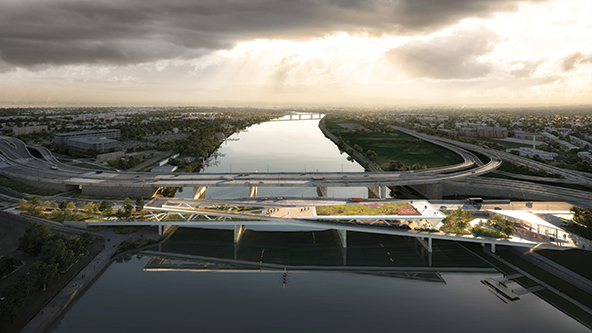
 11th Street Bridge Park in Washington, D.C., will be open to the public in 2026 after more than a decade of community engagement. (Photo courtesy of OMA + OLIN)
Tucked away in the Cascade Mountains of Central Washington, amid miles of hiking trails and fruit orchards, sits Methow Park on the south side of the small town of Wenatchee. In stark contrast with the verdant ecoregion, Methow Park once embodied the community’s inequitable living conditions: a patchy soccer field, two netless basketball hoops, and deteriorating playground equipment. More than 4,200 people lived within a 10-minute walk of the one-acre park, the vast majority of whom are Mexican and Mexican American farmworkers in an otherwise white and middle-class town.
In 2014, Trust for Public Land (TPL), a national conservation organization that creates parks and protects land for people, was invited by the City of Wenatchee to engage residents in renovating Methow Park. For more than a year, conventional attempts at involving the community, such as meetings in school gyms and online surveys, saw poor results. Besides, renovating a park seemed trivial compared with the community’s broader civic and health concerns. South Wenatchee residents had experienced decades of city disinvestment, underrepresentation in local government, and an absence of Latino advocacy groups.
The dynamic began to change when TPL’s team committed to meeting the community where they were. TPL’s program director, Cary Simmons, staffed a table at the popular Northwest Mariachi Festival, where he met Teresa Zepeda, a South Wenatchee resident, who, according to Simmons, “saw me fumbling to engage attendees because I couldn’t speak Spanish.” Zepeda helped Simmons translate at the festival and later connected TPL with neighbors of Methow Park. Rather than holding stale public meetings, TPL started hiring residents to enliven the park with classes that highlighted neighborhood talents, such as piñata design and folkloric ballet dance. “We were connecting the community to the park and to each other,” says Teresa Bendito, Zepeda’s daughter and a TPL intern in summer 2018.
As trust grew, community input poured in, informing an ambitious park design that exceeded the initial $2 million budget. Rather than sacrifice amenities, a dozen South Wenatchee neighbors attended their first city council meeting to demand an expanded park budget. They succeeded. Realizing that Methow Park would need advocates after its renovation was completed, members—among them the Zepeda-Bendito duo—adopted the name Parque Padrinos (Park Godparents) and began planning for the operation and stewardship of the park.
 The newly renovated Methow Park in Central Washington is a physical manifestation of the community’s vision and power, largely stewarded by the Parque Padrinos. (Photo by Stuart Isett)
The Parque Padrinos evolved to be much more than just a “friends of the park” group. With more than 1,000 members within four years of its formation, the Padrinos serve as a bridge between the Latino community and powerful institutions. After the organization’s early win securing park funds, Zepeda says, “I learned that when we speak up, make demands, and go talk to public officials, we can actually change things.” This inspired the Padrinos to partner with the Latino Community Fund of Washington to engage the community in political action, which ultimately led to a remarkable 300 percent increase in Latino voter turnout in the 2018 midterm election. Then, when COVID began devastating the Latino farmworker community in the spring of 2020, the Padrinos received a grant from Wenatchee’s regional hospital system to lead culturally relevant outreach that helped vaccinate more than 3,000 people.
“All that relationship and trust-building helped us when we really needed it to get through something that affected the whole world,” Bendito says of COVID. “When I see neighbors and new faces at the park, it’s a reminder that all the work was worth it.”
The Common-Ground Framework
A community’s power to shape its social, cultural, and physical environment is a cornerstone of a healthy democracy, but for too many citizens, this vision is out of reach. Before she was a parque madrina distributing COVID personal protective equipment, Beatriz Elias was a full-time housewife who felt that she was “in a well” and that “no one ever asked [her] what [she] wanted to see in the neighborhood.” Elias is not alone in this feeling. People’s doubt in their own political efficacy, rampant social polarization, and an epidemic of loneliness have all surged in the past decade. A 2022 survey found that only one in four Americans agree that “people like them” can influence political systems. The fact that Americans trust each other less and experience loneliness significantly more than they did 50 years ago corresponds with levels of polarization nearing historic highs. All this alienation unfolds in segregated cities that silo neighbors from backgrounds, perspectives, and income levels different from their own.
It is hard to experience social isolation, polarization, and flagging trust in democracy, so to confront these trends can feel daunting and even hopeless. However, recent years have seen public and private institutions emerging to tackle them at the root cause. The COVID pandemic, coinciding with a national reckoning with racial discrimination, instigated unprecedented legislation that directs major investments toward historically neglected communities, including the American Rescue Plan of 2021, the Infrastructure Investment and Jobs Act of 2021, the Inflation Reduction Act of 2022, and the CHIPS and Science Act of 2022. The promise of a just and sustainable recovery, though, hinges on the ability of communities most in need to absorb and employ these funds.
Such vast investments acknowledge that repairs to our torn social fabric must be systemic in nature. One emerging approach among social sector practitioners and philanthropists is to shift the focus of their interventions from factors such as environment, health, and education to community power. Anthony Iton and Robert Ross, of The California Endowment, and consultant Pritpal Tamber define community power as “the ability of people facing similar circumstances to develop, sustain, and grow an organized base of people who act together through democratic structures to set agendas, shift public discourse, influence who makes decisions, and cultivate ongoing relationships of mutual accountability with decision makers that change systems.” This definition implies that every community is entitled to power but that structural barriers may stand in the way. The question confronting philanthropists, researchers, and policy makers is, what interventions remove barriers to equitable community power?
Superficial or perfunctory community engagement can result in neighborhood parks with improved amenities, but not the kind that respond to community needs.
Parks and green spaces that enable community engagement and organizing are often overlooked interventions for building community power. Parks have enormous unrealized potential to serve a critical function for the nation: social infrastructure. An emerging concept, social infrastructure is described by sociologist Eric Klinenberg as the “physical places and organizations that shape the way people interact.” These include parks, libraries, schools, barbershops, places of worship, and other venues. Klinenberg adds that social infrastructure includes the “physical conditions that determine whether social capital develops,” serving as a stage upon which civic life unfurls, social divisions are bridged, and bonds are forged. While many communities enjoy bountiful social infrastructure, marginalized communities routinely confront a deficit of quality green space. A 2021 TPL study revealed that parks in communities of color are, on average, half the size of those serving predominantly white populations and serve five times as many people per acre.
Not the natural settings we often consider them to be, parks, plazas, trails, and preserves are physical manifestations of human decisions. City parks are typically created and managed by local governments that are responsible for engaging neighbors in park design and programming, theoretically with the purpose of reflecting community input in shaping the environment. However, definitions of community engagement are highly variable in the parks field and can encompass a range of approaches. Some parks departments employ the International Association for Public Participation’s (IAP2) “Spectrum of Public Participation” model, which features a continuum of citizen engagement: inform, consult, involve, collaborate, empower. In a 2024 TPL survey of the nation’s 100 largest cities, public-park agencies were more than five times as likely to aim to inform the public (“always” or “most of the time”) as they were to empower the public.
Superficial or perfunctory community engagement can result in neighborhood parks with improved amenities, but not the kind that respond to community needs. (A classic example would be building a tennis court where the community prefers a basketball court.) What could have been an inviting setting for leisure, active recreation, and self-expression—and their many attendant social and health benefits—may become an underused, poorly maintained blight on the community. Therefore, we employ the term “community engagement” to mean the practice of building relationships with representative communities in ways that earn trust, legitimize community voices, nurture grassroots collaboration, build capacity, and center the community in decision-making about issues that affect community members’ daily lives and environments.
TPL’s experience working in Wenatchee and hundreds of communities across the country reveals that parks can be a generative setting for social infrastructure, community engagement, and community power. Inspiration from field organizers and community partners led to the creation of TPL’s theoretical model called the Common Ground Framework (henceforth “the Framework”) for building community power through the creation and stewardship of parks and green space. The Framework suggests the development of three goals: community relationships, community identity, and community power. These elements generally operate sequentially: At first, the Padrinos were a group of trusting neighbors, who then gradually formed a collective identity as caretakers of Methow Park; this identity enabled the creation of social networks and shared agendas needed for community power to blossom.
Though positioning parks as catalysts of community power is a novel concept, the Framework’s progression of relationships, identity, and power is hardly original. Two important concepts reinforce the Framework: social capital and intergroup contact. Social capital can be defined in many ways; here, we follow sociologist Nan Lin, who defines it as “the resources embedded in a social structure which are accessed and/or mobilized in purposive actions.” This construct includes both tangible resources (say, a job reference or a tip about an affordable apartment for rent) and intangible ones (such as being able to count on neighbors for help during a natural disaster) while emphasizing resources that give rise to action. Bonding social capital arises in close-knit groups, such as friends, families, and coreligionists, and reinforces shared (and sometimes exclusive) identities. Bridging social capital, by contrast, stems from connections outside one’s close networks, often across different socioeconomic and ethnic divisions.
Intergroup contact theory, proposed by psychologist Gordon Allport in his 1954 book The Nature of Prejudice, holds that contact between groups with distinct identities can reduce prejudice and promote conviviality, particularly if that contact features equal status, intergroup cooperation, common goals, and support by social and institutional authorities. Even in unstructured settings such as parks and other public spaces, intergroup contact can improve intergroup relations.
Anchoring the Framework is the irreplaceable value of in-person community relationships. As measured through social ties and social networks, community relationships are formed through everyday interactions in social infrastructure. They can be characterized as strong or weak social ties; strong ties represent close bonds, and weak ties involve superficial (but often gratifying) interactions. Community relationships are closely associated with improved well-being, including lower mortality rates, reduced depression, increased safety, and heightened civic engagement, and are essential building blocks for community identity.
Several studies have found that accessing green space promotes stronger social ties, reduced loneliness, heightened place attachment, greater social cohesion, and higher rates of community trust in local government. In one study of three inner-city parks in Manchester, United Kingdom, researcher Aleksandra Kaźmierczak found that residents who visit parks regularly have 66 percent more social ties than those who do not visit parks. Parks increase not only the number of social bonds but also the diversity and strength of those bonds. Parks are ideal venues for intergroup contact; park visitors can bond over shared interests (such as sports, hobbies, and recreational activities), participate in community stewardship projects (building playgrounds, painting murals, and gardening), and organize collective action around civic and political issues (equitable parks policy and cultural representation in park monuments).
Community identity emerges as a pivotal factor shaping the quality and functionality of parks as social infrastructure. As measured by social cohesion, sense of community, place attachment, and sense of ownership, community identity can form around shared geography, religion, occupation, ethnicity, and countless other factors and be based on person-to-person interactions, virtual interactions, or a combination of the two. In the context of parks, we focus on place-based community identity. Communities, like individuals, embody multiple identities; a great strength of parks is that they facilitate place-based identity that cuts across and can unite other dimensions of a person’s identity.
Power perpetuates itself in a virtuous cycle; by contrast, the absence of community power can breed mistrust, distress, and poor health.
Quality parks and green spaces are potent drivers of community identity. They function as settings for both bonding and bridging social capital. When friends and family convene in parks, their shared sense of belonging and place attachment intensifies. Robust community identity is a predictor of a community’s success in resisting displacement from green gentrification, in which longtime residents are displaced geographically and culturally when investments in green infrastructure lead to rising property values and demographic shifts. Parks also serve as locations for diverse communities to converge and forge a shared identity. They are particularly promising settings for immigrants and new arrivals to receive messages of belonging, express their heritage in public, and find comfort in cultivating a shared history with US-born park users.
Leveraging community identity as a foundation, members can begin to work toward common goals by exercising community power
through democratic processes. Community power can be measured by civic participation and collective efficacy and is evidenced in actions such as stewardship of the commons, attending public meetings, influencing political decisions, and other acts of civic involvement. Communities with deep reserves of community power are more resilient to acute crises, such as those inflicted by climate change and the pandemic, and can more effectively confront chronic
crises, such as structural racism. Power perpetuates itself in a virtuous cycle; by contrast, the absence of community power can breed mistrust, distress, and poor health.
Owing to their proximity and perceived sociability, parks significantly elevate social capital and civic engagement, countering the broader trend of diminishing social capital. For decades, environmental stewardship groups such as the Parque Padrinos have been a rare exception to declining civic participation by offering an avenue for local volunteerism. For instance, one study led by William Yagatich found that members of a Maryland-based environmental stewardship group were 58 percent more likely to attend public meetings than the average American.
The progression of relationships, identity, and power transcends parks and can be observed in power-building settings such as labor organizing and even in the digital commons. But their nature as social infrastructure makes parks and green spaces particularly opportune for building and sustaining community power.
One crucial attribute of social infrastructure in which parks especially excel is public accessibility, both physically and psychologically. Unlike other built environments, most parks have few barriers to entry: They typically are free to access, close to home, and nonprescriptive in terms of use. These traits encourage longer, more frequent visits and greater opportunity for forming an array of community relationships.
Unlike libraries or museums, parks offer flexible uses for unprogrammed recreation. Unstructured, neutral spaces encourage bridging and bonding interactions among users and offer settings for spontaneous user activation. Parks designed for a mix of uses (such as open space, a playground, a performance stage, and a community garden) invite and encourage interactions among a diverse array of visitors.
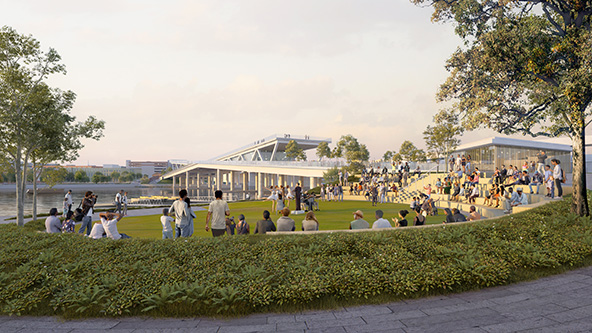 Public life at 11th Street Bridge Park in Washington, D.C., which spans the Anacostia River, will unfold among features designed by and for the community. (Photo courtesy of OMA + OLIN)
Parks also carry important cultural and political meaning. The very nature of parks as shared commons makes them lightning rods for strong opinions on ownership, rights, and representation. For instance, deep questioning of whose histories are memorialized in park statues and monuments has triggered contentious debates about cultural representation in the public sphere. Parks as civic and social infrastructure therefore offer a platform for gauging, debating, and reconciling public opinions, as well as media for communities to translate their beliefs into their built and social environments.
A vibrant piece of social infrastructure requires management and maintenance by an organizing body. For parks, this function is most often handled by park departments, community-based nonprofits, and park stewardship groups. Most park agencies engage their communities through public meetings, community volunteer events, advisory boards, and partnerships with park stewardship groups, although these practices are often not codified in policies and their effectiveness is rarely formally evaluated. However, these widespread practices form a strong vehicle for implementing elements of the Framework.
The presence of a park does not in and of itself ensure that it will function optimally as social infrastructure, or even be accessible to all. Physical and emotional access requires designing for all abilities and identities. This is especially true for BIPOC, immigrant, disabled, and LGBTQ+ communities that carry personal or generational trauma associated with public spaces. These groups often find themselves navigating public spaces designed by people who do not share their experience or values. Engaging marginalized communities in the design, programming, and stewardship of green space is one big step toward preventing exclusion. But it is important to keep goals realistic; decades, if not centuries, of injustice cannot be addressed by just one park project, no matter how extensively communities are engaged. A successful project can, however, set communities on a path to creating a more inclusive and robust social fabric.
Community-Power Building at Work
Building community power through revitalizing parks may sound like a daunting task, but examples of the Framework’s success abound. Across the country, local residents are transforming their communities by using parks to exercise their power in many different ways. From securing favorable park policies to protecting sacred land to converting gray infrastructure to green, communities have successfully applied the Framework in varied contexts. The common thread of these projects’ successes is the Framework’s sequence: Communities build relationships with their environment and with each other, coalesce around a place-based identity grounded in their shared passion, and ultimately consolidate and exercise community power to transform residents’ lives for the better.
For some communities, access to park space is really about access to the resources needed for communities to thrive. The 11th Street Bridge Park (Bridge Park) in Washington, D.C., is set to open in 2026, but for more than a decade it has been a platform for economic development and housing security in historically disinvested communities. Bridge Park, which breaks ground in December 2024, will transform a decommissioned bridge spanning the Anacostia River into a seven-acre park. On the east end of the bridge is Ward 8, and to the west is the affluent neighborhood of Capitol Riverfront. Ward 8 is a historically Black neighborhood that was once a thriving economic and cultural hub for African Americans (Frederick Douglass made his home on this side of the Anacostia River), but decades of disinvestment, isolation from downtown D.C., and urban renewal projects have resulted in 46 percent of the population living below the poverty level, according to nonprofit Building Bridges Across the River (Building Bridges).
In conversations about transforming 11th Street Bridge into a world-class park, Ward 8 residents expressed the hope that such an investment would not only improve access to green space but also bring economic opportunity. Bridge Park was spearheaded by Building Bridges, which held more than 200 listening sessions with Ward 8 and Capitol Riverfront residents. The nonprofit did not simply gather feedback, though; Building Bridges carved out opportunities for residents to run community programs, such as hosting the much beloved annual Anacostia River Festival, and make the final decision on the park design.
Residents and local nonprofits held Bridge Park accountable to the community by cocreating an equitable development plan (EDP). The EDP distills community goals into four topical areas: affordable housing, workforce development, preservation of Black-owned small businesses, and arts and cultural equity. Implementing the EDP has resulted in dozens of initiatives. For example, Bridge Park’s Community Leadership Empowerment Workshop has equipped more than 100 Ward 8 residents with the fundamentals of civic engagement and advocacy. Building Bridges worked with housing nonprofits to establish a homebuyers’ club to forestall green gentrification. The EDP program that senior vice president Scott Kratz is proudest of is THRIVE East of the River, a COVID relief effort that distributed $3 million in direct deposits to more than 500 families in Ward 8. The success of these programs hinged on the trust built and networks formed among residents over years of community engagement.
In the decade leading up to groundbreaking, Bridge Park has raised more than $92 million for the EDP implementation alone—a funding level that matches the cost of actual park construction. Given this success, an audience member asked Kratz at a recent meeting, “Do you even need to build the park?” Another audience member immediately countered, “You better! I designed that park!”
Whereas Bridge Park is an urban example, the Framework is equally salient in rural and suburban areas, where green space may abound but private landownership often denies access to precious natural areas. In Hawai‘i, landownership is antithetical to native Hawaiian practices, which view ‘āina (land, or that which feeds) as a family member and not something to be owned. Protecting land from rampant development in Hawai‘i means protecting native Hawaiian cultural sovereignty.
Alakoko Fishpond was built into the curve of the Hulē‘ia River on Kaua‘i more than 600 years ago by the island’s earliest inhabitants. For countless generations, people came to Alakoko to work, play, and feed their communities, cultivating a healthy watershed that nourished the estuary with fish and seaweed. After Alakoko came under private ownership, the fishpond became choked with invasive red mangrove trees. Mālama Hulē‘ia, a grassroots nonprofit formed by canoers who practiced near Alakoko on the Hulē‘ia River, was permitted access in 2018 to gradually clear the area of mangroves. In just a few years, Mālama Hulē‘ia engaged more than 3,000 volunteers to remove mangrove trees and plant native wetland species. In doing so, volunteers were not just helping rebalance the watershed but cultivating a relationship with ‘āina, kūpuna (elders and ancestors) from whom they inherited Alakoko, and the ‘ohana (family) of today’s caretakers.
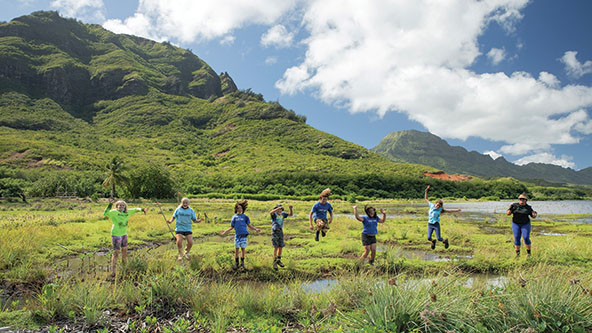 Students have fun while tending to Alakoko Fishpond. Alakoko was built on the curve of the Hulē‘ia River on Kaua‘i more than 600 years ago by the island’s earliest inhabitants. (Photo by Tina Aiu)
When the 102-acre property was put on the market in 2021, Mālama Hulē‘ia and TPL organized a campaign to protect Alakoko from purchase by developers. More than 5,500 community members signed a petition and sent letters to Kaua‘i County to fund the purchase of Alakoko. During a county commission meeting, dozens of Mālama Hulē‘ia volunteers, from children to elders, provided testimony. The county recommended funds for protection of the site, but ultimately a private donor—the Chan Zuckerberg Kaua‘i Community Fund of the Hawai‘i Community Foundation—provided funding for this purpose, and public funds were reallocated toward protecting other culturally significant sites. Ownership of Alakoko Fishpond was transferred to Mālama Hulē‘ia, in a transaction brokered by TPL. This success followed from community members developing relationships with each other and with ‘āina, nurturing their identity within the place, and exercising their collective power to protect Alakoko.
Now that the fishpond is in the community’s hands, “they have the sovereignty to decide its future,” says Reyna Ramolete Hayashi, project manager at TPL. Alakoko incubates education sovereignty rooted in ike Hawai‘i, or traditional Hawaiian knowledge. Partnerships with local schools allow thousands of students to learn science, technology, engineering, and mathematics concepts through traditional Hawaiian aquaculture. “To have the community care for this place means that not only are they preserving […] ike Hawai‘i, [they are] relearning sustainability,” says Enoka Karratti, a Hawaiian educator.
Food sovereignty is an especially important goal for Hawai‘i, which imports 90 percent of its food. “We aim to be feeding spiritually, physically, and mentally,” says Peleke Flores, director of ‘āina and community engagement at Mālama Hulē‘ia. To reach this goal, thousands of community members continue to restore and maintain the watershed in partnership with Mālama Hulē‘ia. “I think it’s super important to get [Alakoko] as close as we can to how it was traditionally,” Flores says, “so that we can have a physical manifestation of all the stories that we’ve been told.”
If Alakoko represents the profound meaning that a single land protection project can carry, the Fresno Parks4All campaign shows how the Framework can operate on the scale of an entire city, and even a state. Fresno Parks4All began as a response to three factors that Fresno Building Healthy Communities (Fresno BHC), an initiative of The California Endowment, could not ignore. First, from 2012 to 2015, Fresno placed at the very bottom of TPL’s ParkScore, a national ranking of park systems for the 100 most populous American cities. These same data revealed that North Fresno had 4.5 times more park acreage per 1,000 residents than South Fresno, where most of the city’s Black, Latino, Indigenous, and Hmong populations live. Second, Fresno was updating its General Plan, which projects land use for the next 20 years and which had major implications for the Fresno in which young people would grow up. Finally, Fresno BHC continued to hear from South Fresno youth that, more than anything, they wanted to have more and better parks.
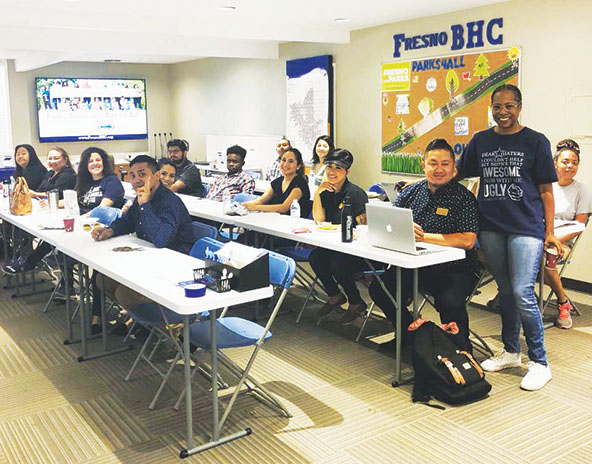 Community members attend a Parks4All orientation in Fresno, California, to gain expertise in parks policy change. (Photo courtesy of Fresno Building Healthy Communities)
“We used parks as an entry point for young people to get involved in the General Plan,” says Sarah Reyes, of The California Endowment. Thanks to stipends from Fresno BHC, a council of South Fresno youth took the lead in creating Parks4All, a parks advocacy campaign to ensure that language for equitable park improvements would be included in the General Plan.
For the next year, the youth council organized intergenerational community events at parks, surveyed park users on desired improvements, and became regular attendees at city council meetings. Parks4All planned to run ads on buses that placed ParkScore data over a photo of a young girl split between a black-and-white park in South Fresno and a full-color park in North Fresno. However, the City of Fresno deemed the ad too political and refused to run it. This decision led to public backlash and national media attention that pushed the city to update its General Plan according to community demands, including updating the 1989 Parks Master Plan.
Soon after this win, the Parks4All coalition jumped back into action when it became clear that the city was not being held accountable to invest dollars in accordance with the General Plan. In 2018, Parks4All designed ballot Measure P, which would apply a five-eighths percent sales tax to raise $2 billion over 30 years for parks and arts. Youth leaders of Parks4All garnered 35,000 signatures, enough to put Measure P on the 2018 ballot. It received 52 percent of the vote. The city council, however, disputed the results, asserting that a citizen-led sales tax needed two-thirds of the vote to win.
“We mourned for 30 seconds and then said, ‘Wait a minute, let’s use the courts,”’ Reyes says. In 2021, the case made it all the way to the California Supreme Court, which held that a citizen-initiated measure indeed needs only a simple majority to pass. Measure P was the first of its kind to employ this rule, paving the way for future citizen-led measures in California to pass with a simple majority. Measure P was certified into law and raised $58 million in a single year to equitably fund parks and arts in Fresno.
The impact of the Parks4All campaign reached far beyond numbers and dollars. Sandra Celedon, president and CEO of Fresno BHC, describes a cultural shift in how South Fresnans see themselves. Rather than asking for permission, “young people are like, ‘Look, you can invest in our communities or we are going to figure out a way around you,’” she says. To her, seeing the construction of new parks is not just an infrastructural win but “a philosophical win.”
Applying the Framework
How can those committed to untapping the potential of social infrastructure apply the Framework to achieve similar successes and support the progression of community relationships, identity, and power? As the previous stories demonstrate, a whole ecosystem of stakeholders, from enterprising nonprofit leaders to selfless park advocates to responsive public officials, is involved in activating the Framework. Two stakeholder groups are especially well situated to elevate park-building to community-building. First are parks staff, specifically community-facing staff and parks directors, in the public and private sectors (e.g., parks departments, conservancies, “friends of” groups, and landscape architects). The other is social impact philanthropists, such as foundation leaders, individual donors, and public grant administrators (e.g., the National Endowment for the Arts and the Environmental Protection Agency). We recommend several strategies for these stakeholder groups to activate the Framework, keeping in mind that these recommendations are applicable beyond parks and can enhance social infrastructure of all kinds.
For parks to serve as social infrastructure, community engagement must be institutionalized with adequate investment, policy, staff, and training. Community-power building is a slow process, and time dedicated to community engagement provides the necessary incubation period for residents to form relationships, coalesce around a common identity, and forge important alliances that sustain community power. Institutionalizing community engagement—from park inception to programming—will safeguard communities from the whims and nuances of funders and practitioners during this time- and resource-intensive process.
Community engagement is an important job, and it deserves to be staffed and resourced accordingly. Practitioners should approach community engagement as they would a valued friendship: Spend quality time with the community, and not just when you need something; show appreciation for community expertise and time by compensating community members; connect the community to other agencies that can benefit and sustain their causes. Such habits cannot be reliant on the goodwill of exceptional practitioners. Rather, parks directors are responsible for codifying community engagement standards and adequately resourcing project-level staff with funding, capacity, and training.
For parks to serve as social infrastructure, community engagement must be institutionalized with adequate investment, policy, staff, and training.
Important policies that enable community-power building include language on community compensation, park stewardship groups, community-engagement staffing, community-led steering committees, and other strategies that prioritize engagement for collaboration. “Friends of” park groups can commit to broad-based community representation on their boards and staffs. In some cities, large destination parks have well-resourced “friends of” groups, while smaller local parks, especially in low-income neighborhoods, lack this support; established “friends of” groups can consider sister park partnerships through which they share resources with less privileged communities.
For funders, supporting initiatives geared toward policy change, campaigns, and democracy-building can be a strategy for mobilizing residents and coalitions to action through their local park and recreation systems. As in the specific cases we have described, seemingly insignificant early investments can yield civic results well beyond the boundaries of the park. Similarly, funders can support not only on-the-ground practitioners but also coalitions that work with local government to change parks policies.
The manifestations of community power in the cases we have examined—sturdy park stewardship groups, the promulgation of public policy, more equitable access to financial resources—didn’t happen overnight. Rather, years of community engagement that prioritized trust-building accompanied the physical realization of these park initiatives. To build trust, community-based organizations operated with open-door policies, in which anyone was invited to attend meetings, give feedback, and volunteer, and in which underrepresented communities received targeted outreach. Furthermore, the initiatives earned trust through iterative engagement: Communities saw their efforts implemented in small wins, such as a park’s design reflecting their feedback, and successful community-organized celebrations. While the physical process of constructing a park may take just a year or two, nurturing trusting relationships, identity, and power is a long-term project with ripple effects across a community.
Funders should consider long-term commitments and structure grants in ways that allow for time and demonstrate trust. Funders too often impose artificially short deadlines on the projects they fund, shift priorities with leadership changes, and impose expectations that grantees become financially self-sustaining at the conclusion of a funding period. Instead, funders can support community engagement that builds power by providing unrestricted grants, multiyear gifts, provisions for pass-through funding, and backbone support for technical assistance and coalition-building. Further, funders can embody trust through progressive philanthropy models such as participatory budgeting and trust-based philanthropy, placing decision-making power directly in the hands of communities and grantees. For example, The California Endowment exhibited several of these trust-building habits in its partnership with Fresno BHC.
Once a park is open to the public, monitoring its performance is important. The social outcomes of parks and green space need evaluation and measurement, especially related to community engagement. Like many dimensions of parks, community engagement is a predictor of a park’s performance as social infrastructure, the principal outcomes of which are relationships, identity, and power. This performance can be measured and evaluated—with successes replicated and failures harvested for the lessons they teach.
Park funders must be conscious of not falling into the evaluation trap. Often, evaluation requirements place undue burden on grantees.
Of the attempts to measure community engagement in parks and social infrastructure, the most thorough may be Reimagining the Civic Commons (RCC). RCC is a $40 million initiative by five foundations to revitalize social infrastructure in five cities through investment in capital projects paired with deep community engagement. RCC evaluated community engagement in public space through mixed methods, including on-site surveys, online surveys, focus groups, social media analysis, and observational analysis. A report by the Knight Foundation used a selection of these tools to determine how RCC communities fared during COVID and found that deep community participation led to greater trust from residents and increased sense of attachment to the spaces.
What about social infrastructure projects without an eight-figure budget? Practitioners can still make evaluation a routine part of their work, complementing surveys and observational data (such as number of attendees at an event) with qualitative data and storytelling that document relationship-, identity-, and power-building. Practitioners can expand the field by collaborating with social science researchers on user-friendly evaluation methods for community engagement in parks processes.
Parks funders must be conscious of not falling into the evaluation trap. Often, evaluation requirements place undue burden on grantees where trust would suffice. Funders should ask themselves: Would it yield better data and outcomes if we were to hire evaluation consultants, rather than put that responsibility on project staff? Otherwise, they should consider applying the rule of thumb to allocate 10 percent of any social infrastructure grant toward impact and process evaluations. Funders can work with grantees to identify manageable data collection methods and outcomes; ensure that any data collected can answer specific, practical questions; and promptly share results with all stakeholders. Evaluation can greatly inform grantmaking, multiplying the impact of individual investments through sharing of results and laying the foundation for community-engagement training for parks practitioners.
One of the most important park outcomes to evaluate is equity. Parks practitioners are increasingly embedding equity in investment prioritization, but few consider community power as an outcome of such decision-making. Geospatial information systems (GIS) mapping tools enable practitioners to layer priority areas, such as health, environmental justice, and racial equity. We recommend adding indicators of community power, such as voter turnout, concentration of nonprofits, and rates of trust. Funders can ensure park equity, too, by channeling resources toward individuals and organizations with a track record of trusting community relationships. Relationship-building—the foundation of the Framework—without a lens toward equity will only reinforce power imbalances.
At this writing, the United States is facing the run-up to the 2024 presidential election. The strength and integrity of American democracy are again salient concerns among a tapestry of intersecting crises, such as climate change, public health, political polarization, and institutional racism. It is natural to feel powerless and hopeless against such odds and high stakes. But if we have learned anything from working deeply with communities, it is that power and hope emerge in surprising places. Envisioning, planning, creating, and stewarding a park exemplifies social infrastructure, enabling communities to address social issues on their terms and replace despair and frustration with hope and action. To respond to the times, parks and public spaces must become not just passive spaces but catalysts in forming a healthy polity. In caring for the commons of parks and green spaces, we nurture social solidarity, civic engagement, and a thriving democracy.
Read more stories by Geneva Vest, Cary Simmons & Howard Frumkin.