

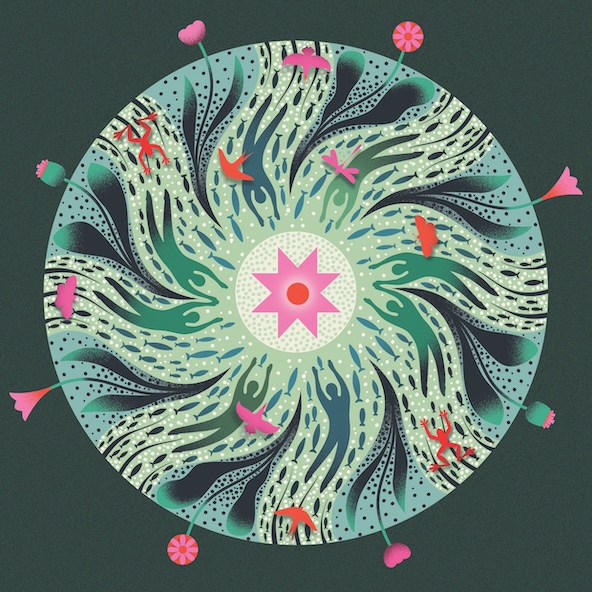
 (Illustration by Vicki Turner)
As a young child, I walked with my grandfather, Miguel H. Trujillo (Kimo, his tribal name), through the copper mines of southern New Mexico. I would pick up a stone—what we would call a Grandfather—and he would ask what I felt in my body. Not what I thought, but what I felt. What was the Grandfather telling me? If I wanted to bring a stone home, I first made an offering, such as water or cornmeal, and shared my intention with the Grandfather stone. Every time I used it, I asked for its permission.
My grandmother, Ruchanda Trujillo, kept a lush garden filled with herbs, vegetables, and flowers. She taught me how to plant, gather, and prepare fresh produce; how cedar supports healing; and how flowers carry medicine. These early experiences taught me to move through the world with respect, to listen to the land and to my body, and to honor the relationships that sustain us.
This kind of awareness begins in our tribal practices at a very young age. We learn to sit still, to remain present through hours of ceremony, to gather water with positive intention, and to pay close attention to how our thoughts and intentions shape the world around us.
At the heart of these teachings is reciprocity: recognizing our relationship with all beings and responding with care. Everyday activities become opportunities to express gratitude, respect, and attention. We sweep the floor as if caring for Mother Earth. We wash dishes knowing they held sacred food that became medicine for our bodies. We care for animals, plants, trees, insects, birds, and all living beings with love and respect. Each is part of the larger web of life that includes those who came before us and those who will come after.
As Pueblo people, we come from the Earth. We are earthly beings, and every part of our body relies on our Mother Earth for survival. Human law calls us to treat one another with respect so that we can live in harmony within our families and communities. Natural law teaches us to live in harmony with the earth, air, water, and fire.
We see these teachings reflected in everyday life. Wind and fire (the Sun) shape the conditions that allow birds, trees, and plants to flourish, influencing rainfall, temperature, and the rhythms of the seasons. Earth and water nourish root systems, feed rivers and lakes, and provide the water that sustains and cleanses our bodies. Trees, too, have their own purpose and communicate with one another. For this reason, we are mindful when introducing new trees into an environment or cutting them down.
We recognize that human and natural law are inseparable. Every action has consequences. If I drive too quickly down a dirt road, I am not caring for Mother Earth. The dust settles on nearby plants, and I may damage the road for those who come after me. Even caring for my vehicle is part of that responsibility, because it transports people, animals, and me. Living in balance means recognizing how our actions ripple through the world.
Then there is spiritual law. It is the source of love, compassion, and care, reminding us that every action begins with intention. We express this understanding through everyday practices of gratitude and reciprocity. Before we eat or drink, we set aside some food or water for the Spirit beings. As we prepare a meal, we honor the life that nourishes us. My father taught me to speak to the land that sustains the animals and to the animals themselves, explaining why we are caring for them and how we will care for them. In this way, natural law, spiritual law, and human action are inseparable.
As an adult, I carried these teachings into my work in rural health, serving remote communities across New Mexico. Then, in 1997, I was asked to become a carrier of Native medicine. At first, I refused. I did not yet understand that some responsibilities are not ours to choose. When my parents later gave their blessing, I began years of learning from tribal elders, healing traditions, and contemplative practices. Through it all, I found myself returning to the same lessons my grandparents had shared with me as a child.
In my traditional healing practice, I remain aware of the ancestral lands, the waters that flow from them, the surrounding plants, and the beings that support the patient. As I approach a person, I quietly ask permission from all relations to interact and open the doorways for the spiritual law to enter. A patient brings with them their family, community, and ancestral lineage; and the elements and the beings that support—or sometimes affect—that balance.
Reciprocity begins with gratitude: receiving life’s gifts with awareness and responding with care. When we slow down, we begin to recognize the interconnectedness of those gifts and consider how we, too, can give back.
Whether I am caring for someone in a healing setting or moving through everyday life, I return to the same teachings. My work is guided by the four sacred elements: earth, air, water, and fire. All beings depend on these elements for life, whether two-legged, winged, finned, rooted, or hoofed. Learning to relate to the elements with respect and gratitude continually brings me back to my grandparents’ teachings and to the importance of reciprocity in everyday life.
Today, the fast pace of modern life, along with social media and technology, can pull us away from our relationship with nature, with spirit, and with ourselves. When this happens, we can lose the inner thread that reminds us how to live in reciprocity. Reciprocity begins with gratitude: receiving life’s gifts with awareness and responding with care. When we slow down, we begin to recognize the interconnectedness of those gifts and consider how we, too, can give back. We become more attentive to the spirit of what we receive and to what the living world is sharing with us. We feel the gentle sweetness of the morning air and the healing rays of Father Sun.
Practicing Reciprocity
Here are some ways to bring reciprocity into everyday life:
- Recognize your relationships. Begin each day by acknowledging the sources of life that sustain you: air, water, sunlight, food, and the people who make your life possible.
- Receive with intention. Before eating, buying, or using something, pause to consider where it came from and who—or what—made it possible.
- Ask what you can give in return. Reciprocity asks not only what we receive, but what we contribute, whether by caring for the land, supporting community, mentoring others, or reducing harm where possible.
- Lead with reciprocity. Whether in your family, workplace, or community, consider how your decisions affect not only people today, but future generations and the living world. Ask not only What can we achieve? but What relationships are we strengthening?
As I step into the role of grandmother, these teachings have become more pronounced. I often ask myself why. Is it because of mindfulness and meditation practice? Is it because I feel my own grandparents’ presence and reminisce about the bond we shared? Or, as a medicine keeper, do I find that these teachings become more pronounced with age?
Whatever the source, I return to the same lesson: Reciprocity with all beings is important to acknowledge. We receive so much from Mother Earth: air, water, food, medicine, and the countless relationships that sustain life. In return, we have a responsibility to act with care, respect, and gratitude.
My grandparents taught me to recognize these gifts before attending to myself. That practice remains with me today. Talk to your home, the ground beneath your feet, the trees, the animals, your relatives, and even the rain clouds with good intentions. Remember that Mother Earth provides food, medicine, and water for all beings. When we honor those relationships, we strengthen our spirit, mind, and body.
May our intentions always be for the greater good—for the rivers to flow, the air to remain clear, Mother Earth to flourish, and all beings to be witnessed and transformed by Father Sun. May we remember: All is One.
Read more stories by Karen Waconda-Lewis.