


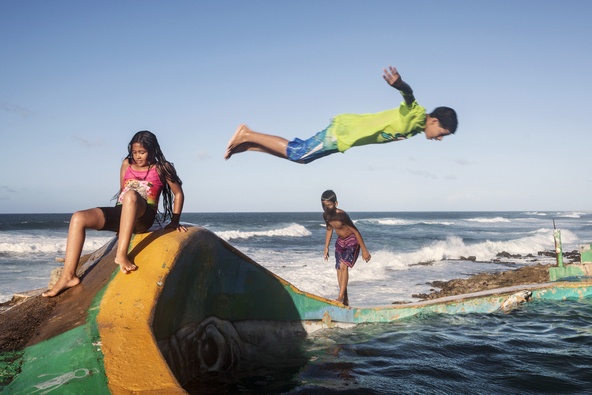
 Children playing in the La Perla
neighborhood of San Juan, Puerto Rico. (Photograph by Albertina D'Urso)
Children playing in the La Perla
neighborhood of San Juan, Puerto Rico. (Photograph by Albertina D'Urso)
One hundred years ago, Puerto Ricans became citizens of the United States. Today, they may be citizens, but Puerto Ricans cannot vote in presidential elections and they have no voting representation in the US Congress. Officially, the island is an unincorporated territory of the United States. Unofficially, Puerto Ricans are second-class citizens. This system has never worked well, but it came to a crisis earlier this year when the Puerto Rican government effectively declared bankruptcy, unable to simultaneously make payments to bond holders, pay pensioners, and fund government operations. In the wake of the filing, numerous public schools have been closed and municipal employees laid off. Puerto Rico’s economy is also in desperate straits. The unemployment rate is twice that of mainland United States, and per capita income is half that of those living in Mississippi, America’s poorest state. Unlike in Detroit, where a consortium of private foundations helped rescue the city out of bankruptcy, there isn’t a white knight on the horizon for Puerto Rico.
Read more stories by Eric Nee.