


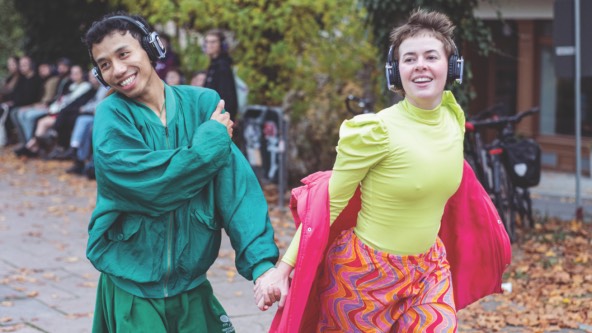
 Performers Jule Hermann and Hein dance through Halle on the Summer 2024 Queer Voices Halle audio-walking tour. (Photo courtesy of Mim Schneider)
The hard-won rights of LGBTQ+ Germans have begun to feel more precarious with recent electoral victories by conservative and far-right politicians. Many of these lawmakers want to ban the discussion of gender identity and sexuality in schools and roll back legislation guaranteeing marriage equality for gay and lesbian couples and self-determination for trans people.
“There is a right-wing backlash now in Germany, and a lot of queer people are concerned,” says Dorothea Wagner, a Leipzig-based artistic director.
To make space for the LGBTQ+ community amid increasing political threats, Wagner and Mim Schneider, a photographer and performing artist, launched Queer Voices, a series of audio-walking tours in 2023. The tours combine oral histories, live performances, and creative engagement with public space to make tangible queer perspectives on Leipzig and Halle, two former East German cities, now located in two German states where the far right has grown in popularity.
Wagner had the idea for an audio experience while chatting with a friend using voice notes on WhatsApp. The medium felt intimate and powerful, so she set out to re-create it. She chose a group audio-walking tour rather than a podcast or other audio formats to offer a more communal experience. On the tour, a maximum of 30 participants are each given a set of headphone through which a roughly two-hour-long audio track is broadcast. A narrator’s voice gives some directions, while a tour guide ensures that participants don’t stray from the planned route as they navigate the cities.
Together, the group walks, pauses, and listens to the recorded stories of local LGBTQ+ people. On the Leipzig tour, interviewees include contemporary German college students; immigrants from Syria, Kazakhstan, and Italy; and members of older generations who describe what life was like as a gay person in East Germany.
“Doing the walk as a group is essential,” Wagner says. “People look at each other, and you can see how others react if a story does something emotional to them, and you can connect. For those two hours, there’s a sense of togetherness and shared feelings.”
In their first year, Wagner, Schneider, and a team of three project assistants and three performers hosted a dozen tours of Leipzig during four weekends in July and October. The tour expanded to Halle in 2024, growing the team to include additional assistants and performers and offering 30 tours in the two cities between April and October. After crowdfunding for startup costs and wages, Queer Voices received support from Leipzig’s Culture Office, the city of Halle, the federal state of Saxony-Anhalt, and Germany’s federal Performing Arts Fund. Tickets for the tour are sold on a pay-what-you-can basis. The project has also received help with advertising from local queer-owned businesses and social media influencers.
Live performers help bring the Queer Voices audio-walking tours to life, acting out scenes from oral histories as they play through patrons’ headphones or leading willing participants in flash-mob-like dances in the cities’ public squares. Through these acts of public expression, the tour makes today’s queer people and their allies visible to onlookers just as it makes queer histories tangible to patrons.
Wagner says that in the current political climate, Queer Voices is even more urgent. “It’s important to take up space as a queer person,” she says. “Many of us felt alone for so long that being in a group of like-minded people is important and sometimes, I think, maybe even therapeutic.”
In 2025, Queer Voices will lead more tours than in previous years, including in July during Germany’s annual Christopher Street Day events, considered a counterpart to other countries’ Pride celebrations.
Read more stories by Marianne Dhenin.