


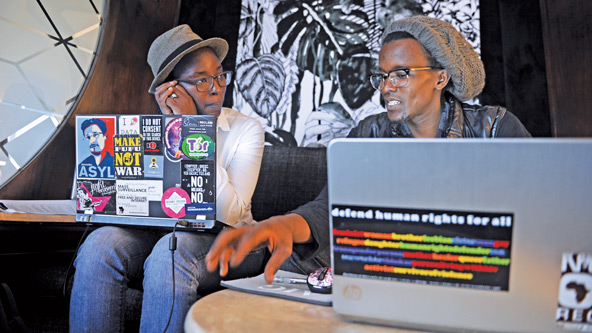
 Two participants share ideas about their digital security strategies at the 2015 CommsLab Kenya convening. (Photo by Dean Hutton)
On July 24, 2016, Phindi Malaza arrived in Durban, South Africa, with 34 other activists for the third convening of CommsLabs —short for Media, Communications and Technology Lab—a program launched by the Astraea Lesbian Foundation for Justice in 2014. Astraea is the only philanthropic organization in the world that exists exclusively to advance the rights of lesbian, gay, bisexual, transgendered, queer or questioning, and intersex (LGBTQI) people globally. And Malaza needed its help.
At the time, Malaza was the executive director of the Johannesburg-based Forum for the Empowerment of Women (FEW), which advocates for freedom, wellness, bodily autonomy, and dignity for black lesbians in a nation where rape is common punishment for gender-nonconforming lesbians. FEW’s website had been down for weeks, making it difficult for Malaza’s small team to manage its Rainbow Activist Alliance, which coordinates 15 community-based organizations across South Africa to build leadership, tackle discrimination in the carceral system, improve working conditions, and secure access to culturally competent public health care for the LGBTQI community.
“We wanted to learn how to create and manage a website,” Malaza says. “We also wanted to develop a communication strategy so that we’re able to create relevant messages, publicize the work that we do, and attract different audiences to contribute to the work.”
Website creation may seem like a simple task to well-resourced organizers, but on a continent where just 34 percent of the population has Internet access (versus 53 percent of the total world population and 88 percent of US residents), engaging digitally takes more than a click. “We tend to miss opportunities to share the work that we do,” Malaza says. “But this technology is very powerful because it can access spaces that you wouldn’t be able to access without media.”
She headed to Durban for CommsLabs to apply a holistic, indigenous approach to addressing activist concerns that lie at the intersection of communications, technology, media capacity, and security. It was another link in a relationship that began when Astraea became one of the first entities to fund FEW, just two years after its 2002 founding.
“South Africa has one of the best constitutional protections for gay and lesbian people of any country, but the implementation is another story, and the lack of resources and communication for folks living in rural areas is astounding,” says J. Bob Alotta, Astraea’s executive director. “FEW creates a lifeline for those women to communicate with one another, to break that isolation, and to advocate and create an environment that lessens the violence.”
In the five days she spent at the convening, Malaza was able to strengthen that lifeline, creating the bones of a new website and a cohesive communications strategy. “Learning the skills and doing the work has been very empowering,” she says. “I’m excited for what will develop because we are creating it ourselves.”
She is just one of Astraea’s broad network of grantee partners worldwide who advocate at the local level. The digital space has become increasingly important for their advocacy, and those partners have expressed the need to not only increase their visibility, but increase their digital and physical safety too.
Hyperlocal to Hyperconnected
In 1977, a group of women gathered around a kitchen table in New York City to figure out how to raise money for women-led organizations that gave specific attention to lesbians and women of color. From this humble beginning, Astraea has expanded its charitable offerings and services globally to include queer women, as well as trans, gender nonconforming, and intersex people. To date, the public foundation has awarded more than $40 million in grants to more than 1,900 organizations in 101 countries.
“If Astraea understands itself to be a racial justice, gender justice, and economic justice organization, the next wave of organizing needs to happen on every plane,” Alotta says. “We know that the people who are organizing—women, people of color, poor people—are the greatest innovators, yet there’s this whole language of innovation being the province of a few men in Silicon Valley,” she continues. “CommsLabs is a movement-building initiative that seeks to combine the skills, the inventiveness, and the technology necessary for us to shift power to where it needs to be.”
The initiative equips activists to work securely via regional and country-level convenings that connect them with trainers, technologists, and healers (from therapists to Reiki workers) who hold the keys to effectively address threats and seize the opportunities available in the digital age. CommsLabs participants leave the convenings with the tools they need to better connect with their constituents and each other. They also learn skills that can increase their personal and group safety and longevity, including conflict resolution, restorative justice, and self-care.
Each CommsLabs convening follows roughly the same structure: Astraea conducts extensive research on advocacy efforts, governance concerns, technology trends, digital security needs, and the lived experiences of LGBTQI people in the region. Using that data, eight to 10 local organizers and technologists form an Activist Advisory Board (AAB), which designs an agenda and sets goals that are tailored to the invited participants. At the Lab, the participants develop tools and strategies they can take back to their communities.
But the work doesn’t stop there. After the convening, Astraea facilitates connections between participants of all past gatherings and provides follow-up grants and technical assistance to implement their new programming. The end game is to create a network of activists and technologists committed to defending LGBTQI rights on a global scale.
“This space has enabled ... cross-country conversations and opportunities for trans- national collaboration,” says Jabu Pereira, an activist with Johannesburg queer-rights organization Iranti who served on the AAB for the Durban convening. “People leave with more connections, deeper friendships, and a sense of solidarity.”
They also leave with a stronger sense of themselves and their capabilities, according to Po Kimani, a Kenyan gender and policy analyst who facilitated the convenings in Nairobi and Durban. “CommsLabs has this element of affirming what we believe in, that we don’t need anything beyond what we have, and that having each other is exactly how we’re going to win this struggle,” Kimani says. “This idea that everyone who is in the room brings important information is key … that also allows you to feel seen, to feel validated, and to feel appreciated, and it’s something that lacks in a lot of spaces.”
The content of the CommsLabs has evolved in response to the needs of the participants; Astraea centers the program on participatory models of capacity building. Perhaps the most notable change was the addition of the healing track, beginning with the Nairobi convening. “Wellness is actually necessary if we want to build strong, solvent, strategic movements,” Alotta explains.
For Pereira, this willingness to adapt to the expressed needs of the participants makes the CommsLabs strategy an innovative one. “When it comes to training and capacity- building programs, often the shortfall in design is about people assuming what our needs are. It’s from that position of ‘Africa needs this,’” he says. “And I think what was really important in this design was that it was truly a collaborative process that took needs into account. Designing something that allows for that flexibility where people can say what they need versus a hierarchy should become a model to other grantmakers who want to conceptualize programs in the region.”
The programming’s results have been monumental. At the first convening in Colombia, the 35 participants adapted open-source, cloud-based software to create the first database for securely documenting LGBTQI rights violations in Central America. The 35 participants at the 2016 Durban CommsLabs created a system for instantly uploading mobile video to document violence and human rights abuses. Of the activists who attended the Kenya convening, in 2015, 100 percent said it was relevant to their work, 96 percent said they had achieved their organizational or personal goals, and 96 percent said the convening had contributed to their technical skills and knowledge.
“The integration of the media tools and our messaging and constructing things that are authentic and indigenous to our situations—that’s where change is going to happen,” Pereira says.
Cycles and Wraparound Support
Today, Alotta is reimagining what it means to scale the program when the work of CommsLabs is locally driven by design. The fourth convening in 2018 was held in Punta Cana, Dominican Republic, and Astraea is looking to take advantage of the innovation and political environments in the Caribbean, India, and the United States for the next set of CommsLabs. But, Alotta says, she is more interested in deepening existing relationships than in adding new cities to the lineup.
“Scaling involves creating CommsLabs cycles. Because it’s not like you do it and it’s done. It has to be a cycle so this work can become the connective tissue to communities that otherwise don’t necessarily work together,” Alotta says. “It’s like how do we create this wave of motion so that people get to collaborate, research gets updated, and we get to support grants on the back end? How do we keep coming back? To me, that is scaling.”
Astraea is also looking to share its collected experience in providing effective, horizontal, wraparound support that exceeds the reach of simply writing a check. “We have plans to develop a secure intranet-style portal where folks can share learnings, connections, and resources well after a convening ends,” says Astraea Director of Communications Bridget de Gersigny.
Astraea has already dedicated an estimated $1 million to $1.5 million to CommsLabs, not including follow-up grants. Although the US Agency for International Development (USAID) LGBT Global Development Partnership originally funded the program, the next round of work will come from relationships with funders who want to shape the next generation of activism.
“It’s very clear to me that we’re on to something, that we’re doing something that hasn’t ever happened before,” Alotta says. “We need people to commit to supporting this work; the more people we bring into the fold, the more people who are forever changed.”
Read more stories by Kenrya Rankin.