


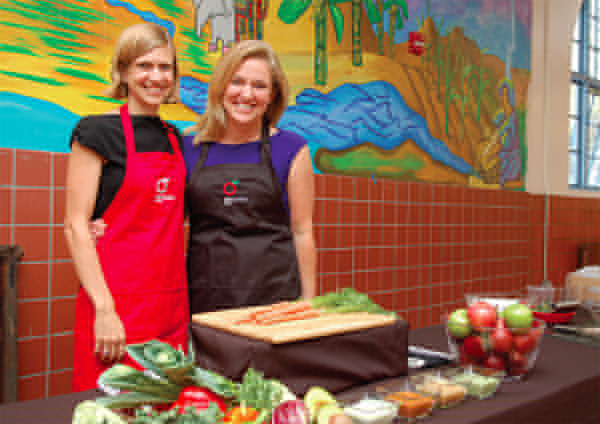
 Kirsten Tobey (left) and Kristin Richmond, cofounders of Revolution Foods, visit a high school in San Francisco. (Photo by Shelly Puri, courtesy of Revolution Foods)
In 2012, the contract between the San Francisco Unified School District (SFUSD) and its school meal provider was nearing an end. The plated meals that the district had been buying from that provider, a large Chicago-based company, were hardly inspiring. The company was “flying them in frozen, and we would heat and serve them,” says Orla O’Keeffe, the head of policy and operations at SFUSD. She and her colleagues began to look for something better. After putting out a bid invitation that set high health and nutritional standards for meals, the district found what it was looking for—Revolution Foods, an Oakland, Calif.-based company that produces fresh meals made with natural products such as nuts, fruits, and vegetables.
But it was what the meals don’t contain that really drew the attention of the district: They’re free of ingredients such as artificial flavors, hormones, antibiotics, high-fructose corn syrup, and trans fats. What’s more, Revolution Foods offers menus that are varied and tasty: spaghetti and meatballs with a whole-wheat dinner roll, steamed carrots, and fruit; or vegetarian chili and cheese enchilada with Spanish rice, steamed corn, and fruit. The Revolution Foods team, O’Keeffe recalls, “cared not just about the quality of the food but also its appeal.”
The impact of changing providers was evident from the start. “We immediately noticed a spike,” O’Keeffe says. “Overall, we were serving a lot more meals.” And Revolution Foods does more than simply prepare and deliver food. It also arranges sessions in which students help develop meals tailored to their school’s population. They even get to create names for the new meals. “The kids love it,” says O’Keeffe. “They talk about ‘Rev Foods.’ They know it as a brand.”
Enabling children to eat healthy food is a goal shared by everyone from parents to policy makers. According to researchers, the quality of school meals appears to affect obesity levels. One study found that students who receive free or reduced-price lunches have lower obesity rates in states that impose high nutritional standards for meals than in states that lack such standards. Other studies provide evidence that links nutrition with academic performance and emotional well-being. Even apart from those studies, of course, most people understand the importance of making sure that students have nutritious food to eat. “Think about it,” O’Keeffe says. “How effective could you be in your job if you were hungry?”
But it’s hard to reap the benefits of serving meals in schools if kids won’t eat them or if they are of questionable nutritious value. That’s how Revolution Foods is making its mark. It’s a for-profit company that expects to bring in more than $100 million in revenue this year. Today, the company serves more than 1 million meals each week in K-12 schools across the United States. It operates in more than 1,000 schools across 15 states. And it has reached that size by showing that there’s no necessary trade-off between offering meals in high volume and offering meals of high quality. Nor, according to its leaders, is there any inherent need to choose between pursuing a mission and building a business.
Good Ingredients
The idea for Revolution Foods was born in the MBA program at the Haas School of Business at the University of California, Berkeley. Two students in the program, Kristin Richmond and Kirsten Tobey, were both former teachers, and they shared an interest in applying their newly developed business skills to the education field. They noted that one aspect of the field—how schools feed their students—had received little attention from education reformers. They also noted a gap in the school lunch market and an opportunity to build an enterprise that would create jobs. “It was very much ‘social mission first,’” Tobey explains. “But then it was about how to address [that mission] with a sustainable business that would not be dependent on foundation funding.”
Richmond and Tobey used their time at the Haas School productively. There, they wrote a business plan and sought out future investors among their fellow students and professors. “We were taking a new-venture finance class as we were negotiating our first term sheet for investment,” says Tobey, referring to the document that sets forth the terms and conditions of a deal. “So it was very helpful to be in that environment.” The pair founded Revolution Foods in 2006.
The enterprise began modestly in a small kitchen in Emeryville, Calif. With the help of four friends, Richmond and Tobey cooked and packaged hundreds of meals—spaghetti and meatballs, carrots, fresh peaches—and delivered those meals to local schools. As the operation began to take off, they set about raising funds to build a kitchen and to hire staff members. They also started building a network of local food suppliers.
At the outset, the Revolution Foods team devoted little time and few resources to marketing its products. Word of mouth, says Tobey, proved to be the company’s most powerful sales tool. She and her colleagues, meanwhile, concentrated on running focus groups and tasting sessions to ensure that they got the flavors and the packaging of their meals right. Early signs indicated that they had found the right recipe: By the end of the first year of its operations, Revolution Foods was delivering about 1,000 meals per day to several charter schools in the San Francisco Bay Area.
Despite their wish to “revolutionize” the school lunch market, Richmond and Tobey developed an approach that taps into existing systems. It does so in two ways. First, Revolution Foods works within the National School Lunch Program (NSLP), which gives schools a subsidy of about $3 for each free meal that they offer. “They’re already serving some kind of school meal to their students, but we offer the opportunity to serve a fresh, higher-quality lunch,” says Tobey. “We’re helping organizations to do something they’re already doing—but in a better way.”
Second, Revolution Foods created an operating model that balances efficiency with collaboration. To keep costs low and to control its ability to deliver high-quality food, the company prepares its meals not in individual schools but in its own centralized kitchens. All the same, this model—unlike that of some food service companies—relies on the schools’ lunchroom workers to serve the meals. “That’s helped us to scale up, because we’re not trying to change the system,” says Tobey. “We’re just changing a component of the system: the food.”
Good Business
To pursue their mission, Richmond and Tobey might have chosen to set up a nonprofit organization. They didn’t dismiss that option immediately, but they soon recognized that launching their venture would require financing on a scale that would not be readily available to them as a nonprofit. “We needed a half a million dollars to build our first kitchen,” says Tobey. “There wasn’t a foundation out there that would give a half-million-dollar grant to an unproven entity, whereas venture capital was very excited to take risks on us.”
Still, the mission of Revolution Foods remains its driving force. For that reason, the company applied to become a certified B Corporation. To obtain this certification, a company must meet certain standards of social and environmental performance, legal accountability, and transparency. Revolution Foods earned B Corp designation in 2011. The B Corp approach is gaining momentum among social entrepreneurs, according to Jay Coen Gilbert, a cofounder of B Lab, the organization that oversees the certification process. “One of the advantages of being a for-profit business is that you can more easily attract the capital and talent needed to scale up quickly,” he says.
Among the investors who have bet on the company is Steve Case, cofounder of AOL. In 2011, he and two colleagues launched Revolution Growth, a $450 million fund that targets companies that combine high business potential with the potential to “change the world” (as the fund’s website puts it). Last year, the fund made a “significant” investment in Revolution Foods. (Company officials did not want to announce the figure formally, but a source familiar with the investment said that it was $30 million.) “The company already had reasonable scale when we looked at investing,” Case says. “But it still has a relatively small percentage of the overall school lunch business, so that in itself gives us a significant market opportunity.”
Funding from mission-driven organizations has also been pivotal to the success of Revolution Foods. At an early stage, the W.K. Kellogg Foundation took an equity stake in the company. “We saw a company that had the potential to turn into a serious, profitable business,” says Joel Wittenberg, vice president and chief investment officer of the foundation. “And from the mission perspective, it was a no-brainer.” In addition, Kellogg has used grantmaking to underwrite the company’s growth. In New Orleans, for example, it funded not only equipment and training in schools, but also the work of a partner organization that helps schools with the NSLP reimbursement process. “It’s supporting the infrastructure that’s necessary for putting in a healthy food system,” says Tobey. “That’s been an important element of our scaling.”
Revolution Foods has not yet attained profitability. But it’s “getting very close,” says Tobey. To further its overall growth strategy, the company has expanded into the retail market by launching Jet Packs, a line of prepackaged meals for children that offer a health-oriented alternative to products such as Kraft Foods’ Lunchables. Even as the company operates as a for-profit business, though, it retains a commitment to advancing its mission-related goals. In that spirit, company leaders have considered filing to gain legal status as a benefit corporation. (Under legislation passed in more than 30 US states, such companies have a mandate to pursue not just profitability but also social and environmental impact.)
Tobey and Richmond see profitability and growth as tools for achieving social impact. “We and our team have a saying: No margin, no mission,” Tobey says.
Read more stories by Sarah Murray.