


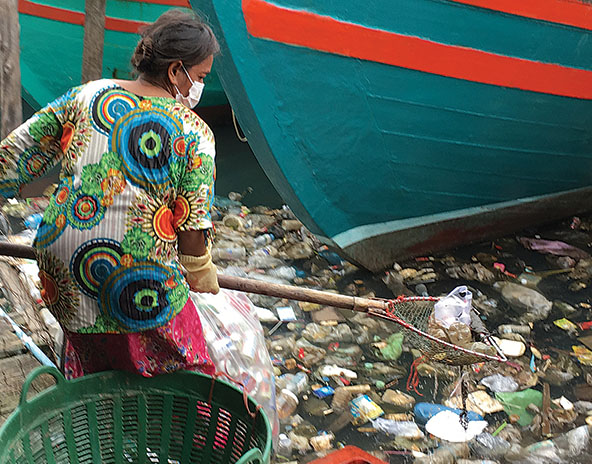
 TONTOTON waste picker Sorn SreyMom collects orphan plastics for cement conversion in Sihanoukville, Cambodia. (Photo courtesy of TONTOTON)
Vietnam’s coastline is a plastic-pollution hot spot. With 13 river systems and a disorganized waste management system, discarded plastics end up burned in dumpsites or, when it rains, washing into rivers, where they then flow into the South China Sea.
“Vietnam is a polluted but beautiful country,” says entrepreneur and environmental advocate Barak Ekshtein, who owns the recycled-plastic-bag business Bkbags.
Most postconsumer plastic waste is not recycled, Ekshtein explains, because either the technology doesn’t exist or businesses decide the effort is not worth the cost. “Next to every recyclable plastic bottle there is a plastic bag, food packaging, or other nonrecyclable plastic that is not being collected because it has no market value,” he says.
In 2019, Ekshtein attended the Ocean Plastic Turned into an Opportunity in Circular Economy conference, where he learned that plastic can be used as an alternative to coal in cement production. He also discovered that government programs often did not provide sustainable funding options to incentivize businesses to recycle.
These insights inspired the idea for TONTOTON, a for-profit company that prevents plastics from reaching the ocean and offers corporations a sustainable solution to reduce their plastic-pollution footprint. The business model of TONTOTON, founded in 2020, consists of paying informal waste pickers to collect and transport the “valueless”—or “orphan”—plastic litter and then paying private companies to convert it to alternative energy.
To recoup those initial costs, Ekshtein adapted the idea of carbon credits for plastic credits, which give companies the chance to buy into plastic-collection efforts through a certification process. For every credit purchased, a ton of collected, otherwise unrecyclable, plastic waste is converted into alternative fuel for cement production. In turn, proceeds from the credits purchased fund the future collection, cleaning, and conversion of the plastics.
Ekshtein shared his vision for orphan-plastic credits with Zero Plastic Oceans (ZPO), an NGO that has set international standards for commercially recyclable ocean-bound plastics (OBP). ZPO created new standards for orphan plastics that have been incorporated into the certification process.
In early 2021, TONTOTON became the first company in the world to be certified by ZPO’s OBP-neutral protocol. The certification process includes an independent third party, Control Union, which ensures that plastic-pollution neutrality standards are met. Control Union issues a certificate that is publicly registered by ZPO. For every ton of orphan plastic processed, a credit is issued—the mission is reflected in the name, “ton to ton.”
“TONTOTON’s plastic credit system offers a solution for companies to take responsibility for all their plastic pollution—not just the much easier, high-value recyclables. By purchasing these orphan plastic credits, they can contribute to cleaning up the massive pollution left on land and prevent it from entering oceans,” Ekshtein says.
Ekshtein initially self-funded TONTOTON but quickly sought outside investments to keep the business sustainable. TONTOTON received its first outside investment in spring 2021 when ClimeCo, a US-based global broker in environmental commodities, prepurchased 600 tons of plastic credits to sell once they were certified.
“We didn’t want them to wait a month or a year down the road before being able to sell credits,” says ClimeCo Plastics program director Chris Parker. “They are doing work that no one else would do.”
The cash infusion gave TONTOTON, Ekshtein says, “not only the funds but the confidence” to expand to new locations in Vietnam and Cambodia that year.
TONTOTON’s commitment also extends to its employees, who are provided with training, personal protective equipment, and health care. Waste pickers, about 50 in Vietnam and nearly 250 in Cambodia, earn $5 to $25 a day to collect and clean orphan plastic such as bags, clothes, and shoes.
Since March 2021, more than 450 tons of nonrecyclable plastic waste has been collected from Vietnam and Cambodia. Seasonal rains and COVID-19 have slowed collection, but TONTOTON met the first 600 tons certified this spring. ClimeCo recently pre-purchased 1,750 tons. It now works with four cement factories to convert the plastic.
In Cambodia, TONTOTON has recently started a “plastic-free coastlines” awareness campaign in partnership with the United Nations Development Programme, local NGOs, and the Royal Government of Cambodia. It plans an educational program about recycling for 15 Cambodian schools, reaching 10,000 students by the end of 2023. By that time, it intends to have built four more collection centers, with the goal of collecting 3,000 tons of orphan plastic.
“Opening new collection centers will help reduce poverty, create more sustainable communities, improve marine life, and help companies take responsibility for their plastic pollution,” Ekshtein says.
Read more stories by Senta Scarborough.