


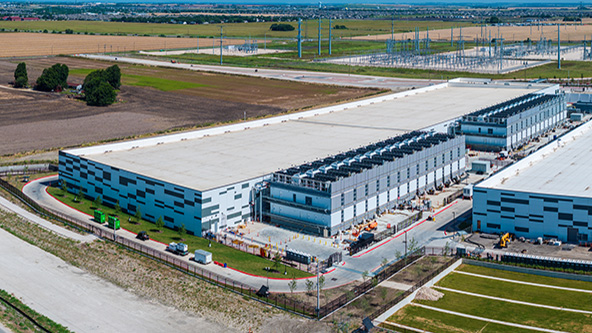
 (Photo by iStock/BackyardProduction)
Just over a year ago, 51 percent of Americans—a majority, albeit a slim one—were broadly receptive to data centers being built near them. Now, 75 percent of people say they would oppose a new data center nearby.
In the midterm elections a few days ago, voters approved dozens of local ballot proposals to restrict or ban data center development. At a public meeting in Wisconsin about a proposed project, a comedian joked that data center opposition has become “the most bipartisan issue since beer.”
Some commentators are explaining away this sudden shift in public opinion as a symptom of NIMBYism—the “not in my backyard” response that communities often have when a controversial highway, energy project, or industrial facility is proposed in the area. But to characterize the movement against data centers solely as NIMBYism is to misread the moment.
In truth, the backlash we are witnessing reflects both a public frustration with how data centers are being built and growing distrust and anxiety with what the data center build-out is powering: an AI future that, for many, is full of uncertainty. It is a two-tiered problem that must be tackled in tandem.
On the ground, there are no common rules for how data centers are built and operated, who bears their external costs, and what information and power local communities should have in decisions about their construction. This must change.
More broadly, there are few policy guardrails to guide how AI is deployed: to ensure it is used for the public good; to protect individuals’ right to privacy; to safeguard civil rights; to advance health and environmental stewardship, not destruction; to enrich human work and knowledge, not replace it. This, too, must change.
What are needed are clear and strong governance frameworks for both AI use and data center development that give people confidence that their interests—and the broader public interest—will always come first, even as technologies and companies race forward.
Why We Need Baseline Standards for Data Centers
From the end of 2024 to the end of 2025, the amount of data center capacity in the development pipeline in the United States grew more than two and a half times over. Roughly 1,500 data centers are projected to be at some stage of construction or development, and the amount of electricity needed to power these facilities is expected to more than double in just the next two years.
This data center build-out is creating much-needed work—including union jobs—for electricians, engineers, and construction trade workers. And in some places, tech companies are using and revitalizing abandoned industrial sites and bringing new, clean power sources online to power the facilities.
But it is also true that, all too often, data centers are saddling nearby residents with unacceptably high costs: rising electric bills, falling water pressure, around-the-clock noise, and diesel backup generators or gas-fired turbines that thicken the air. The wetlands and green space that was once there is gone. And few full-time workers are typically needed once a data center is up and running.
These experiences are sparking anger and frustration in red states and blue states, small towns, and suburban enclaves. Community members—people with kids to raise and full-time jobs—are poring over corporate permit applications to uncover what’s being planned near them, and then doing their best to change it.
These project-by-project, David versus Goliath battles against data centers aren’t fair fights. They also present a longer-term challenge and risk: history has taught us that when companies encounter—or anticipate—powerful-enough resistance in one community, they tend to turn toward others where affected residents hold less political influence.
“Every blocked project that relocates to a community with less power to negotiate is a transfer of environmental burden from the privileged to the vulnerable,” writes Dr. Len Necefer in a deep dive look at data centers and the movement against them. “That is the oldest pattern in American environmental history.”
It’s true. Chemical plants, refineries, incinerators, medical sterilizing facilities, and other big polluters are all concentrated in communities of color and low-income communities. It’s a pattern that will be exacerbated by data centers and the infrastructure that powers them, unless we change course.
For a sense of what more may come, look no further than proposals to build a massive new data center in Lowndes County, Alabama—an area with long-standing environmental justice concerns—or to reopen fossil fuel power plants in predominantly Black communities in South Carolina, Texas, and Illinois to feed data centers.
To prevent organized opposition in one place from simply becoming someone else’s problem, it will take a set of baseline standards—across federal, Tribal, state, and local jurisdictions—that apply to all proposed data center projects and that protect workers, taxpayers, utility ratepayers, and the environment.
Raising the Environmental Floor for Data Centers
From an environmental, energy, and public health standpoint, the following four categories of requirements should be the minimum starting point for developing data centers.
Communities and local governments should have the power to say yes or no. People have the right to know—and to have a say in—what industrial projects are being proposed in their neighborhoods. Data center companies should be required to disclose a project’s footprint and impacts before permitting processes begin, non-disclosure agreements that shield this information from the public should be banned, and communities and their elected leaders should have a chance to shape how projects move forward, or to reject them altogether.
Data centers should be required to pay their own way. When a data center comes to town, utilities often must build new transmission lines, substations, and generation capacity to meet the new demand. Under current rules in many states, those costs are spread across all utility customers, including families and small businesses. This is a public subsidy for some of the world’s most profitable corporations, and it must end. State public utility commissions and the Federal Energy Regulatory Commission should require large new data center loads to cover the costs of the infrastructure they need.
Data centers should bring their own clean energy. Many tech companies have made sweeping climate and renewable energy commitments, but commitments on paper don't guarantee clean electrons flowing in real time. Companies should be required to directly procure enough new carbon-free power generation capacity to meet their needs and to meet state and regional climate goals. The rush to build a data center should not justify locking in new pollution from additional fossil fuel infrastructure.
Big tech should be held to the same environmental standards as other industries. Data centers—along with the energy facilities that power them and the chip manufacturers that supply them—should be expected to uphold the same environmental and public health protections as other comparable industries: full air and water quality permits and compliance before construction begins; public disclosure of water consumption with a requirement to minimize use and prioritize reclaimed supplies over potable water; and siting decisions that avoid wetlands, wildlife habitat, and intact ecosystems, with measurable mitigation required when harms are unavoidable. Facilities proposed in communities that are already bearing high pollution burdens should face heightened scrutiny.
AI companies that want to be seen as responsible corporate citizens should have no reason to object to any of these four core requirements. Many of them already claim to be limiting the energy, water, and noise impacts of their operations. For them, these requirements should simply be a matter of walking the talk.
But companies should also be encouraged to reach higher than these basic environmental standards. Done right, data centers can, for example, help finance the cleaner, more reliable grid they need—through investments in clean generation, energy efficiency, transmission, and load flexibility that could benefit all customers. Projects that meet all requirements, earn local support, and that do the most to advance the public and community interest should be considered above other data center proposals.
Building Momentum for AI Reform
Reimagining and reforming how data centers are built, of course, is a necessary but insufficient response to the challenges we must confront—as a country and as a global community—as AI’s footprint and impact grows.
Currently, few people beyond the leaders of tech companies have any voice in how AI is developed and used. Speaking up against a data center being built nearby is, for many, the only chance to confront an industry whose technologies are staggeringly powerful, promising, and dangerous.
As a society and as a country, we should not resign ourselves to powerlessness in the face of these technologies. They are human-created. They can and must be governed by shared values, public institutions, and global cooperation. Establishing a governance framework for AI that protects the public interest above all else is an urgent, all-hands-on-deck project for civil society in this moment.
The environmental movement, including the organization I lead, has been focused on helping communities address the real, immediate, and on-the-ground environmental and health impacts of data centers. But we must also dedicate ourselves—alongside many others—to passing strong and enforceable AI laws that protect public safety, privacy, civil rights, workers, democracy, and more.
Yes, AI can be used to help biologists analyze data to save at-risk wildlife or to optimize power systems to reduce energy use. These are constructive environmental uses. But AI also has the potential to exacerbate environmental dangers and to create new ones.
Will AI’s use, for example, accelerate the climate crisis and the destruction of nature by making drilling, mining, and logging economically more viable, including in the planet’s hardest-to-reach areas? Will AI-powered misinformation campaigns be used to overwhelm public opposition to an environmentally destructive project or policy? How much land, water, and energy should be used to feed AI, and what impact do these shifts have on the well-being of people, the climate, and the livability of the planet?
There are as many questions about AI as there are potential uses.
“Solidarity demands that decisions regarding data, algorithms, platforms and artificial intelligence take into account not only the immediate benefit for a few, but also the impact on all peoples and on future generations,” writes Pope Leo XIV in his first encyclical.
This is wisdom worth heeding.
Communities speaking out against data centers are worth listening to. Their concerns are direct and real: energy prices, noise, water, pollution. So, too, are their worries—worries that are widely shared—about how the technologies the data centers are powering will reshape our livelihoods, our lives, and the world in the years ahead.
Read more stories by Manish Bapna.