


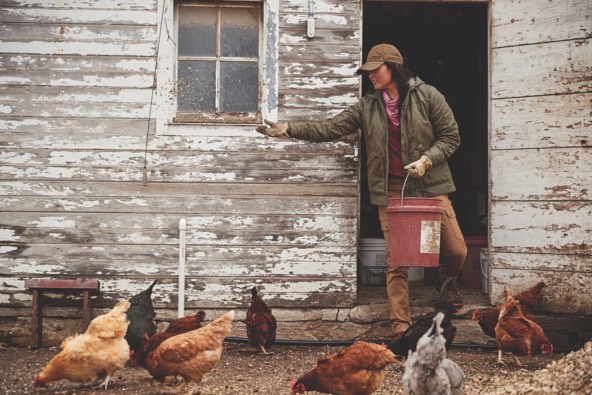
 Iowa farmer Wendy Johnson of Jóia Food & Fiber Farm feeds her chickens. (Photo by Tom Rafalovich, courtesy of Healing Soils Foundation)
It's hard to imagine anything more foundational to our well-being than the food we eat. Yet most consumers know little about how their food is grown and prepared. Where does it come from? How was it grown and processed? Does the quality of air and water affect its nutritional value, and was the environment damaged in the process? What are the impacts of synthetic chemicals used?
Healthy eating begins with these questions, but the next stage is to bolster the farmers who use environmentally sound practices. The mission of the Healing Soils Foundation (HSF), led by Executive Director Sarah Franz since May 2024, is “to empower farmers (in the Midwest) to restore the vitality of our planet’s soil, fostering the well-being of people, communities, and the Earth itself,” and in doing so, “to catalyze a regenerative future.”
Regenerative practices like minimizing tillage, using cover crops, composting, and rotating livestock grazing are critical to maintaining soil health, as the US Department of Agriculture’s Natural Resource Conservation Service has emphasized. Vast swaths of US farmland already have deteriorated soil, due to excessive use of toxic pesticides and herbicides, as well as to the ubiquity of genetically modified crop systems. This soil has a diminished volume of vital microbes—such as fungi and bacteria—which in turn depletes the nutritional value of the crops.
HSF’s core programming supports farmers who are implementing organic and regenerative practices at scale. In its first year of activity, it has provided over $1 million in grants, primarily to farms located in Illinois, Wisconsin, Minnesota, Iowa, and Michigan. But HSF has also had to change course to meet the immediate challenges caused by the current federal administration, which has severely cut or delayed funding for USDA conservation programs. HSF’s new Regenerative Farmer Assurance Fund (RFAF) program is currently providing a lifeline to struggling farmers: “This is a very tumultuous time for farmers, since they put themselves out there economically, taking risks for the benefit of the environment,” Franz laments. “Funding the RFAF program is now our top priority.”
“If USDA funding does not come through, we transition the funding to a traditional grant, ensuring that farmers are not negatively impacted,” Franz says. “We are waiting to see when farmers are feeling stable, when the number of RFAF applicants drop off. When there’s a point of equilibrium, we will offer core programming again.”
Rachel Bouressa, owner of the Bouressa Family Farm, located in central Wisconsin, received $30,000 from the RFAF after her USDA Environmental Quality Incentives Program grant was abruptly canceled, as was 99 percent of the $2.4 million that USDA had originally allocated for her county. But as a result of the RFAF grant, she now can execute her plan to convert 40 acres of her farmland from industrial CAFO use (rented to tenant) to regenerative grazing for her 90 head of cattle.
“It’s hard enough to earn income on a small farm to cover all of life’s expenses,” Bouressa says. “The RFAF grant will cover perimeter and interior fencing, seeding, and waterlines, allowing the acreage to be converted to permanent perennial pasture.”
Beyond supporting individual farmers, HSF also invests in the critical infrastructure that enables regenerative farmers to bring their products to market, as well as scale their operations. For example, the Rebuild Midwest program funds facilities such as on-farm grain storage, regional processing hubs, and meatpacking operations, all critical components in the supply chain. Also, the program Restore Midwest is a partnership between HSF and Zero Foodprint, a nonprofit organization that raises funds from the food industry, typically with contributions of 1 percent of sales, to focus on regenerative agriculture. “We will work together beginning later this year to form a collective regeneration program in the Midwest, leveraging HSF’s initial funding to raise matching funds,” explains Anthony Myint, executive director.
In addition, HSF’s Land Access program focuses on the 4.5 percent of US farmers who classify as “socially disadvantaged” under USDA guidelines, a number that has fallen much lower than it was a century ago. HSF partners with mortgage lenders to arrange reduced mortgage interest rates for these farmers.
Looking ahead, one way HSF intends to make regenerative farming practices more widespread is by growing its own capacity to support farmers. Currently HSF pays out all of its contributions in grants; its vision is to build and scale an endowment over time, in order to deepen and broaden the vital impacts of regenerative agriculture across the Midwest.
Read more stories by Kathy O. Brozek.