


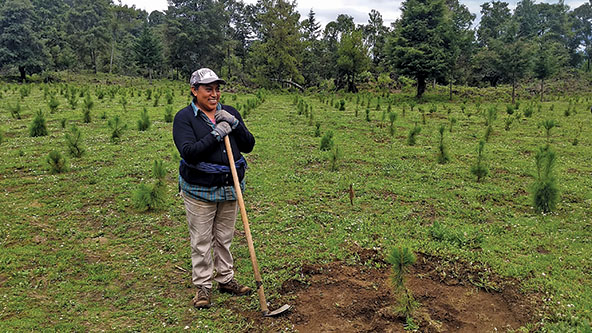
 An Ejido Verde employee tends to a pine sapling in Municipio de Pajacuarán, in Michoacán, Mexico. (Photo courtesy of Ejido Verde)
For David Romero, a typical workday begins the night before. He talks with the managers of nearby resineras—reforested farmlands, planted with pine trees for resin production—to prepare for the next day. Romero works for Ejido Verde, a regenerative pine resin company in the state of Michoacán in southwestern Mexico. The organization’s mission is to restore arid Indigenous lands to health while simultaneously creating living-wage employment for their residents. Its goal is to establish 12,000 hectares (approximately 30,000 acres) of commercial agroforestry lands, primarily in Michoacán, by 2030.
Romero has been involved with Ejido Verde since its start, more than 15 years ago. In 2006, US-based entrepreneur Fredo Arias-King took a “deeply memorable” trip to Brazil to speak at the Pine Chemicals Association’s annual summit. At the time, he was president of T&R Chemicals, a pine chemicals company in Texas. He was impressed by the country’s integration of technology into the management of pine tree plantations and, in a conversation with his uncle, lamented that Mexico didn’t have the same kind of privately held land structures that would allow for larger-scale commercial planting. His uncle suggested “partnering with the Indigenous community [and] planting on community lands,” Arias-King recalls. This idea was the catalyst for Ejido Verde.
Arias-King launched the sustainable business in 2009 in response to the ongoing degradation of farmlands and diminishing supply of raw pine resin in Mexico. Though the country is one of the top pine resin producers in a $10 billion industry, the environmental costs of failed replanting efforts and overtapped pine trees were not sustainable.
In Romero’s town of Cherán—population 20,000—there are about 750 people working on distilling resin. Together with locals from the surrounding towns, the total number of workers is close to 3,000. Romero explains that this group is part of the Meseta Purépecha—the Purépecha Plateau—in reference to the name of the region where the planting takes place. Romero, who oversees a group of resin workers, describes their relationship with Ejido Verde as free from any type of control estadístico de procesos—the total value of the work they’re doing does not rely solely on statistics. They also find meaning in connecting to the earth.
When asked about the best part of the work he does with Ejido Verde, Romero replies, “Regeneration of areas that were once arid and without pine trees, because of surrounding environmental and social problems, and being able to be part of what strengthens and protects the lands overall.”
A Delicate Trade-Off
Pine trees do not produce resin during the first decade of their life, so they do not generate any income for the planters. During this period, the Ejido Verde model provides zero-interest loans to Indigenous community members who are planting and maintaining the trees—the loans cover related expenses like land maintenance and seedlings—and it also pays the community members for their labor. The wages they receive are roughly two times higher than the local minimum wage. These communities then repay the zero-interest loans they’ve received from Ejido Verde with 10 percent of the resin income procured after the trees reach maturity. Currently, the planted tree plantations generate $3,200 in income per hectare. The average family works five hectares of land, totaling approximately $16,000 just from harvesting the pine resin.
What is now a profitable business—pine trees not only produce resin for 70 years but also sequester carbon, strengthen the maintenance of water in soil, and regenerate the soil’s biodiversity—began as an amorphous project primarily funded by Mexican pine chemicals company Pinosa Group. A second Mexican pine chemicals company, Resinas Sintéticas, provided additional funding to Ejido Verde, as did Arias-King’s T&R Chemicals. These companies invested because they saw an opportunity to experiment with a more socially equitable strategy and create a profitable supply chain.
The possibility of land restoration, which would increase pine resin production, was also advantageous to these investors. A $200,000 loan from Kiva, the San Francisco-based nonprofit that provides financial resources to underserved communities, followed in 2014. A year after Ejido Verde received the loan, they became an official Kiva field partner and received extra funding, totaling close to half a million dollars.
Today, Ejido Verde receives financing from more than 10,000 capital providers across 78 different countries. Shaun Paul, a social-impact entrepreneur, joined the organization as CEO in 2016. In 2019, Paul met Dieter Wittkowski, a lead investment specialist at IDB Lab, the innovation laboratory of the Inter-American Development Bank Group at the Latin American Impact Investing Forum (FLII), shortly after the bank’s private sector arm, IDB Invest, dispersed a $2 million loan to Ejido Verde. Wittkowski manages a fund that supports low-emissions agriculture in Mexico, and one of his responsibilities is to identify projects that the IDB Lab can support with those funds, whether loans or equity investments.
Wittkowski’s interest in Ejido Verde was piqued by its model’s inclusion of the residents of Mexico’s communal land (ejido) system. Because no single person or family owns an ejido, it can’t be sold or used as a guarantee for a loan. Most banks won’t lend to this system because there’s no single source of accountability; the rights-holding structure is deemed too complex. But Ejido Verde found a way to work within the existing ejido governance system and create a mutually beneficial system for the multiple stakeholders—the Indigenous communities, who get paid fairly; the corporate pine chemical companies, which want to increase resin supply in the market; and the blended-finance model investors like IDB Lab, who support private sector development through public partnerships.
Financing such an initiative is complicated, according to Pilar Carvajo Lucena, a member of IDB Invest. “The financial agreement and process took four years—mostly to ensure the money was channeled appropriately, to navigate the risks accordingly, and to become fluent in understanding what Ejido Verde itself was about,” she recalls. “By the end of 2018, Ejido Verde had evolved from being a small, productive alliance and gained enough traction in its planting of trees and maintenance of pine resin, without harming the trees in the process—enough for the organization to become a legal independent entity. Pinosa Group remained a shareholder, but Ejido Verde now had its own bylaws.” When Ejido Verde became its own company, IDB Invest moved forward with financing.
Ejido Verde’s ability to find a long-term, financially sustainable solution for use of the Mexican communal lands is significant. “A lot of the terras communales have traditionally relied on short-term crops, with higher turnover,” Lucena says. “These are the kinds of practices that decrease productivity of the land over time. It’s always a trade-off between short-term decisions and immediate income gratification, but there was no solution for the long-term problem of financial instability and land degradation.” Ejido Verde’s restoration efforts are being recognized on an international level. In May 2020, the World Resources Institute named the organization the best private sector Latin American landscape restoration project.
Revising Targets
Before the COVID-19 pandemic, Ejido Verde planted an average of 5,000 new native pine trees and created one new living-wage job per day. During the lockdowns, the organization was able to adapt and continue its field operations even as other local industries shuttered. “Our sector is considered essential,” Paul says. “Our administrative staff worked from home, and we maintained our operations with about 300 field workers adopting new practices in social distancing and hygiene.” Though the pandemic did slow down the planting schedule, it did not halt production entirely. The original plan was to plant 2,000 new hectares (5,000 acres) in 2021, but the target was revised to 1,200 hectares (about 2,965 acres). The benefits of Ejido Verde’s work during COVID-19 have extended far beyond the borders of its forests—pine resin is widely used in disinfectants approved by the US government to combat the novel coronavirus.
Though Ejido Verde was lucky to sustain its operations throughout 2020, Mexico has struggled with accessible and adequate COVID-19 testing during the pandemic. “Forecasting models used by the Mexican government suggested that for every confirmed case, there were another 10 unconfirmed cases,” Paul explains, “and Indigenous communities are among the 50 percent of Mexico’s population that live day-to-day to make ends meet.” As of September 2021, the state of Michoacán had nearly 70,000 confirmed cases of the virus and more than 7,000 reported deaths.
Most of the hardships that Ejido Verde faced directly, however, were economic. When the pandemic caused the pine resin market to plummet in 2020, the prices of petroleum sank with it. The price of gum resin—the product of harvesting resin from reforested communal lands—is linked to the prices of other resins produced from petroleum. Because the pine chemicals industry is so deeply embedded within the global marketplace, it too suffered the effects of the world economic freeze. The good news is that Ejido Verde has been able to weather this kind of volatility because of the natural timeline they’re working with—the 10 years it takes for planted trees to reach maturity and go to market means that there is plenty of time to recover from an economic downturn.
While deforestation may continue to plague Mexico, Romero points out, “there has also been ongoing reforestation, and Ejido Verde will provide more.” Currently, just over 4,000 hectares (nearly 10,000 acres) of land are under Ejido Verde’s management. In 2022, Ejido Verde intends to plant an additional 1,200 hectares with 1,320,000 new trees. And by 2030, when Ejido Verde aims to fulfill its principal goal, there will be not only 8,000 more hectares but also thousands more jobs—each paid at a living wage—and hundreds of tons less carbon in the atmosphere.
Read more stories by Caira Conner.