


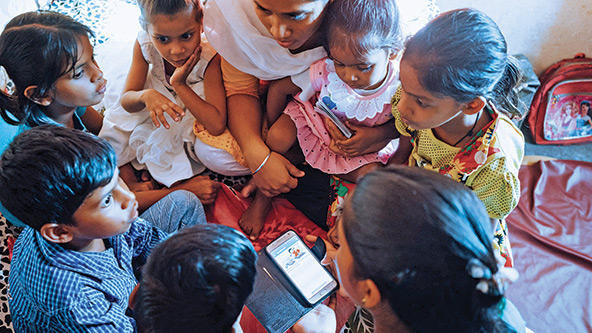
 Children in Delhi, India, participate in a digital book story time as part of the Read to Kids program. (Photo courtesy of Worldreader)
Throughout early 2018, Ruhi would often give her parents a hard time about going to day care and refuse to go, recalls Sapna Roy, a day care center facilitator in the Mahavir Enclave of Delhi, India.
“It was a daily struggle to convince her to come to the center,” Roy says.
But then something shifted. Ruhi began showing up at day care every day. She arrived early and eager, excited about story time, coloring worksheets, and watching puppet shows.
What sparked the change? That year, the Read to Kids program expanded from pilot testing with parents and child caregivers to day care centers in India. The power of reading—adults reading to children via a mobile-phone app filled with hundreds of books—ignited a love of learning in Ruhi and hundreds of thousands of other children like her around Delhi.
Roy says Read to Kids has had a significant impact on children such as Ruhi. Absenteeism dropped, because children did not want to miss story time. Children expressed themselves more than before, and the dynamic book-reading interaction anchored reading habits in the classroom and at home.
Ruhi’s newfound love of books is what global learning company Pearson, literacy advocate Worldreader, and global development partner Results for Development (R4D) hoped for when they created the Read to Kids India pilot program in 2015. The pilot reached 203,000 households around Delhi in its two-year run, and its success is driving the program’s expansion to other parts of India, Jordan, Peru, and the Middle East-North Africa region.
From their decades of collective experience, the organizations knew that making children lifetime readers takes patience and persuasion. But they learned from the Read to Kids program that encouraging parents and child caregivers from low-income communities to read to young children is especially challenging in countries without an established culture of reading books.
“This project was the first time ever that someone was trying to see how mobile phones can be leveraged to change parents’ behaviors, and to encourage more parent-child interactions and more reading to children,” says Annya Crane, global program manager and behavior-change management specialist at San Francisco-based Worldreader.
The Read to Kids pilot found success by forging a diverse partnership of international and local organizations; maintaining a strong focus on changing behaviors; and applying a blended, cross-sector development approach built on the willingness to continually learn, pivot, and adapt.
A Global Network
The Read to Kids India pilot stemmed from Pearson and Worldreader’s shared interest in increasing global literacy and delivering cost-effective access to books in places where they are hard to find.
The worldwide explosion of digital devices has allowed these organizations to reach even more children. Worldreader estimates that 250 million children in low- and middle-income countries start school unprepared for learning. It hoped that enabling parents to read to their children could give these kids an advantage in school and in life.
Pearson and Worldreader, which previously teamed up to make Pearson’s content available in Worldreader’s e-reader programs in schools and libraries across Africa, extended their relationship in early 2015, with the goal of increasing literacy in India.
The organizations focused on transforming India’s ubiquitous mobile phones into mobile libraries loaded with hundreds of digital books. They wanted to discover how parents could use their phones to read to their children, and to encourage new ways to improve their children’s school readiness. Worldreader estimates that many children in India are unprepared for school; 57.5 percent of children in grade three are unable to read grade-one-level texts.
Pearson, the project’s main funder, provided Worldreader with approximately $1.4 million for the two-year pilot from 2015 to 2017, plus an additional $600,000 for the program’s expansion in 2018 and 2019. Worldreader, which also fundraised about $250,000 for the project and dispersed those funds between 2015 and 2019, was the principal program designer and technology provider, offering its digitized content portfolio and experience of creating digital readers in 51 countries. A majority of the Read to Kids funding was allocated to the behavior-change campaign and the mobile-app development.
Results for Development, a Washington, DC-based nonprofit, joined Pearson and Worldreader in May 2015 to oversee monitoring and evaluation. Pearson paid the nonprofit $240,000 to serve as Read for Kids’ evaluation and learning partner from 2015 to 2017.
“From the beginning, we were each invested in making sure this project led to real impact on the ground for families while also generating deep learnings for the global literacy community so that the project could be replicated in other places,” says Jennifer Young Perlman, Pearson’s director of innovations and partnerships.
Once it had lined up the main partners, Worldreader began developing the Worldreader Kids app in mid-2015 to create a child-friendly interface that turned phones into reading devices. The app, which went into beta testing in 2016, contains a culturally sensitive, age-appropriate digital collection of 550 children’s storybooks in Hindi and English, which parents can download through an internet connection. Worldreader sourced the books from 34 local and international publishers, including Pearson, Pratham Books, Katha, Tulika, and Eklavya.
Creating a Reading Culture
During the pilot program, the local and international partners targeted literate or semiliterate parents in low-income communities who had smartphones and sent their children to low-cost schools. The organizations wanted to learn how these parents used their mobile phones and how the country’s storytelling tradition could strengthen reading habits.
The organizations also partnered with several Delhi-based creative, development, education, government, and health-care organizations, such as Society for All Round Development (SARD) and Hindustan Latex Family Planning Promotion Trust (HLFPPT), to better understand phone usage patterns, determine which families would most likely participate, and how best to communicate the central message that “today’s story is tomorrow’s preparation.”
The team got its first set of findings in late 2015 to early 2016 through initial planning meetings and three months of field research that involved data collection and child caregiver interviews and surveys. They learned some surprising things. For instance, they lacked a common vocabulary—even for “read” and “reading.” In Hindi, the words padhna or padhai karna mean to read or study, but they refer to academic work. The idea of story time and reading for the literary development of young children is absent in most Indian households.
“There’s a big culture of oral storytelling in India, but it is not a culture where reading books to kids for fun at home is the norm,” says Molly Jamieson Eberhardt, R4D’s program director. “We realized early that parents who took our survey translated ‘reading with children at home’ as supervising homework, which wasn’t the behavior we were trying to encourage and wasn’t relevant for our target age range of 0 to 8 years old. It wasn’t a mistranslation; it was a cultural translation.”
The words associated with India’s deep oral storytelling tradition were a better option. Using the Read to Kids app to “tell stories” became a major focus of the behavior-change work that followed.
Essentially, each new insight was a chance to reassess previous assumptions, pivot when the data deviated from the team’s expectations, and realign goals for the next phase. This technique—the cornerstone of R4D’s adaptive learning strategy—became the foundation that helped Read to Kids flourish.
This iterative approach was a great success. “We were able to introduce data-based decision-making capabilities through a learning-lab approach with our partners,” says Wendy Smith, Worldreader’s director of education programs. “It helped them think quickly about how to adapt the program to better engage parents and child caregivers.”
Additionally, quarterly learning checks proved to be tremendously valuable. Meetings face to face every three months with the main local partners—SARD, HLFPPT, and Katha—produced significant insights about how users were shifting reading behaviors, how they were sharing stories with children, and what challenges they had in using the app.
“Community engagement is hard. Behavior change is hard. And this kind of behavior-change project had never been tried before,” says Luke Heinkel, R4D’s senior program officer. “We didn’t know what outcomes to expect, but we agreed to be rigorous in how and what we could learn.”
By the pilot’s end, Read to Kids directly supported 15,000 families from 177 low-income Delhi communities via app-usage training sessions in one-on-one and small group settings. The regional mass media campaign and behavior-change messaging, which reached an estimated 17 million people, attracted another 188,000 app users. Nearly 7,000 households became “frequent readers,” reading from the app at least four times per month—an indicator for reading-habit creation and behavior change, according to Worldreader’s project report.
“If we had gone into the project with the ambition to scale Read to Kids before we even understood firsthand what the key barriers were to early reading and whether mobile technology could overcome those barriers, then we would have missed important steps in our learning cycle and would not have been able to successfully replicate the project in more communities within India or even other countries, like Jordan,” Young Perlman says.
This holistic approach of working both in communities and with parents led to the launch of Worldreader’s Tuta Tuta pilot in Jordan in 2017, which reached more than 50,000 refugee or conflict-impacted families. Built on the Read to Kids findings, Tuta Tuta showed how regular reading and select books addressed the social and emotional needs of children in crisis situations.
“Social and emotional learning is now mainstreaming across Worldreader programs,” Smith adds. “Our learnings from Jordan illustrated that many parents perceive a strong emotional benefit to reading to children and are seeking books to support this.”
Read more stories by Jennifer Baljko.