


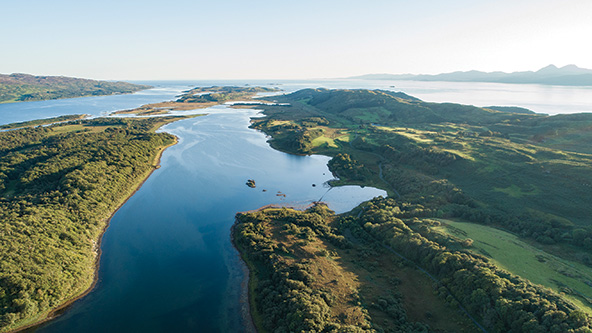
 In Tayvallich, a peninsula on the west coast of Scotland, residents and Highlands Rewilding are working together to restore the environment. (Photo courtesy of Highlands Rewilding)
Tayvallich, a remote peninsula on the west coast of Scotland, was once a varied patchwork of habitats, including now-rare temperate rainforest, rich in lichens, mosses, liverworts, ferns, and an array of tree species, including birch, hazel, oak, and juniper.
But decades of tree felling and overgrazing have decimated Tayvallich’s landscape, leaving behind a smattering of the former fresh- and saltwater wetland habitats and species-rich grasslands.
Tayvallich’s environmental degradation has led to calls for its rewilding, as part of a larger nationwide rewilding effort. The Scottish Rewilding Alliance is demanding that 30 percent of Scotland’s lands and seas be rewilded by 2030.
But these rewilding projects, undertaken by the owners of some of Scotland’s most vast estates, haven’t always been popular with locals. These so-called green lairds have been accused of ignoring the needs of residents in their rewilding efforts.
In Tayvallich, they’re trying something different, by simultaneously restoring the landscape and bringing new opportunities to the local community. Last spring, the 3,500-acre estate comprising the peninsula was sold to Highlands Rewilding, a company whose mission is to rewild landscapes and generate income from biodiversity and carbon-offsetting projects. The company’s founder, social entrepreneur Jeremy Leggett, is the former scientific director of Greenpeace’s climate campaign and the founder of solar-panel company Solarcentury. Leggett says he was attracted to Tayvallich because of its varied ecology and temperate rainforest.
When residents learned that the family who had owned the estate for three generations was selling it, in September 2022 they formed the Tayvallich Initiative to safeguard their interests. One month later, the initiative was incorporated as a limited company with charitable status.
Highlands Rewilding has committed to work with the initiative to ensure that the residents’ way of life will not only be protected but improved under its ownership. In partnership with the Tayvallich Initiative, it formalized a memorandum of understanding (MOU) that outlines 24 objectives to achieve a quid pro quo of community prosperity and ethical profitability.
“The [MOU] is quite groundbreaking,” Tayvallich Initiative chair Martin Mellor says. “It’s an embryonic framework that creates a really good starting point for development over the coming months and years.”
The MOU also includes plans for Highlands Rewilding to sell parts of the estate to the community, with provisos that a dozen properties will be built for locals to rent at affordable prices with a no-eviction policy, as well as a guarantee to maintain all jobs on the estate. The memorandum relies on Scotland’s Rural Housing Burden policy, which requires that any plot or property sold must be used as the owner’s primary residence, as a mechanism to prevent housing from being used as vacation rentals that are financially unobtainable by locals.
“You see a lot of people who leave for work or training or university and finding it hard to move back again,” Mellor says of the current housing market. “So it’s quite exciting to think that in future years we’ll make a difference in making more properties available for people to live in full-time.”
Mellor and Leggett also hope that residents will be able to establish small businesses that take advantage of the restored environment, such as nature tours and kayaking.
Funding for the initiative’s work comes from several sources, including the Scottish government, which bestowed a grant of £194,000 ($238,543) to fund eco-enterprise development. The Scottish Land Fund provided a £565,000 ($694,727) grant for the initiative to purchase the land and buildings surrounding Tayvallich village to construct affordable housing. Leggett added that funding also has come from “high-net-worth individuals and a crowdfunding campaign that raised more than £1 million [$1.23 million].”
This year, Highlands Rewilding plans to carry out a baseline assessment of the local ecology to monitor progress of the rewilding efforts, while the Tayvallich Initiative will develop plans for eco-enterprises.
If the partnership between Highlands Rewilding and the Tayvallich Initiative proves successful, it could provide a template for future rewilding projects.
Read more stories by Emma Woollacott.