


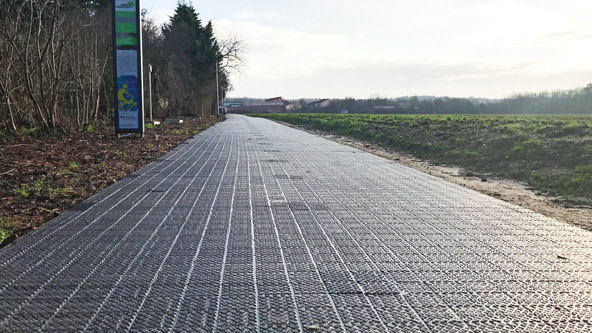
 The solar road that Donald Müller-Judex has developed is made up of coaster-sized tiles with corundum-covered crests that support car tires and valleys that collect dirt and grime. (Photo courtesy of Solmove)
If Germany is to achieve its goal of 100 percent renewable energy by 2050, rooftop solar panels simply won’t suffice. That’s why engineer Donald Müller-Judex has built the country’s first solar road on a small bike path in Erftstadt, near the city of Cologne.
“If we are serious about climate change, we need to use all suitable surfaces for solar power, including streets,” he says. In a joint research project with Rhine-Westphalian Technical University in Aachen, the Jülich Research Center, and the University of Bayreuth, he and his small company, Solmove, developed a “multi-functional solar carpet” whose tiles click into place and connect.
So far, the track of blue solar tiles, each as small as a coaster, is only 90 meters (295 feet) long. But Müller-Judex sees it as a path to the future when all suitable asphalt surfaces are used sustainably. His road is designed to provide electricity, swallow noise, illuminate itself at night, and melt away the ice in winter. Eventually, it could even be smarter than some traffic controllers: The monocrystalline silicon surface has built-in sensors that, on larger roads, could measure traffic flows and optimize traffic light circuits. Each square meter of tiles can supply up to 80 kilowatt-hours per year, which are fed into the local power grid.
Creating the robust yet slip-resistant road surface was a balancing act, Müller-Judex says. He compares its nub texture to a micro-mountain range. Water washes away the dirt that collects in the valleys, he explains. “The car tires are supported by the road’s mountaintops. These crests are covered with corundum, a particularly abrasion-resistant rock that lies just behind diamond on the hardness scale.”
When asked about the cost, Müller-Judex hems and haws. “Don’t forget: The first microchip cost $10 million,” he argues. “If people had said back then that it was too expensive for PCs, then we wouldn’t have computers at all today.”
If the solar road were to last 20 to 25 years, as predicted, the people of Erftstadt could even earn money from the electricity generated. “A normal street costs money. A solar street earns money,” Müller-Judex says.
He came up with the idea almost 10 years ago when he was looking for surfaces for photovoltaic systems in Bavaria. All suitable roofs were already covered. “Why don’t we use the road?” the engineer thought. “It lies in the sun, doesn’t it?”
He began to tinker with solar tiles. For Germany alone, he sees potential for 1.4 billion square meters. “The road network in Germany, highways excluded, would be enough to supply 20 million electric cars,” he says. Roads and parking lots offer the advantage of charging electric cars automatically by induction without a socket.
The idea of putting solar panels on the ground has other challenges. “For solar photovoltaics to work, they need to be free of dust and any objects blocking the light,” says Diane Moss, founding director of the nonprofit Renewables 100 Policy Institute in California. “It’s not clear how technically or economically feasible that is to do on roads.”
Müller-Judex continues to forge ahead. He has just completed an analysis with the German railway company Deutsche Bahn to see how economical it would be to use his solar tiles on rail tracks. He is also building a cycle path for a software company in Silicon Valley and a test facility near Los Angeles.
Similar ideas are being explored in China and other countries. France and the Netherlands already have small test roads. In the United States, a much-hyped solar road concept stalled when it turned out to be too expensive and energy-
inefficient. But the competing systems require that existing roads be milled. By contrast, Solmove’s tiles can be glued onto roads because the flexible tile carpet compensates for the surface’s small bumps.
In 2018, during the first winter trial, not everything went according to Müller-Judex’s plan. Yes, the grooves allowed for the dirt to be washed away, and the cyclists love their unusual track. But the electricity output was significantly smaller than predicted (only 150 kilowatts in the first five months).
“The first aircraft was made of wood and fabric,” Müller-Judex says. “If you look at the proportion of wood and fabric in a modern aircraft, you know how much development has taken place.”
This article appeared in the Fall 2019 issue of the magazine with the headline: "Autobahn Alternative?"
Read more stories by Michaela Haas.