


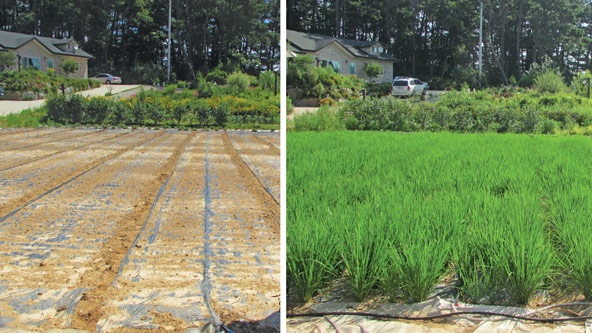
 Green and Seed demonstrates its seed film cultivation by growing rice on a mountain side in Yeoju, South Korea. (Photos courtesy of Green and Seed)
The vast majority of the world’s rice is grown in fields that are flooded for at least part of the year. This flooding can boost growth and eliminate weeds, but it consumes around a quarter to a third of the world’s developed freshwater resources.
A potential solution to this problem is to move more of the world’s rice production upland, out of flooded fields. A technology known as seed film cultivation could help make that feasible.
“Rice is not an aquatic plant,” says Sungjin Choe, the CEO of Green and Seed, a South Korean company that’s developing the technique. Though rice plants can survive while partially submerged, they don’t actually require immersion to grow.
In seed film cultivation, the rice is grown in a dry field. Prior to planting, a machine attaches rice seeds to long strips of opaque, biodegradable film that are then spread out and covered with a thin layer of soil. The film prevents weeds from growing, allowing farmers to use more conventional means of irrigation.
“In the rainy season, we can grow rice with just rain,” Choe says. “In the dry season, we can grow rice with drip irrigation.”
In 2018, Green and Seed’s seed film cultivation was one of the ideas selected for MIT Solve’s Coastal Communities challenge. MIT Solve is a business incubator as well as a marketplace that assists more mature businesses by connecting entrepreneurs with mentors or business partners.
“We are the connective tissue between people with good ideas and people with the resources,” says Alexander Dale, MIT Solve’s senior officer for the sustainability community.
Green and Seed has partnered with a number of organizations so far and conducted field trials in China, South Korea, Cameroon, and Chad. African countries imported more than a third of their rice in 2015, at a cost of more than $4 billion.
Typical upland rice cultivation may only bring in about one ton of rice per hectare on average, too low to be economically viable for many upland farmers. Though there is an upfront cost to purchase the seed film—about $500 an acre—Choe says early trials suggest seed film cultivation could bring yields up to more than six tons per acre, enough to make upland rice cultivation profitable.
That said, the economics of the process could still be a stumbling point. Bruce Linquist, a rice specialist at the University of California, Davis, warned that farmers in these areas often don’t have a lot of savings to invest in new equipment. Even drip irrigation, while a seemingly simple technology, can be expensive to install and use.
“I see that as a huge limitation,” says Linquist.
Steven Linscombe, a professor emeritus at Louisiana State University’s AgCenter, agrees that cost might be a challenge. “In most of these areas, a lot of the production is with subsistence farmers,” he says Anything that makes planting costlier up front—even if it might pay off later—might be a serious challenge.
If it does work out, however, the market for this technology could be widespread. Casiana Vera Cruz, a senior scientist at the International Rice Research Institute, said she thought this kind of seed film could be worth trying out in upland environments in countries like Laos.
For his part, Choe is optimistic. Green and Seed is planning a new trial in Congo later this year that will include an equipment loan system, and if the Chad trials in particular are successful, it would be a good sign of viability.
“The farming area is just below the Sahara Desert,” Choe says. “If we can grow rice there, it would prove our technology can grow rice anywhere.”
This article appeared in the Fall 2019 issue of the magazine with the headline: "Upland Rice"
Read more stories by James Gaines.