


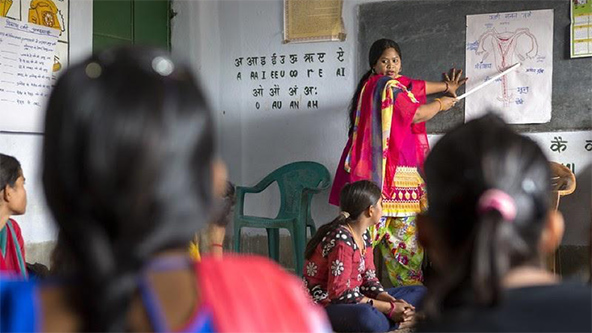
 Schoolgirls in Deogarh, India, learn about menstrual health and hygiene. (Photo by WSSCC/Javier Acebal)
Investing in Menstrual Health Is an Investment in Global Health by Cristina Ljungberg and Sue Coates
It should be easy to help women and girls with menstruation, yet half a billion of them around the world still lack the support they need to manage their periods with safety and confidence. As Cristina Ljungberg and Sue Coates explain, stigma is only part of the problem. Because menstrual health and hygiene cuts across multiple sectors—including health, education, and environmental conservation—the societal issue it represents is too complex to solve without proactive, focused, systemic, and collaborative interventions. In their article “Investing in Menstrual Health Is an Investment in Global Health,” Ljungberg and Coates lay out the kind of program that works, from setting the stage for success to building solutions for the long haul.
 (Photo by iStock/vgajic)
Lessons on Running Virtual Events From Nonprofit News Organizations by Jake Batsell
The COVID-19 pandemic has not only claimed more than one million lives worldwide but also upended the funding sources that keep nonprofits running while simultaneously increasing demand for many of their services. Donations have been declining, and in-person fundraising events have been canceled to prevent transmission of the virus, leaving organizations scrambling to make ends meet by using digital tools like Zoom and Slack.
Nonprofits can find help from a surprising source: the news industry. For years, declining advertising revenues and other internet-driven changes have led to mass closures of local outlets and layoffs of tens of thousands of journalists. But many budget-minded nonprofit news organizations have popped up to fill the void, exhibiting a digital savvy that their predecessors lacked. In “Lessons on Running Virtual Events From Nonprofit News Organizations,” business journalism scholar Jake Batsell explores their experiences with running virtual events, identifying the best practices that will help nonprofits of all types find their footing in a brave new digital world.
 (Illustration by iStock/LuckyTD)
How a Lack of Negative Criticism Can Make NGO Employees Feel Unsafe by Gali Cooks
More and more nonprofits recognize that fostering more diverse and inclusive teams can boost collaboration, resiliency, and innovation, and increase their social impact. But doing it well takes attention to detail, and it also sometimes requires working in counterintuitive ways. In “How a Lack of Negative Criticism Can Make NGO Employees Feel Unsafe,” Gali Cooks describes how promoting an overly positive organizational culture can actually make employees feel psychologically unsafe. Organizations should, she explains, strive to provide positive and negative feedback to employees so they can be comfortable with sharing potentially unpopular opinions. The result will be teams better equipped to critically—and constructively—assess their performance, improving it in the process.
Also Online From Aug. 13, 2020, to Nov. 12, 2020
Explore all of SSIR's online-only content from the past three months:
- Moving Closer to the Problem and Closer to the Solution
- Nonprofits, It’s Time to Own Your Social Media Audience
- Building a New Civic Culture (Book Excerpt)
- Rebalancing Power for Inclusive and Equitable Growth
- Using Six Conceptualizations of Capital to Help Achieve the SDGs
- Rediscovering Fixed Amount Awards
- Membership Programs for Nonprofits
- Creating Strategic Value (Book Excerpt)
- Re-Humanizing Fundraising With Artificial Intelligence
- Nowhere to Grow
- Layering Evidence for Impact Investing Success
- Determining the Right Gift for Both Donor and Nonprofit (Sponsored Podcast)
- Burnout From an Organizational Perspective
- What Investors Need to Know to Embrace Catalytic Capital
- A Better Education for All During—and After—the COVID-19 Pandemic (Coronavirus and Social Change Series)
- Equity and Inclusion: The Roots of Organizational Well-Being (Well-Being Series)
- Cultivating Serendipity (Book Excerpt)
- A Third Space of Proximity
- Emerging Stronger From a Crisis (Coronavirus and Social Change Series)
- Leadership Transition During a Pandemic (Leadership Succession Series)
- COVID-19 Is Challenging Medical and Scientific Publishing (Coronavirus and Social Change Series)
- Spotting and Fixing Dysfunctional Nonprofit Boards
- Effective Change Requires Proximate Leaders
- When Moving a Nonprofit Forward Means Altering the Founder’s Course (Leadership Succession Series)
- Recap of the 2020 Nonprofit Management Institute
- Climate Action Is Too Big for ESG Mandates
- Insuring the Future of Work (Book Excerpt)
- Lessons on Running Virtual Events From Nonprofit News Organizations
- SSIR Guide to Voting, Civic Engagement, and Repairing Democracy
- A Funder’s Learnings on Nonprofit Founder Transitions (Leadership Succession Series)
- How NGOs Can Work With Governments to Build Partnerships That Will Scale
- In Latin America, Impact Finance Demonstrates Remarkable Progress and Untapped Potential (Impact Investing Series)
- Navigating Race and New Leadership in a Time of Upheaval (Leadership Succession Series)
- Seeding the Ground for Tri-Sector Alliances Before the Crisis Hits
- The Cooperation Imperative (Book Excerpt)
- How Higher Education Can Support Local Ecosystems of Innovation (Innovation in Higher Education Series)
- How Tech Companies Can Advance Data Science for Social Good
- When Co-Founder Transitions Collide (Leadership Succession Series)
- How Nonprofits Are Leveraging Donor-Advised Funds (Sponsored Podcast)
- How a Lack of Negative Criticism Can Make NGO Employees Feel Unsafe
- Investing in Menstrual Health Is an Investment in Global Health
- Giving Across Generations: Maximizing Impact Through Family Philanthropy (Sponsored Podcast)
- Leadership Transition When a Founder’s Star Is on the Rise (Leadership Succession Series)
- Art for Solidarity (Well-Being Series)
- How Academia Can Do More to Advance Sustainable Finance (Impact Investing Series)
- Getting Past the Glorification of the Founder (Leadership Succession Series)
- The Startup Market Lifecycle (Book Excerpt)
- Whose Knowledge Is It? (Innovation in Higher Education Series)
- How to Be a Super Board Chair
- How to See What the World Is Teaching Us About COVID-19 (Coronavirus and Social Change Series)
- The Five Stages of Founder Transitions (Leadership Succession Series)
- Finding the Way Forward When Founders Leave
- Scaling Big in India: Leveraging Behavioral Science to Help Feed Millions (Coronavirus and Social Change Series)
- Making a Better Business Case for ESG
- Your Software, Their Hardware: Stacking the Deck for High-Quality Replication
Read more stories by SSIR Editors.