


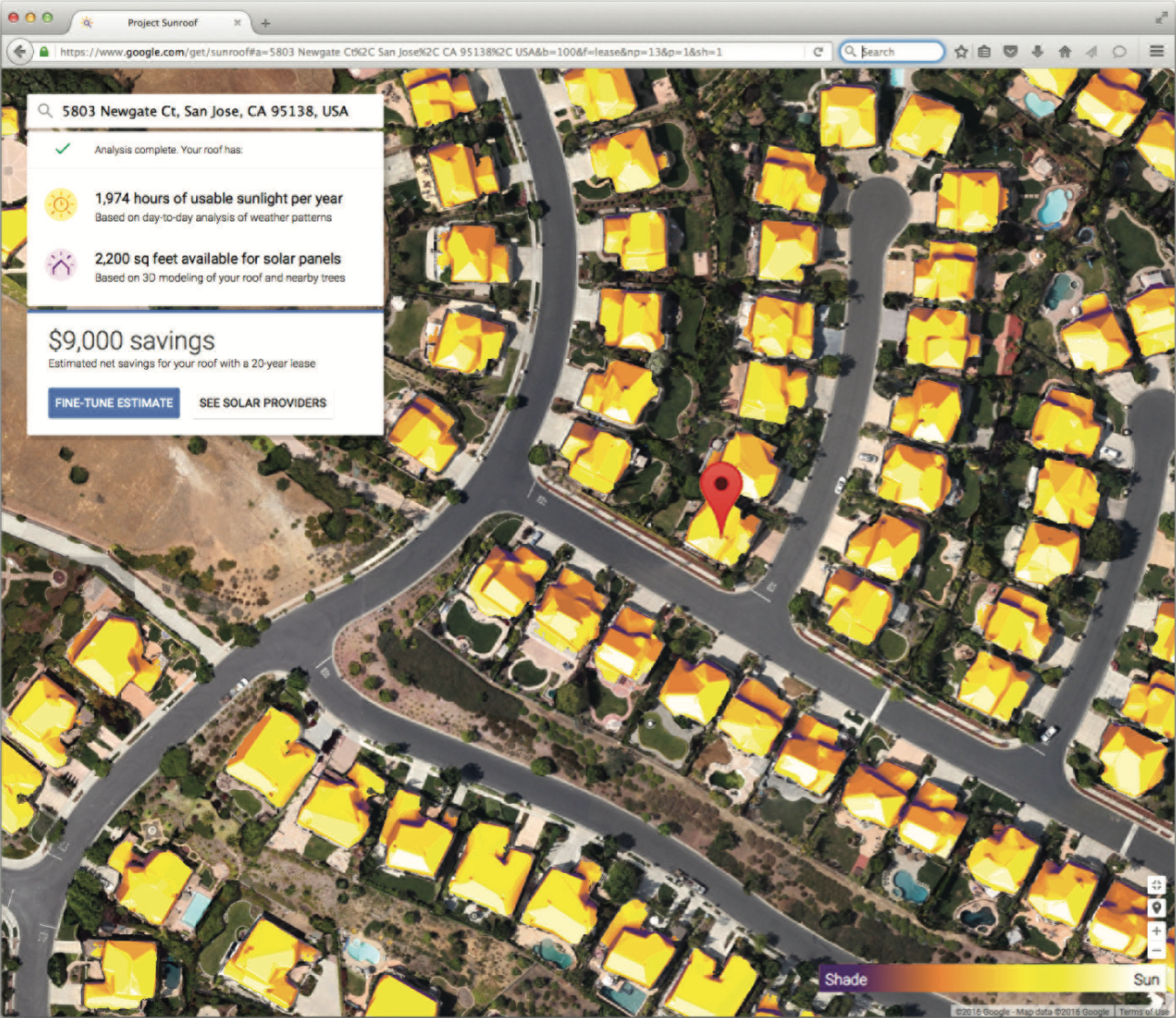
 In this screenshot, Google's Project Sunroof estimates the potential of an individual house's roof to generate solar power. (Image courtesy of Google)
A few years ago, while working as a volunteer for Solarize Massachusetts, a state government initiative to promote clean energy, Carl Elkin spent some time trying to educate his neighbors in the Boston area about the benefits of residential solar installation. Again and again, he heard homeowners express the same concerns. “Almost everyone,” he says, “believed that solar power was more expensive than utility power”—despite evidence to the contrary. Homeowners also had site-specific worries, he recalls: “Many people didn’t know whether their house got enough sun for solar: Was that tree in the yard going to be a problem? Would there even be enough room on their roof for panels?”
To help allay those concerns, Elkin designed Project Sunroof, an online tool for homeowners who are uncertain about the costs and benefits of going solar. In his day job, he is a software engineer who works at Google’s Boston operation, and he developed the tool as a “20 percent time” project. (Google has a long-standing policy of encouraging employees to spend up to one-fifth of their work time on projects of personal interest.)
Project Sunroof deploys high-resolution aerial images from Google Earth, along with other sources of data and various software capabilities, to help users size up their home’s suitability for solar installation. Homeowners start by entering their street address. Then, drawing on data about local weather patterns, the tool calculates the number of hours each year when their roof receives adequate sunlight. Using 3D modeling, Project Sunroof also calculates the amount of roof space that is available for solar panels. A financial calculator estimates cost benefits, factoring in both reduced energy bills and state or l0cal government incentives. In sum, Elkin says, the tool offers an at-a-glance picture of “the effect that sunlight can have on your wallet.”
Developing an actual bid for solar installation requires additional calculations, and Google is partnering with five solar providers that will generate such bids for consumers. Project Sunroof “gives homeowners a quick, first look at the possibility of solar,” says Rex Kehoe, account manager for Pick My Solar, a Los Angeles-based company that is one of those providers. Pick My Solar uses an online platform of its own to help homeowners “azimuth angle” of their roof) that they’re unlikely to know offhand.
When it launched in August 2015, Project Sunroof had three pilot sites. Two of them—the San Francisco Bay Area and Greater Boston—were natural picks for Google, which has operations in both regions. The third was Fresno, a city in the sunny Central Valley of California. Coverage expanded quickly to include three other California communities (Napa, Sacramento, and Visalia), along with Long Island, N.Y.
In December, Google extended the program to certain metro areas in what Elkin describes as the country’s “most active solar states.” (Those states are Arizona, California, Colorado, Connecticut, Massachusetts, Nevada, New Jersey, New York, and North Carolina.) The company intends to add other locations quickly in order to “encourage homeowners to take advantage of state and federal incentives while they last,” Elkin says.
Google hasn’t disclosed usage metrics for Project Sunroof, but the tool is already generating consumer interest. Pick My Solar, according to Kehoe, has seen an uptick in requests for bids from homeowners who live in Project Sunroof pilot areas. In the meantime, people at Google are tracking page views and other metrics “to gain greater insight into the trends around solar,” Elkin says. They’re studying demographic, geographic, and seasonal variations in consumer interest, and they’re investigating barriers to solar adoption.
Those barriers appear to be surmountable: In 2015, providers installed a new solar-panel system in the United States every 2.5 minutes; for the solar industry, it was a record-breaking year. And on millions of rooftops across the country, Elkin says, there is still “tremendous untapped potential.”
Read more stories by Suzie Boss.