


 Illustration via iStock/raferto
The philanthropy field seeks to advance long-term systemic change, yet much of its giving has been short-term, restricted, and episodic. These approaches are misaligned with the sustained, flexible funding that nonprofit organizations need to make real and lasting impact. At the same time, nonprofits operate in an increasingly volatile environment, with intensified competition for the same pool of philanthropic dollars. In this context, current funding practices can leave organizations financially fragile and unable to advance progress.
To address this gap between intent and practice, the Schott Foundation for Public Education engaged PTKO, a consulting group focused on strategy and organization effectiveness with experience in community indicators, to partner with them on creating the Sustainable Grantmaking Benchmark. Its theory of change is straightforward: when funders adopt grantmaking practices that provide longer-term, more flexible financial support, nonprofit organizations are better positioned to pursue the necessary long-horizon strategies that lead to meaningful systemic change. A benchmark provides a standardized method to test whether funders are meeting these needs and an accountability mechanism for both internal and external monitoring. It also translates shared values into comparable, observable practices, thereby making progress visible, discussable, and improvable across a diverse philanthropic field.
The focus on long-term, flexible funding is reflected in the term “sustainable grantmaking.” Unlike frameworks that emphasize intent, values, or relationships, sustainable grantmaking centers on the most basic of a foundation’s activities: grantmaking. It measures how foundations use their wealth to enable their grantees not just to survive, but to lead systemic change, especially important to racial justice grantees. In this way, the benchmark is intended to complement other philanthropic frameworks, offering a clear, practice-based lens on how funders can align their grantmaking with the needs of this moment—and the future they seek to fund.
How We Set Out to Create the Benchmark
Development of the benchmark took place over roughly a year, beginning in early 2025 and culminating in its inaugural public release in January 2026. Sector leaders we spoke to about the idea of a benchmark emphasized the need for a tool grounded in tangible, measurable behaviors rather than aspirational language.
To identify what to measure, the team conducted an extensive landscape review, including interviews with philanthropy-serving organizations and foundation executives and research from leading organizations such as the Center for Effective Philanthropy, Grantmakers for Effective Organizations (GEO), Bridgespan, and others. The published research revealed a lack of concise, practice-based standards that foundations could adopt at scale.
This landscape analysis also led us to identify three key funding behaviors that were most often cited as enabling nonprofit financial sustainability:
- Multi-year commitments,
- unrestricted and general operating support, and
- broader financial tools such as program-related investments (PRIs), endowments, and 501(c)4 support.
Early on we considered a fully quantitative, data-driven model. Ultimately, we designed the benchmark as a qualitative, self-reported assessment to maximize participation and to ensure consistency across a diverse range of funders. This, we hope, will allow funders to provide context about their practices, ensure accessibility for organizations of different sizes and structures, and establish a strong foundation for field adoption.
What We Chose to Include—and Not Include
When we designed the initial version of the Sustainable Grantmaking Benchmark, we worked to set low barriers for funders to participate. We also wanted to ensure that we could easily compare practices across organizations who may have different data collection practices. Therefore, we designed a benchmark that can be completed based on self-reported information, with clear definitions for each practice based on a mix of qualitative and quantitative information that should be readily available to funders’ leadership or program staff.
Several practices were deliberately excluded from the first edition—not because they lack value, but because they are difficult to measure consistently or could undermine early adoption. These include simplified reporting, participatory grantmaking depth, payout rate, and direct assessments of racial justice intent. For example, there are widely varying views about whether an increased payout rate helps or hurts grantees in the long term, and if they are used, what the upper limits should be. In order to include both spend-down foundations and traditional funders that payout 5 percent (or more) of their endowments, we tabled this metric for continued discussion among stakeholders. These decisions reflected both feasibility constraints and guidance from sector leaders encouraging a disciplined, practice-first approach.
The benchmark focuses on a defined set of financial practices that could be measured consistently and objectively. As participation grows and data tracking systems evolve, future versions may introduce new categories or raise thresholds for practices like multi-year giving or unrestricted support.
Advisory Group
To ensure credibility and sector-wide relevance, Schott convened an advisory group of senior leaders representing the ABFE: A Philanthropic Partnership for Black Communities; Asian Americans/Pacific Islanders in Philanthropy; Grantmakers for Education; GEO; Hispanics in Philanthropy; the National Center for Family Philanthropy; the National Center for Responsible Philanthropy; Native Americans in Philanthropy; the Robert Wood Johnson Foundation; the Bridgespan Group; the Trust-Based Philanthropy Project; and the United Philanthropy Forum. Their role was to strengthen the methodology, test assumptions, and guide the strategy for adoption.
As with many collaborative sector efforts, convening senior philanthropic leaders for the advisory group required sustained outreach and coordination. The initial meetings focused on establishing a shared understanding of the benchmark’s purpose and scope and creating space for candid discussion.
While some perspectives emerged more fully through follow-up conversations and confidential feedback, this process ensured that a broad range of insights informed the work. Critical discussions and insights from this advisory group included:
- Practice vs. Ideology: Members debated whether the benchmark should measure what funders support (for example, racial justice) as well as how they support it. Given current data limitations, the advisory group endorsed a practice-first model while encouraging future exploration of justice-alignment metrics.
- Applicability Across Funders: The group highlighted that tribal foundations, community foundations, and smaller family philanthropies may face structural or legal constraints—raising the need for flexibility and potentially differentiated scoring pathways.
- Endowment Payout Rate: While some advocated for including standards for increasing payout rate above the federally mandated 5 percent minimum, members agreed it lacked consensus and risked overshadowing the benchmark’s core intent.
- Motivations for Participation: Peer-driven motivation, recognition, board accountability, and the desire for learning emerged as key motivators—insights that shaped the benchmark’s positioning and rollout plan.
- Future Enhancements: Members recommended clearer branding, identification of influential early adopters, and developing supports such as “train the trainer” models to help funders improve their sustainable giving practices.
The Benchmarking
Securing benchmark participation was essential to building its credibility and impact, and our process was intentionally selective, focusing on foundations already recognized for leadership in sustainable grantmaking or openness to examining and strengthening their practices.
As with many peer-driven initiatives in philanthropy, our engagement required direct relationship-building and thoughtful conversations, particularly given the complex and fast-moving context in which many funders operate today. Through a combination of targeted outreach and follow-up dialogue with different organizations, seven foundations chose to participate and share their results publicly, reflecting a strong level of confidence in the benchmark’s purpose and approach.
Once a foundation agreed to participate, the project team shared the benchmark categories, practices, and definitions, and invited participants to submit preliminary self-assessments. In many cases, responses surfaced important nuances or clarifying questions—such as how specific practices should be interpreted or applied in different organizational contexts. Follow-up interviews provided space to explore these distinctions in depth, allowing our team to clarify definitions, validate practices, and ensure consistency across participants.
After alignment was reached, Schott finalized each organization’s score and prepared a tailored summary highlighting how the foundation’s practices support nonprofit partners, along with a brief narrative profile and designation (Platinum, Gold, Silver, or Bronze) for inclusion in the final report.
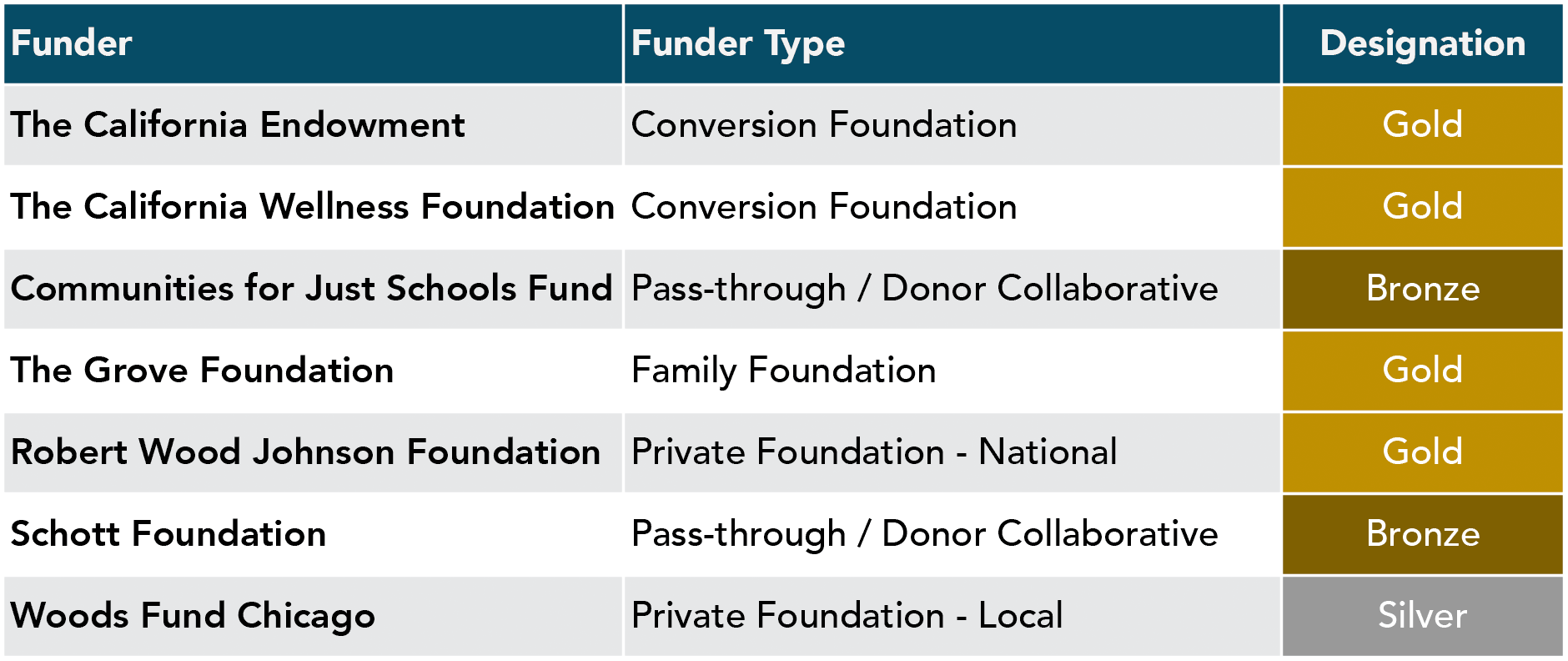
For those who agreed to participate, we provided a comprehensive packet outlining all categories, definitions, and suggestions for advancing sustainable grantmaking. At the conclusion of the process, foundations could decide whether to make their results public. All but one chose transparency—signaling their commitment to modeling both openness and sustainable practices for the field.
What Comes Next
The initial results of four Gold designations, one Silver, and two Bronze helped to validate the benchmark’s structure and its intent. The outcomes reflected that participating foundations are already leaders in sustainable grantmaking, while revealing notable differences in how they adopt individual practices.
This also confirms that the benchmark is neither aspirational nor punitive. Rather, it is capable of distinguishing levels of practice in a way that surfaces growth pathways rather than false ceilings.
For the benchmark to move from pilot to broader field adoption, stakeholders identified four areas where continued development is needed:
- Adapting the Benchmark for Different Funder Types. Funder structures vary widely, and future versions may need modular pathways or tailored scoring for community foundations, tribal entities, intermediaries, and smaller family philanthropies.
- Integrating Racial Justice and Community Impact. While the launch version of the benchmark focuses on measurable practices, the field is eager to explore additional indicators that reflect justice alignment and community outcomes as data and consensus allow.
- Introducing New Practice Areas. Enhancements—such as grant size, capacity-building funding, or additional forms of long-term, flexible funding — could strengthen future versions but require careful consideration of feasibility and equity.
- Building Self-Assessment Tools and Governance. Funders want ways to assess themselves privately and understand how to improve. Developing a digital self-assessment tool, coaching supports, and a long-term governance model will be essential for scale and sustained credibility.
A benchmark alone will not change the philanthropic field, but the engagement of philanthropy leaders and practitioners can. As more foundations engage in this sort of critical self-examination, adopt concrete accountability mechanisms, and act on what they learn, the philanthropy sector has an opportunity to align its funding practices more closely with the systemic changes and collective future we seek to achieve.
Read more stories by Patti DeBow, Mimi Yeh & Melissa Daar Carvajal.