


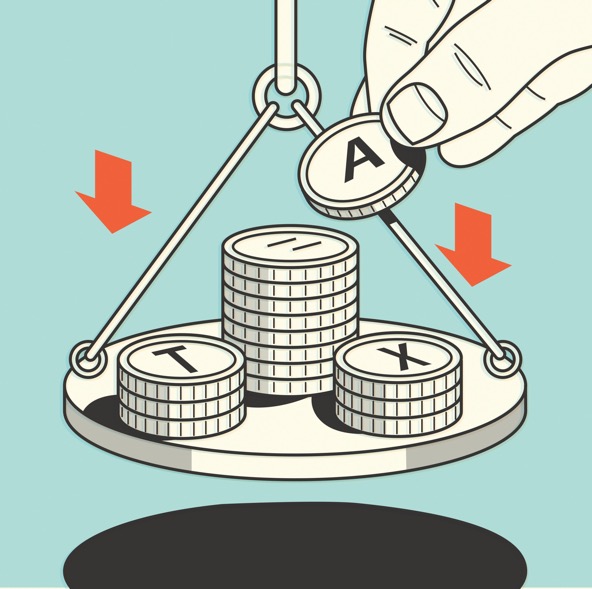
 (Illustration by Harry Campbell)
Ask a typical high-net-worth donor how much they gave last year, and they’ll give you a number. Ask how much it cost them to donate that amount, and you’ll get a blank stare. Despite advances in tax planning and investment analytics, charitable giving comes as an afterthought in life-cycle financial planning, orphaned from the rest of the client’s finances and guided by emotion rather than thoughtful deliberation. The dollars go out a side door in the financial plan, frequently in response to a year-end fundraising drive, but are disconnected from broader tax, estate, and investment strategies.
The long-celebrated charitable tax deduction is, in fact, a mirage in practice. The obfuscation and needless complexity of the tax code typically render it unobtainable without advance planning and skillful execution. According to the Tax Policy Center, only 9 percent of taxpayers itemize tax deductions on Schedule A. Of these, 81 percent claim the charitable deduction. However, these deductions for well-intentioned donations can be disallowed for lack of the required meticulous supporting documentation. The US Tax Court has ruled that even undisputed charitable giving provides zero tax benefit without scrupulous backup.
However, the biggest group of charity donors receiving no tax benefit are the 91 percent of taxpayers who do not itemize deductions. According to the Tax Policy Center, these households donate 35 percent of all individual charitable giving, amounting to $137 billion in 2024.
What happens when people give to charity but fail to secure the tax deduction? The amount donated is after-tax money. At a 22 percent marginal tax rate, the US government has collected $30 billion in tax on the income that funded the gifts. This is the revealed charitable capacity for which donors receive no itemized benefit—approximately twice what the largest US charity (Fidelity Charitable) received in 2024. Our government is the unintended beneficiary of charitable giving, quietly retaining billions of dollars from generous Americans that tax-aware donors would undoubtedly have preferred directing to their charitable causes. Instead, tax-inefficient giving converts these potential charitable contributions into ordinary tax revenue.
For a generation, the social sector has been preoccupied with evidence-based philanthropy: randomized controlled trials, cost-benefit analysis, and utilitarian calculus to extract the most good per dollar. But the sector has ignored an equally important question: How much more good could donors accomplish with the same resources if they tax-optimized their giving? Donors are overdue to look in the mirror at their own giving effectiveness.
Lost in a Labyrinth
Consider the following hypothetical: At a year-end gala, a high-earning California couple writes a check for $10,000 to a nonprofit. They believe that they will receive a charitable deduction. Their accountant knows better: They take the standard deduction. That $10,000 check cost them $10,000, plus over $5,000 in taxes they had to pay when they earned it. Had they done effective charitable tax planning, that $10,000 check might have cost them less than $5,000. The difference between giving with tax planning versus giving without it can be greater than the size of the donation itself.
The next year, they do it again. The only clue that they receive no tax benefit from their check comes four months later, when their voluminous tax forms arrive, but a single page—Schedule A: Itemized Deductions—is missing. Accountants do a good job of taking our completed financial year and packaging it into Form 1040, but it is unusual for them to offer proactive advice or strategic tax planning. Fewer than 3 percent of tax professionals with the American Institute of Certified Public Accountants hold the Personal Financial Specialist credential.
If the couple does their own taxes, the result is no better. When they enter the charitable donation and end up with the standard deduction, TurboTax simply says, “Your standard deduction covers the charitable contribution”—a phrase that sounds reassuring but means the exact opposite: “Your $10,000 donation generated $0 in federal tax savings.” The standard deduction is the great enemy of charitable giving. The government is selling the same acre of tax relief to four different constituencies: donors, homeowners, state taxpayers, and those with big medical bills—none of whom will see a dollar of benefit until their total deductions top $16,100 single or $32,200 married filing jointly in 2026. The standard deduction swallows the vast majority of tax deductions before they ever reach Schedule A.
When Congress established the charitable income-tax deduction in 1917, it was two sentences long. Any taxpayer could deduct up to 15 percent of their net income. The taxpayer made a donation and received the deduction. The underlying compact was that citizens would pay for charities, hospitals, universities, libraries, and all the other cultural, religious, and scientific institutions that made America great, and receive a fair tax deduction in exchange.
Over the past century, the charitable deduction has evolved into a labyrinth of statutory provisions, regulations, revenue rulings, and court decisions that even tax professionals struggle to navigate. The modern documentation regime took shape in three waves. The Deficit Reduction Act of 1984 required qualified appraisals for noncash gifts over $5,000. Then the Omnibus Budget Reconciliation Act of 1993 required donors to obtain a contemporaneous written acknowledgment from the charity for any gift of $250 or more. But the decisive turn came in 2004-06, when the American Jobs Creation Act and the Pension Protection Act of 2006 imposed sweeping new substantiation rules: Every cash gift, no matter how small, now requires either a bank record or written acknowledgment from the recipient organization.
Today donors must obtain specific written acknowledgments for gifts larger than $250, file IRS Form 8283 for noncash donations over $500, commission qualified appraisals for property over $5,000, and so on. What began as a broad incentive for civic betterment has been undone by a bewildering set of rules, floors, income limits, substantiation requirements, phase-outs, appraisal mandates, stacking orders, recapture tests, and carve-outs.
In 2017, the Tax Cuts and Jobs Act nearly doubled the size of the standard deduction, eliminating the charitable deduction for tens of millions of households with a single stroke. Indiana University’s Lilly Family School of Philanthropy calculates that this led to a drop of $20 billion in donations in 2018 alone. The National Bureau of Economic Research found that taxpayers who continued to give after switching to the standard deduction gave $880 less on average. The charitable deduction did not disappear from the tax code; it disappeared from millions of tax returns instead.
The Way Forward
Fortunately, charitable tax planning, long the privilege of ultra-high-net-worth individuals, is moving downstream to high-net-worth and mass-affluent donors. Financial planners view this as a new frontier where they can distinguish themselves from their competition by providing better client service. Charitable planning will be built into the software packages already in use to prepare the standard retirement, college, life-insurance, and estate-planning documents. The transition will not be automatic, nor will software alone solve it. But for many clients, the reports from the charitable-giving modules will be an eye-opener and a catalyst for change.
The donor’s tax problem is the nonprofit’s opportunity. Those charities that embrace donor tax-effectiveness—educating donors about their options, tailoring their approach by donor-giving stage, and building supportive networks—will have a first-mover advantage to reclaim the tax dollars currently slipping to the IRS.
Tax-aware donors will not be giving equal amounts every year, because that works well for the IRS but not for them. Instead, they will identify occasions when charitable giving can be subsidized instead of penalized by the tax code. This frees them to give substantially more money to charity over their lifetimes. It results in a strategic, life-cycle-based approach to philanthropy that can amplify a donor’s total impact while minimizing their out-of-pocket cost. For some donors, this year will be the perfect time to go all-in with a major gift, while for others it may be a year to use the new $1,000 ($2,000 married filing jointly) deduction from the One Big Beautiful Bill Act. Nonprofits need to understand which donors are which and be ready to help them optimize their giving, no matter what their situation.
This dynamic will deepen the role of development officers, who will become philanthropic consultants and long-term donor-relationship managers. Ideally, they might obtain some certification in charitable tax planning to underpin their new specialties.
As philanthropies get in front of this paradigm shift, they will increasingly operate as fiduciaries, not only to the causes they serve, but to the donors who support them.
The new alliance between donors, their financial advisors, and their charities promises to stem the windfall of donor tax dollars currently going to the government. The charity pie will grow, increasing total philanthropic resources for the benefit of society. If our government would simplify the tax code (last pruned in 1987), individuals who donate to charity might once again claim and receive the deduction promised to them under our social contract going back to 1917.
Read more stories by Philip DeMuth.