


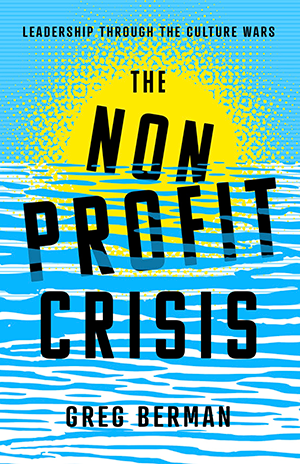
The Nonprofit Crisis: Leadership Through the Culture Wars
Greg Berman
224 pages, Oxford University Press Publication, 2025
When I was the head of the Center for Justice Innovation, one of the largest criminal justice nonprofits in the country, I was often asked about our organization’s mission statement. That’s because, for years, we didn’t have one. This flummoxed some of our funders, and not a few staffers as well.
I had a few different answers for why I was resistant to the idea of a mission statement. The first was that the Center for Justice Innovation didn’t need a mission statement because the name of our organization was, in effect, a mission statement. If that didn’t work, I would argue that mission statements, as printed on a page, were mostly useless. To know what the organization was all about, I thought, people should look at our work, not some abstract words. Performed values are always more important than stated value, I would say. I also didn’t want a mission statement because I didn’t want the organization to be boxed in. Because we had “innovation” in our name, I thought we should have the widest possible latitude to try new things and test new ideas. I would also admit that I could be a bit of a contrarian. I liked the idea of defying the conventional wisdom, which said that every nonprofit needed a mission statement.
I could hold out for only so long, however. As the organization got bigger, it became harder and harder to resist the calls for a mission statement. I couldn’t count on newcomers intuitively understanding what the agency was about. Eventually, I caved to the inevitable, authorizing not only a mission statement but a tag line as well.
With the benefit of hindsight, I now think I was in the wrong all along. Watching so many nonprofits struggle to maintain organizational discipline in recent years has led me to believe that narrower, more precise mission statements are, in the main, better for nonprofits than broader ones. A good mission statement performs a similar function to the role the US Constitution plays (on a good day) for the American government: It helps to keep an organization grounded and offers an important reference point for resolving conflicts about vision and direction. A good mission statement is the first line of defense against mission creep. It is true that many nonprofit mission statements aren’t very good, but that’s doesn’t mean we should dispense with them—it means that we should re-double our efforts to make them sharp and persuasive.
This excerpt from The Nonprofit Crisis: Leadership Through the Culture Wars wrestles with the dangers of mission creep within the nonprofit sector, why it happens so frequently and why it is essential that organizations resist its siren call.—Greg Berman
* * *
Nonprofit mission statements tend to be dull, earnest affairs. They are often written by committee—and you can usually tell. There is an epic-list quality to many mission statements, as organizations try every trick in the book, including multiple parenthetical statements, to stuff as many ideas as possible into the minimum number of sentences.
Another regular feature of mission statements is the use of imprecise language. Mission statements are full of calls to “promote justice,” “strengthen communities,” “create opportunity” and the like. Who could be against such goals? How these vague concepts translate into action in the real world is anyone’s guess.
So the average nonprofit mission statement is hardly a work of art. More clunky than artistic, more hazy than precise, mission statements rarely tell you very much about what organizations are really up to.
But still.
For all of their flaws, mission statements do offer some basic guardrails for nonprofits, defining a scope of work, however broad. And the past few years have offered ample evidence of how tempting it can be for nonprofits to ignore those guardrails. A few examples, among many:
- Planned Parenthood, an organization traditionally focused on reproductive rights and health, issued a statement on the war in Gaza that somehow managed to please approximately zero percent of the people who read it, including the organization’s own employees who denounced it as “disinformation.”
- The Wende Museum, a museum in Culver City, California dedicated to preserving Cold War material culture, announced its plans to build housing for the homeless.
- The Sunrise Movement, an environmental group, decided it was within their remit to host online trainings about defunding the police.
Why are these nonprofits, and others like them, engaged in work that, at least to the outside observer, feels so far beyond their ken? There are good and bad reasons.
The Disease of More
There is a great deal of truth to the old saying that organizations are like sharks: if they stop moving forward, they die. Yesterday’s innovation is tomorrow’s conventional wisdom that needs to be overturned. Healthy organizations adapt to changing conditions and problems as they emerge.
Pat Riley, back when he was the coach of the Los Angeles Lakers in the 1980s, had a talented team that he thought was capable of winning the NBA title year after year. One of the most formidable impediments to the dynasty that Riley envisioned was what he called the “disease of more.” According to Riley, after a team won a championship, everyone wanted more. Stars wanted more money. Supporting talent wanted more credit. Bench players wanted more shots. All of these demands were a constant threat to the fragile chemistry that had enabled team success in the first place.
Riley is not the only person to suggest that success contains the seeds of failure, of course. And the disease of more applies to venues other than professional sports. We see traces of it when celebrity actors decide they want to be directors. Or when Bob Dylan declares that he wants to be a painter. Or when businessmen conclude that they have the answers to our political problems. Put simply, successful people find it hard to stay in their lanes.
The nonprofit sector is hardly immune to the disease of more. Those who are responsible for a successful initiative often find themselves asked to scale it up or to do it again in other places. The temptation to say yes to these entreaties is enormous.
The need for constant reinvention in the nonprofit sector is driven by many forces. Sometimes it is a byproduct of success. And sometimes it is a byproduct of the whims of philanthropy, which can often be faddish and impatient. Foundations have often favored short funding cycles and project funding over long-term, general operating support. Both of these predispositions incentivize nonprofits to manufacture new programs and new initiatives so that they can successfully market themselves to foundations.
Another factor that encourages nonprofits to look beyond their usual remit is a simple one: there a plenty of problems to solve in the world. The daily fodder of nonprofit life is failure and tragedy. Every day, nonprofit workers encounter government systems that don’t work as well as they should and hard luck stories where, through no fault of their own, people find themselves living in dire conditions and dealing with desperate situations. It is understandable that many nonprofits, when confronted with these realities, feel compelled to try to jump into the breach.
All of these dynamics have been at work in the nonprofit sector for a long time. What feels different in recent years is the pressure on many organizations to embrace a broad range of progressive causes. Thus, the assertions that “climate justice is racial justice,” or that the war in Gaza is somehow central to the fight for reproductive freedom. Universities are asked to pursue social justice, not just the production of knowledge or the education of students. It is no longer enough for direct service organizations to aid the needy; they must also engage in advocacy to change the systems that oppress them.
For progressive activists, the argument driving these developments is simple: the world is full of injustice and it’s up to all of us to do our part to address the problem. Elizabeth Merritt, the director of the Center for the Future of Museums, argues that “mission creep” is just another way of saying “going out of our way to do the right thing.” According to Merritt,
Perhaps in a more functional world it would be enough for a museum to focus just on being great at preserving and interpreting art, or science, or history. If, for example, we had systems that equitably addressed everyone’s basic needs and fundamental rights. But we don’t. We live in a patchwork of imperfect solutions that leave many needs unmet and many people deprived of rights…Museums are integral parts of our social and economic systems. They can use their power and authority to reinforce the status quo (if only through inaction), or they can do their part to improve these systems where they fall short.
Nonprofit blogger Vu Le believes we need to rethink the idea that mission creep is a bad thing. “Organizations led by marginalized communities often have broad missions,” Le argues. “This broadness is often seen as a weakness, a lack of organization, when in reality it is a culturally-relevant necessity.” For Le, a tight organizational focus is a luxury that many agencies led by people of color cannot afford.
Less Is More
There are legitimate arguments to be made on behalf of a nonprofit extending its reach, but mission creep can be an insidious opponent, weaponizing an organization’s instinct for compassion and innovation against itself. Consultants Kim Jonker and William F. Meehan, writing in the Stanford Social Innovation Review, argue that nonprofits must constantly be on alert if they hope to combat mission creep:
Mission creep plagues the nonprofit sector. In the private sector, pencil manufacturers, for example, rarely dive into the bakery business or into human resources consulting. Yet nonprofits routinely do the equivalent, expanding their programs far beyond their organizations’ original scope, skills, and core competencies—often in response to funding opportunities or staff members’ interests. This creeping can stretch organizations so thin and so far that they can no longer effectively apply their resources toward their goals.
The problem of mission creep is both obvious and subtle. As Jonker and Meehan indicate, nonprofits, if they are any good, develop a set of core competencies over time. When they depart from their area of expertise—say, when a museum decides to become a developer of affordable housing— nonprofits face considerable risk. First, they face the risk of failure and then they face the risk of reputational damage. As Warren Buffet has suggested, a reputation takes years to build, but it can be ruined in mere minutes. Once a nonprofit has tarnished its reputation with a foolhardy initiative or an ill-considered statement, it may struggle for years to restore its good name.
Mission creep poses a particular threat to advocacy organizations. Jeremiah Johnson of the Center for New Liberalism has argued that these organizations are currently dealing with a metastasizing case of social justice—“if you are an activist for one cause, you’re expected to speak up about all causes now.” One effect of this is that single-issue organizations now face enormous pressure to comment on issues outside of their narrow focus.
This seemingly innocuous dynamic comes with enormous costs. When a climate change organization also takes stands on issues like the war in Gaza or policing or trans identity, it effectively signals that it is a progressive organization. In the process, it significantly narrows the appeal of its primary message.
There are plenty of people across the political spectrum who might be convinced to endorse new approaches to climate change. But how many will also want to sign on to the organization’s position on a range of other controversial issues? The number shrinks dramatically with each new position an organization takes. “The ultimate result of activist mission creep,” as Jeremiah Johnson illustrates, “is that your issue ceases to be something that people across the ideological spectrum can work together on. It becomes coded as a red tribe vs. blue tribe issue, gets swallowed by the general culture war, and progress grinds to a halt as partisan warfare starts.”
There is some evidence to suggest that this phenomenon actually undermines organizational effectiveness. In a study of the historical impact of interest groups on American policy outcomes, political scientist Matt Grossmann finds that liberal advocacy groups like the ACLU and the Sierra Club have traditionally performed “way above their organizational weight” in part because of their ability to partner in broad coalitions. According to Grossmann, these groups have “benefited from strong single-issue reputations that differentiated them from the generic image of the left.” In other words, when contemporary nonprofits move away from a narrow organizational focus and tie themselves to “the generic image of the left,” they are likely to undermine their ability to influence policy.
Nonprofits would also be well-advised to think about whether it is necessary for them to take positions on political issues outside of their area of expertise. In recent months, a number of educational institutions have backed away from issuing such statements, choosing to embrace the principles of institutional neutrality articulated in the University of Chicago’s 1967 Kalven Report. Disagreement over the war in Gaza has been the driving force behind this development; schools realized that they would not be able to come up with a position that simultaneously satisfied both their pro-Palestinian and pro-Israeli constituents, so they used the conflict as an opportunity to get out of the business of making statements altogether.
In general, this is a healthy development—universities and other educational institutions have done a lot of damage to their reputations by unnecessarily speaking out on issues of controversy. Most nonprofits would do well to follow their lead.
Nonprofits should also take a hard look at their organization’s mission statement: chances are good that it needs some tightening up. Mission statements shouldn’t be a straitjacket, an impossible-to-break cellphone contract that ties nonprofits down unnecessarily. Nonprofits will always need some wiggle room so that they can easily respond to new challenges without always having to go back to first principles. Still, there have to be limits. A good mission statement functions in much the same way as the U.S. Constitution does—it serves as a touchstone that can guide an organization through troubled waters and help it figure out when to say yes and when to say no to new opportunities.
Many nonprofits might find that saying they are doing less could actually help them accomplish more. A narrowly focused mission statement can be a valuable tool in the effort to explain to importuning staffers and funders why an organization cannot take on tasks that are a distraction from core activities.