


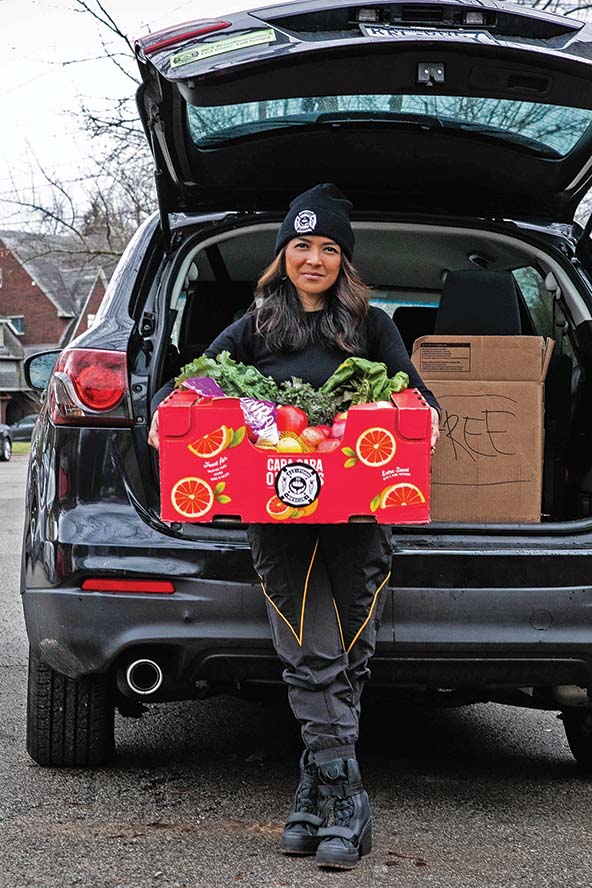
 Food Rescue Hero founder Leah Lizarondo picks up food surplus to give to the food-insecure community in Pittsburgh. (Photo courtesy of Laura Petrilla)
Between 30 and 40 percent of the US food supply goes to waste each year. The US Environmental Protection Agency estimates that nearly 80 billion pounds of food end up in landfills annually. This figure takes on a greater significance in the context of another food crisis: food insecurity. More than 10 percent of US households are food insecure, and the nonprofit Feeding America reports that this number will increase due to the economic and unemployment consequences of the COVID-19 pandemic.
The food waste crisis is not new. Wasted, a 2012 report from the Natural Resources Defense Council, recorded Americans’ annual food waste at 40 percent. Horrified by the report’s findings, Leah Lizarondo, a food and health advocate who began her career working in consumer-packaged goods and technology, was inspired to find a solution.
“I tried to figure out why this inefficiency was happening—where the failing was in the supply chain,” Lizarondo says. She knew that consumer-facing businesses such as grocery stores and restaurants were the second-biggest culprits of food waste—behind American households. And even though these businesses didn’t intend to waste food, they lacked the logistics, structures, or incentives to redirect the food surplus to people experiencing food insecurity. Furthermore, because most wasted food is perishable, traditional waste methods didn’t work within the food-banking structure.
“It was so cheap to just throw food in a landfill,” Lizarondo comments. “There’s no legislation [in the United States] that prevents us from doing that, unlike other countries.” For example, France banned food waste in 2016, while Norway has stores that sell food past their sell-by dates, and Asian countries like Japan and South Korea have adopted their own regulations, including the latter charging a fee to citizens for each pound of food waste. Currently, California, Connecticut, Massachusetts, Rhode Island, and Vermont are the only US states with legislation enforcing organic waste bans.
In 2016, Lizarondo launched the nonprofit Food Rescue Hero, a technology platform that redirects food waste to the food insecure in cities across America.
Since its launch, Food Rescue Hero has given more than 68 million pounds of food to people in need. Currently, it operates in 12 cities in the United States and Canada, with more than 22,000 drivers volunteering their time.
Reversing the Method
Food Rescue Hero’s creation was inspired by an accessibility challenge of another nonprofit of Lizarondo’s—412 Food Rescue.
In March 2015, Lizarondo piloted 412, a nonprofit targeting food insecurity in her home city of Pittsburgh, Pennsylvania. In five of Pittsburgh’s seven counties, 412 partnered with and established distribution sites at local nonprofits, including churches and community centers.
Yet, Lizarondo realized that these distribution sites posed an accessibility challenge. “Looking at services with human-centered design in mind, we realized that we’re not doing enough,” Lizarondo explains. “A senior box at a food pantry, for example, weighs about 15 pounds, but a senior cannot carry that on a bus ride.”
Instead of making people come to them, Lizarondo decided that 412 should bring the food to people. To do so, she created an app for 412, licensing the same technology used for food delivery companies like Grubhub and DoorDash. Volunteers sign up through the app to receive alerts when food is available for pickup at a local business. They then deliver the food directly to a family, individual, or organization in need. The food is donated by vetted sources, volunteers go through background checks, and the recipients do not pay a thing.
“The driver network is essentially a home delivery network for people experiencing food insecurity, and what we provide is simply food access,” Lizarondo says. “It’s not an ‘If you build it, they will come’ mindset. We’ve changed it to, ‘How can we work for you? How can we make this work for you so that you’re actually receiving food support?’”
The app’s impact was significant and quick. Michelle Sandidge, the chief community affairs officer at the Housing Authority of the City of Pittsburgh, says that 412 has eradicated food insecurity in their community.
“We have 20,000 residents that we serve,” Sandidge explains. “Every month, we would get 10 to 12 calls for emergency food. Six months after working with 412, we received zero.”
With Pittsburgh serving as the model for Food Rescue Hero, Lizarondo selected to set up the app in cities—including Cleveland, Philadelphia, and San Francisco—with high rates of food insecurity.
“It’s really us taking that same logistics model, very adept at picking up highly perishable, last-minute smaller quantities of food, and then delivering them directly to a person or household or institution that can consume it right away,” Lizarondo says.
Investors include a diverse range of philanthropists, foundations, and corporations—including The Kraft Heinz Company, AT&T, and the Pittsburgh Steelers. David Shapira, chairman of the David S. and Karen A. Shapira Foundation, was impressed by Lizarondo’s execution and the effectiveness of 412 in Pittsburgh. Now retired, Shapira spent several years observing the mounting food waste crisis as president and CEO of Giant Eagle, Inc., a supermarket chain with more than 50 stores in Pennsylvania, Ohio, West Virginia, Indiana, and Maryland.
“My philanthropic philosophy is to find entrepreneurs who have a project to better the world, which I think is small, but it could grow to be very large and important,” Shapira explains.
Shapira made an initial investment in Food Rescue Hero in 2018 and a matching investment in 2021, adding that he’s already seen his donations put to good use. Shortly after the first investment, Shapira accompanied a Food Rescue Hero volunteer to observe the process in action. He said the experience of seeing the food picked up from a Giant Eagle store and delivered to a local Meals on Wheels destination, where a chef then turned it into meals, was inspiring.
“The interesting thing about it to me was when I looked at our store personnel, they were going through their process and they were smiling and the volunteer was smiling and the people at Meals on Wheels were smiling,” Shapira recalls. “Everybody was happy.”
Shapira also notes that Food Rescue Hero has “enormous potential” to help donors not only feel good about giving but also benefit financially by donating food rather than disposing of it.
“You no longer have to pay to have the stuff hauled away, and you’re getting your full tax credits,” he adds. “It’s just a win-win.”
Lizarondo says that securing investors like Shapira has allowed Food Rescue Hero to continue to scale nationwide while not sacrificing its services, which are tailored to the specific needs of locals in every community. These services include educational opportunities for local residents in low-income housing, from cooking classes on food preparation to meetings with store managers and food service professionals, who explain how both expiration and sell-by dates listed on foods do not indicate that the foods consumed after those dates are dangerous or unsafe.
“Being seeded by the philanthropic community, we license our technology to other food recovery nonprofits in hunger relief, which is how we then kind of generate revenue from it,” she says. “That is what’s going to sustain [Food Rescue Hero] in the long run.”
The Human Difference
During the COVID-19 pandemic, Food Rescue Hero was essential to those who were experiencing food insecurity and couldn’t afford to use and pay for apps like Postmates.
“We look at the people that we’re serving not as people that we’re serving but as customers, and so why don’t we provide them the same convenience that I am provided?” Lizarondo says.
Because Food Rescue Hero’s success relies on its volunteers, one of the biggest misconceptions Lizarondo has had to fight with investors and funders is the idea that people won’t give their free time to help others.
“People have so little faith in each other,” Lizarondo observes. She compares Food Rescue Hero’s volunteers to people in other forms of public service. “I always say that of the more than 1 million firefighters in the United States, 60 percent are volunteers, and so there is that reliability. And, unlike firefighting, which is working for several hours and days, this one is 20 minutes. And that’s the part where I need to convince funders. Now that I have the numbers to back it, it’s really much easier than it was five years ago.”
In fact, what is innovative about Food Rescue Hero is not the app’s technology but the volunteerism—which did not wane during the pandemic. Food Rescue Hero organized no-contact deliveries, and their volunteers followed the US Centers for Disease Control and Prevention COVID-19 guidelines to ensure that food was delivery safely.
“We are still working at a 99 percent service level,” Lizarondo says, “which I always note is higher than some commercial food delivery services.”
Lizarondo observes that, prior to the COVID-19 pandemic, “our lives were dependent on delivery.” The pandemic has only increased people’s reliance on food delivery services—data shows that these services have more than doubled during the pandemic. Lizarondo says that if home delivery is more important to the average American than ever before, then the same is true for people experiencing poverty.
With the pandemic magnifying the importance of Food Rescue Hero’s work, Lizarondo believes she can achieve her vision of reaching 100 cities in the United States and Canada by 2030 without sacrificing the quality of service that Food Rescue Hero has become known for.
“That’s been our driving force right now,” Lizarondo says, “looking at food service customers and thinking ‘How else can we make this better? How can we be nearer what’s happening to people of privilege, like us, and making sure that people who have less have the same?’”
Read more stories by Trish Bendix.