


 Illustration by Adam McCauley
Sarah Parcak, winner of the 2016 TED Prize, may be the most successful archeologist in human history. She deploys advanced satellitebased techniques to find evidence of previously hidden archeological phenomena, and according to a writer at the TED Prize website, she has used those techniques to “help locate 17 potential pyramids, plus 1,000 forgotten tombs and 3,100 unknown settlements” in Egypt alone.1 Parcak now hopes to apply her methods to the discovery and preservation of historic sites in other parts of the world. And thanks to the TED Prize, Parcak now has $1 million to make her wish a reality.
The TED Prize exemplifies an increasingly common form of philanthropic funding that I call the “resource prize.” In many ways, it resembles other prize competitions. It’s an open contest that aims to attract a wide array of participants. In one crucial respect, though, the TED Prize functions like a grant: Winners gain access to resources before they complete a proposed project.
The chief difference between a resource prize and a traditional grant is that the former uses an open Web-based platform to recruit contestants and to field submissions. Through their use of such platforms, prize initiatives offer several advantages over grants: They broaden the pool of potential applicants. They raise public awareness of a problem or issue area. They generate goodwill for their sponsor.
The prize industry as a whole is vast. (As other observers have done, I will use the word “prize” interchangeably with “competition,” “challenge,” and “contest.”) The 36th edition of Awards, Honors & Prizes, a directory published by Gale Research in 2015, includes about 20,000 entries.2 Not all of those entries cover prize competitions, nor do all of them involve a philanthropic purpose. But the expansion of prize offerings by high-profile organizations like TED indicates that prize philanthropy is gaining traction.
The most recent systematic review of philanthropic prize activity—a report issued by McKinsey & Company in 2009—estimated this field to be worth $1 billion to $2 billion. To be sure, that’s a small amount in comparison with the philanthropy sector as a whole. (In 2009, total charitable donations in the United States came to $304 billion.3) Significantly, however, prize philanthropy is expanding more rapidly than other forms of philanthropy. “For more than a decade, the total value of the new prizes that we tracked has grown at roughly 18% per year, far surpassing the 2.5% annual growth in charitable giving in the United States,” the authors of the McKinsey report wrote.4
What’s more, new and emerging organizations appear to take an especially keen interest in the prize model. Between 2000 and 2007, according to the McKinsey report, the bulk of the capital for philanthropic prizes (47 percent) came from foundations and nonprofits that were established after 1995.5
Prizes offer several advantages over grants: They broaden the pool of potential applicants. They raise public awareness of a problem. They generate goodwill for the sponsor.
The McKinsey report featured a strong endorsement of this funding model: “Every leading philanthropist should consider the opportunity to use prizes to help achieve their mission, and to accept the challenge of fully exploiting this powerful tool.”6 Yet the McKinsey report largely ignored what I call resource prizes and focused almost exclusively on prizes that require participants to complete their work before they receive any funding. That report also emphasized the merits of using prize competitions to promote specific, quantifiable goals.
In 2012, Lynn Taliento, a partner at McKinsey and a primary contributor to the 2009 report, wrote an article that highlighted a notable shift in prize philanthropy. Many organizations, she noted, are now using prizes to further not just narrowly targeted goals but also broad social objectives. By way of example, she cited the JobRaising Challenge, a $250,000 initiative that aims “to surface innovative ideas to get people back to work.” Sponsors of the challenge include McKinsey, the Skoll Foundation, the Huffington Post, and CrowdRise. “The appeal of creating competitions like the JobRaising Challenge to solve problems lies in a simple concept: by calling in ideas from anyone, anywhere, you increase the wealth of ideas from which to choose. And at the same time, you boost the chances of hitting on a once-in-a-lifetime answer to some of our generation’s most pressing challenges,” Taliento wrote.7
Although Taliento did not use the term “resource prize,” many of the examples that she cited—including the JobRaising Challenge—fall into that category. One critical aspect of resource prizes, in fact, is that they can enable the pursuit of either highly specific goals or broad social goals.
Another exemplary resource prize is the Children’s Prize, an initiative launched in 2013 with the goal of identifying and funding projects that will help reduce mortality among children under the age of five. Although this prize is fairly new, it has already achieved impressive results. Consider Anita Zaidi, the 2013 winner of the prize, who used her award to implement a set of evidence-based child and maternal health interventions in Rehri Goth, Pakistan. In its first year of operation, Zaidi’s program led to a 36 percent reduction in maternal and newborn deaths in that community. Achieving that kind of impact would not have been possible without up-front funding.
Recently, I served as global impact philanthropy specialist for the Children’s Prize. My work with the prize led me to investigate the current state and future potential of prize philanthropy. In this article, I will survey different types of prizes and provide guidance on the use of resource prizes, in particular. Resource prizes, I have come to believe, have the important attribute of enabling funder organizations to promote social goals while giving recipients the support that they need to bring their projects to fruition.
Three Types of Prizes
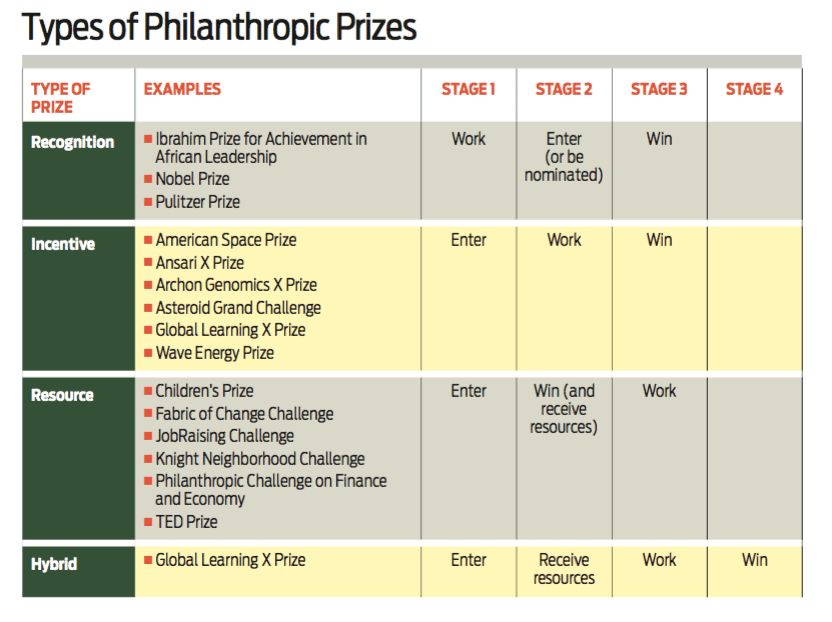
Broadly speaking, there are three types of philanthropic prizes: recognition, incentive, and resource. The main difference between these three types of prizes concerns the sequence of activities that make up the prize competition process: entering (or being nominated), winning, and working. (See “Types of Philanthropic Prizes” below.)
Recognition prizes | The purpose of a recognition prize is to honor work that has already taken place. Winners of this type of prize first work to achieve a certain goal. Then, perhaps many years after they achieve that goal, they enter (or are nominated for) a prize competition. And then they win the prize. In many instances, organizations award recognition prizes not only to celebrate an established record of achievement but also to inspire other people to match that achievement.
Some of the best-known prizes in the world fall into this category. The Nobel Prize, established in 1895, honors significant contributions in the fields of chemistry, physics, medicine, literature, and peace. (The Nobel Memorial Prize in Economic Sciences is a related but different prize.) The winners in each field split a purse, which is currently worth about $1.2 million, and they come from all parts of the globe. The Pulitzer Prize, meanwhile, honors US-based achievements in journalism and the arts. In the early 20th century, the newspaper publisher Joseph Pulitzer left money to fund prizes in four categories of journalism. Today the Pulitzer Prize Board awards prizes in 14 categories, and the award purse for each prize ranges from $7,500 to $10,000.
A more recent example of a recognition prize is the Ibrahim Prize for Achievement in African Leadership. Mo Ibrahim, a Sudanese-born telecom entrepreneur, established the prize in 2007 to promote good governance in Africa. Heads of state in African countries who peacefully and democratically transfer power to other leaders receive a payment of $5 million and then receive $200,000 annually for life. In effect, the prize is a “golden parachute” that encourages leaders to support democracy. It also reduces the incentive for corruption by providing leaders with resources to support themselves after they leave office. The Ibrahim Prize Board does not automatically award the prize every year. The most recent winner was Hifikepunye Pohamba, former president of Namibia, who received the prize in 2014.
Incentive prizes | In launching an incentive prize, an organization aims to motivate entrants to pursue a clearly defined objective. Winners of this type of prize first enter a competition. Then they work to achieve a particular goal. And then, after meeting that goal, they win the prize. Many of the best-known philanthropic prizes that have emerged over the past decade or more take this form.
The Ansari X Prize exemplifies the potential of incentive prizes to generate innovative solutions. Launched in 1996 and renamed in 2004 after its sponsors—the entrepreneurs Anousheh Ansari and Amir Ansari—this prize focused on advancing space flight. By the terms of the prize, entrants had to self-finance their projects, and they had to tackle a very specific challenge: “to build a reliable, reusable, privately financed, manned spaceship capable of carrying three people to 100 kilometers above the Earth’s surface twice within two weeks.”8 In 2004, the X Prize foundation awarded $10 million to Mojave Aerospace Ventures for meeting that objective.
Since then, the X Prize Foundation has launched 13 other incentive prizes, and in doing so it has reenergized prize philanthropy. All but one of those competitions (the Global Learning Prize) is named after an outside sponsor. Six of them have culminated in payouts to winners. With one of them (the Archon Genomics Prize), the sponsor withdrew the prize because contestants failed to show a sufficient degree of innovation in their entries. The X Prize Foundation website lists several prizes that are now in development, and site visitors can vote on those prizes or suggest others. In essence, the foundation has created a franchise that allows multiple external funders to promote innovation through its platform.
Several agencies of the US federal government also support incentive prizes. The Department of Energy conducts many competitions of that type. Among them is the Wave Energy Prize, which the department describes as “a 20-month design-build-test competition that aims to double the energy captured from ocean waves.”9 The National Aeronautics and Space Administration (NASA) makes extensive use of incentive prizes both to spur innovation and to solve operational problems. Currently, for example, the agency is conducting the Asteroid Grand Challenge; the purpose of that challenge, according to the NASA website, is “to find all asteroid threats to human populations and know what to do about them.”10
Resource prizes | Winners of both recognition prizes and incentive prizes receive funding only after they complete their prize-worthy efforts. These prize types differ primarily in how they sequence the work and entry (or nomination) stages. With a resource prize, in contrast, an organization provides winners with crucial funding before they finish their project. Contestants, therefore, follow the same sequence of activities that they would follow in a standard grant process: First they enter the contest. Then they win funding. And then they work toward completion of a proposed project. Some resource prizes (including the Children’s Prize) dispense funding in installments, as contestants reach preset milestones.
Along with the three main prize types, there is also a hybrid type that combines a resource prize and an incentive prize in a multistage process. Take, for example, the Global Learning X Prize. The X Prize Foundation launched this competition in 2014 to encourage the creation of open source software that would enable children in developing countries to learn independently. Each registered team has until November 2016 to develop and submit its entry. Then, between March and June 2017, a panel of experts will select five finalists. Each finalist team will receive $1 million to test its proposal during an 18-month trial that will take place in Sub-Saharan Africa. The trial period will end in early 2019, and the panel will then bestow a grand prize worth $10 million on one team.
The relative prominence of each prize type has shifted over time. Between 1970 and 1990, according to McKinsey, “big-purse” prizes (defined as those worth more than $100,000) accounted for $55 million in philanthropic prize spending, and 97 percent of that sum was allocated to recognition prizes. Between 1991 and 2007, however, spending on big-purse prizes totaled $302 million, and 78 percent of that sum was allocated to incentive prizes.11 Incentive prizes still account for a large share of total spending in prize philanthropy. But resource prizes have developed an increasingly high profile in recent years. Since 2005, for example, Ashoka Changemakers has launched numerous challenge initiatives and has awarded 101 challenge prizes. Similarly, the John S. and James L. Knight Foundation has put increasing emphasis on initiatives such as the Knight News Challenge, the Knight Arts Challenge, and the Knight Cities Challenge. Both of these funders provide winning challenge contestants with up-front funding to pursue their work.
Prizes Versus Grants
All prize types, including the resource prize, have certain critical advantages over traditional grants. The ability to use powerful and efficient Web-based platforms, as I noted earlier, is a particularly important benefit of the prize model. Platform providers such as Bankiton, IdeaScale, InnoCentive, NineSigma, and Skild deliver ready-made tools that simplify document handling and facilitate communication among prize applicants, administrators, and judges. Some prize platforms allow a prize administrator to track performance data, which the administrator can then use to improve both the selection process and the user experience for applicants. In some cases, prize platforms also incorporate advanced collaboration features. Ashoka Changemakers, for example, uses an open source framework to support a community of problem solvers that includes applicants for its challenge competitions. Ashoka posts all challenge submissions on the platform, and any visitor can become a community member and offer feedback on any submission.
For Ted Caplow, founder of the Children’s Prize, it was the availability of prize platform technology that made launching a prize feasible. “The Children’s Prize was born of my desire to do something for kids around the world… . I wasn’t sure that my money would be spent most effectively [by large aid organizations], so I tried to get more involved and opened my own contest. And because we live in the age of the Internet, it turns out this is quite possible to do,” Caplow said at a Children’s Prize selection meeting.12
One of the main benefits of prize philanthropy is that it enables funders to attract a broad pool of applicants. “Contests have proved an effective way of discovering and supporting up-and-coming organizations (not just the ‘usual suspects’) and drawing creativity from different disciplines,” Mayur Patel observed in a 2013 post on the Stanford Social Innovation Review website. Patel, who was then vice president of strategy and assessment at the Knight Foundation, supported that point by citing a survey of people who had applied for a Knight Neighborhood Challenge to fund resident-led projects in Macon, Ga.: “About 25 percent of the entrants surveyed indicated that they had never before applied for foundation funding. The openness and simplicity of the contest format changed that.”13
Philanthropic prizes offer another advantage over grants: They bring welcome publicity for their sponsors. Among the general public, efforts like an X Prize competition have a kind of panache that grant programs simply lack. In addition, some organizations regard partnering with a prize initiative as a way to attract and retain employees. Deloitte Consulting LLP, for example, offers an X Prize fellowship that supports a team of professionals who provide pro bono prize management services. “We’re … giving our consultants the chance to use their business skills to help create social change. Today’s professionals want to work for organizations that nurture innovative thinking and have a positive influence on society—this program helps to meet that demand,” said Marcus Shingles, innovation group leader at Deloitte, in a statement posted on the X Prize website.14
Indeed, prizes often carry an aura of prestige that extends beyond the people and groups that win them. Philanthropic prizes can direct attention to a specific problem or to an entire issue area. They also have the potential to confer prestige even on non-winning contestants. In a 2015 report, the World Bank cited a nonprofit organization called Muso as an exemplary community health service provider. The report highlighted the fact that Muso was one of eight finalists for the Children’s Prize in 2013. It’s unlikely that the World Bank would have mentioned that Muso had applied for a particular grant that it had failed to win.15
Resource Prizes Versus Other Prize Types
Each prize type has specific advantages and disadvantages. A recognition prize, for example, shines a spotlight on otherwise unheralded achievements. And as the Ibrahim Prize for African Leadership powerfully illustrates, such prizes can be an effective force for social change. Yet recognition prizes reward only achievements that have already occurred, and the incubation period for inspiring would-be recipients may last for decades. Like a resource prize, a recognition prize can promote a broad social goal. Unlike a resource prize, though, a recognition prize—precisely because it exists to honor past achievements—cannot identify and fund a new generation of achievers.
The incentive prize type, meanwhile, has one significant advantage: Of all prize types, it has the most potential to leverage resources. The Ansari X Prize, for instance, inspired 26 teams from seven countries to spend more than $100 million on efforts to meet the prize goal. According to the X Prize Foundation, those efforts helped build a private space industry that is now worth more than $2 billion.16 With just a $10 million purse and with little risk to its sponsor, therefore, the Ansari X Prize achieved a big impact. As that example shows, incentive prizes have the potential to stimulate the development of a market to the point where it can expand on its own.
The 2009 McKinsey report set forth three conditions that need to be in place for an incentive prize to achieve significant impact. First, there should be a “clear, achievable goal,” Second, there should be many “potential solvers.” And third, applicants should be “willing to accept outcome risk”—including the risk that comes with financing a project on their own. When an incentive prize meets all three conditions, it can achieve a bigger payoff than a resource prize can achieve. Multiple applicants, working simultaneously to reach a specific goal, are likely to generate more new ideas than the winner of a lone resource prize will generate. Incentive prize applicants also have a greater motivation to keep improving their idea than does a resource prize recipient. And of course, those applicants have a stronger financial incentive: They receive funding only if they meet the prize goal.
If all three conditions do not apply, however, then an incentive prize is unlikely to generate as much impact as a resource prize. The first and third conditions are especially important in this context. Pervasive social problems generally don’t lend themselves to projects that involve achieving specific outcomes within a given time frame. In many cases, therefore, resource prizes offer a more suitable way to pursue broad social goals. Furthermore, the incentive prize model depends on the availability of applicants that are willing and able to finance their own projects. That condition inevitably excludes newcomers and other applicants that lack the means to obtain outside funding—applicants that might, in fact, have the most innovative ideas to offer. Resource prizes can provide a mechanism to reach those applicants.
To see how a resource prize can overcome that problem, consider the Fabric of Change Challenge, an Ashoka Changemakers initiative. This challenge, sponsored by the C&A Foundation, was launched in September 2015, and winners will be announced in May 2016. Its purpose is to encourage and discover innovation in various aspects of the apparel industry value chain, from workers’ rights to environmentally sustainable production. One applicant will receive a prize of €50,000 (about $55,000) to test and implement its innovation, along with an opportunity to pitch its idea to investors. Two other applicants will receive €20,000 each (about $22,000) to help fund their proposed projects.
If the creators of Fabric of Change had designed the challenge as an incentive prize, its lack of a clear, specific goal would have discouraged potential applicants. The use of subjective rather than objective judging criteria would have made it hard for applicants to gauge their probability of winning the prize, and that uncertainty would have reduced their willingness to self-finance a project. In that case, the most likely winner would be a well-established organization in the apparel industry, and the prize would most likely award work that was already under way. By following the resource prize model, though, Fabric of Change is maximizing its ability to drive real change.
Which Type of Prize is Best?
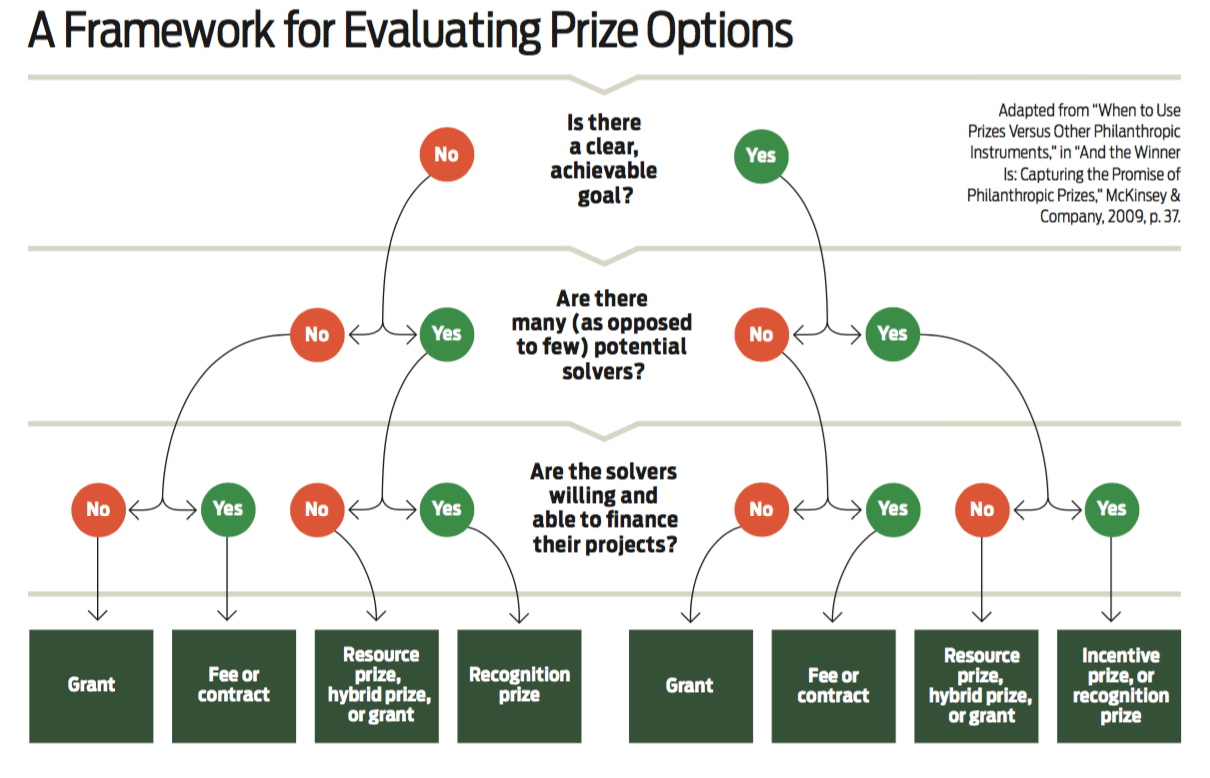
Making decisions on which type of prize to offer—or whether to offer a prize at all—requires funding organizations to consider several factors. The authors of the 2009 McKinsey report presented a diagram to help organizations decide between offering a prize and offering other kinds of financial support. That diagram focused on the use of incentive prizes, in particular, and it drew on the author’s three conditions for ensuring that an incentive prize will be effective. I have adapted the McKinsey diagram to create a framework for evaluating all three prize types, along with non-prize options. (See “A Framework for Evaluating Prize Options” below.) This framework is built around three fundamental questions:
Is there a clear, achievable goal? An incentive prize is generally feasible only in cases where the answer to this question is “yes.” A recognition prize, in contrast, may or may not involve a specific goal. The Ibrahim Prize for Achievement in African Leadership, for example, has a fairly well defined objective, but many recognition prizes (including the Nobel and Pulitzer prizes) honor work achievements in one or more broad categories. For a resource prize, similarly, the answer to this question could be “yes” or “no.” The Children’s Prize has a quantifiable objective. (Its purpose is to fund a single project each year that promises to save the largest number of lives among young children.) The JobRaising Challenge, however, aims to support a variety of projects that might boost overall employment.
Are there many (as opposed to few) potential solvers? As a rule, prizes of all types require the existence of a large pool of applicants. Indeed, tapping into such a pool is a core purpose of the prize model. The Ansari X Prize was able to motivate several groups and companies to pursue its space-flight objective. The Pulitzer Prizes, by gathering multiple nominations in multiple categories, show that the recognition prize type also fits this criterion. And resource prize initiatives such as the Children’s Prize and the JobRaising Challenge are also able to attract numerous applicants.
When the number of potential solvers is small, the cost of administering a prize is usually hard to justify. Instead, organizations should find other ways to find and support those people or groups. The best mechanism in this case is likely to be either a standard grant or a fee-for-service arrangement. Are the solvers willing and able to finance their projects? If the answer to this question is “yes,” then either an incentive prize or a recognition prize could be a suitable option. For both of those prize types, winners must be in a position to self-finance their work. That is explicitly the case with incentive prizes such as the Ansari X Prize, and it is implicitly the case with prizes such as the Pulitzer, which honor achievements that have taken place without the support of a prize-giving organization. Resource prizes, however, exist precisely to support potential solvers that require funding up front in order to carry out their projects.
In sum, an incentive prize is a viable option only when the answer to all three questions is “yes.” A recognition prize is viable only when the answer to the second and third questions is “yes.” And a resource prize is viable when the answer to the first and second questions is “yes” but the answer to the third question is “no.” (A funding effort that meets the conditions of a resource prize could also take the form of a hybrid prize or a grant program.)
Criticisms of Prize Philanthropy
The rise of prize philanthropy has attracted attention from critics who point out the potential costs and limitations of using prizes to fund social change. Kevin Starr, managing director of the Mulago Foundation, in 2013 launched a vigorous plea to his colleagues in the social sector to “dump the prizes.” He voiced several objections to prize-based funding, but his primary complaint was that prize competitions are a big waste of time for nonprofit applicants: Hundreds or even thousands of organizations might enter a competition, but only a few of them (or maybe just one of them) will receive any funding.17 In 2015, similarly, the late Rick Cohen argued that many prize initiatives rely on judging methods—crowdsourcing, for example, or the use of in-house judges who lack expertise—that lead funders to waste resources on unqualified winners.18
Another concern is that prize philanthropy can lead an organization to deviate from its mission. “Awards also can warp what they honor, skewing personal and professional priorities,” Joel Best, professor of sociology at the University of Delaware, told a reporter in 2009. James F. English, author of The Economy of Prestige: Prizes, Awards, and the Circulation of Cultural Value, offered a more wideranging criticism to the same reporter: “I hate these inducement prizes and their language of social benefit. It’s a cover for what they are really about, which is getting attention. I don’t think that kind of small-scale frantic prize-chasing investment is the best way for us to solve big problems.”19 (“Inducement prize” is another term for the incentive prize type.)
In the spring of 2015, a controversy erupted that put some of these criticisms in high relief. The Council on Foundations announced that it would hold a contest—the Philanthropic Challenge on Economy & Finance—at its annual conference that year. During a conference session, contest participants would present their ideas for boosting economic activity, and the winner would receive a $40,000 prize. Critics charged that the prize was too small, that the contest would undermine the dignity of contestants, and that the whole effort celebrated innovation for its own sake. In one published critique of this competition, three social sector professionals compared it to the television show Shark Tank: “Not only will nonprofits be subjected to ‘rapid-fire questions’ from a panel of philanthropic colleagues, the audience will weigh in, too, and then choose the final winners,” they wrote.20 Ultimately, the council opted to cancel the contest.
Resource prizes avoid some of the problems that critics of prize philanthropy have cited. Most important, because sponsors of resource prizes don’t require applicants to complete extensive project work during the competition period, applicants are less likely to waste a great deal of time, effort, and financial resources on chasing a prize that they don’t win. For the same reason, the process of competing for a resource prize is unlikely to cause applicants to veer away from their mission. (Resource prizes aren’t immune from criticism, of course: The Philanthropic Challenge on Economy & Finance fell into that category.)
Prizes have also received criticism for their impact on sponsoring organizations. Small philanthropic institutions are likely to struggle with handling the higher volume of applicants that prizes generate in comparison with grants. In addition, funders may fail to reckon with the full cost of administering a prize. As with a grant program, they need to allot funds for marketing, managing, and evaluating a prize effort. But here, too, prize philanthropy has a distinct advantage: The use of Web-based platforms can result in efficiencies that reduce funders’ overall costs.
And the Prize Goes To…
In Sierra Leone, about 11 out of every 1,000 live births end in death by asphyxia, largely because many women in rural areas give birth in their homes and without the assistance of formal birth attendants. Carrie Jo Cain, a program manager at World Hope International and the recipient of the 2015 Children’s Prize, aims to alleviate that problem. In her winning project, she is using the $250,000 award to bring Helping Babies Breathe—a program developed by the American Academy of Pediatrics, the World Health Organization, and other entities—to more than 40 chiefdoms throughout Sierra Leone. The program, which Cain and her colleagues have adapted to conditions in that country, provides training in newborn resuscitation to both traditional and formal birth attendants.
Initiatives like the Children’s Prize allow donors to find and then fund worthy projects that might otherwise languish or never get off the ground. Donors certainly should not stop offering grants. But they should consider shifting a significant part of their funding efforts from a grant model to a resource prize model. The widespread availability of Web-based prize platforms makes it easier than ever for funding organizations to elicit novel solutions to long-standing problems from every corner of the world. And by structuring awards as resource prizes, organizations can empower a wider-than-ever variety of recipients to pursue those solutions.
Read more stories by Renya Reed Wasson.