


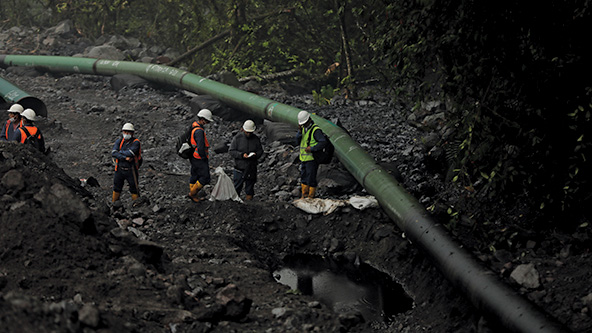
 Rains in January 2022 triggered landslides that ruptured the OCP oil pipeline near San Luis, Ecuador, in the country’s Amazonian region. (Photo by Franklin Jacome/Getty Images)
In April 23, 2021, US president Joe Biden convened the Leaders’ Summit on Climate, a roundtable of leaders from 38 nations aimed at strengthening national commitments to address climate change. At the meeting, representatives of the United States, United Kingdom, and Norway announced the formation of the Lowering Emissions by Accelerating Forest finance (LEAF) Coalition, a public-private partnership among those nations’ governments and a spate of corporations intended to mobilize funds for the protection of tropical forests.1 Later that year, at the United Nations Climate Conference (COP26) in November, the coalition announced that it had raised $1 billion, billing itself as the largest-ever public-private effort to protect tropical forests.2 It signed initial agreements establishing timelines for project implementation with five countries: Ecuador, Ghana, Costa Rica, Nepal, and Vietnam.
The LEAF Coalition’s funding consists of contributions from its corporate participants, who will pay for forest protection programs in exchange for carbon offset credits. Such credits represent a measured amount of carbon absorbed from the atmosphere by trees across a tract of forested land. Offset proponents claim that such programs protect the forests covered by the credits while also reducing carbon emissions. Increasingly, advocates also maintain that they provide benefits to and promote the rights of forest-dwelling peoples and Indigenous communities that live in project areas. The LEAF Coalition’s rhetoric repeats these claims, asserting that its offset program will “empower tropical and subtropical forest countries to move more rapidly towards ending deforestation, while supporting them in achieving their Nationally Determined Contributions (NDCs) [nation-specific targets for emissions reductions] under the Paris Agreement,” and will ensure “the full and effective participation of local and Indigenous peoples.”
In practice, however, carbon offset programs have rarely benefitted forests, Indigenous peoples, or the global climate in the way supporters claim they do. A growing body of scholarship and reporting has demonstrated that land- and forest-based carbon offsets have brought about little to no substantive emissions reductions and minimal, inconsistent forest protection.3 As for carbon offsets’ impact on Indigenous rights, the authors’ work with Amazon Watch—a nonprofit organization that works in partnership with Indigenous peoples of the Amazon rain forest on land rights and forest protection—belies proponents’ rosy claims. As previous Amazon Watch research and advocacy have shown, forest carbon-crediting programs in the Amazon have led to incursions on the land rights of Sápara people in Ecuador and Kichwa people in Peru, false overcounting of climate benefits in Colombia, and overpromised community benefits to Brazil’s Suruí people,4 echoing many other examples from offset programs the world over. The issues of Indigenous rights, forest protection, and climate mitigation are interrelated: Protection of Indigenous land rights and sovereignty has been shown to correlate with reduced deforestation.5
These and other examples around the world demonstrate that offset programs are phony solutions that give pay-to-pollute passes to the very same governments and corporations that are causing the climate and ecological crises and violating Indigenous rights. Although offset programs claim to offer carbon-sequestration benefits that contribute to a carbon-neutral economy, the governments and corporations that reap the financial and reputational benefits of these programs often show no inclination to halt their extractive practices. In particular, governments’ expansion of mining activities and oil extraction—key drivers of climate change, deforestation, and Indigenous-rights violations—generate larger adverse impacts on the environment and Indigenous communities than offset programs can tackle. These contradictory activities demonstrate a lack of political commitment to addressing structural issues at the core of climate change. Forest carbon market programs are based on the faulty premise that deforestation can be solved with marketization and investment, while ignoring problems of land rights, power relations, and building trust among communities.
The LEAF Coalition’s agreement with the Ecuadorian Ministry of the Environment exemplifies how carbon offset programs distract from climate justice. Programs like the LEAF Coalition paint a green veneer over continued threats to Indigenous rights while empowering extractive industries and further commoditizing communities’ relationships with nature. In what follows, we analyze the LEAF Coalition’s model while contextualizing its proposed operations in Ecuador within the country’s existing forest-carbon-sequestration programs. We conclude that the initiative ultimately facilitates greenwashing by affluent nations, client states, and corporations while posing serious threats to Indigenous peoples’ rights.
A Vehicle for Corporate Greenwashing
The LEAF model uses what is known as jurisdictional crediting: National and subnational governments enter into agreements with LEAF and implement forest-protection programs while also assuming responsibility for ensuring that local communities are included in decision-making and receive appropriate compensation for their participation. Emergent, a US-based nonprofit dedicated to mobilizing financial efforts to protect forests, acts as an intermediary between buyers and sellers of forest carbon credits and serves as the LEAF Coalition’s operations administrator. The nonprofit is responsible for validating these programs to ensure that they meet the coalition’s standards for environmental and social integrity. If the programs are validated, Emergent then generates carbon credits based on the forest-protection services rendered. These credits are delivered to LEAF’s corporate participants, and payments are delivered to the jurisdictions, the national and subnational governments that are parties to the agreement. Practitioners call this a “results-based” carbon market scheme—payments are delivered only after results are verified.
The LEAF Coalition’s corporate participants—a group that includes Nestlé, BlackRock, Delta Airlines, Walmart, Unilever, and Amazon—provide the vast majority of its funding. These companies will receive offset credits produced by LEAF projects. Paradoxically, many of these companies rank among the world’s most notorious polluters, and several are directly complicit in the destruction of the Amazon rain forest and violation of Indigenous rights in Ecuador and across the Amazon basin. For example, BlackRock, the world’s largest asset manager, held more than $6 billion in debt and more than $24.2 billion in equity in oil companies operating in the Amazon as of 2021,6 including state-owned oil companies, such as Petroecuador and Petroperú, that have been responsible for continued extraction, corrupt contracting of industry operations,7 and horrific oil spills that have polluted Indigenous communities.8 Meanwhile, Walmart sources beef from multinational JBS, one of the most notorious violators of Indigenous rights and agents of deforestation in the Brazilian Amazon.9
Under traditional carbon offset programs, carbon credits are applied directly to compensate for the emissions of the entity that purchases them. The LEAF Coalition attempts to distinguish itself from this arrangement by requiring its corporate participants to commit to climate targets through the Science Based Targets initiative and the United Nations’ Race to Zero program. These initiatives place limits on companies’ use of offsets to meet emissions-reduction goals, ostensibly committing them to real emissions reductions. However, such voluntary commitments have been weak and inconsistent in practice, and corporations participating in these programs have nonetheless remained reliant on offsets. Many of the LEAF Coalition’s corporate participants—including Amazon, Nestlé, and Unilever—are already exaggerating their climate commitments with deceptive net-zero targets that rely on carbon offsets, rather than real emissions reductions.10
Additionally, LEAF projects’ minimum carbon credit price will be $10. This is a fraction of the proper price, which is closer to $100, that many climate economists target in order to achieve net zero by 2050.11 This disparity typifies carbon markets, from the United Nations’ Clean Development Mechanism to cap-and-trade markets in the United States and European Union:12 Carbon prices low enough to entice the private sector into participating are nowhere near what would be theoretically required to effectively mitigate climate change. This dynamic is exemplified by the failure of California’s cap-and-trade market, in which businesses have increased carbon emissions while the state has appeased them by keeping carbon prices vastly lower than what implementing real emissions reductions would cost.13 As such, the LEAF Coalition represents a new avenue for corporate greenwashing, enabling companies routinely responsible for pollution, deforestation, and rights violations to burnish their reputations by financing so-called “green” programs.
But the LEAF Coalition’s greenwashing is not limited to its corporate partners. That also extends to its governmental sponsors. Wealthy nations such as the United States and United Kingdom have been widely criticized for their failure to commit to sufficient climate finance for developing countries.14 The United States in particular has committed only $1 billion for international climate finance in 202215—a far cry from the $11.4 billion by 2024 promised by the Biden administration, and a shockingly inadequate sum given the country’s disproportionate historical responsibility for global carbon emissions.16 Relying on private-sector climate and forest finance not only offers greenwashing benefits for private industry but also allows the wealthy governments behind the LEAF coalition to continue to avoid their own climate commitments.
A Low Standard for Climate and Indigenous Rights
Carbon offset credits are a fundamentally unreliable way to mitigate carbon emissions. Nature-based offset programs conflate the permanent carbon sequestration of unburnt fossil fuels with the temporary carbon sequestration of absorption by trees or soil. There is no evidence that offsets can mitigate carbon emissions at scale. In fact, recent research suggests that nature-based carbon sequestration can be effective only as a complement to massive emissions cuts—and even this degree of effectiveness is debatable.17
The standard that LEAF applies to its programs does little to allay these concerns. Carbon offset credits generated by LEAF-funded projects will be verified using The REDD+ Environmental Excellence Standard (TREES). (REDD+, which stands for “reducing emissions from deforestation and forest degradation” and enhancing forest stocks, is a United Nations framework for forest conservation.) According to the LEAF Coalition’s website, the use of this standard will “ensure uncompromising environmental and social integrity.” But in fact, TREES’ climate safeguards have weaknesses that increase the likelihood of the deceptive accounting and exaggerated climate benefits that carbon offset programs have repeatedly demonstrated in the Amazon and across the world, according to a 2020 report from Climate Focus.18
In particular, TREES lacks rigor in two areas common to carbon offsets: additionality and leakage. Additionality measures whether an offset project adds new carbon-sequestration capacity. For example, if an offset project is created using a forest that was already protected from deforestation, it offers no additionality, because those trees would have absorbed carbon regardless. TREES’ calculation of additionality, however, uses baseline assumptions, rather than actual performance measurements.19 This means that additionality is calculated only by measuring emissions against historic emissions levels in the project area, instead of by assessing implementation of emissions-reductions policies, investments, or other common measures of additionality. Failing to take these additional steps increases the danger that offset credits sold through TREES will not actually sequester additional carbon from the atmosphere.
Leakage, on the other hand, happens when offset projects do not reduce emissions but simply shift them from one area to another. TREES uses an overly simplistic method of calculating leakage,20 which means that emissions from these forest programs could go uncounted and actually end up adding emissions to the atmosphere—a danger that has been observed in other offset projects.21 TREES’ carbon accounting also does not account for aggregate uncertainty, meaning that its emissions-reduction estimates could contain high levels of error.22 This risk could lead to inaccurate and potentially overcounted carbon sequestration.
TREES’ safeguards on Indigenous rights may be even weaker than its shortcomings in measuring forest carbon sequestration. During the LEAF Coalition’s launch webinar,23 representatives claimed that Indigenous communities would qualify as jurisdictions under then-under-development TREES 2.0, which would allow them to enter into LEAF agreements independently. However, when TREES 2.0 was released, language about Indigenous jurisdictional eligibility had been dropped altogether—only national and subnational governments are eligible under the latest TREES standard. This discrepancy keeps intact the dominant paradigm among carbon market programs that relies on funding trickling down through governments before it reaches Indigenous peoples and local communities.
As a result, Indigenous communities seeking to ensure equitable benefit-sharing from LEAF programs may be forced to do so through engagement with governments that do not abide by international legal standards on self-determination and sovereignty of Indigenous peoples. For example, TREES does not require adherence to the United Nations Declaration on the Rights of Indigenous Peoples (UNDRIP), does not mandate the development of equitable benefit-sharing programs, and maintains only partial commitments to the internationally recognized standard of the need for companies and governments to obtain Free, Prior, and Informed Consent (FPIC) from Indigenous peoples before initiating projects in their territories.24 In short, TREES offloads the implementation of many Indigenous-rights safeguards to the governments with which LEAF partners. As a result, respect for Indigenous rights and consultation will likely only be as strong as the policies of the governments through which LEAF projects are run, and LEAF will be able to shirk responsibility for violations that occur through its programs. In fact, this abdication of responsibility already appears to be taking place: Levi Sucre Romero, coordinator of the Mesoamerican Alliance of People and Forests, recently criticized LEAF’s “hands-off” approach and worried that “if there is no mechanism to secure [our rights], we will be the victims of our own governments and they will decide about our forests without [involving] us.” 25
Cause for Concern
Given the LEAF Coalition’s problems with climate integrity, Indigenous rights, and corporate greenwashing, its 2021 Memorandum of Understanding (MOU) with Ecuador raises serious concerns about its effectiveness. The Ecuadorian government’s implementation of forest and climate programs to date has a checkered history regarding Indigenous rights and forest protection. Ecuador’s forest-dwelling Indigenous communities and the woods in which they live face continued threats from extractive and climate-harming activities, such as oil drilling and mining, even under the apparent auspices of existing forest-protection programs.
Although the Ecuadorian constitution contains provisions that seem to protect against exploitative carbon market programs, proponents have found ways around these protections.
And according to the LEAF-Ecuador MOU, it is these existing forest-protection programs through which LEAF will be administered. Ecuador’s Ministry of Environment, Water, and Ecological Transition (MAATE) plans to channel LEAF funds through the country’s existing REDD+ Action Plan—a national, multiyear initiative, aimed at preserving forests and biodiversity while sequestering carbon emissions, that encompasses several forest-protection programs, including Socio Bosque and PROAmazonía. Although these programs differ in implementation and region (PROAmazonía, for example, is exclusive to the Amazon, while Socio Bosque operates countrywide), they ultimately adhere to the same paradigm: forest carbon sequestration with the aim of attracting international climate investment, both through United Nations funding mechanisms, such as the Green Climate Fund, and through the sale of carbon offset credits.
Although the Ecuadorian constitution contains provisions that seem to protect against exploitative carbon market programs, carbon market proponents have found ways to circumvent these protections. For example, Article 74 of Ecuador’s constitution forbids the “appropriation” of “environmental services.” Some legal scholars have interpreted this to preclude the sale of carbon offset credits, as carbon sequestration can be categorized as an environmental service. However, the LEAF Coalition claims to abide by this regulation by preventing buyers of LEAF-generated Ecuadorian carbon credits from reselling them. Additionally, Ecuador has a constitutional commitment to FPIC (Article 57), but in practice this has meant only “consultation” of Indigenous peoples, rather than true consent. In February 2022, Ecuador’s Constitutional Court ruled that consultations must be carried out with the intention of gaining consent from affected peoples.26 To date, however, there is no existing law enforcing FPIC in Ecuador.
In keeping with these weak safeguards, Ecuador’s REDD+ Action Plan, through which the LEAF Coalition would operate, has a poor record of honoring Indigenous rights. In theory, programs such as Socio Bosque and PROAmazonía are subject to human-rights safeguards implemented by the United Nations Development Programme.27 In practice, however, the story has been much different. Although many communities join these programs thinking that they will protect the communities’ territories from extraction, Ecuador’s forest programs aimed at reducing emissions in the Amazon often operate in the very same areas of forest and Indigenous territories in which the government is expanding oil and mining activity without Indigenous consent.
The experience of the Shuar Arutam people (PSHA) offers one example of how Ecuador’s REDD+ programs enable extractive industries in Indigenous territories. The PSHA are composed of 47 communities with a total of 12,000 inhabitants. They live in their ancestral territory in the southern Ecuadorian Amazon, which has been part of Socio Bosque since 2008.28 However, the mining industry has also operated in this area since 1980. Even though PSHA oppose mining in their territories and participate in Socio Bosque, which claims Indigenous-rights safeguards and a commitment to FPIC, the majority of their land continues to be dominated by major foreign mining companies, such as Solaris Resources Inc. (Canada), SolGold (Australia), ExplorCobres S.A. (China and Canada), and EcuaSolidus S.A. (Canada). Indigenous leaders and families who have opposed mining activities have been subject to threats and harassment from mining companies, police, and the Ecuadorian military.29 PSHA communities have faced intimidation and violence that have threatened their livelihoods and the health of their ecosystems.
Despite its significant failures, Socio Bosque was a major source of income for the PSHA—until MAATE terminated the contract, claiming that the PSHA failed to comply with program requirements. However, MAATE’s implementation of Socio Bosque had been rife with irregularities and inconsistencies. According to the PSHA, the government failed to provide support for proper implementation of the agreement and still allowed mining companies into PSHA territory.30 The termination of the program has inflicted even more economic difficulties for the PSHA, creating divisions among communities and families that could leave them more vulnerable to bribes from mining companies—a perverse outcome of a program aimed at forest protection.
The Kutukú-Shaimi Protected Forest, one of the most important natural areas in the Ecuadorian Amazon, offers another example of the deceptive nature of forest carbon programs in Ecuador. Without carrying out a proper FPIC process, the Ecuadorian government authorized mining company EcuaSolidus S.A. to operate within the territory. Kutukú-Shaimi is part of MAATE’s System of Protected Areas, and some of its Indigenous populations receive compensations from Socio Bosque for protecting their territory within the forest. Additionally, the Ecuadorian government updated the management plan for the forest through PROAmazonía. But the updated plan has excluded community demands to declare the territory a mining-free area, according to José Esach, president of the Kutukú Shaimi Protected Forest Defense Committee, and the state failed to consult all communities dependent on the forest, circumventing FPIC processes. As a result, mining and environmental degradation continue within the territory.
The flagrant contradictions in the Ecuadorian government’s embrace of financialized forest carbon programs tell a clear story: Programs such as LEAF and REDD+ are being used to enable continued government prioritization of extractive activities and economic interests over guaranteeing collective rights. Ecuador’s commitments to protecting Indigenous territories from extraction are questionable at best, and carbon market programs create the illusion of progress on its NDC commitments to the Paris Climate Accords.
These discrepancies are further amplified by the centrality of oil and gas in Ecuador’s national development plan. President Guillermo Lasso has pledged to double oil extraction, opening up Ecuador’s state-owned oil companies to private investment in a bid to dramatically increase production.31 This oil extraction often threatens Indigenous lands, even in areas where forest conservation programs are supposed to operate.
For example, according to Ecuador’s 2019 NDC document, the government plans to achieve additional climate change mitigation through the reduction of flaring—the wasteful and pollutive practice of burning by-products of natural-gas extraction—and by using less gas for electricity production. However, the Ecuadorian government has not taken any significant steps to comply with this policy, raising questions about its commitment to mitigate climate change. In fact, the government continues to grant authorizations to fossil-fuel companies flaring natural gas at more than 447 sites across the Ecuadorian Amazon, contaminating the air of local communities. Affected populations filed a lawsuit in February 2020 with the Court of Justice of the Ecuadorian province of Sucumbíos, alleging impacts on their health and violation of the rights of nature, which are enshrined in Ecuador’s constitution. Additionally, even though the court ruled in July 2021 that all flaring near affected towns must be discontinued within 18 months, the Ecuadorian government continues to permit gas flaring in these areas.32
It is no surprise, then, that Ecuadorian Indigenous activist Patricia Gualinga, a Kichwa leader and member of the Amazonian women’s collective Mujeres Amazónicas, has called carbon credit programs “pure hypocrisy,” noting that such programs are “a way of commercializing rain forests that are already being protected by Indigenous peoples.” 33
Not all of Ecuador’s existing REDD+ programs produce carbon offset credits. However, marketized conservation programs like REDD+ financialize forest carbon, turning natural forests into commercialized areas and creating a bureaucratic web of regulatory schemes that are inaccessible to Indigenous peoples subject to them. The LEAF Coalition’s addition of corporate carbon offsets into the mix adds yet another layer of deceptive accounting and greenwashing that would allow the Ecuadorian government’s violation of Indigenous rights to continue while simultaneously furthering corporate pollution.
Beyond LEAF
Indigenous peoples in Ecuador and across the Amazon basin face difficult decisions about maintaining their sovereignty and protecting their homelands from extractive companies and government policies. Financing forest protection by delivering payments to Indigenous peoples for community-based, Indigenous-led conservation programs can be an effective tool for protecting forests while strengthening Indigenous communities. However, protecting forests without drawing down fossil-fuel emissions is not a climate solution. As such, attaching forest funding to carbon market schemes can distract from real climate action and direct, reparative forest-and-climate finance for Indigenous peoples.
The LEAF Coalition’s agreement with the Ecuadorian government threatens to expand forest carbon programs that have enabled the operation of extractive companies in Ecuador’s Indigenous territories, all while delivering carbon offset credits and greenwashing reputational benefits to corporations and governments of affluent countries that routinely violate Indigenous rights, destroy forests, and worsen the climate crisis. As the LEAF Coalition expands operations into other countries, communities and activists should be wary, because they have little reason to believe that this pattern of deception and perpetuation of extractive practices will change.
In the short term, the LEAF Coalition and the Ecuadorian government can avoid some of the pitfalls covered in this article by honoring the right to sovereignty and self-determination of Indigenous peoples, carrying out robust FPIC processes, and ensuring that Indigenous peoples’ land rights are protected—particularly from extractive activities like oil and gas exploration and mining. Additionally, Indigenous communities should be fairly compensated for their participation in LEAF programs. Ultimately, though, given the problems inherent in carbon offsetting, programs like the LEAF Coalition are unlikely to provide a long-term, durable solution for Indigenous rights, forest protection, or climate change.
What, then, can be done to protect forests, advance Indigenous sovereignty, and halt climate change? Ironically, the rare instances when carbon offset programs have claimed some measure of success provide part of the answer. REDD+ offset projects in the Yaeda Valley of northern Tanzania and Colombia’s Selva de Matavén have effectively channeled resources to Indigenous communities in ways that both improve livelihoods and heal ecosystems.34 These programs have demonstrated the essential truth of what Indigenous peoples and environmental justice activists have been saying for years: Financing truly Indigenous-led conservation programs on a foundation of cooperation, community control, and enshrinement of land rights is one of the best ways to protect forests and strengthen communities’ sovereignty.
However, even these somewhat successful offset programs have serious issues that exemplify the unworkable nature of offsets as a climate change solution. The Yaeda-Eyasi Landscape REDD Project in Tanzania sells carbon credits to myclimate, a European company that offers carbon offsets to climate-harming companies, including airlines and a fossil-fuel company.35 Meanwhile, the Selva de Matavén REDD+ project has reportedly overcounted carbon credits, thus exaggerating its climate impact.36
Such problems illustrate the fundamental contradiction at the heart of carbon offsetting: Trading carbon credits invariably perpetuates the carbon emissions that drive climate change. Rising temperatures have already begun to destabilize the Amazon rain forest’s delicate ecosystems and drive drought and searing temperatures in sub-Saharan Africa. In practice, then, even when carbon offset programs deliver immediate benefits to forest-dwelling Indigenous peoples, those benefits are contingent on maintaining the drivers of climate change that threaten the very environments on which they depend—a total perversion of climate justice.
We have seen that prioritizing climate finance for community- and Indigenous-led conservation programs can have remarkable results—but it must be done unconditionally, and free of any offset schemes or pay-to-pollute models that enable continued carbon emissions elsewhere. Conservation programs must be governed equitably by Indigenous peoples and comply with FPIC before any decision that affects the integrity and environmental or social balance of Indigenous communities. While repairing and preserving natural carbon sinks can have an important climate impact, offsets cannot be trusted to reduce emissions at scale. Instead, we must rapidly draw down consumption of oil and gas, with immediate cessation of exploration and drilling on Indigenous lands.
We can look to the Indigenous Kichwa of Sarayaku in the Ecuadorian Amazon for inspiration. Through a lengthy community decision-making process, the people of Sarayaku developed their Kawsak Sacha (“The Living Forest”) proposal, which would create a new, internationally recognized conservation classification allowing Indigenous peoples to practice traditional management of their territories, free of extractive activities such as mining, fossil fuels, or agribusiness. Ultimately, supporting initiatives such as Kawsak Sacha not only promotes environmental justice and Indigenous rights but also provides a more effective solution for preserving forests than the LEAF Coalition or similar offset programs. Corporate sustainability actors would do well to remember this when thinking about how to fulfill their social and environmental commitments.
Read more stories by Roshan Krishnan, Sofia Jarrin Hidalgo & Marianna Fuchs.