


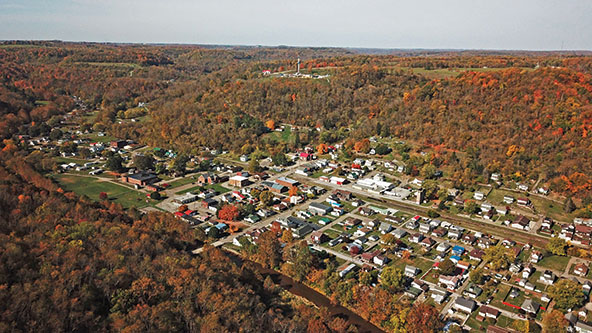
 Fracking wells populate communities in and around Belmont County, Ohio, including Dillonvale, pictured above. (Photo courtesy of Ted Auch, FracTracker Alliance, 2020.)
Powered by thousands of early-career scientists and students, a global movement to transform scientific practice has emerged in recent years. The objective is to “expand the boundaries of what we consider science,” says Rajul Pandya, senior director of Thriving Earth Exchange at the American Geophysical Union (AGU), “to fundamentally transform science and the way we use it.”
These scientists have joined forces with community leaders and members of the public to establish new protocols and methods for doing community-driven science in an effort to make civic science even more inclusive and accessible to the public. Community science is an outgrowth of two earlier movements that emerged in response to the democratizing forces of the internet: open science, the push to make scientific research accessible and to encourage sharing and collaboration throughout the research cycle; and open data, the support for data that anyone can freely use, reuse, and share.
For open-science advocates, a reset of scientific practice is long overdue. For decades, the field has been dominated by what some experts call the “science-push” model, a top-down approach in which scientists decide which investigations to pursue, what questions to ask, how to do the science, and which results are significant. If members of the public are involved at all, they serve as research subjects or passive consumers of knowledge curated and presented to them by scientists.
The traditional approach to science has resulted in the public’s increasing distrust of scientists—their motives, values, and business interests. Science is a process that explores the world through observation and experiment, looking for evidence that may reveal larger patterns, often producing new discoveries. However, science itself does not decide the effects or outcomes of these results. The devastating opioid epidemic—in which manufacturers have aggressively promoted the highly addictive drugs, downplaying risks and misinforming doctors—has shown that the values and motives of those who practice science make all the difference.
Instead, open-science advocates believe science should be a joint enterprise between scientists and the public to demonstrate the value of science in people’s lives. Such collaboration will change the way scientists, communities, regulatory agencies, policy makers, academia, and funders work individually and collectively. Each player will be able to integrate science more easily into civic decision-making and target problems more efficiently and at lower costs. This collaborative work will create new opportunities for civic action and give the public a greater sense of ownership—making it their science.
The Science of Power Sharing
Community science is currently embedded in the larger citizen-science community, where practitioners continue to debate the differences. The fact that the terms “citizen science” and “community science” have often been used interchangeably has resulted in some referring to the latter as “community-driven science” to emphasize the main distinction between the two. Citizen scientists do science in some form, by assisting or collaborating with scientists to identify or answer research questions and collect data. Many of these efforts are organized and led by researchers at scientific institutions and government agencies. Popular citizen-science portals include Zooniverse, a platform hosted by Oxford University and partner institutions where researchers create projects and invite the public to work with them, and SciStarter, a research affiliate of Arizona State University and North Carolina State University that is a research database for more than 3,000 projects. Zooniverse alone has more than 2.3 million registered volunteers who can, for example, help teach a Mars Rover how to classify Martian terrain; hunt for gravitational waves; identify the age, sex, and group size of beluga whales; and do other investigations in a wide range of disciplines.
As the name suggests, community-driven science always originates with a community concern, such as excessive flooding, wildfires, or lead-tainted water, that motivates a community to seek a scientist’s help. It is suited not to every field of scientific inquiry but to fields connected to civic action, like public health, where community science has been used to investigate and devise strategies for issues that include infectious diseases, substance abuse, domestic violence, and food security. For environmental issues, it is deployed in multiple areas, including pollution control, disaster risk and natural-resource management, and climate resilience.
An important difference between citizen science and community science is power sharing. In citizen science, funding usually goes to scientists and their organizations, and they typically control decisions about what issues to study. In community science, the scientist often shares ownership of a project with a community, and community members help determine the research questions based on their needs. Tangible improvements in people’s lives—rather than scholarly research papers—are priority outcomes. Community members may or may not help a scientist do the science and may share funding and codesign research protocols. If a project warrants academic publication, the community often shares credit for the research, as in the case of a 2020 Journal of Public Health study on water insecurity in Detroit that both academic researchers and community leaders coauthored.
Oriented toward civic action, community science is one of many tools a community may employ to address priorities and aid in decision-making. Native American and other Indigenous peoples have been instrumental in developing community-science methods that include Native-run review boards that oversee the research and tribal data sovereignty provisions that specify tribal data ownership—their response to a long history of abuse at the hands of the “science-push” model. Community science has become the dominant way in which many tribal nations in the United States and Canada now do science.
How Science Falls Short
Indigenous peoples are not the only ones who have criticized existing scientific practices. Community-science advocates have cataloged shortcomings in the current scientific systems and structures that affect civic life, pointing to flaws and historic inequities in academic and scientific practices that justify the need for community science. Below are four major shortcomings of traditional science, as currently practiced, that impinge on civic life.
Undone science | Sociologists have coined the term “undone science” to describe unfunded or ignored scientific research on topics that civil society believes are important. It also refers to the inequitable playing field for doing science. Communities, especially those that are marginalized or poor, lack access to the monitoring equipment, laboratories, and expertise needed, for example, to measure air and water quality, conduct health impact assessments, and analyze the probable effects of construction and development on their well-being. Even when communities report smelling fumes or tainted water and become ill, authorities may ignore or downplay their complaints.
The inability to do science when they need it has grave consequences for communities. Without documented scientific evidence, serious public health and environmental problems remain anecdotal and difficult to prove or remedy. For example, many state environmental agencies do not measure the much higher levels of pollutants in frontline communities—those neighborhoods adjacent to factories; landfills; incinerators; power plants; industrial zones; chemical, oil, and gas facilities; transportation hubs; and freight corridors. Under standard practice, agencies average out data over much larger areas. Some monitoring devices are programmed to limit pollution-level readings and are situated far from pollution sources to produce lower readings. Regulators often rely on self-reporting by industry for emissions and effluents and to detect and report spills, leaks, and other accidents. Environmental impact statements produced by developers and polluting industries may not include critical measurements or may vastly underestimate potential hazards to local communities, particularly historically marginalized ones.
No cumulative impact measurements | With the exception of states like California and Minnesota, no requirement exists for the US Environmental Protection Agency (EPA) or for most state EPAs to measure cumulative exposure from multiple pollution sources. When they zone or grant permits to industrial facilities, such as oil refineries, incinerators, and chemical plants, many regulatory agencies issue individual permits to each facility, pollutant by pollutant.
This arrangement leads to situations like the one a southwest Detroit community faced. The predominantly African American community residing in zip code 48217 is surrounded by more than 27 heavy industrial facilities within a three-mile radius. Though nearly half the community lives below the poverty line and many residents suffer from rare cancers and respiratory illnesses, community members had to seek help on their own. University of Michigan professor Paul Mohai helped them do a cumulative impact assessment of contaminants in the air, water, and soil that they had been exposed to for years because neither the state nor the federal government was required to spearhead such a process. In 2019, Mohai and community advocates testified to Congress about the health consequences of excluding cumulative impact assessments, and, in 2020, after a nearby refinery released toxic fumes into the community, the state awarded residents funds to install air filters in the local elementary school.
Antiquated monitoring and enforcement regimes | Many of the procedures, policies, and laws that regulate the environment and public health are 40 to 50 years old—artifacts of the pre-internet era. They lag behind current capabilities to do more extensive, targeted monitoring and to measure and analyze more recent classes of pollutants, like fine particulate matter and volatile organic compounds.
Federal and state agencies lack the mechanisms and resources to do comprehensive environmental monitoring. Together with state and local governments, the federal government has a network of approximately 3,900 air pollution monitoring devices, about 1 monitor per 1,000 square miles, and the number of deployed government pollution monitors has been declining. Some are not properly operated or maintained. Around 120 million Americans live in counties where the federal EPA does not monitor small-particle pollution, a major cause of heart and respiratory diseases, as well as a risk factor for COVID-19. The government’s existing monitoring network failed to alert regulators to risks from 10 of the biggest refinery explosions in the past decade. Even when residents report incidents, few trained inspectors with the proper equipment are available to investigate. Many regulations and required mitigation are not enforced.
Public-health and environmental-justice activists charge that agencies remain passive until complaints roll in, by which time considerable damage has already occurred. When new construction is proposed, opportunities for public comment often take place late in the process, and procedures for public input are often so convoluted that they are unworkable. Many times, the onus is on overburdened communities with few resources to collect evidence and marshal expertise to demonstrate and document the severity of a problem. It may be years before the EPA or a state health or environmental authority investigates, and years more before these agencies recognize and measure the problem, during which time community members continue to be exposed to hazards.
Many states do not report multiple violations of drinking-water standards to the federal government or local residents. At least 25 million Americans drink water from systems that do not meet federal health standards. Regulations exempt the oil and gas industries from certain provisions of the clean air, clean water, and safe drinking water acts.
As a result of these omissions, many of the modeling and data collection methods government and business currently use paint a misleading picture of actual environmental and health risks. Many regulatory agencies also lack mechanisms and procedures to incorporate into enforcement or mitigation procedures information from new screening and mapping tools now available. When the information is used, it is often done on an ad hoc, case-by-case basis and much of the time cannot serve as evidence in court.
Marginalized in academia | Community-science advocates have experienced an academic system that prioritizes publishing in academic journals and securing research grants, rather than orienting the science toward public needs, equity, and social justice. Working on community-driven projects may not count toward a degree or tenure and may diminish a young scientist’s academic career prospects.
Sacoby Wilson, director of the University of Maryland’s Center for Community Engagement, Environmental Justice, and Health (CEEJH) and a new member of the EPA’s science advisory board, is a leading advocate for more community science in academia. Too much US academic science is extractive or “helicopter” science, he told an August 2021 CEEJH symposium on environmental justice and health disparities. “You study people’s pain, their anguish, their being poisoned. [But] that’s not good enough,” he said. “What have we done to translate [these] data into action for these communities?” Centers like CEEJH secure funding for scientific studies but struggle to find support to connect that science to underserved communities. Many government- and private-sector academic-grant programs are not designed to link science to civic action, perpetuating funding cycles that exclude community science.
Rise of a Movement
The public’s desire for community science has existed for decades. An early project that influenced the field occurred in Mebane, North Carolina, in the mid-1990s. As with many Southern towns in the United States, Mebane’s majority Black neighborhoods were denied basic amenities—including water and sewage services—through a practice called extraterritorial jurisdiction, which still exists in several Southern states today. Under extraterritorial jurisdiction, town officials design city boundaries to push majority Black and Indigenous neighborhoods just beyond city limits. Consequently, these minority communities are denied the right to vote for city officials. The town is absolved of providing basic services but still has jurisdiction over zoning and land regulations.
In Mebane’s Black and Indigenous neighborhoods, bacteria from failing septic tanks and chemical seepage from nearby factories contaminated surface and well water. In 1994, the North Carolina Department of Transportation announced plans to build an eight-lane, federally funded interstate bypass corridor through their neighborhoods that would destroy historic Black churches, homes, and cemeteries. Local and state authorities ignored their complaints. So, later that year, four Black couples established the nonprofit West End Revitalization Association (WERA) to document the threats that highway construction and lack of public-health infrastructure posed to these communities, and to seek legal remedies. In 1999, WERA used the federal government’s role in funding the highway as leverage to file an administrative complaint with the US Department of Justice. It protested the bypass construction, citing numerous civil-rights and public-health violations.
When WERA first sought to partner with university researchers to document water and soil contamination for its complaint, it believed that the community-based participatory research (CBPR) models university researchers proposed would produce academic papers but would not lead to the corrective action the group sought. WERA instead decided to develop its own research model to address its compliance goals, calling it community-owned and managed research (COMR). Community members were principal investigators, managed the research process, retained ownership of scientific data, and received direct funding from the government and private foundations.
Because most scientists have not been trained to work with communities and do not know where to start, the collaboration and cocreation of knowledge poses challenges.
From WERA’s organizational perspective, the science had to fit into a larger framework that addressed the zoning, permitting processes, and regulatory regimes with legacies of historic racism that contributed to the problems, and the legal remedies that would contribute to solutions. But if WERA could not translate the scientific research into action, the research wouldn’t help. The organization has subsequently established partnerships with universities, lawyers, and others who have agreed to use the COMR framework. These coalitions are another feature of community science.
It took WERA years to get enough training and funding to implement its approach. Eventually, it helped facilitate federal block grants to fund water and sewer lines for nearly 100 homes, but most of Mebane’s Black and brown residents are still waiting for the town to provide those services. It’s not unusual for such community efforts to take 15 to 20 years to produce results, in part because environmental-justice organizations like WERA have been the least resourced sphere of environmental grantmaking. A 2020 study by the New School found that environmental-justice organizations received only around 1 percent of philanthropic environmental-grant dollars in the Gulf South and Midwest.
Despite these challenges, in recent years new technologies and networking capabilities have made scientist-community collaborations easier and less expensive and have produced data equivalent to or surpassing state and federal data. In a decade, citizen science has become well established in higher education, with faculty positions, academic centers, and labs. Thousands of scientists and other practitioners have joined new citizen-science associations in North America, Europe, Australia, Asia, and Latin America, developing communities of practice. The US Congress passed legislation authorizing and encouraging federal agencies to incorporate more citizen science and crowdsourcing into their work. By 2018, at least 14 federal agencies were participating in citizen-science and community-science activities. Even more participate in a federal community of practice to share best practices and advance the professional practice of these two new disciplines.
President Donald Trump’s years in office challenged the legitimacy of scientific inquiry in numerous fields and were marked by open hostility to science. Early-career scientists and STEM students became increasingly dissatisfied with the disconnect they saw between science in academia and its societal applications. At gatherings and conferences and on social media, they noted how easily officials disregarded and marginalized science in policy- and decision-making. The racial-, social-, and environmental-justice movements that intensified during this period caused them to question whether the science they practiced also reflected their values. People of color, they observed, also distrusted science. Many researchers treated the communities they encountered like guinea pigs, using their biological materials for other purposes without people’s consent and profiting from their discoveries without offering the community any treatment for the maladies they studied.
While community science in the United States grew under the radar as the Trump administration attacked science, Europe embraced the movement. In 2013, the European Union adopted the multibillion-dollar Horizon 2020 research innovation funding program to promote European global competitiveness in science and research. The European Union invested almost $600 million in the Science with and for Society section of the program to support public engagement in science.
As community science has gained momentum, the movement has entered the scientific mainstream. The AGU, the largest US professional association for earth-and-space scientists, has recognized that supporting community science can also advance its larger organizational goals. Like other scientific associations, the AGU has fielded demands from its membership to address social-justice and equity issues, including its lack of racial and ethnic diversity. The geosciences are the least diverse of all STEM disciplines and have made no progress toward increasing racial and ethnic diversity for more than 40 years. In 2016, only 6 percent of geoscience doctorates went to underrepresented minorities. Communities of color are disproportionately affected by climate change, but only 8 percent of the geoscience workforce includes them.
The AGU’s leadership has promised to change the culture and practice of science. Former AGU president Robin Bell told members at their 2020 conference that this change is possible through seeing “examples and best practices of scientists doing environmental-justice work, showing how it’s done, and [building] avenues of institutional support,” so that more scientists understand its importance and how to incorporate environmental justice into their work.
The TEX Method
The AGU has invested in community science as part of this strategy. Since 2013, its Thriving Earth Exchange (TEX) program has served as a place where scientists can learn about and engage in community science, including research that involves environmental-justice issues. TEX has been developing and implementing methods and protocols for practicing community-driven science, testing them in more than 150 communities in the United States and abroad.
Because most scientists have not been trained to work with communities and do not know where to start, this collaboration and cocreation of knowledge poses challenges. But TEX, COMR, and other community-science groups are developing new methods to tackle such issues. The TEX method, for example, anticipates and manages the conflicts that may arise in such collaborative endeavors. Scientist-community partners learn how to set realistic expectations, navigate mistakes, cope with setbacks and failure, anticipate problems, and disagree without acrimony. TEX helps manage these partnerships as they evolve over time, fostering mutual trust and a culture of shared goals and collaborative problem-solving that helps keep relationships strong.
While the TEX method is designed for use in the geosciences, its four phases—scope, match, solve, and share—can be applied to other community-driven investigations. Let us consider these phases in turn.
Scope | The parameters of the investigation create conditions for a project’s success. TEX requires a community to initiate the request for a scientist’s assistance. At least two community leaders must commit to working with a scientist for 6 to 18 months and must also perform due diligence to ensure that the project is wanted by the community and addresses community priorities. Because environmental problems are complex and seldom have simple solutions, communities may be confused about what they need, or may have multiple priorities. They may not have funding. They may not necessarily favor shutting down an offending facility, for instance, if jobs are at risk. TEX asks community leaders fill out a project identification questionnaire that guides them through these issues to help them identify their priority goals for a scientific investigation.
TEX staff and cohorts of volunteer fellows—some but not all of whom are scientists—serve as project managers. They coach the scientists and the community on how to establish and maintain a productive partnership and stay focused on the project as it progresses. Prior to determining a project’s scope, the project manager communicates with the community to gain a better understanding of their issues and of how the community works and organizes itself. The project manager then develops a tentative project description.
During this phase, the project manager and community establish written ground rules for behavior and team interactions. They also delineate the roles and responsibilities of the various participants. These documents become reference points when problems arise. Limiting an investigation’s scope to manageable proportions helps establish realistic expectations. TEX encourages communities to start small, avoid overpromising, and build in benchmarks to measure progress.
Match | Once the scope is determined, the project manager searches for a scientist using AGU databases and scientific affiliations. More than one scientist may work on a project, depending upon its scope. Project managers vet the candidates, check references, and present their list of candidates to the community, which selects who they want to work with. After the community and scientist agree on a match and the scientist is onboarded, the community project team and scientist refine the project and decide how data will be used and shared. TEX requires both community leaders and scientists to sign a separate document outlining the risks associated with doing community science and a statement of scientific integrity.
The scientist and community leaders meet weekly, often remotely. Project managers, heavily involved early in the process, gradually reduce their involvement and ease out of the project completely once the community-scientist partnership is stable.
Even though the match process ensures strong alignment between the scientist and the community, disagreement and conflict can arise. The TEX method does not seek to eliminate conflict but plans for it. The project manager encourages the team to envision worst-case scenarios and how they might address them through problem-solving exercises. TEX encourages community-scientist teams to generate up to half a dozen possible solutions. The project manager often refers to the project plan to ensure that solutions are compatible with the project’s existing scope. If necessary and if all parties agree, the project scope can be modified.
Solve | This phase describes the TEX project’s investigation and outcome. When it works well, the results help communities to better understand their problems, and the evidence that they have collected helps them chart a path toward solutions. Communities should understand at the outset that investigation results may not solve all their problems and may not support a community’s original thesis or assumptions. In such instances, flexibility and a willingness to change course can transform what some might perceive as failure into agile development—new knowledge that helps the scientist and the community redirect their efforts in more promising directions.
Project results may also raise new questions. In some cases, TEX projects have relaunched as new follow-up projects when communities wished to continue exploring issues outside the scope of the original project.
Share | In the last phase, the community disseminates results from the scientific investigation to others—including the wider community, lawmakers, and civic activists—to advance its larger objectives. Connecting scientific research to civic action can be the most challenging stage of a project.
The following two case studies of recent TEX projects illustrate the TEX method in practice. They also demonstrate how scientific investigations are shaped by community priorities and designed to provide actionable information for innovation and civic action.
Clairborne Avenue Alliance
In March 2021, President Joe Biden’s infrastructure plan cited New Orleans’ I-10 corridor, also known as the Claiborne Expressway, as an example of the historic inequities plaguing the interstate highway system that hurt Black communities. In New Orleans, construction of the expressway gutted Claiborne Avenue, the once thriving, tree-lined, commercial main street and cultural center of several of the city’s historic Black neighborhoods, destroying hundreds of mature oak trees and ushering in an era of disinvestment.
In 2018, the Claiborne Avenue Alliance (CAA), a coalition of local residents and business groups that advocated for tearing down the expressway, searched for researchers to help them evaluate and respond to six different scenarios the city proposed to revitalize the Claiborne Avenue corridor. Some scenarios called for preserving the expressway, others for tearing it down. The CAA knew it needed data but didn’t know where to turn for help—until a friend of a community leader mentioned TEX in conversation.
That year, TEX matched the CAA with Louisiana State University (LSU) School of Public Health professor Adrienne Katner, who had previously worked at the National Institutes of Health and the Louisiana Office of Public Health, where she ran the state’s environmental public-health tracking program.
The CAA and Katner agreed that they could not evaluate the city’s redevelopment scenarios without first conducting a baseline study to get a more accurate picture of current conditions along the I-10 corridor. Katner and community leaders decided to measure the expressway’s environmental and health impacts on adjacent neighborhoods. Along with her team of LSU students, Katner measured particulate matter and noise in the corridor, studied health and environmental data from federal and state databases, and reviewed scientific literature on the hazardous exposure levels of various pollutants. They also compared the health statistics of residents in zip codes next to the Claiborne expressway with state and federal data.
In the solve phase, TEX project manager Sarah Wilkins checked in with the LSU team and CAA leaders monthly, facilitated conversations, and assisted when needed to keep the project on track. The LSU team’s final report produced a health impact assessment of the I-10 traffic corridor’s cumulative effects on residents’ well-being. It showed that the exposure levels to pollutants and illness rates for asthma, autism, heart disease, pulmonary disease, cancer, and pregnancy complications along the corridor exceeded city, state, and national levels. The LSU team also modeled the probable health impacts of the redevelopment scenarios the city proposed, concluding that some of them would actually increase health hazards for residents. All this research was done by scientists, students, and community leaders volunteering their time—without funding. All parties expressed satisfaction with the partnership, attributing success in part to maintaining open and clear communication.
For the project’s share phase, the CAA held community forums to present the report’s findings in 2019. TEX nonprofit partner Public Lab helped fourth graders at an elementary school in New Orleans’ Tremé neighborhood launch weather balloons to document traffic-related pollutants. Students produced a children’s book describing their monitoring efforts and their thoughts about the corridor, which led to increased media coverage. A teacher at the school created a lesson plan to introduce students to citizen science, air monitoring, and civic engagement.
The most challenging part of this phase, CAA cofounder Amy Stelly explained to me, was getting decision makers to take an interest in the study. It took a year before the New Orleans city council agreed to discuss the report’s findings. Stelly also shared the report with Louisiana’s congressional delegation, presented it at conferences, and used the findings to strengthen New Orleans’ case for federal infrastructure support. While many local leaders remain reluctant to get rid of the expressway, US Representative Troy Carter, a member of the House Committee on Transportation and Infrastructure, supports its removal.
Despite remaining challenges, Stelly said the TEX investigation gave the community important information and a new yardstick with which to measure desirable outcomes. The benefits have extended beyond New Orleans. Since the Claiborne Expressway was highlighted in Biden’s infrastructure plan, community advocates in other cities have shared the LSU report with their transportation departments to demonstrate the public-health hazards posed by urban highways. Like the CAA, these highway-removal advocates had not realized how health impact assessments could strengthen their case. They had focused on traffic, disinvestment, and other social and economic effects but had not thought to include public-
health data in their tool kit.
Concerned Ohio River Residents
The second case study takes place in the western Ohio River Valley. Belmont County is Ohio’s most heavily fracked community, hosting more than 600 hydraulic fracking operations. Residents have complained numerous times to state and federal environmental and health authorities about toxic emissions—even calling 911 with health emergencies—to no avail. Community groups also learned of plans to construct an enormous ethane cracker plant in the county to produce plastics that would result in significant new emissions.
Neither the Ohio EPA (OEPA) nor the federal EPA tracks the cumulative impact of emissions from the many petrochemical facilities in and around Belmont County. The few EPA air monitors in the region intentionally average out emissions over a large area—a practice that can miss heavy concentrations and hot spots where air quality is much worse. The few air monitors deployed do not collect data for total volatile organic compounds (TVOCs) from fracking operations or effectively monitor large, episodic releases and leaks from compressor stations and other facilities. Like many states, the OEPA often relies on industry to report leaks and other accidents, and many such incidents are missed or not reported.
The community group Concerned Ohio River Residents (CORR) sought to rectify these regulatory deficiencies. CORR first heard about TEX in 2018, when it was invited to attend an information session in Pittsburgh for community groups. In 2019, CORR contacted TEX for a scientist’s help to analyze the county’s air quality and to establish baseline air monitoring.
Later that year, Garima Raheja, an atmospheric scientist and Columbia University doctoral student, joined the project as a TEX community-science fellow. Elisabeth Freese, an MIT doctoral student and an atmospheric chemist, was matched as the TEX scientist. Both worked remotely with CORR throughout the COVID-19 pandemic.
The project team decided to address inadequacies they had identified in both the EPA’s and the OEPA’s air quality monitoring in the valley. Early on, Raheja and Freese figured out the county’s cumulative emissions by downloading and analyzing each individual permit the OEPA had granted to calculate total emissions.
CORR did not have the equipment, training, or funds to collect and analyze data on airborne pollutants. But they were able to purchase low-cost air monitors, thanks to a grant from the Community Foundation for the Alleghenies. A local scientist helped install the monitors in residents’ homes to record concentrations of fine particulate matter. Carnegie Mellon University’s CREATE Lab, which was developing new low-cost monitors to measure TVOCs, also installed several of its beta models in the valley.
The TEX scientists combined the data accumulated from the newly installed monitors with meteorological data and other data sets to create computer models that provided a more detailed picture of emissions’ origins and movements in the valley. The data showed emissions coming from the direction of a compressor station and underground pipelines. The monitors also recorded significant spikes in TVOC discharges on several occasions. Freese is currently building additional computer models to pinpoint the location of these discharges and is also modeling what TVOC emissions from a future cracker plant would look like and how they would further affect air quality.
In the share phase, CORR created two community education webinars to illustrate the extent of air pollution in Belmont County. It also has begun a second phase of the project, to expand its air monitoring, assess whether the region is in compliance with clean-air regulations, and develop emission visualizations with the CREATE Lab. CORR and the TEX scientists hope to write a white paper about their findings, apply to the US EPA for support, and share their methods and best practices with other activist networks in the region.
Lessons Learned
What do these case studies reveal about the way community science operated in these instances and affected civic life? What lessons do they hold for scientists, activists, policy makers, and funders who may wish to explore doing or supporting community science? Six major takeaways result from these studies.
First, they demonstrate that communities and scientists can work together effectively. Despite differences in priorities, culture, and knowledge systems, scientists and communities can collaborate to produce solid science that better informs civic decision-making.
Inaction has consequences. If government-run science continues to ignore scientific evidence that communities discover, public distrust of government-led science will grow.
Second, they show that communities are eager to do science, including baseline studies and health impact assessments, when the science relates to their needs and contributes to civic action.
Third, lack of funding and access to scientific equipment and expertise are the major barriers that prevent communities from doing science.
Fourth, the case studies also demonstrate that scientists can defer to community interests without compromising scientific integrity. Once scientists and communities come to an agreement about what needs to be studied, the scientists can conduct investigations that adhere to the highest professional standards.
Fifth, when the science relates to and informs larger community goals, it strengthens the community’s position to influence decision makers who can enact policies that lead to positive outcomes. Community science also creates many opportunities for productive scientist-community interactions, strengthens bonds between scientists and the public, and fosters greater trust in scientific methods.
Finally, community science spurs scientific discovery. When confronted with real-world problems and community feedback, scientists learn to do research more suited to community needs and implementation and engage in creative, multidisciplinary problem-solving.
The Future of Community Science
This rich potential for collaborative civic action has begun to manifest itself as community-science drives and is being driven by a wave of technological innovation producing publicly available screening, mapping, and sensing tools that make it possible for communities to collect data block by block. This innovation frees them from the constraints of limited government monitoring programs and revolutionizes data collection methods for compliance and enforcement.
California, Michigan, North Carolina, Maryland, and several municipalities across the United States are developing environmental-justice screening and mapping tools that combine layers of government data and community-generated data to pinpoint specific overburdened neighborhoods and compare them with surrounding neighborhoods. The Biden administration is working on a new climate and economic-justice screening tool that may utilize the community-generated information collected by state- and local-level tools to better inform federal agencies’ efforts to identify and invest in overburdened communities.
The scientists developing these tools hope they will embed community science so deeply in the fabric of civic life that dislodging it in the future will be difficult—no matter which party holds the presidency or has a majority in the US Congress.
Advocates want community-driven science to play a more central role in permitting, zoning, compliance, and enforcement processes. In 2020, the International Network for Environmental Compliance and Enforcement (INECE), an informal global network of environmental and enforcement practitioners, considered the steps government agencies need to take to incorporate community science into their operations, including updating laws and procedures and creating standards for community data collection so that it can be used more extensively in policymaking and litigation.
Some states have already issued standards for community water quality monitoring. As part of a new state strategy to mitigate air pollution in overburdened communities, a new California law gives grants to disadvantaged communities to measure local air pollution with low-cost sensors and links the findings to action plans.
In academia, scholars want to establish community science as an academic discipline that includes studying theoretical and practical models of how such science might work in municipal and regional settings, with practicums, certification processes, career paths, and funding formulas that take account of its reoriented priorities. The AGU is joining with four other scientific societies and academic publisher Wiley to launch a new portal and peer-reviewed journal dedicated entirely to community science. And some scholars are advocating for a new National Applied Science Foundation to create a bridge between basic and applied science, which would operate alongside the National Science Foundation and the National Institutes of Health—currently the premier federal funders of scientific research.
Inaction has consequences. If government-run science continues to ignore or conflict with scientific evidence that communities discover through their own investigations, public distrust of government-led science will grow. If academic science remains disconnected from community needs, public alienation from scientists and the public’s reluctance to fund research will increase.
A new generation of scientists and community activists is committed to making science more democratic, civic minded, equitable, and justice oriented. Perhaps it is the kind of response needed to convince a skeptical public that asks, “Who and what is science for?”
Read more stories by Louise Lief.