


 (Illustration by iStock/akindo)
Though the organization and infrastructure—and the challenges and opportunities—of social innovation differ widely between regions, it remains a global phenomenon that needs strengthening and expansion to meet the many social challenges of today. SSIR is committed to working with contributors around the world to share local solutions to social challenges and to exchange ideas and inspiration across borders. “Scaling Across Borders by Cocreating with Government” by Ashleigh Gillwald Morrel, “Asian Philanthropy Can and Must Lead from Within” by Naina Subberwal Batra, and “Continuous Transformation to Serve the Mission” by Tina C. Ambos, Alexander Zimmermann, and Sebastian H. Fuchs are just a few examples of recent stories that contextualize and address issues of wide concern in locally relevant ways.
The editors of SSIR’s local language editions are equally committed to field building through the development and exchange of knowledge, and each edition has translated and published dozens of stories that are relevant and meaningful to social innovation communities in the regions they serve, including Brazil, China, Japan, Korea, and a range of Spanish-speaking countries. As 2025 draws to a close, these editors reflect on some of the issue areas and articles that have resonated most with their edition’s readers and why.
SSIR Brasil
This was the year that the United Nations Climate Change Conference came to the Amazon, and COP30 dominated Brazil’s public agenda not only because it was the first climate summit hosted in the country, but also because holding it in Amazonian territory carried profound symbolic and political weight for local social innovators. Combined with the worsening climate crisis—marked by heat waves, droughts, and devastating floods across several regions—this unprecedented context brought renewed urgency to discussions on climate solutions.
 Participants arrive at the main pavilion of COP30 in Belém, Pará, Brazil, on November 12, 2025. (Photo by Bruno Peres/Agência Brasil)
At SSIR Brasil, we published several original articles presenting practical responses to climate-related challenges. “How to Finance Productive Forest Restoration” by Isabel Apel Britez, Marcelo Pereti, and Valmir Ortega examines the difficulty of funding large-scale restoration in a country with nearly 80 million hectares of degraded land, and outlines financial innovations such as blended finance, development bank instruments, and impact investment funds. “Sport as an Ally in Climate Action” by Fernanda de Castro and Fernando Trevisan explores how the sports sector can reduce its environmental footprint, adapt to climate risks, and leverage its cultural influence to mobilize society. And “The Role of Companies in Climate Adaptation” by João Morais, Caroline Cotta, and Antonia Lo Prete argues that businesses must shift from reactive aid to preventive, collaborative strategies that strengthen community resilience. The article shows how corporate social investment can link private capital, public policy, and civil society to support shared-value solutions such as climate-resilient education and nature-based approaches.
Together, these articles reflect a broader shift taking place in Brazil: a growing recognition that leaders and communities cannot address climate action in silos and must root their efforts in the realities of a country marked by deep social inequalities, vast biodiversity, and territories disproportionately affected by climate impacts. The country’s social innovators, businesses, and civil society actors are increasingly embracing integrated, locally grounded solutions. Their work illustrates how climate action in Brazil is inseparable from questions of territorial development, community resilience, and inclusive economic transformation.—Carolina de Assis, editor-in-chief of SSIR Brasil
SSIR Korea
Korea’s long-standing culture of intense educational competition continues to place substantial emotional pressure on young people. In 2023, the suicide rate among people in their 20s remained at roughly 22 per 100,000, a persistently high level over recent years. While the figure itself is concerning, it has also broadened expectations of what universities should provide—positioning them not only as academic institutions but as infrastructure for psychological safety and resilience. Within this context, the article “Promoting a Culture of Caring in Education” by Alison Badgett resonated strongly with readers. The Jed Foundation’s preventive and systems-driven approach offers a credible model for Korean universities, prompting wider reflection on the need for institution-level responses rather than isolated programs.
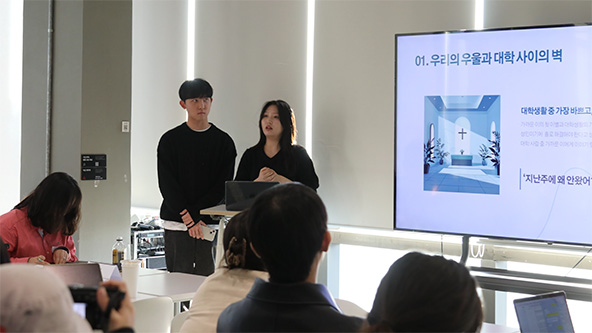 A recent colloquium brought together Hanyang University students and SSIR Korea to read “Promoting a Culture of Caring in Education” and discuss potential interventions that universities could explore. (Photo courtesy of Hanyang SSIR Korea Center)
At the same time, Korea’s nonprofit and public sectors showed heightened interest in the future of public data and its role in shaping public value. As AI becomes embedded across decision-making systems, questions around how organizations design, store, and use data have become increasingly important. In the article “Unlocking the Power of Data Refineries for Social Impact,” Jason Saul and Kriss Deiglmeier encourage readers to see data not simply as technical infrastructure but as a foundation for democratic accountability, equity, and trust.
These stories reflect the issues that Korean readers found most compelling in 2025: how to better safeguard the well-being of young people, and how to build responsible data systems capable of upholding fairness and public purpose as AI use grows.—Seo Hyunsun, editor-in-chief of SSIR Korea.
SSIR China
The article “Building Community-Centered AI Collaborations” (English version) by Michelle Flores Vryn and Meena Das emerged as one of the most shared and highlighted pieces among Chinese readers this year. Across our WeChat channels, many treated it almost like a digital booklet—saving and marking reflections about a people-centered future for AI, the irreplaceable contextual knowledge of community organizations, and the role of arts and storytelling in making data human and accessible. Their engagement reflects a widely shared concern: How can AI advance social good without eroding the lived experience, relational understanding, and ethical awareness that define nonprofit work?
AI is attracting intense global attention, and China’s social sector is part of that conversation. Over the past year, our team experimented with using AI, including testing DeepSeek during the translation of the article by Vryn and Das. The process echoed what many practitioners elsewhere are finding: AI can accelerate tasks, but it cannot substitute the contextual sensitivity, community insight, or value-based decision-making that social impact work relies on.
The piece invites readers to ask how the nonprofit sector should shape, adapt, and situate AI within its practice. It highlights how partnerships with universities, community-based organizations, artists, ethical-tech groups, and philanthropic funders can help ensure that AI becomes a community-centered tool rather than a purely technical solution. For Chinese practitioners, this offers a way to think about where to begin and which collaborations might support responsible adoption, while contributing to the broader global discussion on how technology can strengthen community agency, equity, and human connection—not just efficiency.—Guijuan Shi, digital editor, and Shuijing Liu, executive editor of SSIR China
SSIR Japan
In 2025, Japan reached a point where both its limits and its possibilities came sharply into view. Births fell to a record low, and population decline and rapid aging continued to reshape communities, public systems, and labor markets. At the same time, severe heat, heavy rainfall, and climate-related disasters, as well as rising social isolation and child poverty underscored that these are structural issues no single country, organization, or project can solve.
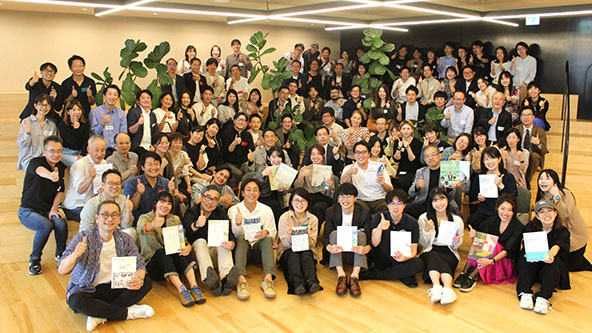 More than 100 social-sector leaders came together—alive with energy and ideas—at SSIR Japan’s Social Innovation Morning in October 2025. (Image courtesy of SSIR Japan)
There were also signs of renewal. Nonprofit organizations and civil society—despite aging leadership, scarce resources, and slow digital change—began rethinking how to change the flow of money and build relationships, including testing impact investing, new funds, and trust-based approaches. Gatherings such as the AVPN Northeast Asia Conference and the Asia Philanthropy Congress in Tokyo gave Japan space to share experiments and learn with peers across Asia.
SSIR Japan’s most-read pieces of 2025 reflected these dynamics. The top article, “Drawing Young People Out of Social Isolation in South Korea,” showed how extreme social withdrawal, long visible in Japan, is now a major issue in South Korea—illustrating how in Asian contexts many problems are less about whether they emerge than when and in what form. The second most-read article, “Revitalizing Japan’s Nonprofit Sector Through Spinoffs,” presented spinoffs as an option for renewing a nonprofit sector constrained by aging leaders and stalled succession. The third, “The Strategic Value of Trust-Based Philanthropy,” linked SSIR debates to the creation of the social movement-style organization Trust-Based Philanthropy Japan, helping to grow trust-grounded capital.
Taken together, these patterns show that interest in cross-border knowledge flows, better-quality capital, and a stronger nonprofit sector is beginning to feed back into practice. A vivid example is SSIR Japan’s participatory Social Innovation Morning event in October, where more than 100 participants collectively explored SSIR articles and used that shared thinking as a launchpad for context-specific action in Japan and across Asia.—Masataka Uo, editor in chief; Sadakazu Ikawa vice editor in chief; and Kei Eriksen community facilitator of SSIR Japan
SSIR en Español
I’m not good at delivering bad news. Maybe I’m out of practice. SSIR en Español aims to publish inspiring stories about social innovators in Latin America and around the world. But this year, for the first time in my almost four years as editor in chief, our most-read articles talk less about social innovators and more about major financial and human resources crises in the social sector.
 SSIR en Español’s “Basics of Social Innovation” stories, published in 2020, are still relevant today. (Illustration by freepik/by drynvalo)
It was not an easy year for Latin America. Economic growth was stagnant and major channels of international aid were cut-off. Our most-read articles—“The Language of Crowdfunding,” “Ten Nonprofit Funding Models,” and “Organizational Culture as a Tool for Change”—reflect that reality: Faced with the need to do more with much smaller budgets, nonprofit and other social sector teams came to SSIR en Español looking for new funding ideas and strategies for change.
Surprisingly enough, the latter two articles belong to the first batch of articles we translated in 2020 and published in our “Basics of Social Innovation” series. Perhaps this only makes us aware how much the sector needs to go back to basics.—Andrea González, editor in chief of SSIR en Español
Read more stories by SSIR Global Edition Editors.