


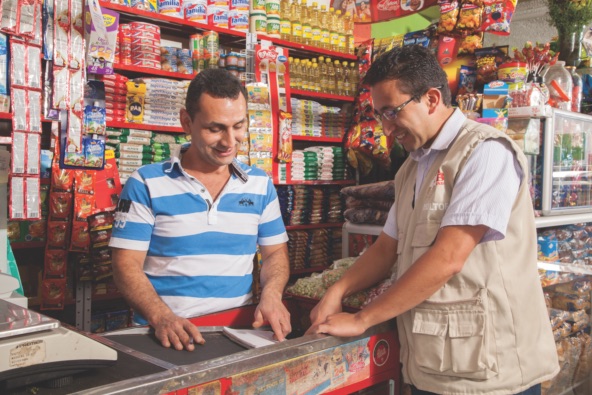
 A shop owner (left) in Bogotá, Colombia, receives advice from a FUNDES consultant as part of the organization’s 4e project with SABMiller. (Photo courtesy of FUNDES)
On the evening of October 8, 2024, guests poured into the posh restaurant of ÇUINA, the Culinary Innovation Academy, to celebrate an anniversary. In the heart of Mexico City’s hip Roma neighborhood, ÇUINA teaches and showcases chef Xano Saguer’s socially conscious vision of the culinary arts. That night his staff would cook a special meal to mark 40 years of the Foundation for Sustainable Development (Fundación para el Desarrollo Sostenible), better known as FUNDES.
As people entered, they each received a puzzle piece, on which they were asked to write their vision for FUNDES’ future. Since its inception, FUNDES has sought to foster sustainable economic development across Latin America through financing, education, and support for micro- and small enterprises (MSMEs). While the assembled guests enjoyed their welcome cocktails, members of the board shared their own visions of the organization’s next four decades.
“In the first 40 years of FUNDES, it had to reinvent itself continuously,” said Andreas Eggenberg, member of FUNDES’ board and chair of MASISA, a long-term client of FUNDES. “I don’t know where we will be in 40 years, but definitely different than now, keeping the motivational spirit and curiosity to reinvent ourselves again.”
The puzzle pieces were eventually assembled, coming together to complete a larger-than-life mural depicting typical FUNDES clients: two female bakers wearing white aprons and hairnets while shaping dough into small loaves of bread. The puzzle featured the FUNDES logo and the slogan “You are also part of the future of Latin America.” The exercise created a fitting symbol of FUNDES’ multidecade struggle and enduring mission to maintain close, meaningful interactions with its beneficiaries. FUNDES champions MSMEs, because of their role in driving employment, poverty reduction, and economic inclusion, and in fostering equitable and sustainable growth. Despite that singular vision, FUNDES has undergone numerous reinventions to sustain itself and its clients in its first 40 years and will inevitably face more in the future.
Today, many leaders of social impact organizations puzzle over how to reconcile a strong social mission with a sustainable financing model and experiment with a variety of different approaches. Imagine, for example, that you head an international philanthropic organization with a strong social mission and suddenly your funding is stopped. What would be a disaster for most nonprofits was just the beginning of the FUNDES story that took it from a philanthropic organization to a shared value consultancy and ultimately to a social-venture incubator. Yet, FUNDES ultimately had to maintain the same mission throughout its history. “The one thing you may not touch is the mission—the sustainable development of MSMEs in Latin America,” says Ulrich Frei, current director on FUNDES’ board.
The FUNDES case reveals the conditions, opportunities, and challenges associated with taking different approaches. It shows that realizing a long-term sustainable impact for society requires managers who are entrepreneurial, an ability to approach entirely new market domains, the openness to embrace new stakeholder groups, and a willingness to radically change organizations and their cultures.
A Mission Is Born
The idea for FUNDES was born in 1983, when Archbishop Marcos McGrath of Panama embarked on a fundraising trip through Europe to seek help for Latin America’s social and economic challenges. These included structural poverty, low economic growth, and few formal employment opportunities for a young and growing population. During his journey, he met with a group of prominent Swiss businessmen, including Stephan Schmidheiny, entrepreneur and scion of a wealthy industrialist and philanthropic family.
Schmidheiny was captivated by McGrath’s vision of spurring development in Latin America through small-business support. In Latin America, micro- and small enterprises (MSMEs)—such as traditional mom-and-pop stores, small-scale banana farms, and scrap-metal collectors—play a crucial role in the economy. McGrath envisioned transforming these small ventures into growth engines by providing them with financial assistance and essential business knowledge. Intrigued by this vision, Schmidheiny became the primary donor.
FUNDES began its operations in 1984 by offering guaranteed loans to MSMEs in Panama and set up a headquarters in Switzerland to work closely with Schmidheiny. In subsequent years, FUNDES expanded into a loosely organized network across nine more countries: Costa Rica (1986), Guatemala (1988), Colombia (1989), Bolivia (1990), Chile (1992), Argentina (1993), Mexico (1993), Venezuela (1994), and El Salvador (2000). These local offices were “small kingdoms,” according to Ulrich Frei, a Swiss businessman with extensive experience in Latin America who became FUNDES’ CEO in June 2008 and served in that role for more than four years. “Every country office decided what to do as long as it was for the good of MSMEs.” Each country office independently shaped strategies for providing support directly to beneficiaries, such as farmers or small-shop owners. During the first decade, the philanthropic model allowed FUNDES to focus entirely on its purpose and tailor its approach to local contexts.
“To invest in MSMEs, people have to go to these companies and understand what they do,” says Urs Jäger, associate professor with INCAE Business School, Costa Rica, about informal markets in Latin America. “Investors have to enter this dark world before investing.” This groundwork is what FUNDES did. However, over time, its decentralized structure increasingly created operational inefficiencies without paying off in greater impact or learning across countries. Furthermore, its reliance on Schmidheiny, a single donor, made it financially dependent and vulnerable to changes in his philanthropic strategy. FUNDES would need to change.
The Importance of Knowledge
In 1996 FUNDES headquarters conducted an internal review. The investigation flagged the limitations of its credit-guarantee model—loan repayment rates were low, and while FUNDES guaranteed the repayment of the loan to the bank, the fundamental challenges for small businesses often remained unaddressed. The study further found that the poor organizational skills of small-business owners and entrepreneurs impeded their success and overall contribution to the regional economy.
 In 2016 FUNDES began to experiment with digital strategies to help small shops like this one in Mexico City earn more money and improve business efficiency. (Photo courtesy of FUNDES)
“After 10 years, we realized that giving MSMEs access to capital without also giving them access to knowledge was a really risky business,” Frei says. Instead of seeing this as a setback, Schmidheiny closely worked with FUNDES management to develop an entirely new model to address their mission.
They reaffirmed their commitment to empowering MSMEs as essential players in Latin America’s economic and social development but shifted their focus toward education. FUNDES began offering workshops and classes for MSME owners across various sectors, from retail to agriculture. These programs improved the organizational and financial skills of MSME owners and, by extension, the management practices of their businesses. By equipping entrepreneurs with practical tools, FUNDES helped them increase their efficiency, expand market reach, navigate regulatory challenges, and grow their businesses sustainably. By 2002, its educational program had reached more than 140,000 participants and covered 40 different subjects, including administration and finance, production, marketing, and human resources.
At the time, MSMEs struggled primarily with “access to credit, tax procedures, unfair competition, and the need to adapt to globalization and technology,” said the owner of a textile SME in Guatemala who wished to remain nameless. The volatile economy, with its unstable financial institutions, waves of inflation, and high levels of corruption, provided harsh conditions for small-business owners across the region. They were often forced to focus on bare survival. Through access to business know-how and a peer group of like-minded entrepreneurs, they were better able to navigate the challenges they faced.
FUNDES expanded its training model over the subsequent years, becoming a significant provider of business education to MSMEs in the region. The model also helped FUNDES learn more about their real pain points in Latin America’s economy. They discovered that MSMEs were critical links in the value chains for big multinationals, yet these relationships were usually not well integrated or managed. Unlocking ways to professionalize MSMEs and enabling them to join forces with larger companies was seen as essential for unlocking economic growth.
Frei believed that large corporations would be willing to provide much-needed financial support for FUNDES’ activities, “not necessarily because they are better people, but because they wanted to stay competitive ... because the MSMEs are the backbone of their value chains.”
In 2004, FUNDES officially changed its goal from just “delivering knowledge” to “implementing knowledge” in Latin America by offering retail consulting to small-shop owners. That year, FUNDES participated in a study of the United Nations Economic Commission for Latin America and the Caribbean (ECLAC). It found that educating people was important, but that FUNDES’ focus should shift toward the actual impact for their businesses. João Carlos Ferraz, UN-ECLAC’s director, saw the collaboration with FUNDES as “an important opportunity to deepen and refine applied research techniques and methodologies for the evaluation of education programs.”
FUNDES thus adapted its service portfolio to consult with MSMEs on how to improve their operations. Schmidheiny subsidized the new remit, because the MSMEs did not have the resources to pay for the service. While the first consulting projects targeted inventory management, accounting, and other small-scale operational improvements at individual MSMEs, one project was different. In 2006, COPROCA, a Peruvian company storing and exporting llama and alpaca yarn, collaborated with FUNDES on a larger scale to support and professionalize 500 small farmers and turn them into more reliable suppliers. While this was an unusual project for FUNDES at the time, it turned out to be a glimpse into the future.
Combining Purpose and Profit
In 2008 the global financial crisis dried up credit, led to mass unemployment, and hit Latin America’s MSMEs hard. The emergency also limited the ability and willingness of philanthropic funders to continue supporting their causes at the same levels. This crunch created another pivotal moment for FUNDES. In need of refocusing its portfolio of beneficiaries, Schmidheiny’s team identified FUNDES as a project that could potentially become self-sustaining and decided to phase out its annual donations. Frei remembers it as their “biggest wake-up call.”
“We were told that within five years, we must become a financially sustainable organization,” Frei says. “But one thing you may not touch is the mission—the sustainable development of small- and medium-sized enterprises in Latin America.”
How could FUNDES continue to fulfill its social mission while generating enough revenue to sustain its operations? The management team knew that MSMEs in Latin America were integral to the value chains of large corporations, operating as suppliers or distributors. Banana farmers for agriculture firms or mom-and-pop stores for beverage producers—there was a lot of interdependence, as well as a lot of potential for efficiency gains and business development if the MSMEs could be supported to operate more successfully and professionally. Frei believed that large corporations would be willing to provide much-needed financial support for FUNDES’ activities, “not necessarily because they are better people, but because they wanted to stay competitive … because the MSMEs are the backbone of their value chains.”
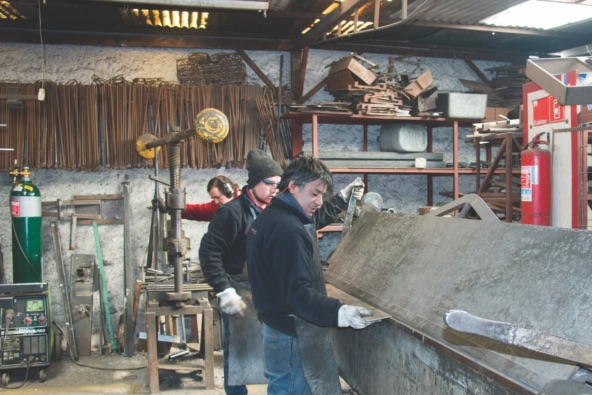 Over 80 weeks in 2014-15, FUNDES worked with Brazilian steel producer Gerdau to train and organize thousands of scrap-metal shops—such as this one in Santiago, Chile—to strengthen Gerdau's supply chain. (Photo courtesy of FUNDES)
He was proven right, as FUNDES worked with major companies such as Walmart. “Working on shared value allows us to have a direct impact on our business and on the different stakeholders with whom we work, such as MSMEs in agricultural products and mass consumption,” explained Viena Ochoa, corporate social responsibility manager at Walmart Central America, in 2015. “The challenge for them is to grow with us sustainably over time.” This need for sustainable growth was where FUNDES was actively supporting the MSMEs to match their corporate partners’ expectations.
FUNDES decided to go beyond simple knowledge delivery to knowledge implementation through retail consulting services. “The idea of our founder was great in its time, to directly help the MSMEs,” FUNDES’ current CEO, Elfid Torres, says. “There was an inflection point, where the team had to show courage, and if we would not have pivoted then, the organization would probably have ceased existing.”
FUNDES’ new dual consulting model—offering support for both MSMEs and large multinational corporations—coincided with a growing interest in combining purpose with profit, particularly through the lens of “creating shared value,” a concept developed by Harvard Business School professors Michael Porter and Mark Kramer in 2011. They defined shared value as policies and practices that “enhance the competitiveness of a company while simultaneously advancing the economic and social conditions in the communities in which it operates.” Porter and Kramer saw FUNDES as a practical embodiment of this idea. They visited the organization multiple times and referenced it in high-profile discussions with executives.
While SABMiller praised FUNDES’ activities for their impact, it wanted to reach far more small retailers selling their products than the numbers FUNDES provided, and at a lower cost per engagement. But FUNDES’ ability to scale had reached its limits.
While the shared value model was appealing in theory, implementing it was challenging. FUNDES needed a team with a commercial mindset to pitch projects to multinationals and other for-profit firms—unfamiliar territory for many of its employees, most of whom had backgrounds in philanthropy. To align with this new model, CEO Frei and Torres, who at that time was in charge of the change management office, saw the need to establish a more commercially focused culture at FUNDES. “We had nonprofit professionals in our organization, and all of a sudden, we needed business-minded people,” Frei recalls. In 2008 and 2009, FUNDES let go of 150 out of 200 employees due to their lack of business experience and hired about 60 new employees to support its new consulting model.
The new FUNDES had to revise its strategy and mindset as well as overhaul its organization. While FUNDES remained dedicated to supporting MSMEs, it now needed a regional strategy to work effectively with multinational clients and benefit in a more coordinated way from its regional presence. More than 50 multinational enterprises, including Walmart, PepsiCo, CEMEX, Gas Natural, and MASISA, began to work with FUNDES to develop their value chains with MSMEs.
To better serve these multinational clients, who wanted integrated solutions in several countries, FUNDES consolidated its decentralized structure into regional or country offices that could coordinate more seamlessly with headquarters. FUNDES’ centralization marked a major cultural shift. “The country kings had to take off their crown,” Frei says. The organization’s headquarters in Costa Rica assumed a dual role, overseeing operations and supporting subsidiaries while directly coordinating a few multinational projects. The core team there, led by Torres, was ambitious, but initiatives often faced bottlenecks. Subsidiary managers sometimes hindered the flow of strategies from headquarters to local teams, making it challenging to fully implement new ideas.
“I don’t want to be a consulting company,” said a vocal subsidiary manager, who wished to remain nameless. “I want to do business with the government. I want to close deals with foundations. And those partners will not be working with us, if they think we are a consultancy.”
What’s more, many years into the new strategy, some employees still saw FUNDES as an NGO rather than a consulting firm with a social mission. “I believe that our value proposition is to support and develop micro-, small-, and medium-sized companies; it is not to charge them or to generate profit,” said one project coordinator from Mexico who was also guaranteed anonymity. “As our director Ulrich Frei said, if you help develop these companies and help a little to generate economic benefit, you will reduce poverty. That is what I believe FUNDES should do.”
Despite such challenges, FUNDES’ shared value model gathered momentum, with every successful consulting project serving as an additional proof of concept. One exemplary success was a project with Brazilian steel producer Gerdau, which involved training and organizing thousands of scrap-metal collectors in Mexico, Venezuela, and Colombia to strengthen Gerdau’s supply chain. Gerdau sought two goals from the project: first, to work with its established suppliers on quality, cost reductions, and community development to achieve a relationship of mutual trust, respect, and sustainability; and second, to identify novel suppliers and to develop and integrate them into Gerdau’s supply chain. This large-scale project, supervised by managers from both FUNDES International and in-country heads, was carried out over 80 weeks in 2014 and 2015, improving the work of 58 Gerdau suppliers (13 in Mexico, 25 in Venezuela, and 20 in Colombia).
 Fundamental, the social incubator that FUNDES developed, has helped to launch many start-ups, including Voalá, a micro-franchising social venture supporting beauty salon professionals in Guatemala. Here a beauty salon owner participates in a Voalá pilot in Mexico City. (Photo courtesy of FUNDES)
FUNDES expanded its client and beneficiary base, working increasingly with more corporate giants such as Coca-Cola, AB InBev, and Bimbo. For AB InBev and its subsidiary SABMiller, FUNDES implemented its first major cross-regional project across six countries—El Salvador, Honduras, Panama, Colombia, Ecuador, Peru—from 2013 to 2018 supporting small retailers not only to improve their overall business performance, but also to foster the quality of life for their employees and to take leadership roles in their communities. The project, called 4e, was first implemented in El Salvador to great success and then expanded across the region. The program had three objectives: first, the development of business capabilities (including group training with personalized technical advice); second, the improvement of quality of life for individuals and their families (including income management, investment, and life planning); and third, the fostering of community and social leadership (including training to develop social enterprises).
Based on the first successful examples, FUNDES joined forces with Inter-American Development Bank’s Multilateral Investment Fund (MIF) to launch a $20 million project to support small retailers’ business performance. It included a 12-week cycle of recruitment, diagnosis, classroom training, in-store mentoring, monitoring, and awarding of certificates. The first regional iteration of 4e reached 5,631 stores in total (2,780 in Colombia, 622 in Ecuador, 376 in El Salvador, 269 in Honduras, 175 in Panama, and 1,409 in Peru).
SABMiller’s ambition was to become more embedded in strong and supportive regional business ecosystems and work with mom-and-pop stores in a way that would ultimately impact the lives of up to 10 million people. “The tenderos [‘shopkeepers’] are community references and opinion leaders,” Torres wrote. “Their shops are centers of information and integration for their neighborhood, they build social capital and create a culture of empathy.”
While SABMiller praised FUNDES’ activities for their impact, it wanted to reach far more small retailers selling their products than the numbers FUNDES provided, and at a lower cost per engagement. But FUNDES’ ability to scale had reached its limits, as it could rely on only six project managers and roughly 100 consultants for all of Colombia, Ecuador, El Salvador, Honduras, Peru, and Panama.
This lack of scalability was a complaint shared by other corporate clients. Until 2016, FUNDES had worked with 450,000 MSMEs. While that number may sound big, it represents only a fraction of Latin America’s 20 million MSMEs. Furthermore, FUNDES’ big corporate clients concluded that scaling through traditional consulting was financially unsustainable.
“Just when we reached break-even, and we were ready to conquer the world, our clients came with new demands,” Frei recalls. “They told us they liked the things we do, but they would not only like us to do this with hundreds or a few thousand MSMEs—but with a hundred thousand MSMEs. At the same time, they said that the cost should be reduced.”
While FUNDES confronted this problem in its work with corporate clients, it cultivated other partnerships with international philanthropic foundations. One of those partners, the elea Foundation for Ethics in Globalization, would eventually lead FUNDES into its next reinvention. The mission of elea, founded by Susanne and Peter Wuffli, is to fight poverty with entrepreneurial means, leveraging the opportunities of globalization. The collaboration between FUNDES and elea began with a joint project to support small mom-and-pop shops in Bolivia in 2009 and developed over the years into a closer relationship.
“We realized that FUNDES not only had a mission that was closely aligned to ours, but that they were also very entrepreneurial and understood the local value chains really well,” recalls Adrian Ackeret, chief investment officer at elea. “However, the hope that it would be possible to win a growing number of large consumer-goods manufacturers as main clients for this approach within a few years was too ambitious. What was needed was a stronger focus on technology to reduce cost, foster scalability, and effectively use FUNDES’ network.”
Scalability Through Digitization
From 2016 to 2021, FUNDES gradually realized that it could not continue its shared value consulting services at the scale demanded by its corporate partners. It faced a choice: Continue the same model on a smaller scale or embark on yet another transformation to continue its mission? FUNDES leadership decided to pivot once again to guarantee financial stability, corporate partner satisfaction, and scaling impact. Over time, it developed a digital model that amended and could eventually replace the old and costly model based on country offices.
In 2016, Armando Moguel joined FUNDES as strategy and business development director. A physicist and systems engineer by training and founder of a collaborative supply-chain platform, Moguel brought an outsider’s perspective. He diagnosed that the regional synergies envisioned by Torres and Frei had not materialized. In fact, early international projects, such as the one with SABMiller, exposed FUNDES’ country and regional structures as overly complex and difficult for clients to navigate. Furthermore, the consulting model struggled to meet clients’ demands for scalability and efficiency. “The clients wanted to have twice the work done for half the price,” Frei said.
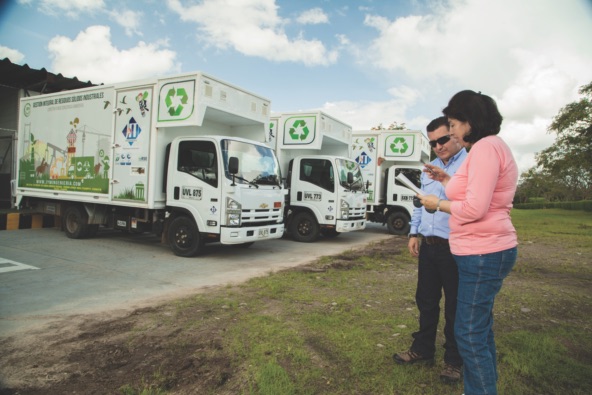 A FUNDES consultant (left) advises the owner of an industrial waste management business in San José, Costa Rica, in 2017. (Photo courtesy of FUNDES)
The management team decided on two critical responses: First, to reduce costs, FUNDES reorganized its country units into a centralized, hub-based structure. The majority of staff would work in Costa Rica and Mexico and focus on projects with cross-country synergies. Second, to enhance scalability, FUNDES started experimenting with new technologies and business models to reach more MSMEs without sacrificing social impact.
During this time, FUNDES’ leaders decided to focus on customer value—determining what clients needed and what they were willing to pay for it. However, Torres also drove FUNDES to make the organization far more efficient. He closed several offices to streamline operations. For Torres, FUNDES’ core competency involved creating project pitches, selling them to clients, and implementing them through local project managers. He described this period as a “search for pain in the market,” seeking out issues FUNDES could help MSMEs address while making a meaningful impact on them. “The truth is that all of this was gradual, the regional reorganization,” Torres says. “Today we only have one managing director for all regions.”
To further streamline their operations and better serve their clients, FUNDES embraced digital solutions, identifying new opportunities to create impact while maintaining its financial sustainability. FUNDES’ leaders deemed the monetization of its core knowledge—data on MSMEs, which would be crucial for analytics of supply-chain and distribution networks for big corporations—as especially promising. But such a change to FUNDES’ business model would require new agreements and new partner firms. Its leaders engaged in heated discussions on whether the digital future was the right path. But they ultimately agreed that they had little choice: They had to embrace the new digital model if FUNDES wanted to continue to serve its mission.
In one of the first new initiatives, FUNDES created a platform in Central America to geo-locate mom-and-pop shops, providing them with consulting and logistics support. The platform also generated market insights for larger clients working with small retailers. At the same time, Elfid Torres led brainstorming sessions on the future of FUNDES. Armando Moguel was added to those sessions to innovate the organization and its operating model. Torres found that adding Moguel was “like a reagent that you add to another static fluid”—he helped catalyze an abundance of new ideas. In 2016 FUNDES launched a unit called the “Innovation Factory,” made up of a small team tasked with experimenting with digital strategies to leverage this new knowledge base. After two years, in 2018, the Innovation Factory evolved into FUNDES Digital, a separate legal entity led by Moguel.
During the height of the pandemic, as FUNDES’ leadership yet again debated the future of the organization, two young managers weighed in. “Why do we not become the Rocket Internet of solutions for micro and small businesses in Latin America?” they recall asking.
FUNDES quickly proved that digital tools were not only a way to earn money but also instrumental to continuing to serve Latin America’s MSMEs. FUNDES Digital launched Facebook-based communities for mini-store owners in several countries, including Peru, Costa Rica, Colombia, El Salvador, Honduras, and Chile. The groups served as a platform for FUNDES to provide free content and gather insights on MSMEs’ digital skills. Next, FUNDES launched an app called EntreTenderos, which delivered free business knowledge capsules to small-shop owners. Mini-grocery-shop owners in Colombia appreciated the help and rated the community highly on Facebook. Comments included: “Every video did help me a lot” (Roa Adrigarz), “Good advice on how to manage a store” (Simon Diaz Mora), and “What a good site. We needed it” (Alvaro Jaramillo Moreno).
FUNDES also began collecting and digitizing data for sale to fast-moving consumer-goods (FMCG) companies interested in better understanding the behavior of FUNDES’ retail network. However, the idea proved to be too challenging to implement—it was not technically feasible to constantly update the data on the MSMEs. By late 2019, FUNDES Digital had initiated a variety of projects. However, as is typical for such early-stage digital initiatives, they did not yield significant cash flow but rather depended on capital to grow. The funding for these initiatives was provided by elea Foundation as an impact investor and by FUNDES, which tapped into its strategic reserve.
During this phase of testing its digital bona fides, FUNDES’ partnership with elea evolved into a closer collaboration and joint development. While being a philanthropic organization, elea had always applied an investor logic, striving to establish initiatives that relieve poverty but can be self-sustaining in the long run. This experience was very helpful for informing FUNDES’ digital transformation.
“When FUNDES was building up its digital activities, there was the need to establish an early-stage investors’ logic,” Ackeret says. “That was entirely new to FUNDES and in some sense also to us, as we used to invest in later-stage entrepreneurial initiatives. I was impressed by the entrepreneurial mindset at FUNDES and how the top management was radically questioning their established model. There was a steep learning curve, which we at elea could support.”
In 2020, as FUNDES explored new business opportunities in the digital world, the COVID-19 pandemic struck. MSMEs in Latin America were hit particularly hard. FUNDES itself was forced to accelerate its transition toward a more integrated, digital-first, and virtual organization. In 2021, FUNDES launched Merkomuna, a digital platform for community-based group buying with small stores serving as distribution points. The new venture quickly showed potential by attracting investors and a sizable user base of shop owners: After two years of operation, it spun off from FUNDES Digital with a dedicated CEO and board of directors, which included seats for FUNDES and elea. Furthermore, Michael Jost, former CFO of Nestlé Mexico, became a board member and investor.
Jost had experience in FMCG and retail operations, including logistics, last-mile solutions, and the peculiarities of food products and their margins in value chains. He was convinced by FUNDES’ well-organized approach to developing the business. “They looked at 20 different models of how Merkomuna could work, and they did systematic benchmarking, in particular with Pinduoduo, a famous Chinese group buying site,” Jost says. “Based on this benchmarking, we concluded that the group buying model could be applied to small changarro stores [mini-supermarkets]. In Mexico alone we had a million changarros. … From my experience in FMCG, I knew that large corporations do not have this direct connection because it is too much of a headache to manage them.”
The platform raised $2 million in capital within 18 months and achieved annual sales of $1.5 million. All of this was achieved through serving only a part of Toluca, Mexico, where Merkomuna scaled quickly to serve 4,000 small stores. Despite such growth, however, Merkomuna never reached profitability.
“In the end we had scaled too fast, moved to a bigger warehouse, invested a lot in the app, integrated the back-office logistics, and hired too many people,” Jost says. The challenges of the capital-intensive model were further magnified by an operational disconnect between Merkomuna management and FUNDES leadership. Ultimately, Merkomuna closed in late 2023. Despite this setback, FUNDES learned a lot from the process and saw an opportunity to build on the insights gained; it formalized its venture-building approach by more systematically exploring, ideating, prototyping, and launching social ventures.
Institutionalizing Social Venturing
Back in 2020, during the height of the pandemic, as FUNDES’ leadership yet again debated the future of the organization in the face of a global crisis, two young managers, Solutions Manager Mauricio Ramirez and Director of Growth Corentin Larue, weighed in. “Why do we not become the Rocket Internet of solutions for micro and small businesses in Latin America?” they recall asking.
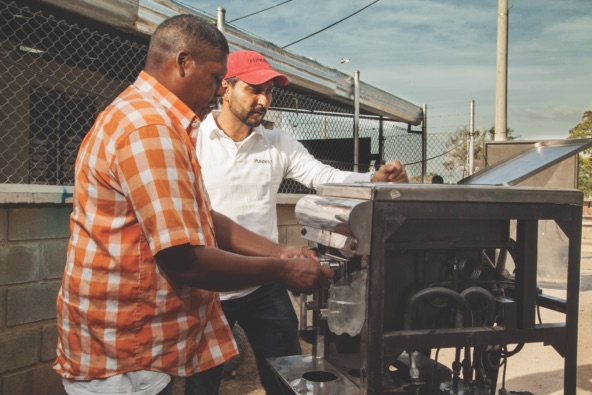 A FUNDES consultant (right) conducts a workshop with a small steel supplier in Ecuador in 2018. (Photo courtesy of FUNDES)
They were inspired by the business model of the German-based venture capital firm Rocket Internet, which specializes in replicating successful internet-based business models in emerging and underserved markets. Just as Rocket Internet launched e-commerce platforms such as Zalando in Europe and Lazada in Southeast Asia, Ramirez and Larue saw potential for a similar model in Latin America. “This came from the realization that we were working with micro and small businesses, and we saw more and more start-ups offering products and services to this audience that we knew very well,” Larue says.
The upshot of this rethinking was Fundamental, a social-venture incubator to launch solution-oriented businesses out of the project portfolio that FUNDES had developed. Once again, however, FUNDES had to figure out what this new venture’s trajectory would be. While FUNDES’ early digital initiatives focused on complementing and supporting its consulting model, building new ventures began to turn into an independent avenue for creating impact. Fundamental launched start-ups such as Simón, a software-as-a-service platform that allows large companies to train micro-entrepreneurs in the value chain or workers who serve these micro-enterprises via a TikTok-like video format; Voalá, a micro-franchising social venture supporting beauty salons in Guatemala by offering beauty professionals “a product marketplace to buy and sell, certified training and mentoring, and in-person community events”; Ékole, a healthy-snack enterprise connecting producers to markets; and Trófica, an end-to-end recycling service. Today, Fundamental has developed a robust portfolio of innovative solutions addressing the core business needs of MSMEs, such as last-mile delivery, e-learning, and micro-franchises.
Fundamental’s primary focus was on exploration and ideation. Once a venture concept showed promise, Fundamental looked for an entrepreneur to take it forward, offering a 30 percent stake that could grow to 60 or 70 percent over time. Fundamental’s goal was to launch at least one new social venture each year. After 18 months of incubation and venture building, projects would seek independent financing and further development.
“This is an ecosystem,” says Torres about the interplay between FUNDES’ consulting model and Fundamental. “FUNDES stays the organization that works with the MSMEs and the corporate world, but that also looks for what could be a social venture [for Fundamental]. Then, the [Fundamental] ventures can bring business to FUNDES and serve as examples of how the corporate world can integrate social value creation in their core and not only entertain CSR [corporate social responsibility].”
FUNDES is an exciting example of how difficult it can be to pursue a social mission over several decades. While its transformations have all turned out to be effective over time, the journey has been anything but easy.
FUNDES’ transformation into a social-venture incubator was facilitated through partnerships with an array of philanthropic investors, including Julius Bär Foundation, Leopold Bachmann Stiftung, and Argidius, as well as impact investors like Fourfold Foundation, GitLab Foundation, and elea. These funders not only contributed financial support but also helped implement the new operating model.
“In the beginning, there was a strong focus on strategy, and we have probably put too much emphasis on it,” Ackeret says. “In hindsight, we should have put extra emphasis on establishing reporting standards and financial transparency for investors. FUNDES has always been very professional at impact reporting. But reporting to investors is more about KPIs [key performance indicators] and proof points.”
In FUNDES’ previous transformation, CEO Torres hired business managers to replace philanthropy-focused staff. This time he brought on board individuals with entrepreneurial mindsets who wanted to develop their stakes within ventures and grow alongside them. To further this new model, FUNDES also promoted talent from within. This new generation of staff included leaders like Mauricio Ramírez, who became FUNDES’ new managing director in October 2023; Corentin Larue, who became Fundamental’s managing director in early 2022; and Maxime Braun, an experienced venture builder from Paris, who became Fundamental’s portfolio director in February 2022. Amicably described by Frei as “hipsters,” Fundamental’s teams gathered in Mexico City, a capital for digital nomads, working remotely from the managers on the ground who looked after clients in FUNDES’ core markets across Latin America. Located in its largest market, FUNDES’ Mexico City office has become its strategic hub.
Lessons From FUNDES
At FUNDES’ 40th anniversary party, different generations of FUNDES management met to celebrate their past achievements and envision a future for the organization. The evening captured the development of FUNDES: While each generation had faced and mastered unique challenges, all of them were united by the enduring mission of helping MSMEs bring prosperity to Latin America. FUNDES’ fidelity to its mission was confirmed by a recent beneficiary, Luis Antonio Tello, the owner of Shucos Estelita, a sandwich store in a low-income neighborhood in Guatemala City. “They helped me realize my dream for my whole family,” Tello said. “Thank you, FUNDES!”
Throughout FUNDES’ transformations, Frei maintained oversight, acting as the steward of the organization’s mission. Although FUNDES remained steadfast in its commitment to Latin American MSMEs, its definition of “impact” has evolved. In FUNDES’ early years, each employee could immediately see the impact he or she was having on MSMEs. In the second, consulting phase, the understanding of impact became broader and more complex, as it also referred to FUNDES’ large corporate partners. This complexity has gained even more momentum for the more recent social-venture initiatives.
“The more investors want to measure, the more we have to measure,” Frei says. “But those metrics don’t always relate to impact. For example, if 100,000 people use our app, we cannot assume that we lift 100,000 people out of poverty. This was different in the beginning of FUNDES, where we could directly see our impact for MSMEs.”
The FUNDES story ultimately reveals the conditions, opportunities, and challenges associated with the long-term pursuit of a unifying social mission under changing internal and external circumstances. First, it shows that realizing a long-term sustainable impact for society requires dedicated and very entrepreneurial managers. In the case of FUNDES, the entrepreneurial mindset is rooted in both its mission and the people in charge of driving this mission. FUNDES executives showed a flair for identifying opportunities, took calculated risks, solved problems creatively, persisted in the face of challenges, and exhibited a proactive and innovative approach to business and societal issues. For example, the first transformation into a shared value consultancy required the identification of a radically new business model where there were no role models on the market.
Second, FUNDES had to enter entirely new market domains to continue following its mission. Despite pushback from many employees, managers persisted and entered uncharted territory. During the first transformation, they began collaborating with large retail multinationals that differed dramatically from the MSMEs that were FUNDES’ prior customers. Similarly, the second transformation into a social-venture incubator brought again a new market logic and required FUNDES to manage a novel set of key performance indicators, such as user numbers, scalability, or cash flow.
Third, new market domains came with the need to embrace new stakeholder groups. FUNDES’ early days as a philanthropic organization required it to act very donor-centric and align to the vision and funding purpose of the donor. Foundations remain important today, but in different roles. For example, elea Foundation became more engaged than initial donors. However, complexity was rising with every transformation. As FUNDES is a shared value consulting firm, large corporations and governmental institutions had to be managed carefully without alienating the existing stakeholders. The latest transformation increased stakeholder complexity even further, with many more organizations involved. While before, there was typically one foundation providing financial support, FUNDES management now deals with boards of investors consisting of multiple foundations and funds. Also internally, FUNDES today needs to cater to very distinct demands, such as those of the IT specialists who require remote work opportunities and different incentive mechanisms than those of the frontline consultants working directly with MSMEs.
Finally, FUNDES is an exciting example of how difficult it can be to pursue a social mission over several decades. While its transformations have all turned out to be effective over time, the journey has been anything but easy. There were numerous drawbacks, challenges, and conflicts. The good news, however, is that the experiences and capabilities that the organization has accumulated over the last 40 years will likely help it to continue its transformation journey and defend its mission, whatever new challenges await on the horizon.
Read more stories by Tina C. Ambos, Alexander Zimmermann & Sebastian H. Fuchs.