


 Pixza’s Agents of Change, such as Ángel photographed above, are formerly homeless youth who work in the business. (Photo courtesy of Pixza)
In 2015, Alejandro Souza launched the Mexican social enterprise Pixza with a dual purpose. It was a hip, socially responsible pizzeria that offered gourmet slices with uniquely Mexican ingredients that became the talk of the town in Mexico City. But it was also a social reinsertion organization for the homeless youth of the city, who worked at the pizzeria while receiving services and learning valuable skills.
Souza weathered many challenges to create and grow Pixza. “An entrepreneurial roller coaster” is how he describes the experience. What sustained his effort was a commitment to Mexico City’s marginalized young men, something that had become the core of Pixza’s brand.
“People loved coming to Pixza,” Souza says. “It was a place where you could interact with our Agents of Change, which is what we call our employees. They would tell you about their lives, and you would live this empowerment story. It was a special place.”
As 2018 began, Pixza was on track to double its social impact thanks to new investment funding secured to expand operations.
Then in March 2020 the COVID-19 pandemic came to Mexico, and business collapsed. “Our sales went down 90 to 98 percent,” Souza says. “We basically weren’t selling.”
As the city locked down, most restaurants in Mexico launched massive layoffs to stabilize their businesses. Souza, however, knew they could not abandon their Agents of Change: “Pixza is always mission first, mission-focused, mission-driven.” But could Pixza’s commitments be sustained during a once-in-a-lifetime pandemic?
Over the ensuing months, Pixza’s leadership pivoted repeatedly to preserve the organization’s commitment to Mexico’s socially abandoned young men. Through sustained social innovation, Pixza evolved its business model not only to maintain its commitments, but also to scale them up for a postpandemic future. Its story highlights the power of purpose to fortify a social enterprise through even the most challenging crises.
An Idea at the Bar
“I’ve always been a social entrepreneur,” the 35-year-old Souza says. “It’s always been a passion of mine to seek out models that sustainably drive change.”
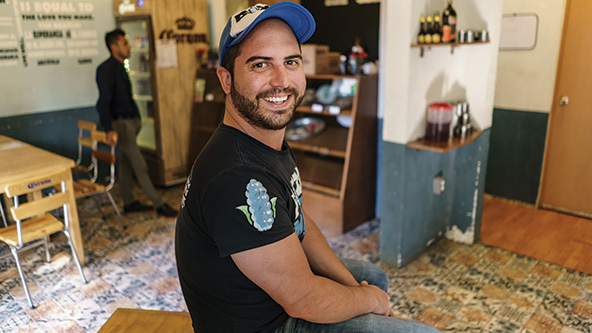 Pixza’s founder Alejandro Souza combined an idea for gourmet pizza and a social commitment to help the homeless. (Photo by Marcus Yam courtesy of Pixza)
Born to a middle-class family in Mexico City, Souza moved to the United States when he was two and returned to Mexico when he was nine, around the time his entrepreneurial father launched Mexitlán, an educational theme park in Tijuana devoted to Mexican culture and history. This background gave him an interest in entrepreneurship and the empowerment it can provide.
The Oxford English Dictionary defines “empowerment” as “the process of becoming stronger and more confident, especially in controlling one’s life and claiming one’s rights.” Souza sees social entrepreneurship as more attractive than more traditional charitable aid or philanthropy because it empowers rather than creating dependency.
“Imagine you see someone who needs a shirt and you give them your own,” Souza says. “You feel good and the person that receives the shirt feels good. Imagine that you then receive a shirt from someone else. And so on. The problem is that, in the end, there is someone that does not have a shirt. So you actually feel good, but you have not solved the problem.”
In 2005, Souza undertook undergraduate studies at Babson College, a private university in Wellesley, Massachusetts, that focuses on entrepreneurship. Souza became one of Babson’s pioneering students in coupling business with social purpose.
After graduating in 2009, Souza participated in a series of social enterprise development projects around the globe, including Rwanda, Uganda, Bhutan, and Brazil. The projects enabled Souza to witness international development on the ground and interact with national development ministries as well as multilateral agencies such as the World Bank, the United Nations, and the Inter-American Development Bank.
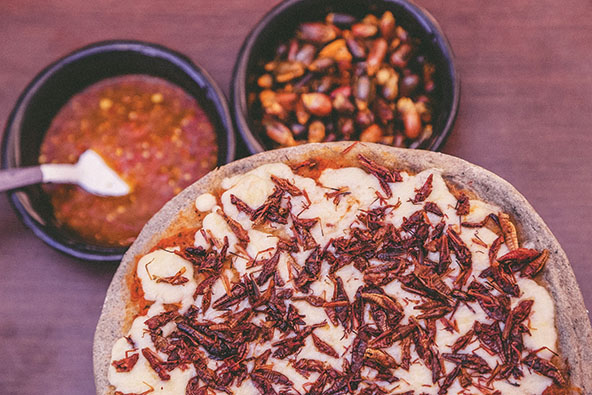 Pixza serves pizza with authentic Mexican ingredients such as blue corn meal, Oaxacan cheese, grasshoppers, and marinated pork. (Photo courtesy of Pixza)
These international and cross-sectoral experiences led Souza back to school, pursuing a master’s degree in international and public affairs at Columbia University in New York City. An assignment in one of his graduate classes turned out to be formative. The professor asked students to find someone in the city who had an amazing story, follow that person, and tell his or her story. That is how Souza met “Joe,” a homeless man who, in his 50s, had spent most of his life on the streets. Souza shadowed Joe for four months, learning firsthand about the homelessness crisis in New York City and in the United States at large. Souza became motivated to support homeless adults through social enterprise, a desire that would eventually be realized in his future pizzeria.
Around the same time, Souza had a chance meeting with a Mexican friend at a New York City bar. Their conversation predictably turned to a perennial topic of Mexicans living abroad: Mexican food. Souza loved New York’s pizzerias, with their giant slices, and began wondering out loud to his friend why there were no Mexican pizzas. The idea of a pizza restaurant that served up Mexican pies made with traditional flavors and ingredients took hold. With his recent time with Joe and his commitment to empowerment constantly on his mind at the time, his thoughts turned to marrying his pizzeria idea with his desire to help the homeless. By the end of the conversation, an idea crystallized, Souza recalls. “I will start my pizza place, and I am going to exclusively hire homeless adults,” he told his friend.
In 2015, after finishing his studies, Souza returned home to MexicoCity. He had been thinking through his idea and was ready to get serious. He gathered his savings and launched his social empowerment restaurant. He decided to call it Pixza, a humorous take on the way that many Mexicans pronounce “pizza” (“pic-sa”). His business model would integrate a profit-generating enterprise with a social support program aimed at providing social reintegration opportunities for Mexico City’s homeless populations.
A Social Project Within a Pizzeria
From the get-go, Pixza intended to generate positive social and environmental impact through both its products and processes. On the product side, Pixza sold innovative pies made from locally grown, organic, and traditionally Mexican ingredients. The crusts were made with blue corn, a culturally important grain indigenous to Mexico. Different pies incorporated such items as grasshoppers, tamales, chile poblano, Jamaica flower, chorizo, Oaxaca cheese, cochinita pibil, spicy meat, and even mole, a delicate sauce made from a host of spices and ingredients.
Because Souza at first did not know how to make pizza, let alone whether a blue-corn pizza was possible, he turned to his personal network for help, reaching out his grandmother’s former cook, Chayito, a woman who had lived with his family for many years. At that time, Chayito had left Mexico City, so Souza went to visit her for cooking lessons in Cuautla, a city two hours south from Mexico City by car. After spending an immersive 14 hours in the kitchen with her, Souza felt he understood how to imbue his pizzas with traditional Mexican ingredients and flavors.
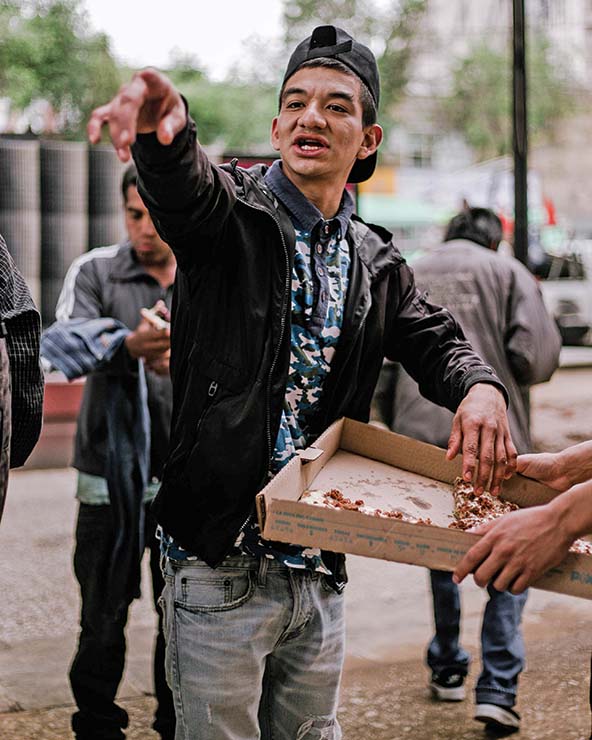 After completing Pixza’s program, Agents of Change, such as Tokio above, are offered jobs as managers. (Photo courtesy of Pixza)
But the pizzas, no matter how innovative, were merely a vehicle for advancing Pixza’s social purpose as the core mission of the company. Souza had integrated social impact directly into Pixza’s business by exclusively hiring young homeless adults from Mexico City shelters. An estimated 20,000 young people were considered “socially abandoned” in Mexico City, living isolated and often dangerous lives in shelters or on the streets. While public support programs existed, most addressed only partial aspects of the issue, such as health care or temporary shelter. By contrast, Pixza’s comprehensive approach invited young men to join its Route of Change program, which guided participants through a dignifying empowerment process that ultimately led to employment and self-reliance.
“The Route of Change is the process that the Agents of Change experience during their time at Pixza,” Natalia Pedroza, a Pixza manager, says. “It starts by learning new habits and the discipline to maintain a stable job. Then working on their professional and personal development to evolve and finally achieve an independent life. To be able to gradually improve the quality of life and have stability.”
Upon completing the 12-month program, participants receive a formal job offer from Pixza and officially become an Agent of Change. Pixza’s ultimate goal, however, is not for Agents of Change to stay on at the business indefinitely. Rather, as Pixza cofounder Raymundo von Bertrab explains, the enterprise seeks to “ensure that people in social abandonment arrive at Pixza and later leave for a better opportunity, achieving sustainable social inclusion.”
Pixza used a “buy one, give one” model to recruit new Agents of Change while connecting Pixza’s customers to its mission. Pixza workers would deliver a free slice of pizza to a person on the streets for every five slices bought by customers in the restaurants. Pixza linked its clients into the empowerment process by inviting the person buying the fifth slice to write a personal message for the eventual recipient. This first free slice would be the homeless person’s initial contact with Pixza and offered an important early step of trust and interest in Pixza’s empowerment program. Through a series of steps—including a shower, a fresh shirt, a haircut, a medical checkup, and a life-skills course—Route of Change participants would gradually retake control of their lives.
“It is a program developed individually for each person, to help them in different areas of their lives according to their stage and needs, covering areas such as work, education, self-esteem, finances, independent living and so on,” says project manager Regina Medina Mora. Upon graduating from the program, participants received a formal job offer to work for Pixza as a manager, having previously covered entry-level positions such as cashier and server.
Pixza was a hit with Mexico City’s foodies. Customers would often line up down the street waiting patiently for a slice of pie. The international restaurant rating site Restaurant Guru ranked Pixza as the eighth-best Mexican restaurant out of 17,149 in Mexico City. And customers were drawn by both pizza and purpose.
“Pixza is one of the few restaurants with a cause in Mexico that seeks to work as a platform for social empowerment,” one customer wrote on the site. “In addition to sharing a menu of exquisite pizzas with very Mexican flavors, their establishments have the purpose of being an inclusive movement, employing only people with a profile of social abandonment.”
Following up on his successful launch, Souza moved quickly to open a second and then a third location in the Mexico City neighborhoods of Roma Norte and Bolívar. With a full staff of seven managers and three successful operations, Pixza was poised to substantially scale up its impact. However, while Pixza was creating value for many of its stakeholders, a looming crisis threatened the sustainability of its business and mission.
Sustaining Purpose in the Pandemic
Pixza’s business model had cleverly tackled two of the common challenges facing social innovators: sustaining and scaling impact. Pixza did this by incorporating its target beneficiaries—homeless youth—directly into the business. As employees, they were an indispensable part of Pixza’s business operations, which guaranteed that impact would be sustained as restaurants succeeded. Furthermore, the impact would scale up as new locations were added, and the chain of restaurants grew.
“The model is designed that way because if we make more money, we automatically generate more impact,” Souza says. “To sell another pizza, I have to hire someone else to create those pizzas and as long as we continue to exclusively hire previously homeless young adults, the impact follows the sales. We cannot escape the impact.”
The ability to build impact into the business model differentiates successful social enterprises from more traditional corporations taking on social impact initiatives. For many established corporations, sustainability efforts are created to redress social and environmental costs arising from the company’s core business activities. While business corporate social responsibility (CSR) initiatives can create social and environmental value, they are not directly integrated into the business, and so impact can be tenuous. In effect, companies through CSR subsidize the creation of social value. If leadership changes, if market conditions deteriorate, or if any number of other business challenges arise, companies tend to cut back on social subsidies because they are outside the business model.
“Pixza is a 100 percent social company, not a socially responsible company,” says Luis Alonso Castellanos, head of Verne Ventures and professor of entrepreneurship at the Instituto Tecnológico y de Estudios Superiores de Monterrey. “This means that its economic sustainability and social impact depend fundamentally on its business model.”
The COVID-19 pandemic tested the core of Pixza’s business model. As Mexico City began locking down in March 2020, restaurateurs responded to the dramatic drop in revenues by laying off employees as the easiest way to cut expenses. Pixza faced the same challenges as its hospitality sector peers, but it would violate its social purpose if it chose to shed employees.
“We had a burn rate of three months,” Souza says. “So, the first and most important decision was that we’re not going to fire absolutely anyone. That’s where the mission comes to play because you can say it all day long, but you’re tested when you’re hit with a pandemic. You need to decide whether or not you’re going to live it.”
The pandemic was a health and economic crisis that put Pixza’s Agents of Change, the enterprise’s target stakeholders, at their most vulnerable. This commitment to purpose may have closed off the path that the restaurant industry took to survive, but it powered Pixza’s intense effort to preserve and sustain itself through the crisis.
“During the pandemic, what led me to do everything possible for Pixza to survive was the fact of knowing that there were people whose lives practically depended on Pixza,” Pedroza says. “Our Agents of Change were giving it all the desire in the world to get ahead, so we had to put in that same desire for Pixza to survive.”
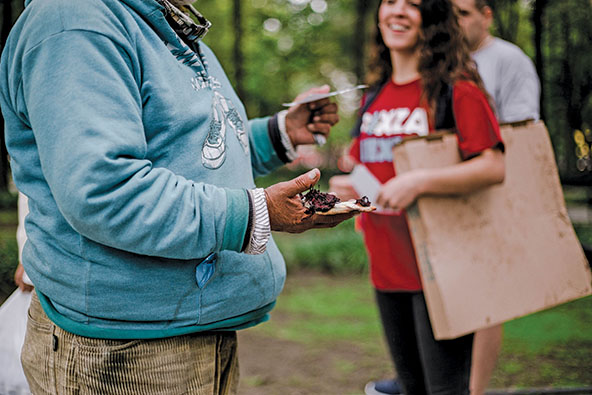 For every five slices purchased by customers, Pixza gives a free slice to a person on the streets who might benefit from its program. (Photo courtesy of Pixza)
Monetizing Purpose to Preserve the Business
Pixza’s commitment to its Agents of Change prioritized them as the focal point of the enterprise. However, Pixza’s employees were not the only stakeholders to see value in Pixza’s purpose. Many others were drawn to the business and its mission, including customers and investors. Pixza’s leadership sought to tap into these stakeholders for a lifeline that could sustain them through the pandemic.
Fostering positive social and environmental impact can create both tangible and intangible types of value. Tangible value, of course, is the easiest to manage, because it can be quantified and inventoried. Monthly revenues and assets such as restaurant equipment can be tallied. So can the growing number of young men who had moved from the streets to self-sufficiency. But social impact can also create intangible value, something that tends to be less understood by business leaders.
While corporate finance defines intangible value as nonphysical assets such as goodwill or brand recognition, where is this value stored? Intangible value primarily resides in the heads of stakeholders. The value exists in the perceptions that people have, both positive and negative, of a company and its products. The ability to mobilize and monetize this intangible value is important to the ongoing success of many businesses. How does this intangible value get turned into tangible business value? In the case of a brand, it happens when a customer’s positive perception of a company and its products leads them to purchases. But there are other ways that enterprises can convert intangible value into tangible value.
Pixza, for example, creates tangible benefits for its Agent of Change in the form of training, psychological support, and skills for a successful career beyond Pixza. But Agents of Change also develop an intangible perception about Pixza that goes beyond the tangible benefits they receive. While it can’t be measured directly, some of this intangible value materializes for Pixza in the form of employee loyalty, which can be tangibly seen in employment statistics.
“Turnover is significantly lower, so that means it’s a lot cheaper to hire the kids, despite them having a much more challenging profile,” Souza says. “And that’s because of what we do. Pixza is an empowering place for our Agents of Change.”
One of the biggest expenses in the restaurant and hospitality sector is the cost of recruiting, training, and retaining employees. In Mexico, the average employee restaurant turnover is around 138 percent, which means positions are turning over multiple times each year. By contrast, Pixza’s turnover is only 70 percent, which means employees are twice as likely to stay longer and be more loyal to Pixza. This is impressive for the restaurant sector, and even more so considering the challenges that Pixza’s Agents of Change face. Through their commitment to staying on with the franchise, they reaffirmed the value that Pixza purportedly created for them.
Souza and his colleagues found other avenues to mobilize intangible value in ways that supported Pixza through the pandemic. An opportunity arose early in the crisis as Souza deliberated with the company managers about what to do.
“At the beginning of the pandemic, we had to sit down with our managers,” Souza recalls. “We said, ‘Listen, this is the situation. We’re not asking you to do anything that you don’t want to, but we’re allowing you to help us out if you want to.’ And it was amazing. Many of our managers said, ‘Don’t pay me my salary until you can.’ Many of them cut their compensation by 50 percent, and it was completely voluntary. So that was beautiful.”
While managers were forgoing their tangible financial compensation, they were continuing to receive the intangible benefit of supporting and contributing to Pixza’s mission when the company needed it most. Manager Edgar Garcia Roble explains the concessions in terms of organizational purpose: “I believe that Pixza was born to show the world that all is not lost with humanity and with our system and that there are thousands of sustainable ways to help each other.” Psychologists refer to this type of intangible value as psychic compensation, which is the positive perception and feelings that people gain from contributing to missions they believe in.
The managers’ concessions provided moral support and some financial easing, but Pixza needed more help. So, Souza reached out to another stakeholder group that was receiving intangible value from Pixza’s mission: its customers. While they gave the company’s pizzas rave reviews, they also valued Pixza’s social purpose.
“Today I had the opportunity to visit Pixza,” one customer on Restaurant Guru wrote. “What admiration for their social project! The delicious food and the Agent of Change who attended us were incredible. What a work ethic and the INCREDIBLE customer attention! I hope to visit more often. Many congratulations and again THANK YOU!”
To give customers a chance to demonstrate this stated support, Pixza created an online digital platform that enabled people to offer various forms of financial assistance. Clients could purchase coupons to sponsor individual Agents of Change or to buy pizzas in advance that could be redeemed when the pandemic subsided. Pixza also created a series of branded products for purchase, such as coffee mugs, hats, and T-shirts.
“We were the first company in Mexico to mobilize people to help in any way that they could,” Souza says. “We put up a digital platform where people that love the brand and mission could support us. Basically, it was a monetization plan, a monetization platform, that gave us three months of life.”
One product that exemplified the value of Pixza’s purpose was a book written to tell the behind-the-scenes stories of the company’s Agents of Change as they moved from life on the streets and into their apartments and a stable livelihood. The book was written by the managers of Pixza based on interviews with the Route of Change participants documenting their stories over time.
Because their ability to sell pizzas through their restaurants had been foreclosed by the pandemic lockdowns, Pixza further reached out to its customers to develop a pizza distribution system. Pixza began producing individually wrapped frozen pizzas and invited customers to buy them in bulk at wholesale prices and then resell them in their neighborhoods to friends and family. “We mobilized a community of our fans and our supporters, not charity-wise, but to become part of our revenue engine,” Souza says. The distribution of Pixza’s pies expanded to 10 states and 13 different cities in Mexico.
While the three-month lifeline was a huge improvement, it would not be enough to sustain the company through the restructuring needed to pandemic-proof the business. So Pixza again sought to leverage the intangible value of its mission and purpose by reaching out to investors. While few investors were looking to risk their funds during the pandemic, especially in the restaurant business, Pixza was not just offering financial returns. As Souza says, they were “selling the mission hard because that’s what we do. That’s also being very honest and saying, ‘You’re going to help us. Your money is not going to help us grow, but you’re going to help us survive.’”
The pitch worked. Investors were willing to fund the survival of Pixza and its mission. Two investors, Aldo Andrés Saucedo Gómez and his wife, Arabelia Ivette Barrios Leal, highlighted the importance of Pixza’s social value in their decision: “We can’t really measure our ROI [return on investment] only in economic value. We also take into consideration the social impact, all the people that go through the program and finish it. We are sure there is a lot of talent on the streets, and we feel the urge to help to provide opportunities for them. We are confident that Pixza gives them those opportunities.”
Pixza’s managers and owners were elated. “Imagine getting two new investors in the thick of the pandemic when you’re basically telling them, ‘We don’t know if we’re going to make it,’” Souza says.
Pivots and Purpose
By monetizing intangible stakeholder goodwill, Pixza had created a lifeline long enough to allow them to rethink the business model. With the additional time, Pixza made several important pivots. First, they began by shifting away from a location-based business model not only for pandemic resilience, but also for scaling. While impact scaling was built into the original business model, such growth was merely additive: Tack on one more restaurant to the chain, and you add one more staff of Agents of Change. While this was a good model, was it the best way to scale impact? This approached focused on tangible value by investing in new physical locations. But could Pixza find a way to scale impact on a multiplicative or even exponential level?
One possibility was to franchise the model. Souza did not need to rely solely on Pixza to fund the new tangible locations; he could instead expand impact through Pixza’s intangible know-how—its proprietary “Purpose IP”—by sharing it with others. “We have a lot of interest from people that really want to take Pixza to their cities, and we’re going to help them do that,” Souza says. “We’re going to start franchising the model. It’s a hybrid model where we basically control who goes into the business, but they run it by themselves.” According to this plan, Pixza would stay involved in identifying and training Agents of Change while the franchisee focused on day-to-day operations. “We have a key hire for that, and they’re basically prepping the company so that we can start signing our first franchises by the end of 2022,” Souza says.
The other important pivot to ensuring ongoing scaling of impact was entering into retail. “We realized that the only real lines of business that were going to grow were going to be retail,” Souza says. “It’s basically getting our frozen pizzas into the homes of as many people as we can by taking products to big retail partners like Walmart. And we are revamping our operations so that we can sell more pizzas and have to hire more young adults to create those pizzas.”
Pixza is also leveraging its mission and social purpose to pursue the retail partnerships needed to expand distribution. In 2021, the enterprise began reaching out to purpose-driven companies such as Ikea, because, as Souza says, “they’re super mission-based and values-focused.” Early agreements were concluded with several Mexican food distributors, including Adama, Hadasa Gourmet, and Mora Market—outlets that had similar business commitments to sustainable and equitable practices. At the time of this writing, all of these projects were in their early stages, but the Pixza team was optimistic about their viability and impact-driven value.
These pivots opened new business directions for Pixza that would diversify and scale impact. But, as Souza says, “we realized that we had another product.” The Pixza team began to see that the enterprise’s value lay not only in its restaurant-based business model but also in the accumulated know-how that the company had developed about moving at-risk youth off the streets and into gainful employment. If this know-how could be repurposed, it could be used to create an entirely new business line based on the Route of Change program.
“We saw it wasn’t just only our pizzas, but our empowerment methodology that was the core of the social value Pixza was creating,” Souza says. “It was intellectual property.” Not only would this tack help pandemic-proof Pixza’s social purpose, but it would also be a powerful way to leverage their know-how to scale impact.
The initiative aligned with emerging societal trends that were making corporations receptive to Pixza’s model. In response to a wave of anti-discrimination social movements—including Me Too and Black Lives Matter—companies were becoming sensitive to issues of diversity, equity, and inclusion and had begun searching for ways to align their operations with societal expectations. Several companies in the restaurant industry and elsewhere were making public commitments to become inclusive enterprises. However, most did not know how to develop an inclusive culture that could empower marginalized communities and contribute to social change. Fortunately, these were the exact competencies that Pixza had been developing for the last four years. “Pixza had validated that inclusion is good for business and that it works,” Souza says.
Pixza developed the idea into an inclusive organization certification program that would offer companies the needed know-how to hire, train, and support Agents of Change in the way that Pixza had demonstrated was effective. The certification would provide access to Pixza’s tools for supporting multidimensional employee well-being. The companies could use Pixza’s evaluations and guidance to take on socially disadvantaged employees and provide the support needed to help them achieve self-sufficiency.
“We’re going to give them the exact same methodology that we used to become an empowering place and certify business owners as an empowering place,” Souza says. “Once they get certified, then they can start hiring directly from that same platform.” By sharing its methodology, Pixza was using its know-how to generate more employment opportunities for Agents of Change outside of its pizza business—something that, if successful, could dramatically scale up impact.
Fortunately, this initiative also aligned with an emerging trend in the training sector toward online workforce programs. The pandemic had forced many companies to move their business processes online, something that Pixza could take advantage of by creating digitized training programs. Souza foresaw an HR-type platform with two different interfaces. One would be oriented toward employers to get them certified as an inclusive enterprise. The other would enable their Agents of Change recruits to start their training in advance, even while they were in a homeless shelter.
“Our future employees can log on to our platform and take the entire training onsite, while being in their shelters, which will allow them to jump-start the empowerment program,” Souza says. “When they graduate from the online program, they will be eligible to be employed. So, it becomes an employment platform that culminates at the possibility of finding an offer.”
With this new concept in place, Pixza was able to separate the social impact from the pizzeria business and use it for further scaling. They imagined that the model could be shipped to any part of the world.
“If a firm wants to learn how to be an empowering and inclusive institution, it can receive the tools today and can start doing it,” Souza says. The new model moved beyond the demonstration stage when a middle-sized chain restaurant in Mexico signed on to fill a hundred new positions with Agents of Change in the coming year.
A Postpandemic Future
By focusing on its purpose and mission, Pixza moved on from the pizzeria model to establish several new lines of business that promised to shield it from the pandemic and dramatically expand its impact. But COVID-19 and the ripples it has caused are not over yet.
“We are still in this hell of a ride,” Souza says. “If we’re going to survive, it will be because we are resilient and very creative. But most importantly it is because we have kept our mission first. We’ve done all of these pivots to continue our mission. For the time being, we are happy where we stand. And we think we’re going to make it.”
Souza is not alone in his optimism. “We are confident that a lot of companies will join their initiative and will be looking to add value through replicating our business model, especially now that ESG [environmental, social, and governance] investing has become such an important trend,” married Pixza investors Gómez and Leal say. “We are sure that the company will keep growing in all its different business units. The company has the best team and business partners, which are the keystones for the success of the business.”
Pixza demonstrates the power that a compelling purpose can have when clearly understood and leveraged by an entrepreneur. The future of Pixza will be spreading its purpose beyond its own operations, something the company’s newest shareholders are betting on.
Read more stories by Gregory C. Unruh & Fernanda Arreola.