


 (Illustration by Diana Ejaita)
Two young children head to the market after school. They confidently read the board listing what’s for sale, place their order, and carefully count their change. On the way home, they chat about what they learned that day.
This is the dream. It’s a simple one: that all children go to school and actually learn—and that one day we will look back in horror on the fact that things were ever different.
The reality is far from it. In sub-Saharan Africa, only 1 in 10 children can confidently read the market board or check their change by age 10. At least 8 of those children are in school. Learning levels vary, but gaps are large and persistent across contexts. Despite countless reforms and inputs, including many millions of dollars in school grants, provision of textbooks, and new educational technologies, few initiatives have meaningfully improved foundational learning at scale.
How can this be changed? Mulago Foundation CEO Kevin Starr wrote in his 2022 SSIR article “Strategy: Go Big or Go … Oh, Just Go Big” that making any dream real starts with finding both a doer and a payer. Government, NGOs, and businesses are potential doers. Customers, large-scale foreign aid, and governments are the three potential payers at scale. But, as Starr has written more recently, sudden cuts to USAID and other aid programs leave fewer options. Across sub-Saharan Africa, governments already finance 69 percent of total education spending; this share will only grow as donor support declines.
The conclusion in this case may seem obvious: Drop everything and help governments deliver quality education. Yet examples of governments and partners scaling and sustaining effective solutions remain rare—within countries, and even more so across them. The question, then, is not whether to work with governments for enduring impact but how. How do organizations resist the temptation to design solutions in isolation and expect them to be effectively “handed over” to governments toward the end? How do organizations balance pressures to achieve milestones quickly with the need to support governments’ ability to succeed in the long term? And how do organizations reject a binary approach to evaluation that labels programs as either “success” or “failure” and instead embrace an approach of continuous learning and adaptation?
Teaching at the Right Level (TaRL) Africa, where I work, supports governments and their partners to apply the TaRL approach. Our mission is for public education systems to equip all children with foundational skills. We grapple with these questions every day.
The TaRL approach was first developed in India in the early 2000s by the education NGO Pratham to tackle the problem of children progressing through primary school without gaining foundational reading and math skills. Ambitious curricula and high-stakes exams encouraged teachers to teach to the top of the class, leaving many children behind. TaRL flips the script by asking a simple question: What can each child do today? Children are assessed; grouped by learning level, rather than age or grade; and engaged in targeted, playful instruction to build confidence and reading and math skills. Several randomized control trials (RCTs) show that, when well implemented, TaRL improves children’s learning outcomes and the children furthest behind benefit the most. The Global Education Evidence Advisory Panel (GEEAP) ranks targeting teaching by learning level, rather than grade, as a “great buy” for its cost-effectiveness and its basis in strong evidence.
While TaRL was developed in India with no agenda for global adoption, the simple approach addresses a challenge that is particularly common across sub-Saharan Africa. In 2015, the Zambian Ministry of Education was looking for ways to help children catch up on foundational skills. In response, J-PAL Africa shared evidence on what had worked in other countries. The government was most taken with TaRL. While there were key similarities in the causes of the learning crises in both countries, there were several contextual differences, like class size, language, monitoring systems, and other existing educational approaches and programming. We knew TaRL could not be copied and pasted from India to Zambia. It needed to be molded by the government officials who knew the system best and would be expected to take it forward. The Zambian Ministry of Education, Pratham, J-PAL, and partners VVOB and UNICEF cocreated Catch Up, Zambia’s adaptation of TaRL. Every decision—who should facilitate classes, who should mentor them, which grades to target, who should coordinate and manage the work, which classroom activities to use—was made jointly, drawing on global evidence, years of implementation experience, and local knowledge and priorities. Nothing was prepackaged or “validated” by the government—everything was designed together. The process became a blueprint for how TaRL Africa designs initiatives in collaboration with governments across Africa.
Catch Up grew quickly, with support from implementing partner VVOB, and ignited interest across the continent. TaRL met the “strategic triangle” of criteria for government scale. It was technically sound and backed by decades of rigorous research. It was politically supportable, as governments were recognizing the foundational learning crisis and the need for decisive action. And it was administratively feasible, introduced in ways that focused on what was practically possible within the systems that would need to run it. By 2019, Catch Up was scaling up to thousands of schools, and TaRL pilots had launched in Botswana, Côte d’Ivoire, Nigeria, and Uganda. The need for a team to support the effective adoption of TaRL was becoming more apparent. Pratham and J-PAL, with investment from Co-Impact, formed TaRL Africa, which spun off as an independent organization four years later.
Today, TaRL Africa and partners have reached more than seven million children with TaRL programming. Governments across Africa have shown they can effectively deliver the approach at scale, doubling or tripling the number of children able to read and do arithmetic in fewer than 100 days of implementation. Several countries are now approaching nation-wide implementation, and some are beginning to integrate program costs into their own budgets. While we still have a long way to go, there are strong signals that lasting education systems change is possible. On reflection, three ways of working, and some related principles for each, have helped TaRL initiatives gain sustainable traction with governments.
1. Start With Authentic Demand
Many education interventions are introduced through a single transaction: A donor articulates a need, and a provider—usually a winning bidder—delivers a predefined solution, often with significant time-bound funding attached. In such cases, governments may feel obligated to accept, even if the approach is not what they would have chosen or even if they are aware it is not likely sustainable after the withdrawal of external support. When the donor moves on and the provider exits, what remains is often a program that few on the ground asked for, believe in, or are prepared to carry forward.
 (Illustration by Diana Ejaita)
We have found that working with governments that voice a strong demand for TaRL is a useful starting place. Two conditions usually spark authentic demand at the early stages: a shared understanding of the problem, and firsthand experience of TaRL that demonstrates what’s possible.
In Zambia, the ministry of education began with an open acknowledgment: Many children were not learning the basics. This willingness to name the problem created space for new thinking. When officials visited Pratham in India and saw TaRL in practice, it became more than an abstract idea—it was something they could see and imagine adapting for Zambia.
In Côte d’Ivoire, demand was enabled through design. The Transforming Education in Cocoa Communities Initiative, a program initially financed by the Jacobs Foundation and aimed to improve the quality of education for children in cocoa-growing communities, allowed the government to test out several different approaches. TaRL was one of them. After evaluating the options, the government chose TaRL for scale—a decision rooted in seeing firsthand that learning outcomes were beginning to improve.
Nigeria followed a different process. After TaRL Africa and partners supported two state governments to implement the approach, the results were presented to other states across northern Nigeria, and TaRL Africa offered technical support only if there was interest. Several states responded by allocating resources and seeking out partnership. More recently, a learning visit to Kaduna, where TaRL is being scaled, sparked interest among additional states, several of which have now committed funding to begin implementation.
Relinquish Credit and Control
Hand in hand with this focus on demand is the need for a community of actors to get behind the approach, creating an enabling environment for the initiative to grow. Too often, organizations position themselves as the sole supplier of an intervention, branding it as “ABC’s XYZ approach.” Even when such a model is effective, its reach is constrained by the presence and bandwidth of the original implementer. Worse still, an insular approach often sidelines other actors within the education ecosystem, limiting the broad buy-in essential for lasting change.
Pratham took a different path. Their generosity and vision allowed us to use and adapt the TaRL approach, not as confidential content but as a public good. Flexible funding from groups like Co-Impact and Founders Pledge gave us the flexibility to respond to the needs of the ecosystem and enabled this same spirit of openness so that TaRL Africa could support not only governments but also a wide array of organizations to adapt and grow TaRL in their own contexts. We did not have to decline requests for support from other organizations because there was no corresponding budget line or because we had concerns about competition; our funding was tied to supporting the system. Since 2019, TaRL Africa has provided technical assistance (training, program design support, and ad hoc troubleshooting) to more than 75 organizations and ministries of education. The technical assistance is designed to help others think through what TaRL could look like in their systems, not just to replicate what has worked elsewhere.
In some cases, especially early on, it was challenging to let go of certain pedagogical aspects of the approach. On reflection, what was really needed was trust. Over time, TaRL Africa stepped back from some programmatic details and saw what could happen when others stepped forward. Organizations and governments innovated in ways that could never have been scripted, creating locally grounded versions of TaRL that were different but no less effective.
This growing community of TaRL implementers is now pushing the approach into new frontiers. The ministry of education in Côte d’Ivoire has fully integrated TaRL into its foundational learning strategy, including creating hybrid training models and starting to use the approach in preservice training at colleges of education before teachers start teaching. YARID, an NGO in northern Uganda, uses TaRL to help refugee children reenter mainstream education. The Japan International Cooperation Agency supported TaRL integration into national school management systems in Madagascar and Niger, building on its existing School for All initiative, which was operating at scale across several countries, to strengthen school-based management committees. Teach for Nigeria equips thousands of volunteers to use TaRL in classrooms. Building Tomorrow has embedded TaRL into its holistic school support model for communities in Uganda. Youth Impact, in Botswana, moved from direct delivery to supporting teacher implementation at scale, reaching the brink of national coverage.
None of these is a carbon copy—and that is the point. They are evolving, context-driven models, shaped by those who know their communities best. The willingness to share the TaRL approach, rather than guard it, has helped build a bridge between global research and local classrooms. It has kept demand alive—not just because learning outcomes improve, but because organizations and governments themselves become champions.
Maintain Demand
Initial enthusiasm, even when grounded in real interest, can fade without continued reinforcement.
One of the most powerful tools for sustaining demand has been visibility—of both the problem and the progress being made. A core part of TaRL is a simple, one-on-one assessment of foundational literacy and numeracy skills. The consistency of this assessment makes it possible for teachers, mentors, and policy makers to see change over time, from a child unable to read a letter to one reading full stories, or from one struggling with number recognition to one solving division problems. In systems where progress can be difficult to measure or where positive change feels elusive, this visibility creates momentum. It shows that improvement is possible and that our efforts are worthwhile.
Positioning government partners such that they can share their success has also enabled ongoing demand for the expansion of TaRL programming. As one of the earliest adopters, the Zambian Ministry of Education has hosted delegations from more than 20 countries to see Catch Up in action in the classroom. These visits have served a dual purpose—to inspire other governments while reaffirming Zambia’s own commitment to expanding the approach—and have been a source of local pride, hope, and motivation.
This dynamic reflects a kind of symbiosis between local leadership and global visibility. Recognition has followed Zambia’s progress through high-level political support from Zambian President Hakainde Hichilema, who was identified as Africa’s Foundational Learning Champion by the Association for the Development of Education in Africa. In this role, he has opened high-level policy forums on foundational learning and committed Zambia to elevating literacy and numeracy in Africa’s agenda.
2. Keep a Long-Term Perspective
The second key way of working for TaRL Africa has been to internalize the fact that complex challenges take time to fix sustainably. A 2017 study of 15 “world-changing” social initiatives, such as the eradication of polio and the adoption of child car seats, found that such transformations took 20 years on average to materialize, and some extended up to 90 years.
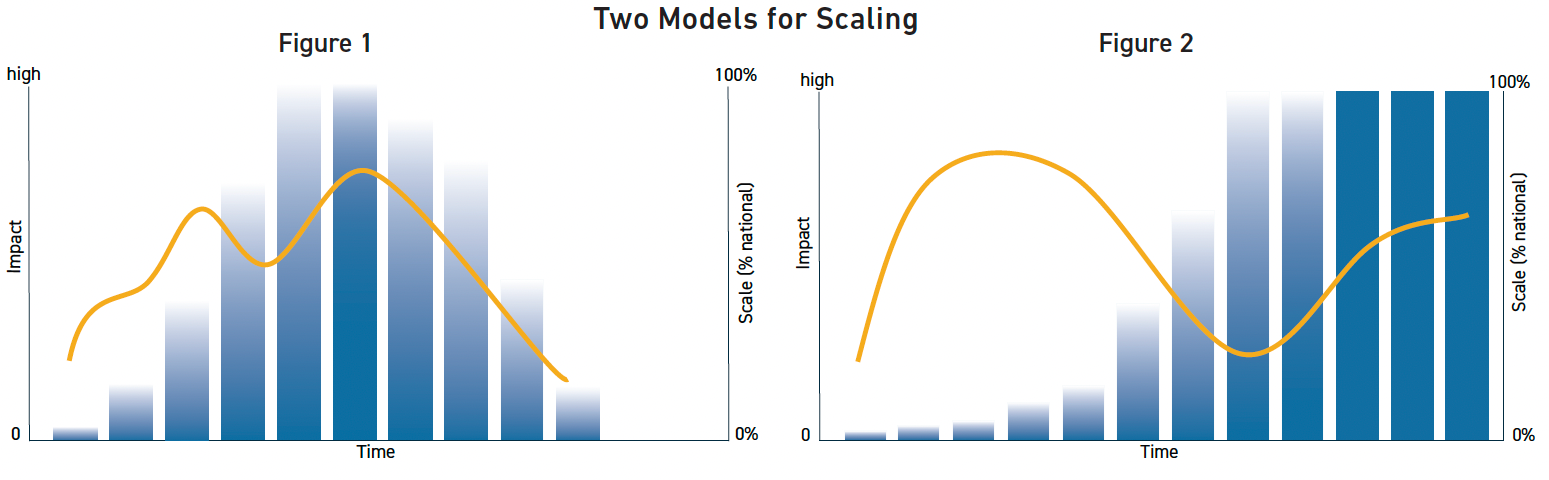 (Click to enlarge)
At a recent conference, coauthor of the study, Abe Grindle, director of programs at Co-Impact, presented two models for scaling innovations in global education. The first model, which describes the journey of many education interventions in Africa, involves innovations heavily supported by external partners. These initiatives can scale rapidly but often wane once funding ceases. The first graph above (Figure 1) depicts this pattern. The darkness of the blue bar indicates implementation quality, the orange line represents impact, and the height of the blue bar denotes scale.
In contrast, the alternative model (Figure 2) positions the government at the helm throughout all phases. While impact and implementation strength may fluctuate during scale-up, it ultimately strengthens at the national level when fully integrated into the system, as illustrated below. This second model is what we have in mind when we codesign and support TaRL initiatives. Several related principles make this long-term approach more likely to succeed.
Ground the Model in What Can Work Within the System
We work alongside governments to cocreate the program. We think together with officials about how the necessary components of TaRL can fit into existing systems, wherever possible, and about the minimum adaptations to the system that may be required. While we advise in this process, government officials are responsible for taking decisions from the start. Developing a program that uses existing effective systems increases the likelihood that the initiative is accepted by stakeholders and sustainable.
Before we initiate a program, we find it useful to invest time in listening and learning to grasp the system’s current operations. Comprehending both the formal roles assigned to various government levels and the actual roles they play, examining past reforms and programs to learn from previous successes and challenges, and understanding financial and human resource constraints are also important. This understanding informs how TaRL could integrate within the existing landscape, what contextual adaptations may be necessary, and how it interacts with different system components.
This is not a one-off exercise; perfect integration may not be possible from the onset, but it can be something people work on over time. In Zambia, when we first collaborated with the ministry on assessment data collection and aggregation, we understood that the existing system was paper based, so we codesigned a paper-based system. It was slow and cumbersome. As the program grew, continuing with such a model became untenable, so we agreed with the ministry to create a new data portal to help manage the scale-up phase. This was a necessary move, but suboptimal, as it was not fully integrated into the system. However, 10 years on, the ministry systems have progressed, and we are exploring ways in which we can create one fully integrated system.
Support Government Officials to Learn by Doing
If approaches are ultimately going to be run independently by governments, they must learn how to manage and adapt programs. This means supporting government officials at various levels to oversee delivery, rather than doing it yourself—building capacity, not substituting for it.
For TaRL programming, this includes responsibilities such as school mentoring, planning, budgeting, logistics, meeting coordination, reporting, and making strategic decisions like prioritizing particular schools or districts. As officials engage in these routine but vital activities, they develop skills essential for coordinating programs at scale. This gradual skill building can be more effective than expecting officials to manage large-scale programs without prior experience. By making and communicating decisions, officials gain insight into the rationale behind choices, fostering accountability.
This approach involves trade-offs, particularly in the short term. Government processes can be slow, and skill acquisition takes time. But this gradual skill building can be more effective than expecting officials to manage large-scale programs without prior experience. As programs scale, oversight approaches may evolve. In Zambia, initial coordination by a single, national-level official transitioned to a broader committee called the Catch Up Coordinating Committee, comprising officials from various directorates to enhance governance as the program expanded.
Keep Costs Affordable for the Government (or Have Plans to Make Them Affordable)
Understanding a system before codesigning a program can help clarify constraints, notably cost. TaRL Africa aims to ensure that the long-term costs of the program are affordable and to help the government integrate these costs into its budget. While we don’t yet have an example of a government that has fully integrated the operating costs for TaRL into its routine budgets at scale, signs that this may be possible in the future exist, although the pathways toward sustainability may look different across contexts.
We have seen three different pathways emerge across the countries with which we are working most closely.
1. Government funds from the start, using domestic revenues. In Nigeria, several states have funded TaRL programming from the onset, partly through a government financing mechanism that allows state governments to apply for federal funding if they’d like to introduce a new approach. This pot of funds can be allocated across states for things like materials and training. This is a helpful internal mechanism for state governments to have the flexibility to adopt new things. The advantage of government funding from the start is that officials at all levels of the system are more likely to understand the program as a government priority. The challenge is that funds are often limited and can be delayed, which may compromise the quality of programming or slow down growth.
2. Government has access to external resources (Global Partnership for Education or World Bank projects) that can be allocated to TaRL implementation costs and chooses to do so. In Côte d’Ivoire, the government is using World Bank and Child Learning and Education Facility funding to support the national rollout of its foundational learning strategy, which includes the TaRL approach. This practice can be helpful where domestic funding may not cover the higher initial scale-up costs. It may also help governments to understand the costs of the program, which may assist with integration into domestic funding in the longer term. But there can be drawbacks: Sometimes the funding is allocated for a fixed period of time and may require national reach, resulting in rapid scale-up without time for learning and adaptation.
3. Government relies on external funding, managed largely through NGOs, to implement TaRL, with the expectation that costs can be integrated. The risks with this pathway are that the program is seen as a donor project and that it often runs into challenges with integrating these costs into government budgets. However, it may be necessary for countries with fewer resources that simply don’t have the funding to start and scale a TaRL initiative but that may have the funding to sustain one. After initial scaling, running costs typically decrease to 25-33 percent of the scaling-phase expenses. In Zambia, for example, the cost during scale-up was $5.83 per child, while the projected nationwide running costs are less than $2.
For any of these pathways to have a chance at achieving long-term sustainability, it is helpful to collaborate with officials during program design and implementation to identify cost-saving measures, such as adjusting materials or training methods. Even when costs are affordable, supporting officials to integrate these into budgets can take time. We’re still learning, but we predict that this step will require collecting evidence to support budget advocacy, better understanding the timing of budget processes, building a coalition inside and outside the government who will advocate for the program, and likely some luck.
Stick Around When Things Get Tough
Supporting a public education system to integrate TaRL is not a linear process. Critical aspects like funding and government commitment can rise and fall over time. We set out to be a long-term partner who will work alongside officials, adjusting our role as the environment changes. One example of this dynamic is what happened in Zambia. USAID was a key partner in scaling up the Catch Up program to about 2,000 schools between 2018 and 2020. In 2021, USAID was discussing a further expansion with the ministry of education but later withdrew this possibility of support as the US budget shifted to other priorities. TaRL Africa worked with the Zambian government and partners to maintain momentum without those funds by continuing to provide technical assistance while working closely with VVOB to identify other sources of funding. Ultimately, other funders came forward, and the program has now scaled to more than 6,700 schools, more than 60 percent of schools in the country.
Government commitment can also change over time. In Nigeria, the Kebbi State government funded a pilot in approximately 100 schools in 2021. Following positive results, the state sourced federal funds to expand to more schools. However, a change in state leadership led to a change in priorities. We continued to support the existing schools implementing TaRL while engaging with the new leadership and demonstrating the effects of the program. We believed the state was capable of sourcing additional funds, so we did not seek external funding. Now, in 2025, state officials are working toward future expansion.
3. Focus on Continuous Learning
A key reason for TaRL Africa’s existence is the rigorous evidence behind it. Prior to TaRL Africa’s creation, seven RCTs demonstrated that effective implementation of TaRL led to significant improvements in learning outcomes in India. The underlying principle of tailoring instruction was also proven through RCTs in Africa, including the evaluation of an initiative in Ghana and a streaming study in Kenya. As the adoption of TaRL has grown, data has remained at the center of TaRL Africa’s work, although what is collected, how it is interpreted, and what is done with it have evolved, guided by a couple of key ideas.
 (Illustration by Diana Ejaita)
Prioritize Data for Government Use
As with many of the principles described above, positioning data as a tool that governments can own and use to improve their programs, rather than something that “evaluates” them, has been critical.
Many governments collect data based mainly on inputs, such as infrastructure or textbooks, through their own systems. Data on learning outcomes are often gathered separately by projects or large-scale assessments, usually conducted by external enumerators every few years. In TaRL programs, teachers use the results from their one-on-one student assessments to group children by level and immediately adapt their teaching. They then share these classroom data across the system to guide decisions, from what teachers focus on in lessons to which schools need mentor support to where governments should allocate more resources.
In government-led TaRL programs, the goal is to integrate learning-outcome data into existing government systems. We codesign simple tools and processes with government teams, tailoring them to local contexts and systems and processes that already exist, as much as possible. In some countries, when tablets already exist in schools, head teachers enter results directly into an app; in others, they pass paper summaries to mentors who upload them to a simple platform on a laptop. Across contexts, the focus is on ensuring that government staff—not external actors—are the ones assessing, collecting, analyzing, and using the data, and that, where possible, they are leveraging what already exists.
This approach can trigger two big shifts:
- Government doers, not external evaluators, are empowered with data.
- Action centers on children’s learning, not just inputs.
In Zambia, head teachers often begin discussions about TaRL by referencing data. During a visit to Mfuwe, in Eastern Province, the district office linked Primary School Leaving Examination results to Catch Up learning-outcome data. In Nigeria, government officials have shared that TaRL data have motivated state governments by highlighting areas needing improvement and making progress tangible. Similarly, the Côte d’Ivoire government has integrated TaRL assessment results into its standard statistics booklet to be a national performance indicator.
Collecting additional data for continual improvement through external mechanisms can also be useful, as long as those team members don’t substitute for government responsibilities. This can mean collecting data with an NGO or research firm to ensure the quality of government learning-outcome data, to measure the effectiveness of our support, or to aid areas requiring further investigation.
Interpret Impact Evaluations as Only Part of the Puzzle
Randomized evaluations were a key part of why TaRL Africa was founded and remain a key part of our strategy. Today, many more impact evaluations of government-led TaRL programs in Africa exist than when we began. Yet RCTs are most useful if interpreted as only one part of the puzzle. We have found the following questions helpful in interpreting results.
Where was the government on its journey to national scale and systems integration? Government-led RCTs in Africa roughly map to Grindle’s S curve described above (Figure 2), which gives us some benchmark for what we should expect to see. Early-stage impact evaluations find lower impact than programs in their second year that are not yet scaling substantially, while evaluations of programs that are scaling up more rapidly saw impact measures drop, to varying degrees.
What was happening in that context at the time of the evaluation? All the studies of TaRL in sub-Saharan Africa to date are anomalous in that they were evaluated either during or in the immediate aftermath of the COVID-19 pandemic. In Kano, Nigeria, despite implementation being designed for more than a year, children received only seven months of implementation because of COVID-related school closures. While one initiative that was evaluated in Côte d’Ivoire didn’t suffer from school closures, it was implemented in a region outside the country’s core TaRL programming and therefore received less support from the government.
Who benefits most from the intervention? One striking and consistent finding is that the children who benefit the most from TaRL are those at the bottom of the learning distribution. This finding is significant, as many foundational learning initiatives tend to impact children in middle to upper performance brackets.
How can we use this information alongside other information to make positive shifts? Once you have the necessary framing, evaluations can be used as opportunities for learning and program enhancement. In Nigeria, the Kano evaluation revealed substantial results for mathematics, modest positive effects for Hausa, and no significant outcomes for a newly cocreated dual-language English approach. These findings prompted us to reassess and reshape our English language-learning strategy into a new approach that has now been adopted more widely across Africa. More recently, results from Côte d’Ivoire indicated that TaRL’s impact was concentrated at foundational levels—children effectively learned letter/number identification and decoding skills but made limited progress in reading comprehension and arithmetic. These insights have raised critical implementation and design questions, which we are exploring before the next scale-up in the country.
Looking Ahead
Kevin Starr’s final step for achieving a dream is the set of activities required for the “big shift” that sustains acceleration toward ambitious goals. Across Africa, the TaRL movement already shows signs of such a shift. Governments and NGOs are growing TaRL within their contexts and are enabling others to do the same, while champions across philanthropy, research, and policy are driving collective action to expand it further.
Some countries—such as Côte d’Ivoire, Zambia, and Nigeria—are even closer to making the big shift as they move toward nation- or statewide scale. Côte d’Ivoire and Nigeria exemplify governments moving toward becoming “payers at scale”; both have underway policy discussions to embed TaRL in the core of their education systems. These transitions matter. They determine whether millions of children will benefit for a limited period or whether hundreds of millions will gain foundational skills for generations to come.
For this transformation to endure, TaRL cannot remain a standalone program. It must integrate seamlessly into the way governments deliver foundational learning. That requires grappling with the broader architecture of education systems:
- Teacher training must embed TaRL principles into preservice preparation and continuous professional development, reducing reliance on costly add-on training.
- Assessment systems must align around streamlined tools that capture foundational skills without overburdening data systems.
- Curricula and pedagogy must connect across the full journey of a child in school, ensuring children do not fall behind early and that instructional methods reinforce, rather than contradict, one another.
These changes must occur without any loss of the essence of what makes TaRL effective. Full integration of TaRL principles into all parts of the system will require even more flexibility than the early ways of working. This transition is scary, but it holds the promise of transforming not only specific classrooms but the way entire systems approach teaching and learning.
Starr also references “tech.” Technology changes all the time, so governments and their partners will need to consistently assess whether tech can boost effectiveness or efficiency.
Education systems regularly face change too: new curricula, revised assessments, and shifting priorities. A scalable, durable approach must be able to evolve. This means continually seeking ways to improve performance and reduce costs, learning from diverse contexts, and remaining open to new ways of thinking and working. It also means ensuring that governments have the muscle to navigate change too, without compromising effectiveness or sustainability.
We also cannot take for granted that the demand for foundational skills will endure among key country stakeholders: communities, civil society, and the private sector. Sustaining this demand is essential to maintaining, and ideally deepening, political commitment to quality education. Keeping that momentum alive requires broad stewardship: researchers who continue to generate and interpret evidence, funders who provide long-term support, and media who keep public attention on the issue. Together, these actors help ensure that the call for foundational learning remains a shared priority, not just a passing moment.
Ultimately, the path to enduring impact, for TaRL and for many other potentially transformative social initiatives, depends on governments’ being firmly in the driver’s seat. They cannot simply be passengers on reform journeys; they must lead them. The role of the broader sector is to enable this leadership effectively. Doing so may require partners to step back when governments step forward, accept slower progress in the short term to secure deeper ownership in the long term, and embrace the uncertainty inherent in systems change. Long-term, flexible funding that allows for government-driven and government-paced support is also necessary. Catalytic investments— such as the support provided by Co-Impact to TaRL Africa—create the space for adaptation, cocreation, and resilience.
The stakes are high. Achieving scale for a few years through external funding is not enough. For TaRL Africa, the true measure of success will be when foundational learning is delivered as a matter of routine by public systems, financed through government budgets, supported by policy, and carried forward by teachers and officials as part of their everyday practice. If that shift is achieved, the dream of every child in Africa gaining the skills to read, write, and calculate will no longer be a distant aspiration—it will be an enduring reality.
Read more stories by Ashleigh Gillwald Morrell.