


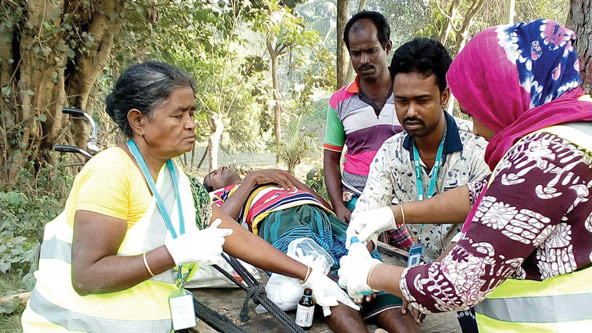
 TraumaLink volunteers treat a man injured in a road traffic accident in Manikganj, Bangladesh. (Photo courtesy of TraumaLink)
The "Wild West" is the way Jon Moussally describes Dhaka’s roads. Cars, trucks, buses, bicycles, motorcycles, rickshaws, three-wheeled vehicles known as CNGs (for their fuel, compressed natural gas), and pedestrians flood Bangladesh’s capital city. Street signs, working signal lights, and traffic law enforcement are scarce.
This chaos inspired Moussally, a physician in Massachusetts and instructor at the Harvard T.H. Chan School of Public Health, to cofound TraumaLink, a volunteer-based emergency response system aimed at reducing death from road traffic injuries (RTIs). The system consists of an emergency hotline number, a 24/7 call center, and volunteer first responders who are trained in basic trauma first aid and provided with medical equipment to stabilize accident victims.
RTIs are the leading cause of death and disability in Bangladesh, the highest-density developing nation in the world. The country had nearly 25,000 road traffic deaths in 2016, according to the World Health Organization (WHO); the Bangladesh Passengers’ Welfare Association estimates that another 16,000 people were injured or permanently disabled in 2017. This problem is common to developing countries: RTIs are the leading cause of death for children and young adults ages 5-29, the WHO says, and the eighth leading cause of death overall. Low-income countries suffer three times as many RTI deaths as high-income countries.
The financial consequences of RTIs are profound, too, since they not only hinder the victims’ earning power but can cause a family’s economic ruin. According to the NGO Bangladesh Rehabilitation Assistance Committee (BRAC), most affected families are driven into poverty from lost income and the cost of medical care.
Drivers’ licenses and official vehicle inspections are uncommon in Bangladesh. There is no public transportation system, and bus drivers at private transportation companies earn more money by collecting more passengers and fares—a system that incentivizes profit over safety.
A Pragmatic Model
In 2013, Moussally visited Bangladesh with his fellow Harvard T.H. Chan School of Public Health master’s students Eric Dunipace and Ryan Fu for a global health course. The group was horrified by the frequency of Dhaka’s traffic deaths and disasters.
At the time, Moussally was also an emergency room physician who created a basic
first aid curriculum with the Harvard Humanitarian Initiative, which trains humanitarian leaders in war-stricken countries, and wondered if such training deployed in Dhaka could help reduce casualties on its roads. Dunipace thought he could perhaps use data analysis to help direct injured people to medical facilities in emergency situations. “It’s shocking just how little you can move in five hours’ time,” Dunipace says.
While in Bangladesh, the trio met Mridul Chowdhury, the CEO of the design tech firm mPower Social Enterprises Ltd., who became one of TraumaLink’s cofounders. “TraumaLink is really an extension of the work that I do in my own organization,” Chowdhury says, because it employs an “innovative social business model around a much-needed service” and requires “roundabout ways of getting revenues from sources other than the direct beneficiaries.”
In 2013, Moussally, Dunipace, and Fu won $5,000 for their entry in the inaugural Harvard University Deans’ Health and Life Sciences Challenge for multidisciplinary global health solutions. With this seed funding, they returned to Bangladesh to refine their model, with community connections, operational support, and office space provided by Chowdhury’s mPower. The TraumaLink cofounders met with community leaders, including law enforcement and representatives of two Bangladeshi organizations, the Road Safety Council and Accident Research Institute, to determine an affordable RTI-response model they could realistically implement and sustain.
“From a public health perspective,” Fu explains, “prevention is always better than treatment.” But true prevention would require
a radical improvement of infrastructure—an overwhelming challenge for a large, developing country like Bangladesh.
Instead, TraumaLink focused on enlisting local volunteers to provide first aid to RTI victims. Basic trauma care can save lives and prevent catastrophic disability if implemented within the first critical hour after injury. Moussally’s first aid curriculum simplified trauma care to its most important practices—control bleeding and protect the spinal cord and head from further injury—which any volunteer could learn.
Building a call-and-response system seemed achievable within a limited geographic catchment area. TraumaLink initiated its pilot along a particularly hazardous 14-kilometer span of the Dhaka-Chittagong Highway. Community-based volunteers, who live or work along the highway, were trained over two days in first aid and TraumaLink logistics, after which they received a certificate, ID badge, and reflective vest.
The response process begins the moment someone at the crash scene contacts the TraumaLink call center, which then reaches out by SMS to trained volunteers, prioritized by proximity to the crash scene. Volunteers either report to the scene and send an SMS to let the call center know when they’ve arrived, or alert TraumaLink that they can’t respond to the incident, in which case the next volunteer on the roster is contacted. The system recalibrates every three minutes. En route to the crash site, volunteers pick up a first aid box located at participating sites such as CNG stations and police stations. The average time taken by volunteers to report to crash sites is less than five minutes.
Once the crash victim is stabilized, the responding volunteer contacts the call center to coordinate transportation to a hospital best equipped to treat the severity of the injury. Transportation is provided mainly by CNG drivers, in addition to local fire brigade ambulances and police vehicles.
As of mid-2019, about 500 TraumaLink volunteers have responded to almost 1,000 emergency calls and have treated nearly 2,000 patients. Its catchment area has expanded to 115 kilometers along three highways.
Navigating Barriers
One main challenge TraumaLink encountered was the police response to crashes. Police generally focused more on building a legal case about what they regarded as a crime scene than on helping injured victims. Bystanders were reluctant to help the victims because they risked detainment as suspects.
TraumaLink’s cofounders approached police in a nonadversarial manner, starting a conversation with Deputy Inspector General Rowshan Ara Begum, the first woman to reach the rank (who, tragically, was killed in a vehicular accident in the Democratic Republic of Congo in 2019). She and her colleagues quickly supported the organization’s mission, recognizing that its approach could help both injury victims and law enforcement.
Since educating the police on their work, TraumaLink has not had a single instance of police harassment at crashes. Indeed, police have requested that TraumaLink notify them when a volunteer responds to a crash and have even provided transportation for volunteers. “We’ve yet to have an incident where police are anything but supportive,” Moussally says.
TraumaLink faced another potential challenge from recruiting volunteers in a Muslim country. Islam prohibits physical contact between men and women unrelated by blood or marriage. The cofounders were uncertain whether the community would accept female volunteers treating injured men, and vice versa, but were gratified to find widespread acceptance of female volunteers and enthusiastic support from religious leadership. Moussally explains that imams strongly encourage “helping someone in need [which] is doing Allah’s work”—in fact, five imams currently serve as TraumaLink volunteers.
The community response has been heartening, with the number of volunteers steadily rising. “We can provide very simple but lifesaving first aid to the crash victims,” TraumaLink volunteer Abu Sufian says. “The victim may be my relative or my neighbor.”
TraumaLink has faced funding challenges. Knowing that medical care costs are a barrier, TraumaLink does not charge accident victims a fee but instead has sought funds from the government and charitable foundations. The organization also looks to local companies for sponsorship, including Kemiko, a pharmaceutical company that sponsored volunteer vests.
Obtaining government funding has proved difficult. In 2015, TraumaLink’s founders were thrilled to hear they’d been granted $142,500 from USAID’s Development Innovation Ventures program, an amount that could support their operations for 18 months. But the disbursement of the first funding installment was delayed two years for political reasons, and the organization nearly shut down.
A more successful funding model has been a “membership subscription plan,” which enlists “subscribing” organizations to contribute monthly, under three different contribution models: Silver (5,000 Bangladeshi taka [BDT]/$75), Gold (10,000 BDT/$125), and Platinum (20,000 BDT/$250). United Trust, the social-welfare wing of infrastructure-based company United Group, recently became a Platinum subscriber and sponsored a 20-kilometer service-area expansion. TraumaLink was “a credible partner” on the RTI issue, says United Trust Executive Director Fazlur Rahman, who notes its “innovative ideas” on accident response, as well as its “smart organizational capability and good professional track record.” United Trust intends to expand its collaboration.
TraumaLink’s outlook is promising. It received the Fondation Pierre Fabre’s 2018 Global South eHealth Observatory Award, an honor that provided funds sufficient to cover some operational costs while expanding service coverage by an additional 35 kilometers on two highways. Now that some companies have led the way with funding, financial support is coming much more easily. The organization is in the early stages of negotiating several partnerships for a broader rollout of these services in Bangladesh and elsewhere in South Asia—which may represent the first international expansion of its community-based, people-powered model.
This article appeared in the Fall 2019 issue of the magazine with the headline: "People-Powered Trauma Care"
Read more stories by Deborah Milstein.