


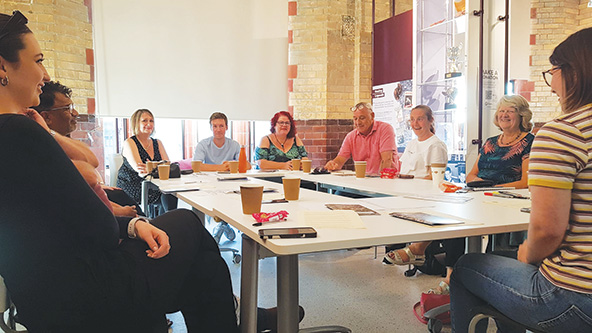
 A dozen strangers met in 2023 to determine the distribution of economist David Clarke’s family inheritance. (Photo courtesy of David Clarke)
In June 2023, a dozen strangers met at a community center in Liverpool, England, to do something they had never done before: give away someone else’s money. The funds—totaling £100,000 (US $130,730)—were the family inheritance of 34-year-old Liverpool-based economist David Clarke. His decision to let others decide where his money goes represents a more democratic way of giving.
“It’s better if a diverse range of people can be involved in deciding how money gets used,” he says. “This generally leads to better decision-making because it mitigates against individuals’ blind spots and biases.”
Clarke’s project is called Wealth Shared and is documented on a website of the same name. He drew inspiration for his giving model from the United Kingdom’s Citizens’ Assemblies—randomly selected groups of people who discuss issues and make recommendations to policy makers. In early June, after consulting experts on the project’s design, he sent 600 invitations to a random selection of households in Liverpool’s L8 postcode, a racially diverse area long blighted by unemployment and economic stagnation. The invitation welcomed anyone over the age of 16 to apply to participate in four sessions that would take place a few weeks later.
From the 38 people who responded, Clarke selected a dozen at random. Each participant received £200 (US $257) as compensation. Led by Emily McChrystal, an experienced facilitator, the sessions ranged from discussions of various causes and evaluations of nonprofits to debates on whether to attach conditions to the money’s use.
Glynis Jackson, an education support officer who was one of the participants, appreciated Clarke’s decision to bestow his grantmaking power on citizens from L8 postcode communities. “People who live in those areas and potentially lead those kinds of lives—they’re experts,” she says.
For Jackson, the process was unfamiliar and challenging, but also rewarding. “A lot of people got quite personal and emotional,” says Jackson, who argued strongly for giving all the money to one organization, since she believed dividing it would leave insufficient amounts to make a significant difference to the recipients.
In the end, she agreed with the group’s decision to divide the money equally among four local nonprofits, all tackling economic deprivation in different ways: the Dingle, Granby, and Toxteth Collaborative network of schools; Team Oasis children’s charity; Granby Toxteth Development Trust; and The Florrie community center, where the sessions were held.
Clarke was impressed by the team’s commitment to the process: “Everyone contributed meaningfully, and there was a lot of very rich discussion.”
While grantees were not required to report on how they spent the money, Clarke’s giving process inspired transparency from the recipients. “I wanted to let him know that the money was spent wisely,” says Laurence Fenlon, chief operations officer at The Florrie, for which the funds were essential in restocking the shelves of its food bank.
Clarke is not alone in attempting to shift philanthropy’s balance of power. In 2024, for example, 32-year-old Austro-German heiress Marlene Engelhorn gave 50 people responsibility for choosing how to distribute €25 million (US $27,586,875) of her inheritance. In a selection process similar to Clarke’s, she sent a survey to a randomly chosen group of 10,000 people in Austria. Of those that completed the survey, she selected 50 from a diversity of demographics. The group awarded the money to 77 organizations focused on everything from poverty and homelessness to health and environmental protection.
Clarke’s model of giving represents the growing use of a trust-based approach to democratize philanthropy. And while he won’t be making further donations, since the initial gift was the sum of his inheritance, he created the Wealth Shared website to inspire others to give similarly. Starting as blog posts providing updates on the discussions, the website has developed into a hub hosting media coverage and has published a report describing the process and its outcome.
“[The website is] leveraging the project to get more people to talk about sharing wealth and the idea of putting decisions about money into the hands of a wider range of people,” he says. “I hope it’s planted a seed in people’s minds.”
Read more stories by Sarah Murray.